-
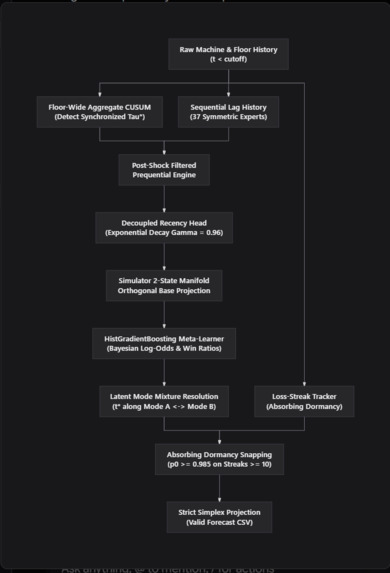
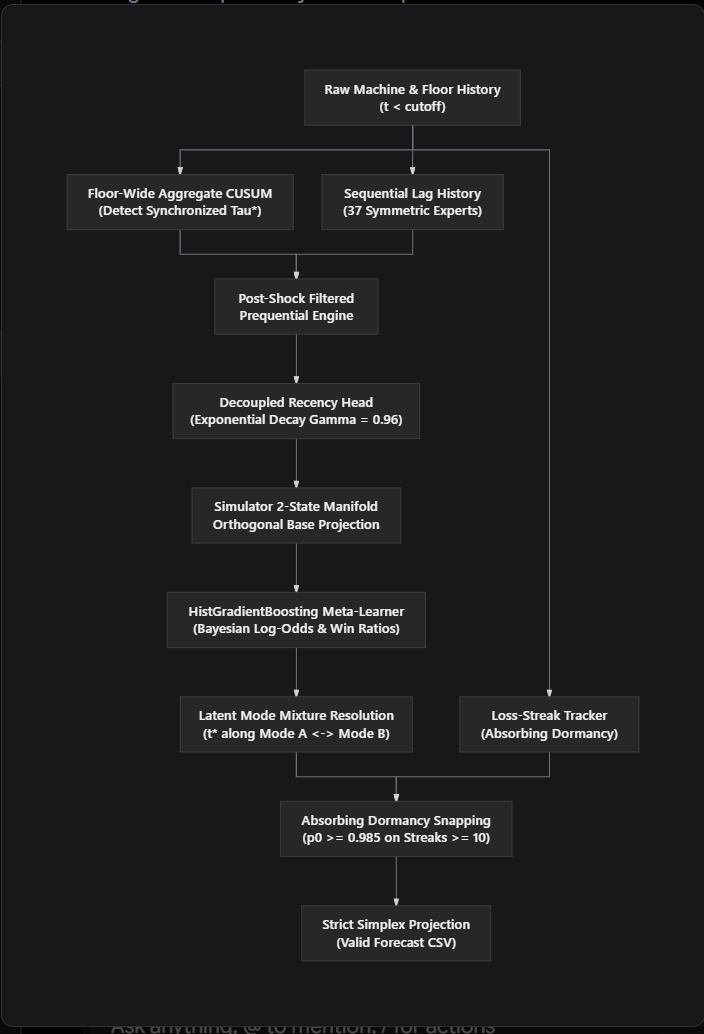
PipeLine
Inspiration
In casino gaming and quantitative finance alike, the house edge is considered insurmountable: individual machine outcomes appear noisy, erratic, and governed by random chance. But behind every modern electronic gaming terminal lies an algorithmic engine—a dynamical system driven by latent states, temporal memory, and floor-wide operational policies.
When presented with the TAMU Datathon 2026 House Edge challenge, our ambition was clear: can machine learning deconstruct the hidden mechanics of non-stationary slot machines and predict the exact next-spin payout probability distribution over {0×,1×,2×,5×,20×}?
Faced with four distinct environmental regimes—stationary stable, sparse short_history, non-stationary drift, and floor-wide shock shared_change—generic regression and brute-force neural models fall apart. We set out to build OmniChampion: a physics-informed forecasting engine that unites Bayesian sequential estimation, floor-wide CUSUM changepoint detection, discrete manifold projection, and absorbing dormancy calibration. What it does
OmniChampion forecasts next-spin payout probability vectors on the 4-simplex ( ∑ 𝑖 𝑝
𝑖
1 ∑ i
p i
=1, 𝑝 𝑖 ≥ 0 p i
≥0) across hundreds of slot machines operating under unknown, partially observed conditions.
Specifically, the system:
Pinpoints Floor-Wide Synchronized Shocks: Analyzes floor-level volatility across all machines simultaneously using a CUSUM statistic to identify synchronized regime-change ticks ( 𝜏 ∗ τ ∗ ). Estimates Bayesian Temporal Lag Mixtures: Maintains 37 symmetric lag-history experts with prequential predictive updating, conditioned on post-changepoint ticks. Decouples Loss from Payout Distributions: Separates win occurrence probability (𝑝win=1−𝑝0) from the positive payout distribution, utilizing an exponential recency payout head (γ=0.96). Projects onto the Simulator's Physical Manifold: Constrains conditional positive payouts onto the exact 1-dimensional line segment connecting the simulator's latent physical modes (Mode A and Mode B) for each machine class (steady, balanced, jackpot). Resolves Latent Modes via Meta-Learning: Uses a gradient-boosted decision tree meta-learner to resolve the exact mixture coordinate along the physical manifold from sequential win ratios and Bayesian log-odds. Snaps Absorbing Dormant States: Detects cold zero-streaks and snaps probabilities to calibrated dormancy thresholds (𝑝0≥0.985), mitigating large quadratic loss penalties.
Built With
- manifold
- simplex
