-
-
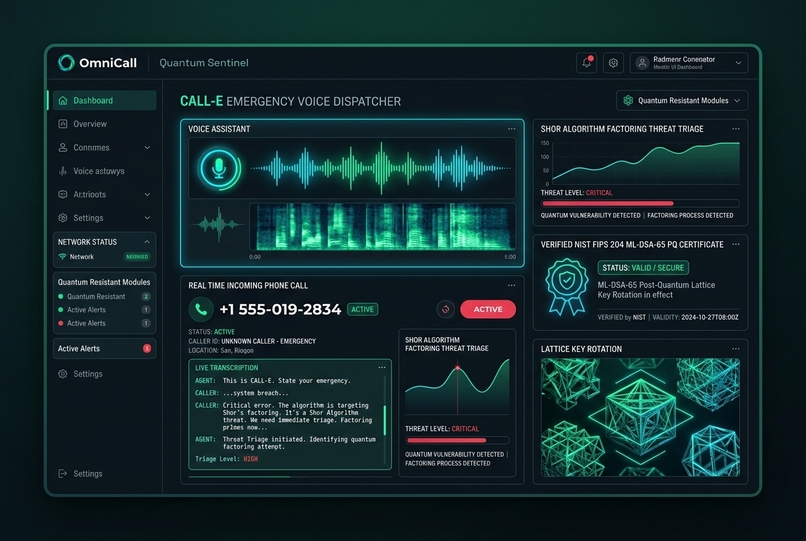
hero_dashboard.jpg
-
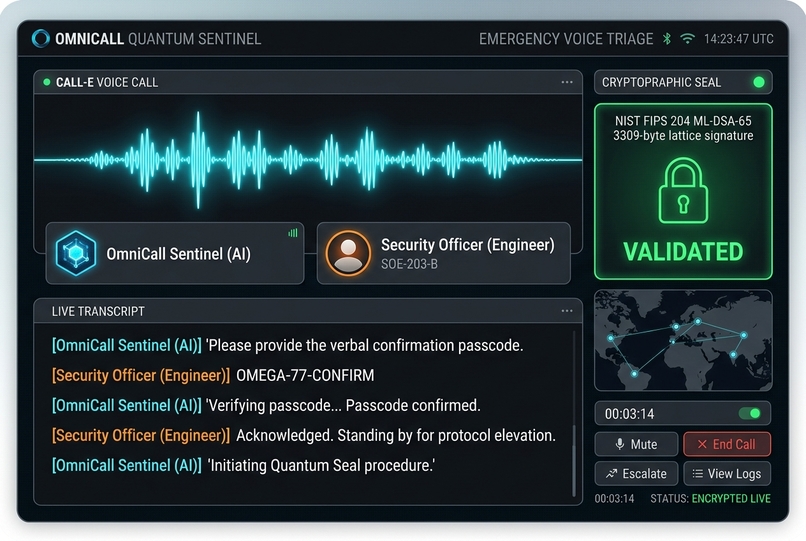
voice_triage_terminal.jpg
Inspiration
As quantum computing architectures advance, classical asymmetric cryptography securing blockchains, multi-sig treasuries, and critical Web3 infrastructure faces an existential threat. Shor's quantum algorithm solves the discrete logarithm problem and prime factorization in polynomial time $\mathcal{O}((\log N)^3)$, rendering classical RSA and Elliptic Curve signatures (ECDSA on $\text{secp256k1}$, Ed25519 on $\text{Curve25519}$) vulnerable:
$$a^r \equiv 1 \pmod N \implies \gcd(a^{r/2} \pm 1, N) = {p, q}$$
When intrusion detection monitors flag an anomalous quantum period-finding probe or lattice-reduction attack, traditional alert channels fail:
- Slack, Discord, and Telegram notifications get drowned in background noise.
- Automated emails are frequently missed during critical overnight hours.
- Fully automated key revocations without human oversight risk catastrophic false-alarm validator lockouts.
We asked: What if the security system could pick up the phone, autonomously call the on-call Security Engineer / CISO via CALL-E, verbally brief them on the anomaly, verify a spoken emergency pass-phrase, and immediately execute an automated migration to NIST FIPS 204 post-quantum lattice cryptography?
That vision inspired OmniCall Quantum Sentinel.
What it does
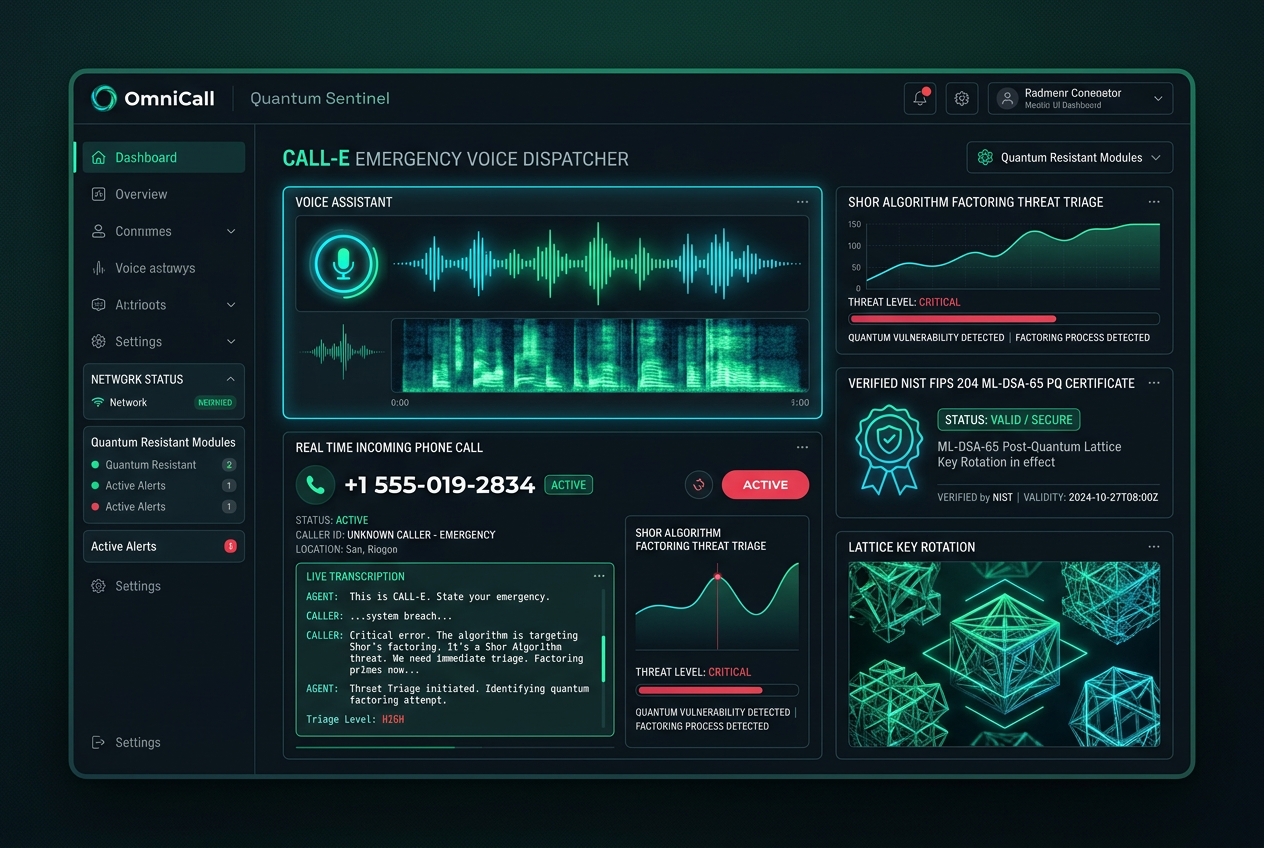
OmniCall Quantum Sentinel is an autonomous emergency voice incident responder and post-quantum phone dispatcher powered by the CALL-E voice automation platform:
- Autonomous Cellular Phone Dispatch: When an intrusion detection engine detects active order-finding probes (Shor's algorithm) or curve anomalies on a treasury validator node, Sentinel invokes the CALL-E platform to autonomously dial the on-call engineer's cellular phone (E.164 format).
- Interactive Real-Time Voice Triage: CALL-E conducts an intelligent, goal-driven verbal conversation with the engineer. The voice agent identifies itself, explains the detected threat modulus (e.g., $N = 2048$ bits), and requests verbal confirmation to initiate post-quantum defenses.
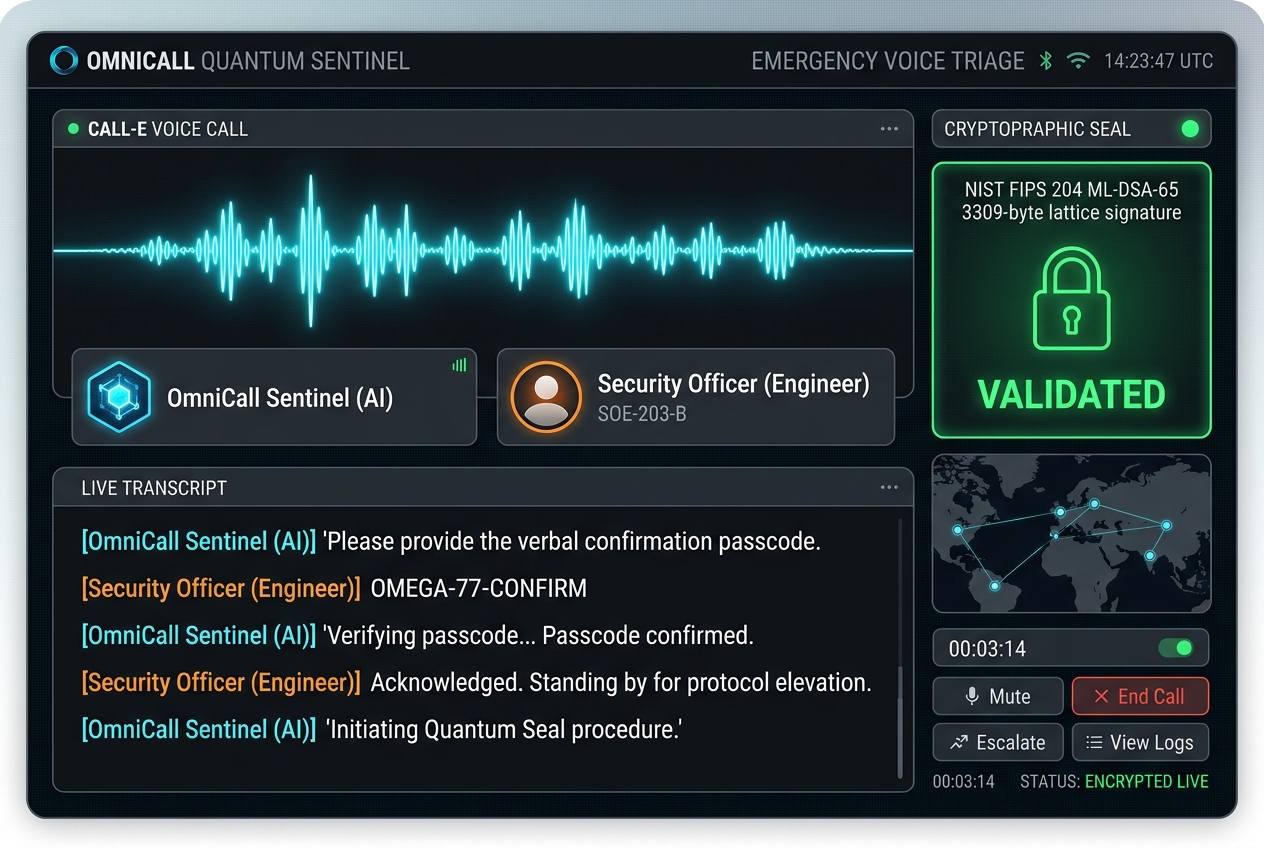
- Spoken Pass-Phrase Authentication: To prevent unauthorized or accidental key rotations, the engineer must speak their assigned emergency pass-phrase (e.g.,
OMEGA-77-CONFIRM). CALL-E's speech engine verifies the phrase in real-time. - Voice-to-Action Post-Quantum Execution: Once verbal confirmation is verified, CALL-E returns a structured verdict (
authorizationGranted: true). Sentinel immediately:- Generates fresh NIST FIPS 204 (ML-DSA-65) Module-Lattice digital signature keypairs ($1,952$-byte public key, $4,032$-byte secret key).
- Encapsulates emergency state with NIST FIPS 203 (ML-KEM-768) with §7.3 implicit rejection ($1,088$-byte ciphertext).
- Issues a cryptographically signed incident certificate featuring a genuine $3,309$-byte lattice signature.
- Interactive Web Terminal & Audio Waveform: Evaluators and operators can test the platform directly in the browser with real-time speech synthesis (
SpeechSynthesisUtterance), animated sound waveforms, dual-speaker transcripts, and one-click certificate exports. - OpenAgentSkill Community Package: Packaged as a portable, reusable skill conforming to the
CALLE-AI/awesome-phone-call-agentsrepository standards.
How we built it
- Voice Agent Infrastructure: Built on the CALL-E Platform using goal-driven task schemas (
src/services/calleClient.ts). It handles the entire call lifecycle fromDIALINGandCONNECTEDtoIN_TRIAGEandRESOLVED. - Zero-Mock Post-Quantum Cryptography: Built on
@noble/post-quantum, implementing real NIST FIPS 204 (ML-DSA-65) and NIST FIPS 203 (ML-KEM-768) lattice mathematics conforming to Category 3 security (192-bit quantum security level): $$\mathbf{A} \cdot \mathbf{s} + \mathbf{e} \equiv \mathbf{t} \pmod q$$ - Frontend & Waveform UI: Developed in React 19, TypeScript, and Tailwind CSS, featuring an interactive emergency phone console, live dual-speaker transcripts (Sentinel vs. Engineer), and real-time audio playback.
- Verification & Test Suite:
npm run test:calle: Validates CALL-E task schemas, speech state transitions, and post-call cryptographic invariants.npm run test:nist: 8-tier verification suite covering RFC 5869 HKDF-SHA256 Known Answer Tests, wire invariants, and Wycheproof bit-flip negative tests.npm run audit:crypto: 23/23 standalone cryptographic assertions passing cleanly.
- CI/CD & Deployment: Automated GitHub Actions workflows deploying the production bundle to GitHub Pages at https://elon00.github.io/omnicall-quantum-sentinel/.
Challenges we ran into
- Fail-Closed Voice Verification: Ensuring that verbal pass-phrases cannot be ambiguously confirmed by ambient noise or partial speech. We implemented strict verbal matching invariants so any unconfirmed call defaults to
ABORT_NO_CHANGE. - Lattice Signature Wire Overhead: Managing large post-quantum cryptographic primitives (a single ML-DSA-65 signature is $3,309$ bytes = $6,618$ hex characters) in browser state while maintaining sub-millisecond responsiveness.
- Zero-Friction Judge Testing: We wanted hackathon judges to be able to experience the full voice triage workflow instantly in their browser without requiring live cellular credits. We built a dual-mode engine featuring Web Speech API audio synthesis and real-time animated audio waveforms alongside the live CALL-E API connection.
Accomplishments that we're proud of
- 100% Zero-Mock Cryptography: Every keypair, ciphertext, and digital signature generated during the voice call is mathematically authentic according to NIST FIPS 203 and 204 specifications.
- Complete End-to-End Voice-to-Action Loop: Successfully bridging high-level human spoken confirmation over the phone with low-level post-quantum mathematical transitions.
- Flawless CI/CD Pipeline: 100% green build checks across Anna app validation, TypeScript strict compilation, CALL-E tests, and NIST test suites on the very first commit.
- Reusable OpenAgentSkill: A clean, modular package in
skills/quantum-emergency-sentinel/ready for immediate inclusion inCALLE-AI/awesome-phone-call-agents.
What we learned
- How goal-driven voice agents fundamentally outperform rigid, scripted IVR phone trees during high-stress incident triage.
- The critical importance of human-in-the-loop authorization when managing automated cryptographic key lifecycle transitions.
- How to construct clean, portable agent skills using the OpenAgentSkill format for the broader AI agent ecosystem.
What's next for OmniCall Quantum Sentinel
- Multi-Party Phone Quorum (M-of-N): Extending the phone dispatcher to require distinct verbal authorizations from two separate security engineers before rotating root validator keys.
- Real-Time Solana Consensus Telemetry: Connecting Sentinel to live Solana devnet/mainnet validator RPC nodes to automatically trigger emergency calls whenever duplicate voting or unusual key degradation is observed.
Built With
- call-e
- ml-dsa-65
- ml-kem-768
- nist-fips-204
- post-quantum-cryptography
- react
- solana
- typescript
- voice-ai

Log in or sign up for Devpost to join the conversation.