

Project Inspiration & Vision
Inspired by Turing City, where AGI is commonplace, and we explored an idea human-centered: a tool designed to help people remember the location of objects of interest and provide agentic guidance back to them with voice and spatial cues.
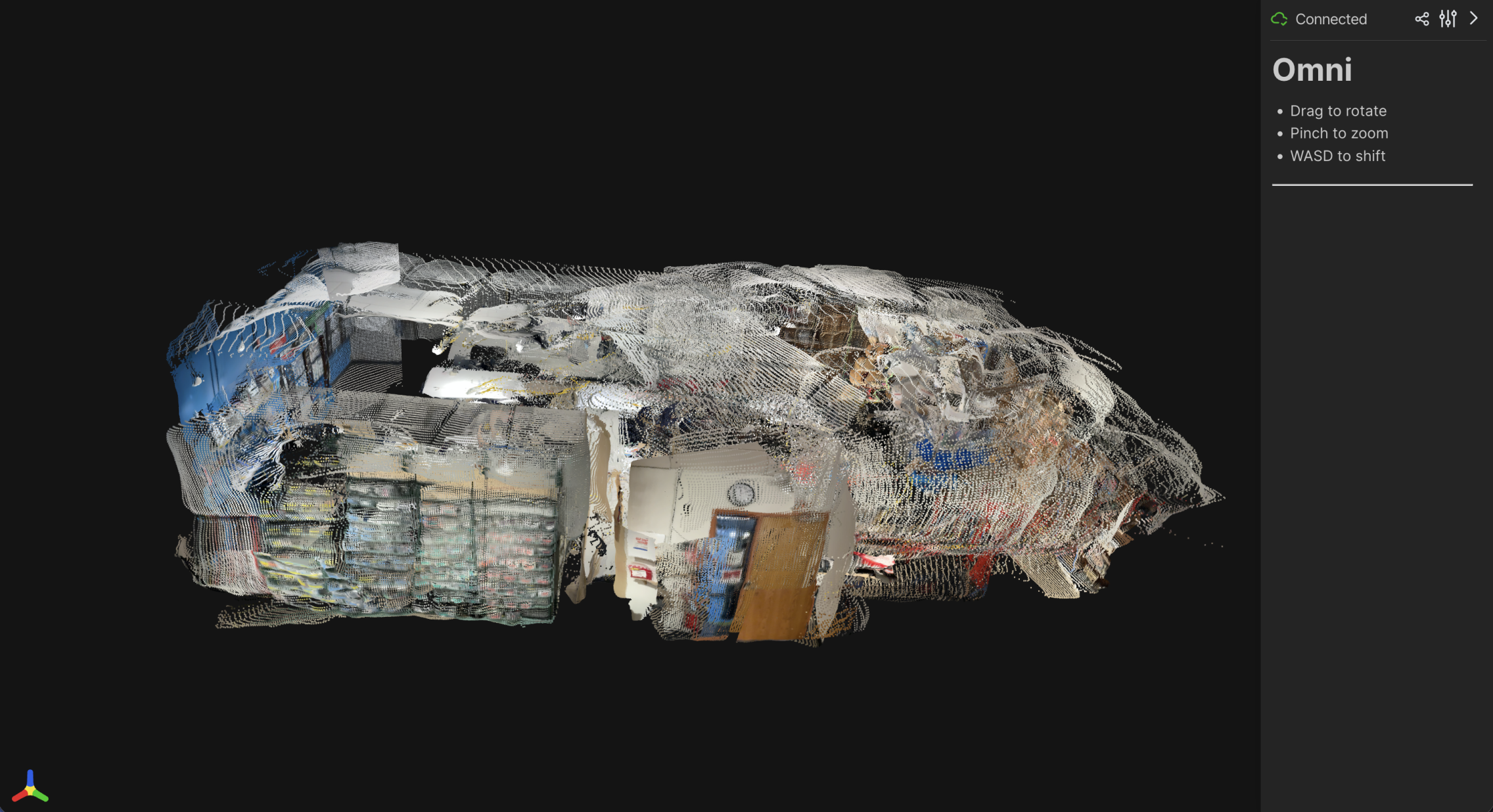
Given our strong interest in augmented reality (AR) and computer graphics, we focused on creating a digital twin environment that allows users to visualize the locations of previously handled objects. This environment is powered by novel Gaussian splatting technology, enabling an intuitive and immersive spatial memory experience. As we refined the idea, we uncovered several compelling real-world use cases.
Use Cases
Everyday users can benefit by remembering the locations of important personal items
Senior users can use the app to strengthen memory and improve cognitive ability
Users in low-light or hazardous environments can rely on spatial audio and AR guidance
- Examples include cave divers, mine workers, and first responders
Team Structure & Collaboration
Our team consisted of four members:
Two primarily focused on backend
Two primarily focused on frontend
Despite these roles, we frequently crossed into each other’s domains—through discussion, collaboration, and the power of vibe coding—to ensure cohesion across the project.
Development Phases
The project was divided into three main phases:
Phase 1: Ideation
Created multiple flowcharts for planning and tech-stack clarity
Chose sponsor tracks and APIs to guide development
Selected:
- LiveKit for mobile data collection, streaming, and aggregation
- Overshoot for video-to-text and object recognition
- PostgreSQL for database
- Google Gemini for future text analysis, information summary, and voice prompts
Phase 2: Core Development
Built a web app to display Gaussian splat results in a 3D rendering. Web app also supports advanced object detection and tracking using Overshoot.
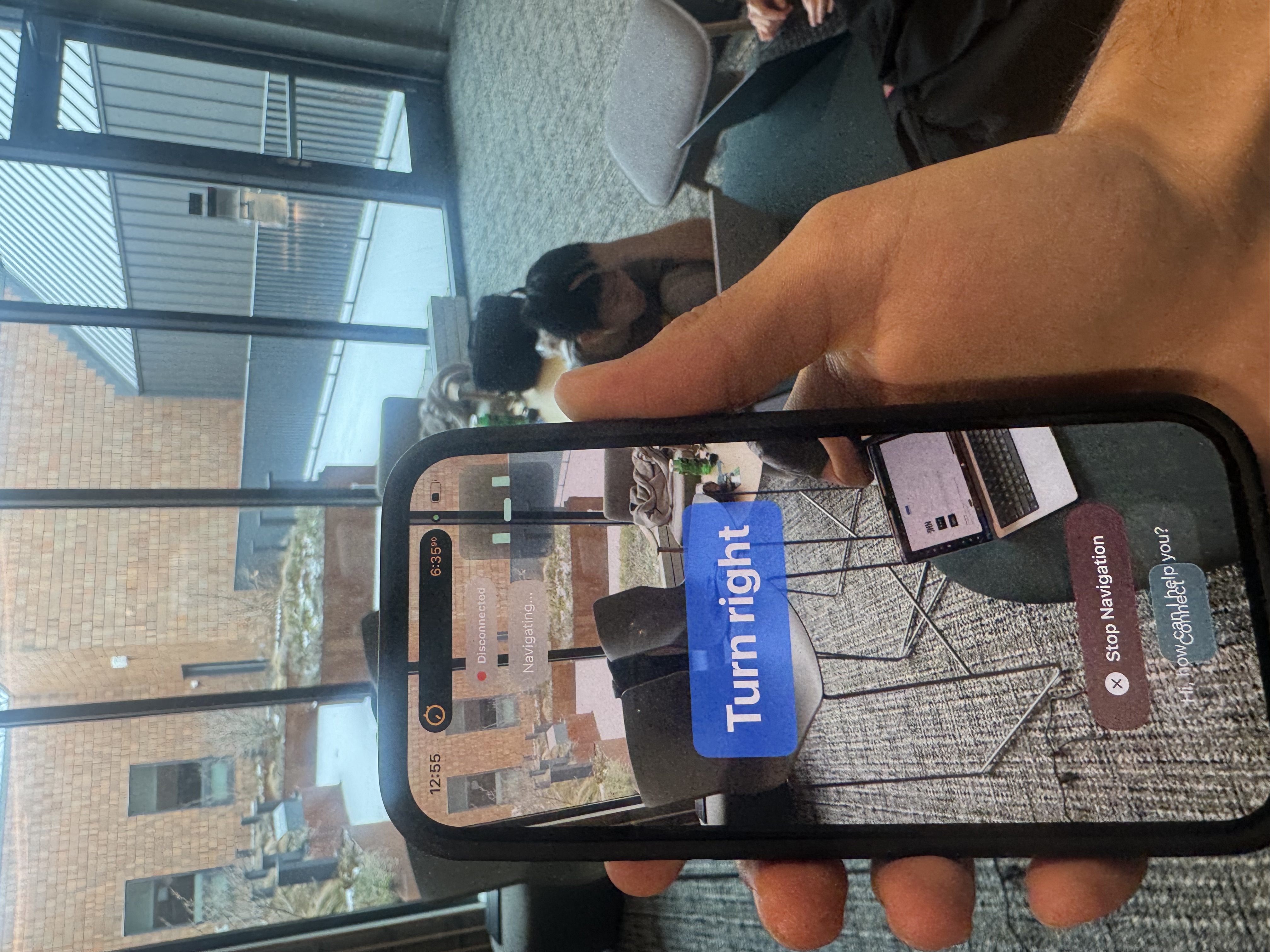
Developed a mobile app with AR capabilities to track users' objects of interest and be able to lead users back to the last points when the objects were visible. Implemented a feature to detect objects leaving a user’s hand via camera input.
Implemented custom UI/UX flow and from-scratch animations to improve user experience of both the web app and mobile app.
Phase 3: Final Polish
Integrated all individual components, and applied a stylish final design.
Have a full system of servers, endpoints, and a centralized database to collect and process information needed to localize users and track objects.
Refined the mobile web app experience.
Challenges & Solutions
One of our biggest challenges was navigating the documentation for sponsor APIs. Speaking directly with sponsors at their tables proved invaluable for understanding best practices and implementation details. At times, directly adding functionality to sponsor software proved important to progress and provided a strong learning experience.
Another challenge was managing the workload of integrating many complex features. Thanks to strong planning and prior experience in our respective areas, this process went smoothly for the most part. Effective splitting of work, while balancing rest and collaboration during the process, was expectedly challenging, but ultimately highly rewarding.
Reflections & Takeaways
Through this project, we gained a deeper understanding of the current capabilities of AI and the exciting developments just beyond the horizon. Along the way, we also bonded during late-night, snowy walks around campus—often searching for a classroom that wasn’t already taken over by hackers. The technical difficulties of the project, alongside the many internal and external challenges we faced during development, allowed us to truly appreciate the value of "learning by failing" and ultimately learn a lot of new paradigms.
We are confident that this application provides genuine value to its target audience. Overall, the project was a race to the finish line without a second to spare, and we wouldn’t have had it any other way.
Built With
- antigravity
- arkit
- claude
- fastapi
- google-gemini
- javascript
- livekit
- ngrok
- node.js
- openrouter
- overshoot
- python
- react
- swift
- vggt
- visor
- vite


Log in or sign up for Devpost to join the conversation.