-
-
Omni Hospital AI System
Inspiration
What it does
How we built it
Challenges we ran into
Accomplishments that we're proud of
What we learned
What's next for Omni Hospital AI System
🏥 Omni Hospital AI System — About the Project
🌍 Inspiration
Healthcare systems across the world face a major challenge: limited access to doctors, delayed diagnosis, and overloaded hospitals, especially in rural and emergency situations. I was inspired by real-life problems where patients wait hours for basic medical screening, while doctors are overwhelmed with repetitive diagnostic tasks.
The idea behind Omni Hospital AI was to build a central AI-powered assistant that can help doctors by automating initial diagnosis, reducing time, and improving efficiency — especially for emergency and remote healthcare.
This project aligns strongly with the AI for Good mission by aiming to make healthcare more accessible, faster, and smarter.
🧠 What I Learned
While building this project, I learned:
- How AI can be integrated into real-world healthcare workflows
- How to build an end-to-end AI system, not just a model
- Using FastAPI to create real backend APIs
- Handling medical images (X-ray uploads)
- Structuring AI outputs into clinical-style reports
- Debugging real deployment issues (dependencies, servers, environments)
- The importance of responsible AI, especially in healthcare
Most importantly, I learned that AI is not just about accuracy — it’s about usability and impact.
🛠️ How I Built the Project
The system is designed as a modular AI backend:
1️⃣ Medical Image Analysis
- Users upload medical images (e.g., X-rays)
- The backend validates the image
- A placeholder AI model simulates diagnosis results such as:
- Pneumonia detected
- Possible fracture
- This design allows easy replacement with real deep learning models later
2️⃣ Symptom Input & Processing
- The system is designed to accept voice or text symptoms
- Speech-to-text integration (Whisper-ready architecture)
- Symptoms are structured into clinical data fields
3️⃣ Medical Report Generation
- AI-generated structured medical reports
- Outputs can be extended to PDF or JSON
- Reports are designed to be doctor-friendly and standardized
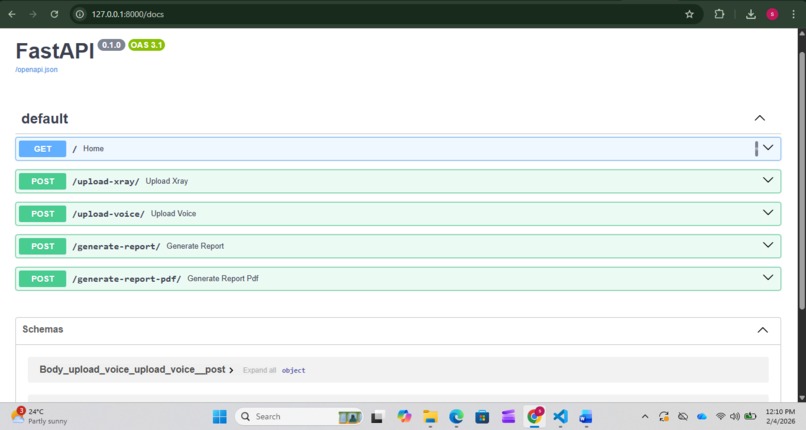
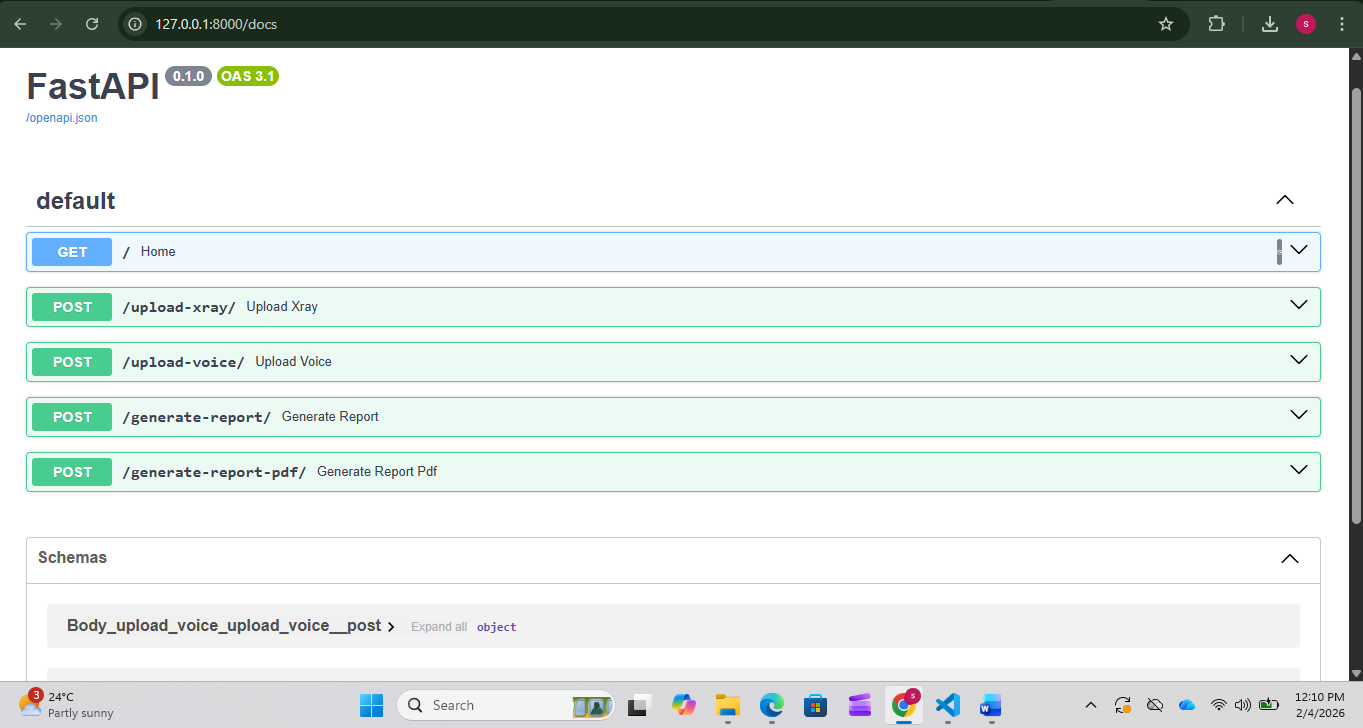
4️⃣ Backend & API
- Built using FastAPI
- Fully working endpoints tested via Swagger UI
- Designed for cloud deployment and scalability
🤖 How AI Is Used
AI plays a central role in the system:
- Computer Vision → Medical image understanding
- Natural Language Processing (NLP) → Symptom analysis
- Decision Logic → Diagnostic suggestions
- Automation → Report generation and triage
Mathematically, the diagnostic decision process can be thought of as:
[ Diagnosis = f(Image\ Features, Symptoms, Clinical\ Rules) ]
Where AI models act as the function ( f ) to assist medical professionals.
⚠️ Important Note:
This system is designed as a clinical decision support tool, not a replacement for doctors.
🚧 Challenges Faced
- Setting up AI libraries and environments correctly
- Handling different image types and validation
- Understanding medical data structure as a non-medical background developer
- Managing deployment and dependency issues
- Designing AI outputs that are ethical and non-misleading
Each challenge helped me grow both technically and conceptually.
🌱 Impact & Future Scope
Omni Hospital AI has strong future potential:
- Integration with real deep learning medical models
- Full voice-based diagnosis for accessibility
- Telemedicine integration
- Hospital EMR system connectivity
- Deployment in rural and emergency healthcare setups
The ultimate goal is to support doctors, save time, and improve patient outcomes using AI responsibly.
❤️ AI for Good
This project demonstrates how AI can be used ethically and meaningfully to address real-world healthcare problems. By focusing on accessibility, automation, and assistance, Omni Hospital AI contributes toward a more inclusive healthcare future.

Log in or sign up for Devpost to join the conversation.