Inspiration
Every year, humanity generates over 53 million tons of e-waste. Why? Because modern electronics are intimidating. Most people want to repair their devices, but they lack the knowledge, confidence, and safety awareness. Manuals are confusing, and mistakes can be dangerous. We wanted to change that by turning every smartphone camera into an expert engineer's eye using the power of Multimodal AI.
What it does
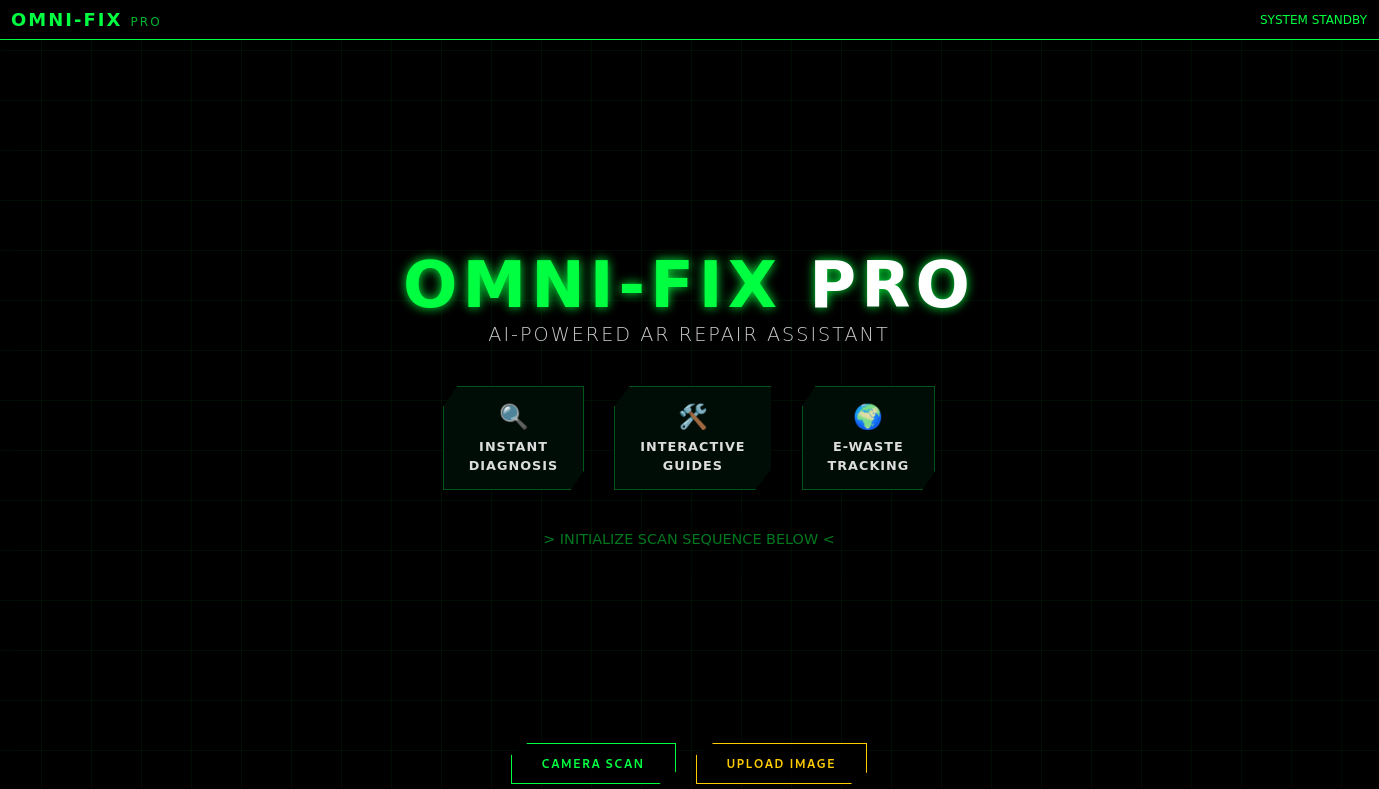
Omni-Fix Pro is an AI-powered AR Assistant that guides users through repairs in real-time.
- Instant Diagnostics: Users upload a photo or scan a device live via camera.
- Gemini 3 Intelligence: The system identifies the device, diagnoses the problem, and generates a step-by-step repair guide.
- AR Target Locking: We use a coordinate system to visually highlight exactly where the repair is needed (e.g., a broken headband or a burnt chip) using a dynamic on-screen marker.
- Safety Protocol: The system detects high-risk components (like exposed high-voltage capacitors or burnt MOSFETs) and triggers a Red Alert, locking the interface until safety steps are taken.
- Eco-Gamification: The system calculates the exact amount of e-waste prevented (in kg) for every successful repair.
How we built it
We built Omni-Fix Pro as a high-performance web application:
- Backend: Python with FastAPI serving as the neural core.
- AI Engine: Google Gemini 3 Flash (via API) handles multimodal image analysis, safety assessment, and coordinate estimation for the AR overlay.
- Frontend: A futuristic HUD interface built with HTML5, CSS3, and Vanilla JS. It handles the camera stream, visualizes the scan line effect, and renders the dynamic AR markers.
- Dev Environment: Developed entirely on Kali Linux to ensure robust system handling and security practices.
Challenges we ran into
- AR Coordinate Mapping: Translating Gemini's textual understanding of location (e.g., "top right hinge") into precise 2D CSS coordinates on a responsive screen was difficult. We solved it by prompting the model to return percentage-based [x, y] coordinates.
- Safety First: Tuning the model to aggressively detect hazards was critical. We had to ensure it prioritizes user safety over repair instructions when it sees fire damage or exposed wires.
Accomplishments that we're proud of
- The Safety Override: Seeing the UI turn red automatically when a burnt motherboard is detected feels genuinely life-saving.
- Latency: Achieving near-real-time analysis using Gemini 3 Flash makes the "Live Camera" mode feel fluid and responsive.
What we learned
We learned that Multimodal AI isn't just about describing images—it's about reasoning. Gemini doesn't just see "broken headphones"; it understands structural integrity and material stress, which allowed us to generate professional-grade repair advice dynamically.
What's next for Omni-Fix Pro
- Integration with Right-to-Repair parts databases (eBay/iFixit APIs).
- Mobile App version using native ARKit/ARCore for 3D depth tracking.
- Voice interaction mode for hands-free repairs. ## What we learned
What's next for Omni-Fix Pro
Built With
- css3
- fastapi
- google-gemini-api
- html5
- javascript
- linux
- python

Log in or sign up for Devpost to join the conversation.