Inspiration
Imagine waking up to a message that says your bank account has been frozen because of a clause you unknowingly agreed to.
Or imagine accepting your dream job, signing the employment contract in a hurry, and months later discovering that you agreed to unfair working conditions because you never understood the legal language. Picture a young creator giving an app permission to collect their contacts, microphone, and location forever because they clicked "Accept" on a privacy policy they never read. Or think about two neighbors who stop speaking to each other over a land dispute because neither of them knows what the law actually says.
These stories are not rare they happen to millions of people every day.
The truth is that legal knowledge has become a privilege instead of a basic life skill. Most people only learn about their rights after something has already gone wrong. Contracts are filled with confusing legal terminology. Privacy policies hide important permissions inside pages of text. Hiring a lawyer is expensive, and searching online often returns conflicting or overly complicated answers.
We asked ourselves a simple question:
What if everyone had an AI legal companion that could explain the law like talking to a trusted friend?
That idea became OMINI AI LAW—an AI Legal Operating System built to make justice understandable, affordable, and accessible for every person, regardless of age, profession, or financial status. We believe knowing your rights should be as easy as asking a question.
What it does
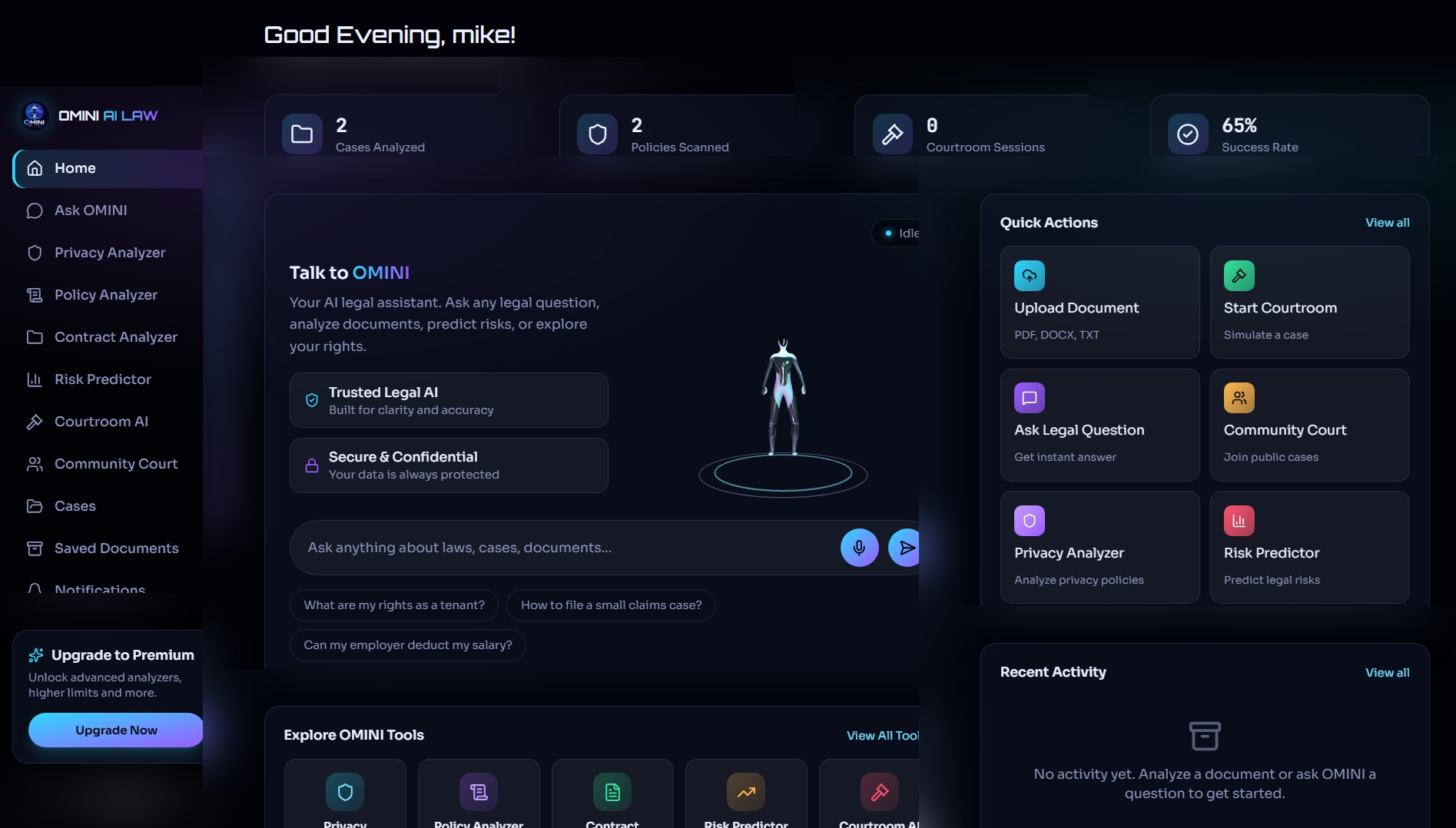
OMINI AI LAW is much more than an AI chatbot it is a complete platform that helps people understand, navigate, and interact with legal information through artificial intelligence.
Users can ask legal questions in everyday language and receive clear explanations instead of complicated legal jargon. OMINI translates difficult legal concepts into simple English so anyone can understand their rights and responsibilities.
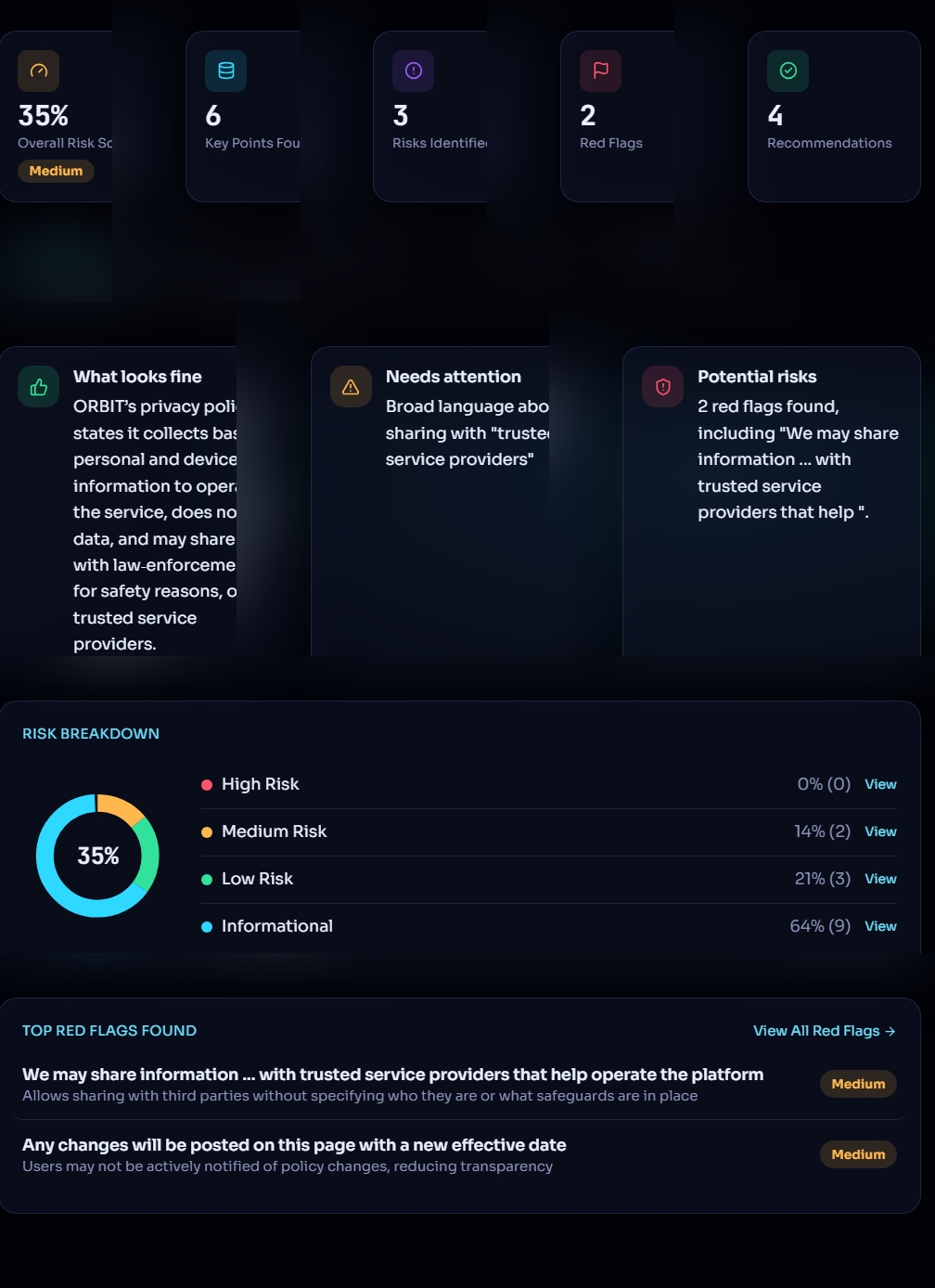
The platform analyzes privacy policies, contracts, rental agreements, employment offers, school regulations, and other legal documents. Instead of showing pages of text, it identifies dangerous clauses, hidden permissions, financial risks, deadlines, obligations, and possible consequences before a user signs or agrees to anything.
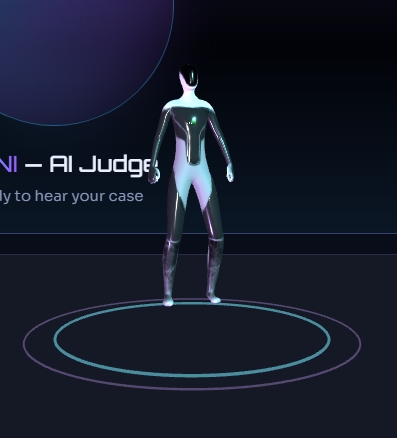
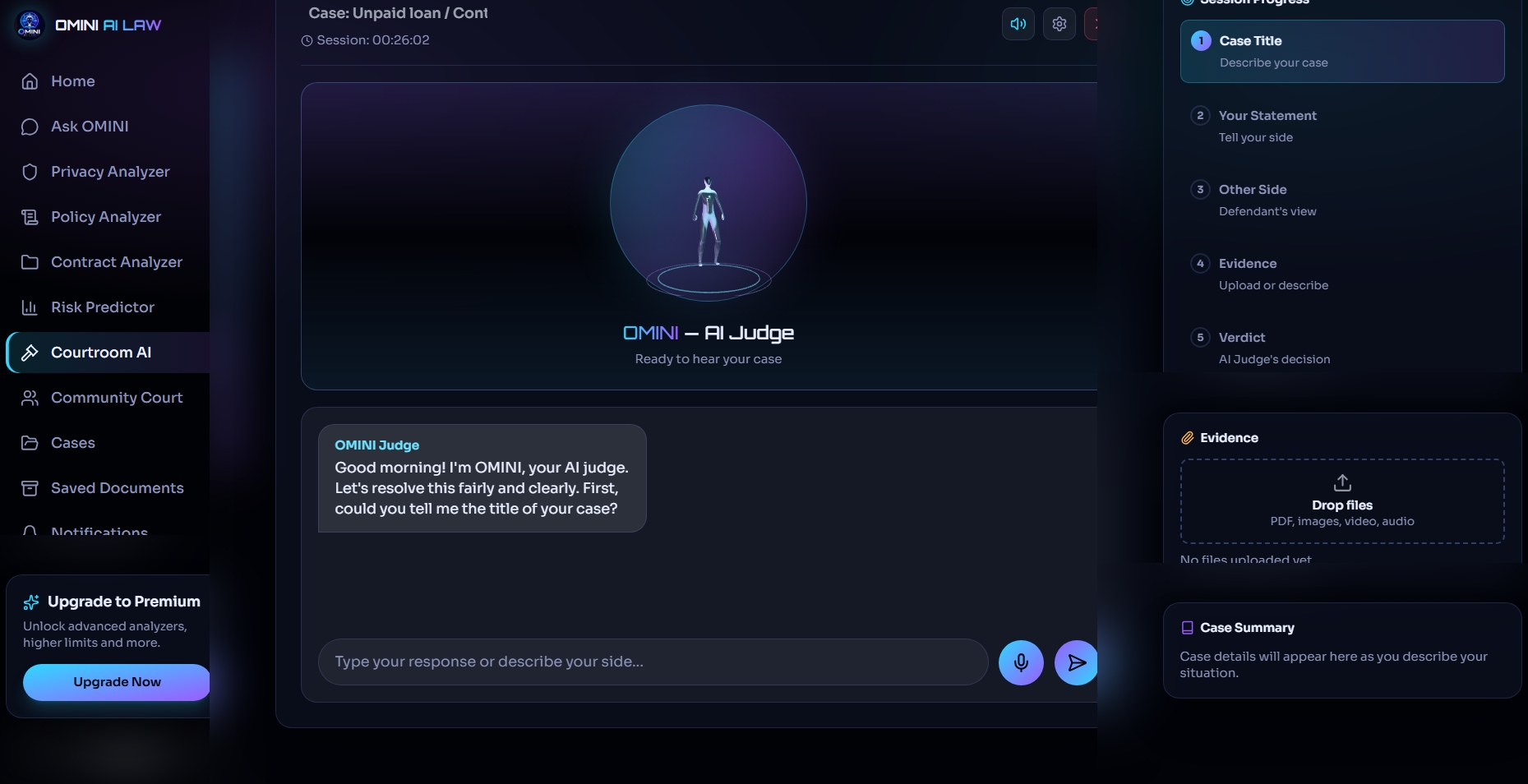
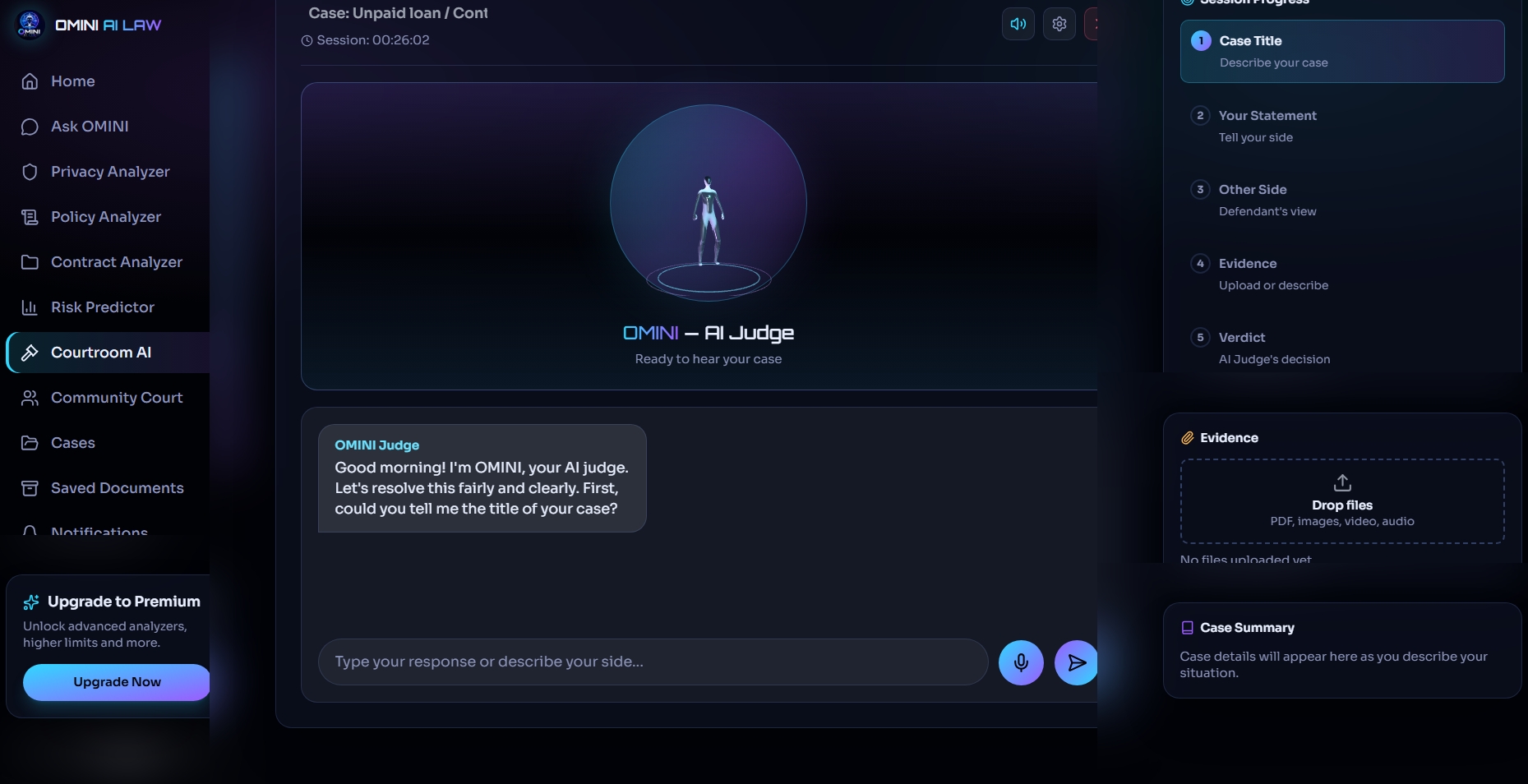
OMINI also introduces a completely different way of resolving disputes through its Interactive Practice Courtroom. Users can simulate a courtroom where OMINI acts as a neutral AI judge, listens to both parties, asks follow-up questions, requests evidence, and delivers a fair verdict with reasoning.
The Community AI Court takes this even further by allowing multiple people to join the same case using their usernames. Victims, defendants, and witnesses participate in a guided legal conversation while OMINI moderates the hearing and evaluates the evidence submitted by everyone.
OMINI is designed for students, workers, freelancers, startups, families, tenants, landlords, creators, and everyday citizens who simply want to understand the legal decisions they make every day.
How we built it
We built OMINI from the ground up as a real AI-powered web application instead of a prototype or static demo.
The frontend was designed using HTML, CSS, JavaScript, and Three.js to create a futuristic dashboard inspired by AI operating systems. Every page from the landing page to the courtroom interface was designed to feel modern, immersive, and easy to use.
The backend was built with Python and Flask, which powers authentication, document uploads, AI conversations, courtroom logic, user sessions, and community court management. We created APIs that allow users to upload documents, chat with OMINI, participate in courtroom sessions, and retrieve analysis history.
For AI intelligence, we integrated the Groq API with the GPT-OSS model to perform legal reasoning, summarize documents, explain legal concepts, generate courtroom questions, analyze contracts, identify privacy risks, and produce structured verdicts.
OMINI accepts PDF, DOCX, and TXT documents, extracts their contents, processes them with AI, and returns structured legal insights. User accounts, conversations, courtroom cases, documents, and verdict history are stored in SQLite, making the application lightweight and easy to deploy.
Finally, we deployed OMINI on Render, making the platform publicly accessible through a live production URL for judges and users to experience.
Challenges we ran into
Building an AI platform around law presented challenges that were very different from building a normal chatbot.
The first challenge was designing a courtroom that feels realistic and fair. We had to create a conversation flow where each participant speaks at the correct time, evidence is collected separately, witnesses can participate, and OMINI remembers the entire case before making a decision.
Another major challenge was document intelligence. Privacy policies and contracts come in different formats and writing styles. Some contain hundreds of paragraphs, legal references, and technical terminology. Extracting meaningful information while keeping explanations simple required careful document parsing and prompt engineering.
We also faced challenges managing multiple users inside the Community Courtroom. Victims, defendants, and witnesses all have different permissions and speaking turns, so we had to build logic that keeps the hearing organized and prevents participants from interrupting each other.
Deploying the application securely was another challenge. We learned how to separate secret API keys from the codebase using environment variables, protect user authentication sessions, and configure production deployment on Render.
Most importantly, we learned that legal AI should never feel biased. Every response had to be structured to encourage fairness, transparency, and understanding instead of simply choosing a winner.
Accomplishments that we're proud of
Our biggest accomplishment is building something that solves a real human problem rather than simply demonstrating AI.
We created an AI platform that empowers people before they make important legal decisions instead of after something goes wrong. OMINI can explain contracts before users sign them, detect hidden privacy risks before users accept policies, and educate people about their rights in language they actually understand.
We are especially proud of the Interactive Practice Courtroom, where users experience a guided legal hearing with an AI judge that listens, questions, evaluates evidence, and explains its verdict step by step.
Another accomplishment is the Community AI Court, where multiple people can join the same dispute, submit evidence, invite witnesses, and receive an AI-generated judgment inside a shared courtroom environment. This transforms AI from a private assistant into a collaborative justice experience.
We also built a clean authentication system, document upload system, AI chat history, legal document storage, and a production-ready deployment that users can access online.
Most importantly, OMINI proves that AI can make legal education accessible to everyone—not just legal professionals.
What we learned
Building OMINI changed how we think about technology and justice.
We learned that millions of people do not ignore their rights because they do not care—they ignore them because legal information is difficult to understand. The biggest barrier is not access to documents; it is access to understanding.
We also learned that AI becomes significantly more valuable when it explains why something is risky instead of simply saying it is risky. People want guidance, education, and confidence, not just answers.
Technically, we learned how to build conversational AI systems that combine document intelligence, authentication, databases, multi-user collaboration, and structured workflows into one seamless experience. We also learned the importance of secure deployment practices, API management, and designing AI experiences that remain transparent and user-friendly.
Most importantly, we learned that technology can empower people with knowledge before they ever need legal intervention.
What's next for Omini
OMINI is only the first version of a much bigger vision.
Our next milestone is building a fully interactive 3D Voice AI Judge that users can speak with naturally, making legal conversations feel like talking to a real legal advisor. The AI will listen, respond with voice, explain documents aloud, and guide users through disputes in real time.
We also plan to expand the Community AI Court into live voice-enabled hearings where multiple participants can speak, upload evidence, invite witnesses, and collaborate inside an immersive courtroom moderated entirely by AI.
Future versions of OMINI will support multiple languages, country-specific legal systems, smarter evidence analysis, legal education courses for students, business compliance tools for startups, and AI-powered legal research assistants for professionals.
Our long-term vision is ambitious: to build the world's first AI Legal Operating System that gives every person, in every country, instant access to understandable legal guidance and the confidence to know and protect their rights before problems become crises.
Because justice should not be confusing. It should be understandable, accessible, and available to everyone.

Log in or sign up for Devpost to join the conversation.