Inspiration
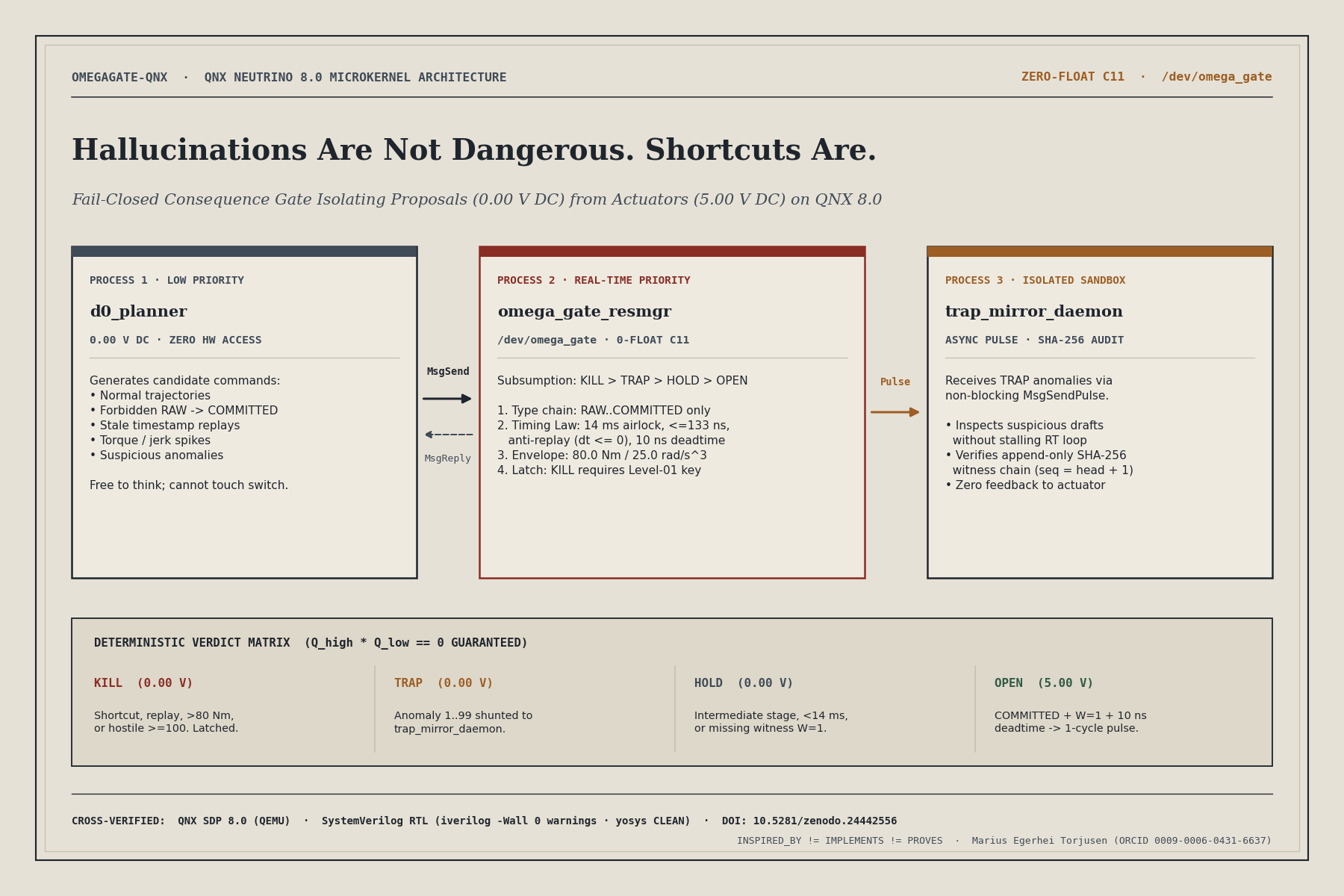
Hallucinations Are Not Dangerous. Shortcuts Are.**
Most AI safety work tries to make the model smarter, tighter, and more obedient. In
real-time robotics, medical devices, and autonomous vehicles, that misses the real
failure mode. A hallucination trapped inside an isolated process hurts no one — it is
just numbers in memory. Damage only begins the moment an unverified proposal gets a
direct shortcut to a physical motor (`RAW` → `COMMITTED`).

**QNX Neutrino 8.0** is built on the exact microkernel philosophy this problem demands:
strict memory protection between processes and synchronous message passing (`MsgSend`,
`MsgReceive`, `MsgReply`). **OmegaGate-QNX** uses that isolation to pour an unyielding
boundary in concrete:

* **Proposals** live at `0.00 V DC`. Zero authority.
* **Realization** lives at `5.00 V DC`. Witnessed, measured, and timed.

An AI is free to think. It is never allowed to touch the switch.
What it does
OmegaGate-QNX** splits responsibility across three isolated QNX Neutrino 8.0
processes:
1. **The Planner (`d0_planner`):** Low priority, zero hardware access. Generates
candidate commands — normal trajectories, intermediate stages, unwitnessed requests,
suspicious anomalies, forbidden `RAW → COMMITTED` shortcuts, and hyperbolic horizon
breaches — and sends them over QNX IPC.
2. **The Gatekeeper (`omega_gate_resmgr` at `/dev/omega_gate`):** High real-time
priority. Pure zero-float C11 enforcing a strict four-stage subsumption hierarchy where
the most severe state always wins:

```text
KILL  >  TRAP  >  HOLD  >  OPEN
- The Mirror Chamber (trap_mirror_daemon): An isolated sandbox that receives suspicious anomalies via non-blocking QNX pulses (MsgSendPulse) without slowing the real-time loop.
Every command trying to pass through /dev/omega_gate must survive five walls:
• No Shortcuts in the Chain: Commands must walk RAW → ESTIMATE → STRUCT → VIABILITY →
COMMITTED. Skipping a step latches KILL. Intermediate stages (1..3) stay in HOLD (0 mV);
only COMMITTED may energize 5000 mV.
• The Timing Law: A 14 ms maturation airlock, monotonic sequence IDs, strict lightcone
bounds (133 ns, rejecting stale timestamps Δt ≤ 0), and a 2-cycle deadtime state machine
guaranteeing mutual exclusion (Q_{high} · Q_{low} ≡ 0) before a single-cycle 5.00 V pulse.
• Physical & Hyperbolic Envelopes: Hard integer limits at 80.0 Nm (80,000 mNm) torque,
25.0 rad/s³ (25,000 mrad/s³) jerk, and an overflow-free zero-float Poincaré ball 𝔹³ check
(x² + y² + z² < 1.0 in Q16.16 → Q32.32, no square root or division by zero).
• The Mirror Chamber (TRAP): Anomaly scores 1..99 are shunted asynchronously to
trap_mirror_daemon at 0.00 V DC; hostile scores (>= 100 or < 0) latch KILL.
• Append-Only SHA-256 Witness Chain & Level-01 Sovereignty: Every verdict is chained with
index, seq_id, prev_hash, and FIPS 180-4 SHA-256. Once KILL latches, software cannot
clear it — only an explicit Level-01 human reset appends a recovery record and returns to
safe HOLD (0 mV).
How we built it
• Zero-float C11 core & zero-dependency SHA-256: Built to compile cleanly with -Wall -
Wextra -Werror under both qcc (QNX SDP 8.0 for x86_64 and aarch64le) and host gcc.
• Native QNX 8.0 Resource Manager: Uses resmgr_attach (/dev/omega_gate), devctl over
synchronous QNX IPC, name_attach / MsgSendPulse for asynchronous TRAP isolation, and
ClockCycles() for per-evaluation timing telemetry.
• Live QNX Neutrino 8.0 QEMU execution: Built with mkqnximage and reproduced via .
/scripts/run_qnx8_qemu_demo.sh on QNX noname 8.0.0 x86pc x86_64, executing all 8
canonical vectors (~10.7k–12.1k cycles per eval + SHA-256) with bit-identical SHA-256
hashes (bb09be7c325f → fe4553001c12) across Linux host and QNX 8.0.
• Hardware RTL cross-verification: The identical KILL > TRAP > HOLD > OPEN state machine
and 10 ns deadtime invariant are cross-verified in synthesizable SystemVerilog IEEE 1800-
2012 RTL (11/11 test vectors passing in iverilog -g2012 -Wall with zero warnings, yosys
check -assert clean at 110 cells) and documented openly under DOI 10.5281/zenodo.24442556.
Challenges we ran into
• QNX 8.0 strict C11 headers: Under qcc -std=c11, QNX's SETIOV macro in is hidden unless GNU/QNX extensions (-std=gnu11) and are enabled explicitly. • Preventing L01 reset deadlocks: Ensuring idle bus states (stage == 0, prev_stage == 0) are never misread as shortcut faults that lock out an authorized human reset. • Bit-identical determinism across targets: Keeping torque (mNm), jerk (mrad/s³), Poincaré coordinates (Q16.16 -> Q32.32), and SHA-256 serialization strictly integer-based so QEMU x86_64, ARM64, host C11, and RTL agree bit-for-bit.
Accomplishments that we're proud of
The tech industry has a habit of selling simulations as finished safety. We refuse that shortcut.
We proved live on QNX Neutrino 8.0 (QEMU x86_64) that QNX's microkernel IPC can enforce Constructive Hallucination Control — letting untrusted planners explore freely while guaranteeing 0.00 V DC on every shortcut, replay, or Poincaré breach, with bit-identical SHA-256 witness hashes across host C11 and QNX 8.0 (16/16 C11 tests PASS, 11/11 RTL PASS, Yosys CLEAN). At the same time, we keep an honest boundary between verified digital logic and physical bench hardware (analog RC snubbers, mechanical brakes, and physical WORM media).
What we learned
Time is not just something you log. Time is a load-bearing part of safety. Enforcing when a command is allowed to exist (maturation airlock, lightcone anti-replay, and deadtime) is just as critical as verifying what it asks to do.
What's next for OmegaGate-QNX
• Hard CPU isolation: Extending /dev/omega_gate with QNX Adaptive Partitioning (APS) for strict CPU budgets between d0_planner and the consequence gate. • Hardware-in-the-loop (HIL): Deploying our already-compiled aarch64le QNX 8.0 binaries onto a Raspberry Pi 4 wired to a physical relay and an FPGA crowbar stage.
Built With
- c
- c11
- iverilog
- make
- posix
- qemu
- qnx
- qnx-sdp-8.0
- sha-256
- systemverilog
- yosys
