Inspiration
Millions of customers and small merchants already communicate through messaging applications. OmataPay explores a simpler shopping experience where customers can describe what they need in natural language rather than navigating complicated online storefronts.
What it does
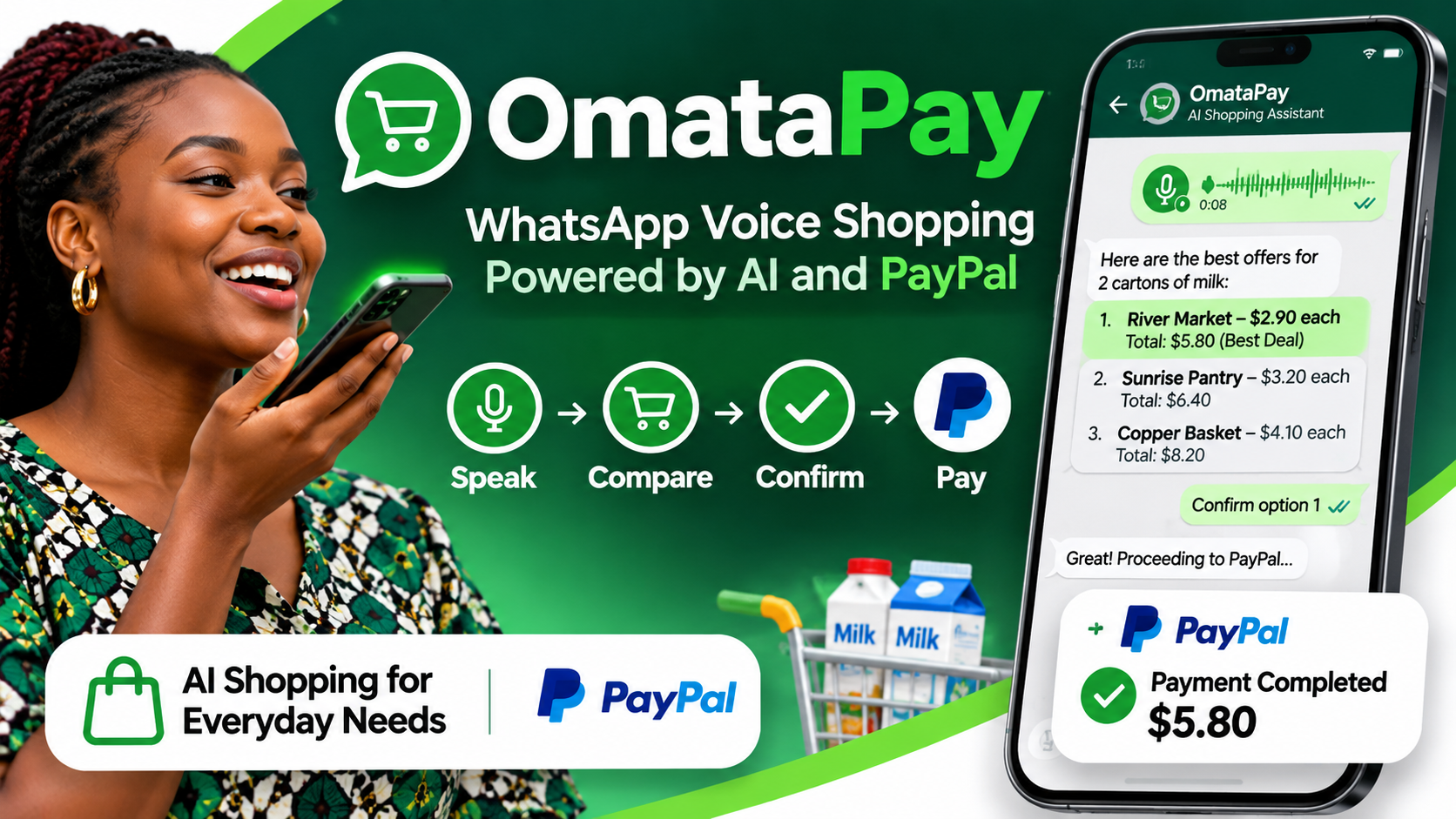
OmataPay is a WhatsApp-oriented conversational shopping application. It is designed to interpret customer voice or text requests, identify shopping intent, compare merchant offers, request explicit customer confirmation, and initiate secure PayPal checkout.
How we built it
The application uses Python, FastAPI, Groq-hosted AI models for natural-language interpretation, Whisper-based speech transcription, SQLite for application state, Meta's WhatsApp Cloud API integration, and PayPal's Sandbox APIs for payment processing and verification.
Demonstrated results
In a recorded local shopping run, a customer requested two cartons of milk. OmataPay generated three sample merchant offers, processed the customer's selection and explicit confirmation, and created a PayPal Sandbox checkout.
The buyer approved the payment, and the application captured and independently verified a COMPLETED $5.80 Sandbox transaction.
Voice transcription and AI processing have also been tested independently. The WhatsApp webhook is configured and Meta's sample delivery test succeeded, but genuine end-to-end WhatsApp message delivery to OmataPay remains unverified.
Challenges we ran into
We focused on handling ambiguous shopping requests safely, requiring customer confirmation before payment, maintaining payment verification evidence, and integrating AI with PayPal without treating model-generated responses as proof of payment.
What we learned
Building OmataPay taught us that successful AI commerce requires more than understanding natural language. A conversational shopping assistant must distinguish customer intent from authorization, present understandable merchant choices, and verify payment results independently.
We learned how to combine Groq-powered language processing, Whisper speech transcription, structured shopping workflows, and PayPal Sandbox payments while preserving explicit customer confirmation.
We also learned the challenges of integrating WhatsApp webhooks across multiple applications sharing a business account. Although our Meta webhook configuration and sample delivery test succeeded, genuine end-to-end WhatsApp delivery to OmataPay remains an outstanding integration milestone.
Accomplishments that we're proud of
Our biggest accomplishment is completing and independently verifying a real PayPal Sandbox payment through an AI-assisted shopping workflow.
A customer requested two cartons of milk, received three merchant offers, selected an option, and explicitly confirmed the purchase. OmataPay created the PayPal checkout, and the buyer approved the transaction. The application captured and independently verified the $5.80 payment as COMPLETED.
We also implemented conversational shopping logic, voice transcription capabilities, confirmation safeguards, merchant-offer comparisons, payment verification, and auditability.
The project demonstrates how AI and PayPal can work together to simplify commerce for small businesses and their customers.
What's next for OmataPay
Our immediate priority is completing genuine end-to-end WhatsApp voice-shopping verification, from a customer voice note through merchant comparison and PayPal checkout.
We plan to onboard real merchants, replace sample offers with live product inventories, improve multilingual voice interactions, strengthen transaction monitoring, and introduce richer merchant dashboards.
Our long-term vision is to make OmataPay a voice-first conversational commerce platform that enables customers to discover products, compare offers, and pay securely using familiar messaging interfaces.
Built With
- cloudflare
- fastapi
- groq
- paypal-res-api
- python
- sqlite
- whatsapp-cloud-api
- whisper
