-
-
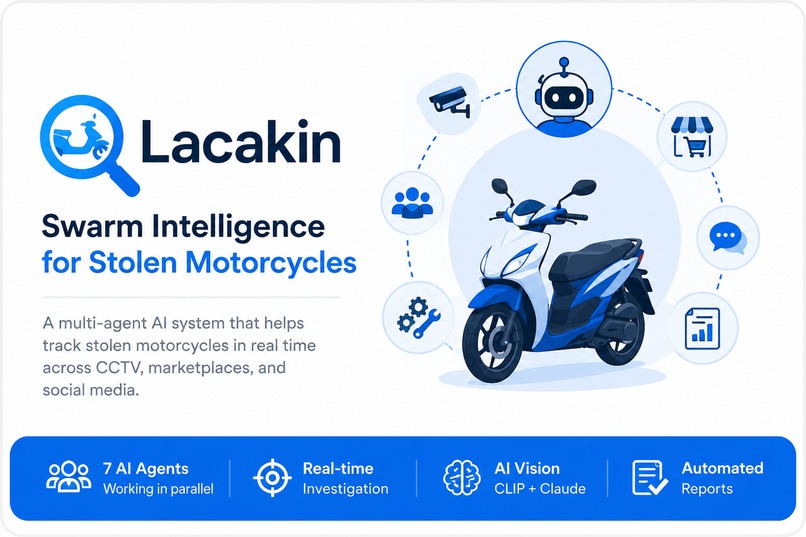
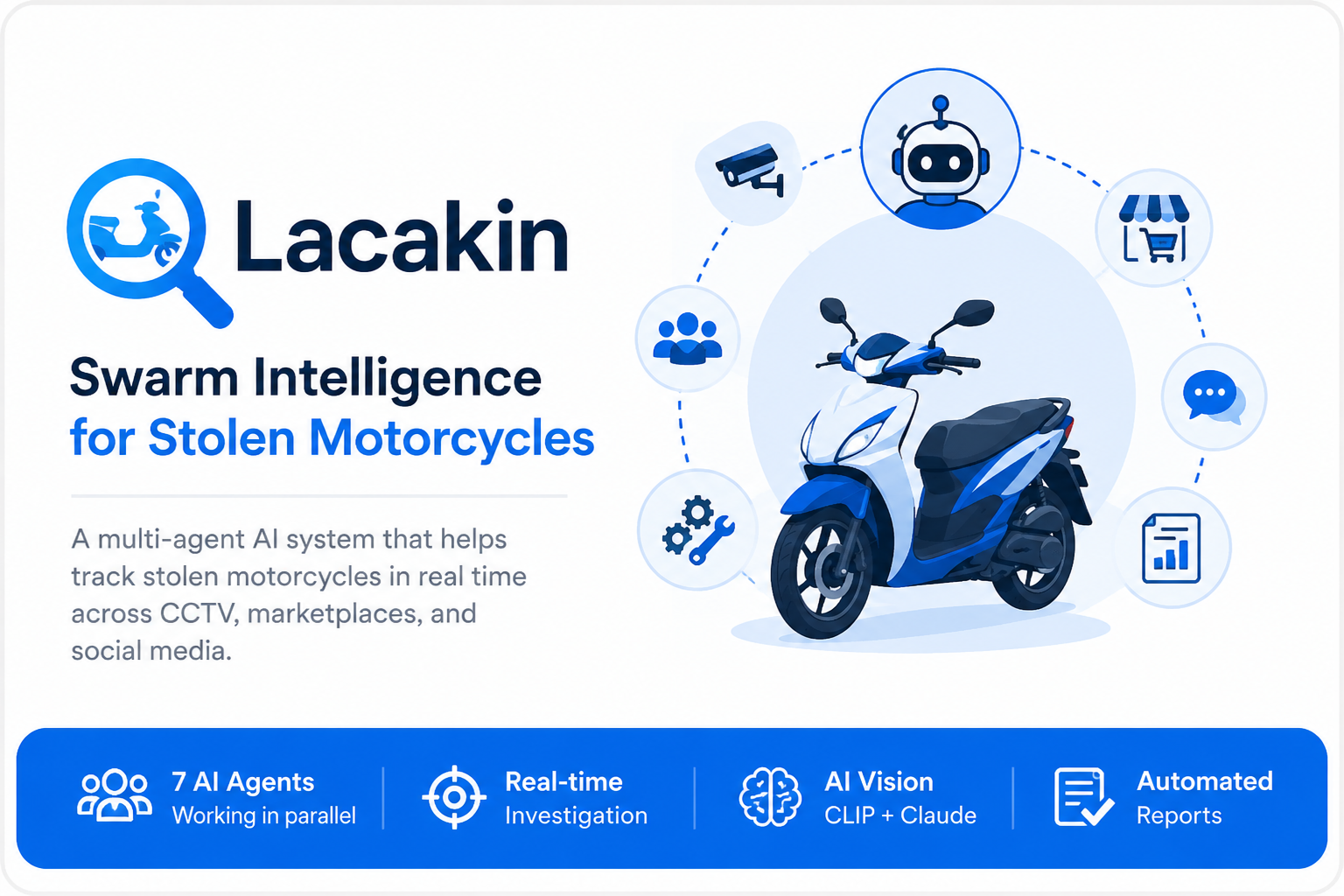
Lacakin — Swarm Intelligence for Stolen Motorcycles
Inspiration
Motorcycle theft is one of the most common crimes in Indonesia, yet victims are often left alone to search manually through CCTV footage, online marketplaces, and social media posts.
We asked ourselves:
“What if a swarm of AI agents could investigate together in real time?”
That idea became Lacakin — a multi-agent AI system designed to help victims and investigators track stolen motorcycles faster using collaborative AI workflows.
What it does
Lacakin is a real-time AI investigation platform for stolen motorcycles.
When a case is reported, multiple AI agents activate simultaneously:
- Scanning CCTV footage
- Monitoring Facebook Marketplace listings
- Detecting suspicious spare-part sales
- Tracking social media keywords
- Sharing findings through agent-to-agent communication
- Generating investigation reports automatically
The system uses a two-stage vision pipeline:
- Jina CLIP v2 for fast and low-cost visual similarity filtering
- Claude Sonnet 4.6 for deeper reasoning and structured analysis
All agents collaborate through an A2A-powered swarm architecture built on OpenClaw.
How we built it
We built Lacakin using:
- OpenClaw as the multi-agent orchestration framework
- Python 3.12 for backend services
- Telegram Bot API as the user interface
- Playwright MCP for web scraping and monitoring
- SQLite-based A2A messaging for inter-agent communication
- Jina CLIP v2 for image similarity filtering
- Claude Sonnet 4.6 for reasoning and report synthesis
The architecture consists of specialized agents:
- orchestrator
- cctv-bandung
- marketplace
- parts
- sosmed
- report
Each agent has a dedicated responsibility but can exchange findings in real time.
Challenges we ran into
One of the biggest challenges was coordinating multiple autonomous agents while keeping the workflow understandable and reliable.
We also faced challenges in:
- Designing efficient A2A communication
- Reducing vision model costs
- Handling noisy marketplace data
- Creating a fast demo pipeline within hackathon time limits
- Balancing speed vs reasoning quality
To solve this, we implemented a two-stage vision pipeline where only high-confidence matches are escalated to Sonnet reasoning.
Accomplishments that we're proud of
We are proud that we successfully built:
- A working multi-agent swarm investigation system
- Real-time collaborative AI workflows
- A low-cost vision filtering pipeline
- Automated investigation report generation
- A demo-ready prototype in only 12 hours
We are especially proud that Lacakin demonstrates how AI agents can collaborate like an actual investigation team.
What we learned
Through building Lacakin, we learned:
- Multi-agent systems become far more powerful when agents can exchange context
- Cheap filtering models dramatically reduce operational costs
- Real-world AI products require orchestration, not just a single model
- Human-centered problems create the strongest AI use cases
We also learned how important reliability, explainability, and workflow design are in AI-assisted investigations.
What's next for Lacakin — Swarm Intelligence for Stolen Motorcycles
Our next goals are:
- Integrating live CCTV streams in Bandung
- Expanding real marketplace monitoring
- Adding license plate OCR
- Supporting YOLOv8 real-time detection
- Scaling to multiple cities across Indonesia
- Building APIs for collaboration with law enforcement and local communities
In the future, we hope Lacakin can evolve into a real public safety intelligence platform powered by collaborative AI agents.
Built With
- a2a-messaging
- claude-sonnet-4.6
- jina-clip-v2
- mcp
- multi-agent-architecture
- ocr
- openclaw
- playwright-mcp
- python-3.12
- sqlite
- telegram-bot-api
- vision-pipeline
- yolov8


Log in or sign up for Devpost to join the conversation.