-
-
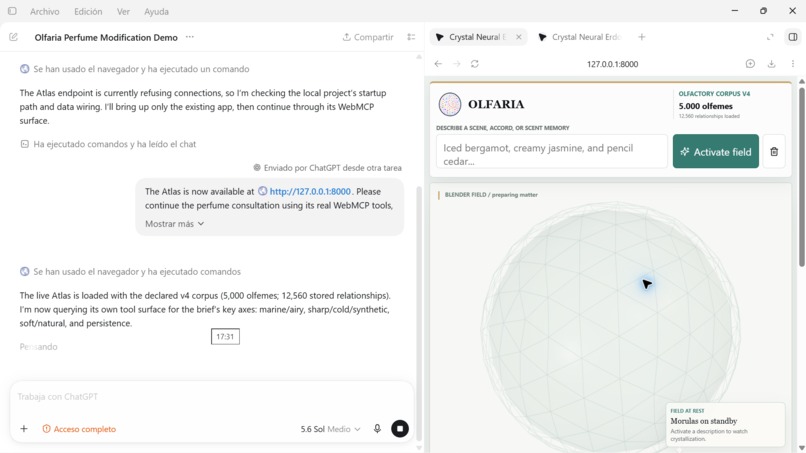
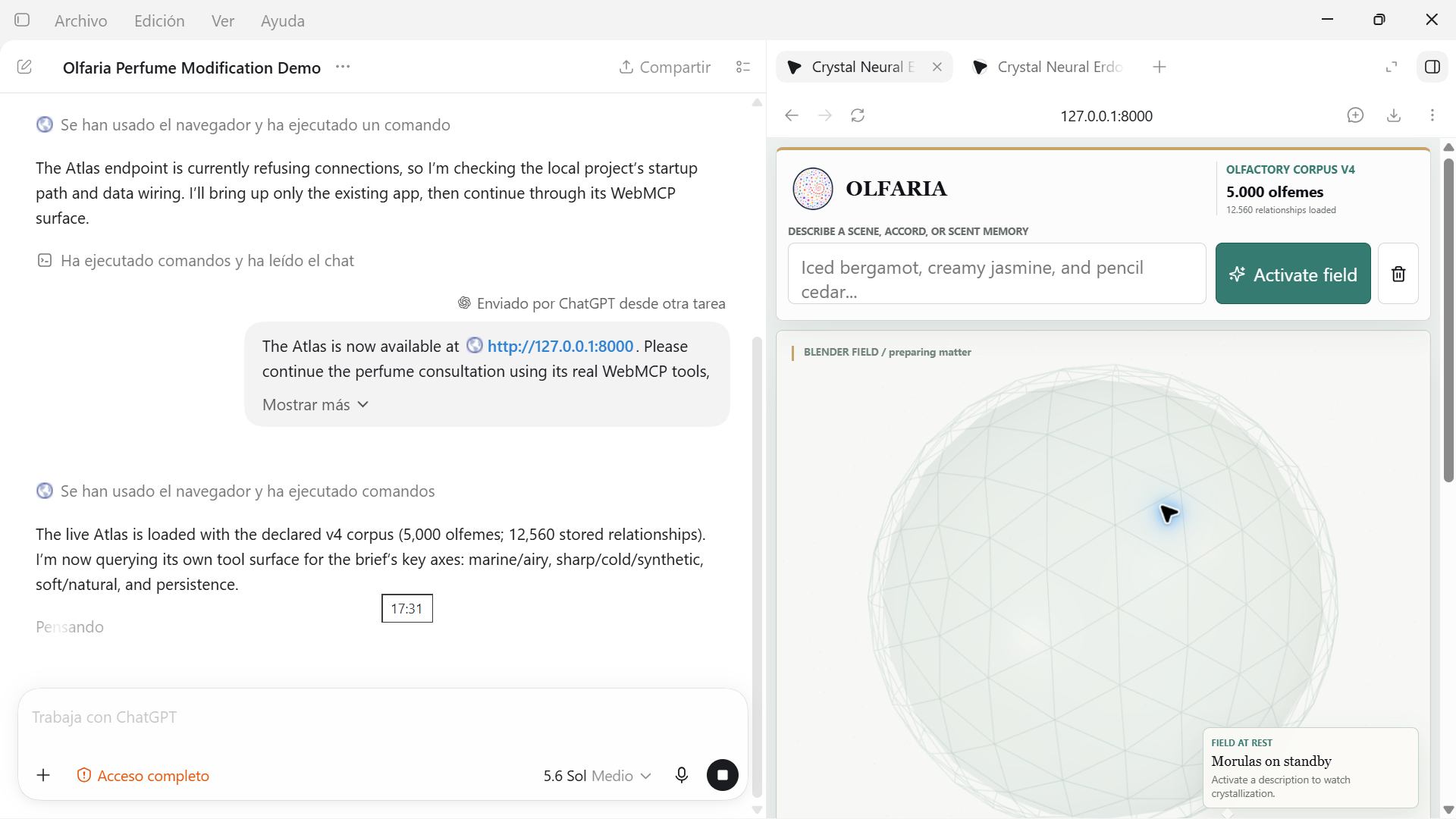
ChatGPT using Olfaria's five WebMCP tools beside the authenticated Crystal Neural Atlas.
-
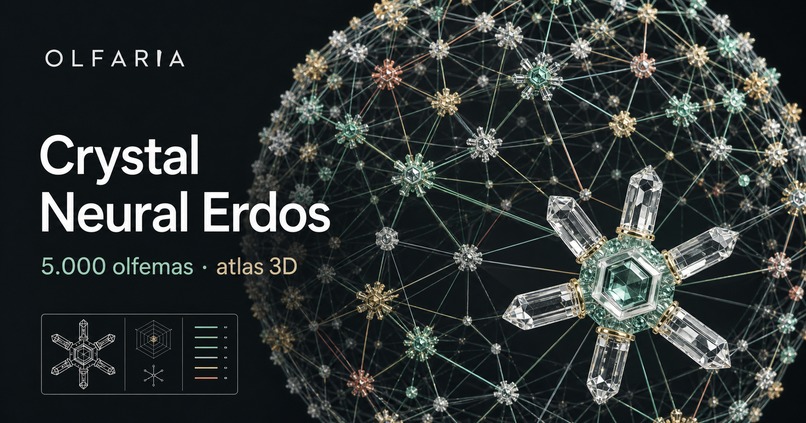
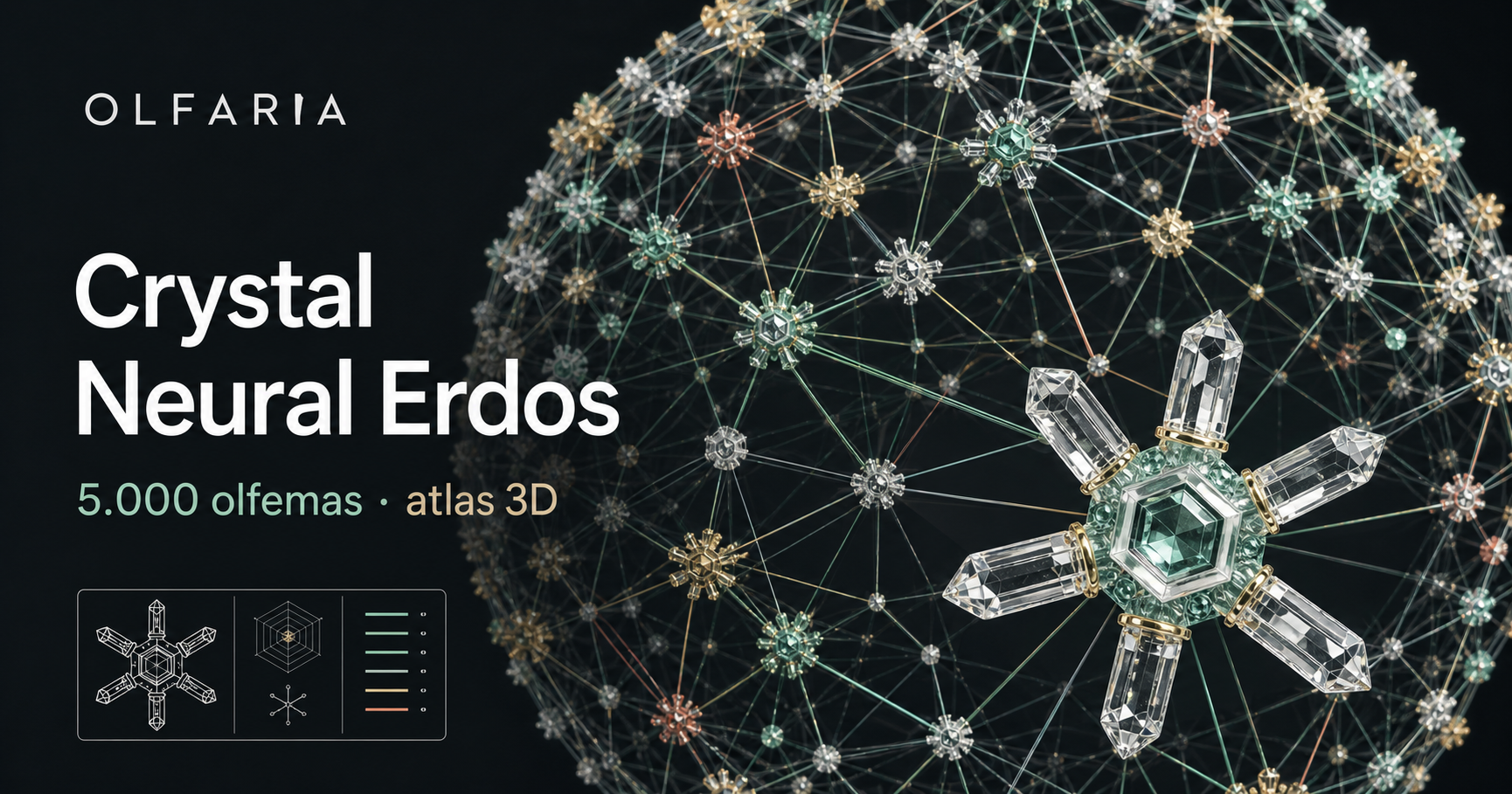
Olfaria Crystal Atlas Neural Erdos showing traceable olfemes and graph relationships in the live 3D workspace.
Inspiration
What it does
How we built it
Challenges we ran into
Accomplishments that we're proud of
What we learned
What's next for Olfaria Crystal Atlas Neural Erdos
Inspiration
Smell is difficult to search and explain. Sensory language is ambiguous, formulation problems are contextual, and the evidence behind a recommendation is hard to keep visible. The existing Olfaria Crystal Neural Atlas made those relationships explorable for a person, but an agent still had to guess how to operate a dense 3D interface. WebMCP provided the missing contract between structured reasoning and shared visual context.
What it does
A perfumer can describe a problem in natural language while an agent uses five typed Olfaria tools:
- search_olfemas maps language to bounded corpus results.
- get_relations reads recorded relationships and uncertainty.
- compare_olfemas separates shared attributes from differences.
- find_path traces a reproducible route through existing graph edges.
- focus_nodes makes the relevant evidence visible in the live Atlas without modifying the corpus.
The person remains in control of the visual exploration. The agent handles precise retrieval and traversal, then points back to the same olfemes on screen. Corpus evidence stays separate from formulation interpretation.
Why WebMCP
Conventional browser automation would have to infer meaning from canvas graphics, controls and transient UI state. Olfaria instead declares exactly what an agent may do, with bounded JSON schemas and explicit side-effect semantics. The agent does not scrape the 3D interface or receive unrestricted application internals. It calls narrow tools that reuse the Atlas's deterministic graph service and existing visual controller.
This makes the interaction faster and more reliable, but the larger improvement is epistemic: a recommendation can remain visibly connected to its source concepts, stored relations and uncertainty.
Human-agent experience
Before WebMCP, a person could explore the Atlas and an agent could discuss fragrance concepts, but their contexts were separate. With WebMCP they collaborate in one loop: the person supplies intent, the agent retrieves structured evidence, the Atlas visualizes the exact nodes, and the person evaluates the result. The visual state becomes a shared working memory rather than a screenshot to interpret.
How it was built
The existing Crystal Neural Atlas remains the only product renderer. A narrow window.OlfariaAtlasApi bridge exposes visual focus without leaking internal state. The page registers five tools through document.modelContext.registerTool.
Four read-only tools call bounded deterministic graph operations. focus_nodes delegates to the Atlas controller and changes only the current browser view. The corpus loader validates the dataset, constructs immutable indexes and records a SHA-256 digest for reproducibility. Authentication protects the production Atlas, APIs and WebMCP registration with signed, HttpOnly, SameSite=Strict browser sessions.
The public repository documents the implementation and includes the WebMCP adapter, service design and approved media, while local test packages, proprietary corpus data, production account hashes and session keys remain outside Git.
Challenges
- Preserving the existing 3D renderer instead of creating a parallel agent-only experience.
- Defining tool outputs that distinguish stored evidence from deterministic technical inference.
- Keeping graph traversal bounded over 5,000 olfemes and 12,560 relationships.
- Making a session-protected WebMCP app deploy safely under a subpath.
- Publishing implementation context without releasing proprietary corpus data or credentials.
Accomplishments
- Five stable, typed WebMCP tools with clear side-effect annotations.
- A real human-agent fragrance workflow that keeps evidence visible in the Atlas.
- Deterministic corpus operations with bounded inputs and traceable outputs.
- Graceful degradation when WebMCP is unavailable.
- A sanitized public implementation record without local test data or production secrets.
- A production login boundary that does not place credentials in the repository.
What we learned
Agent-native design is not the same as automating more clicks. The most useful interface was a small semantic contract aligned with the application's real domain boundaries. Visual actions and scientific reads also need different trust semantics: focusing a node is reversible browser state, while corpus claims must remain immutable and traceable.
What's next
- Version the WebMCP contract independently from corpus releases.
- Add audit identifiers to every result so a judge or researcher can trace it to a specific corpus build.
- Add controlled multi-user workspaces without weakening session isolation.
- Extend evidence visualization while preserving the distinction between recorded and derived relationships.
Challenge-period extension
The Crystal Neural Atlas and corpus existed before the challenge. Between August 25 and September 3, 2026, the project was meaningfully extended with the WebMCP bridge, five typed tools, deterministic service endpoints, visual focus controller, English human-agent workflow, production authentication and subpath-safe deployment. The public repository preserves the implementation record and includes a dedicated development-history document.
Built With
- chatgpt
- css3
- fastapi
- html5
- javascript
- knowledge
- python
- three.js
- webmcp


Log in or sign up for Devpost to join the conversation.