Inspiration
During a clinical posting at a hospital in Ikom, Cross River State, a patient came in for a chest X-ray. The request said hypertension and congestive cardiac failure. We took the X-ray that day, but there was no radiologist on site, so the films waited. By the time the report came back, the patient had died.
The images were ready. What was missing was someone to read them.
Nigeria has an estimated 250–300 radiologists for roughly 197 million people:
$$\frac{197{,}000{,}000}{300} \approx 658{,}000 \text{ people per radiologist}$$
Most of them work in big-city teaching hospitals. Meanwhile, hospitals and diagnostic centres in small towns own X-ray, ultrasound and CT machines whose scans wait days or weeks for a report. We saw the same problem at the University of Calabar Teaching Hospital, where images had to be carried to a reporting room and a radiologist covering several hospitals had to be physically present to report them.
We are three radiographers, one of whom is also a software engineer. We built Olembes so that where a patient lives no longer decides whether their scan gets read in time.
What it does
Olembes is a teleradiology platform that connects rural facilities to radiologists anywhere in Nigeria.
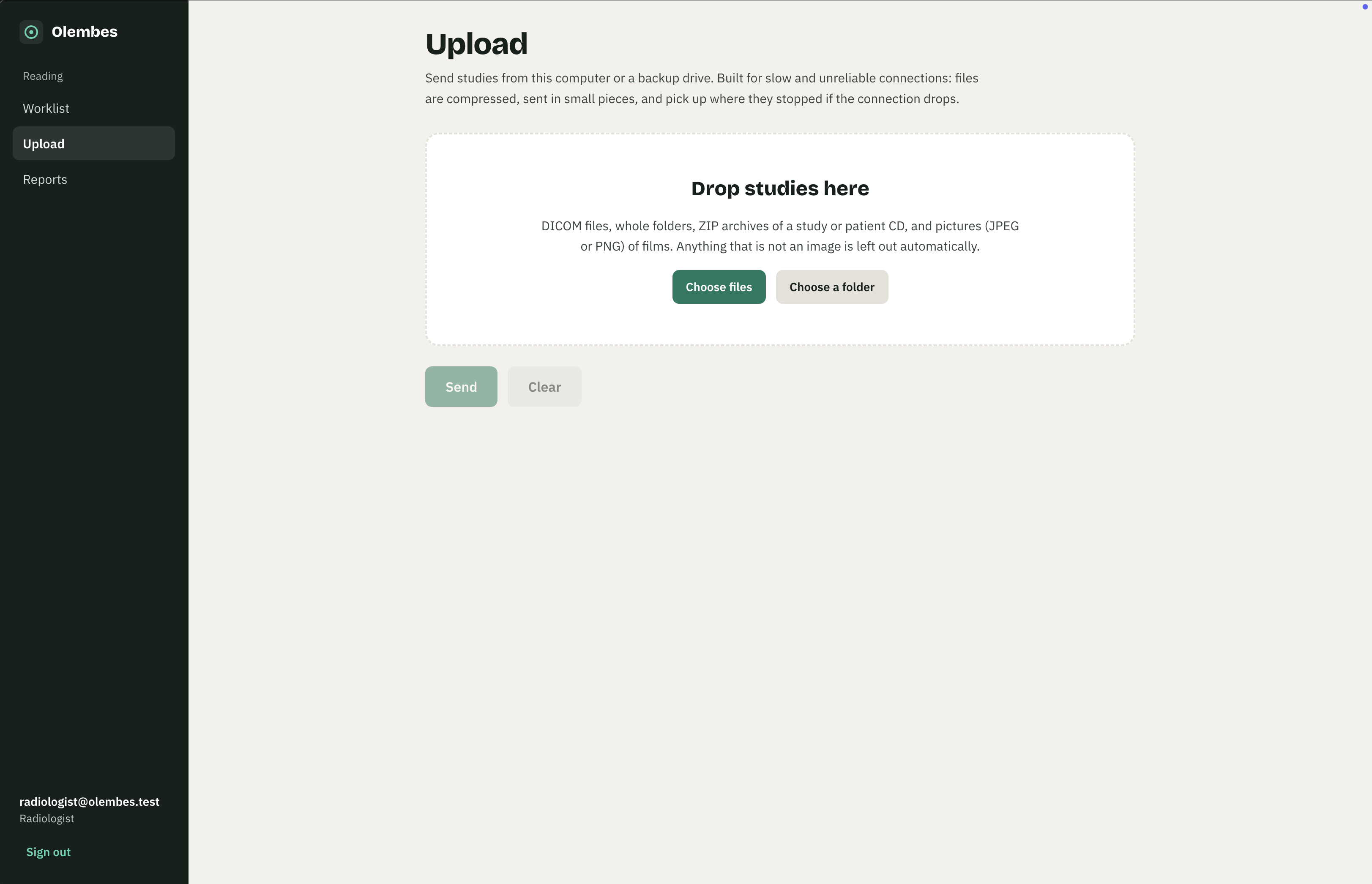
- Get the scan in. Machines that support DICOM send studies automatically after a guided four-step setup that tests the connection. Facilities whose machines can't connect upload from any computer: DICOM files, zipped patient CDs, or even photos of printed films, which are wrapped into proper DICOM images.
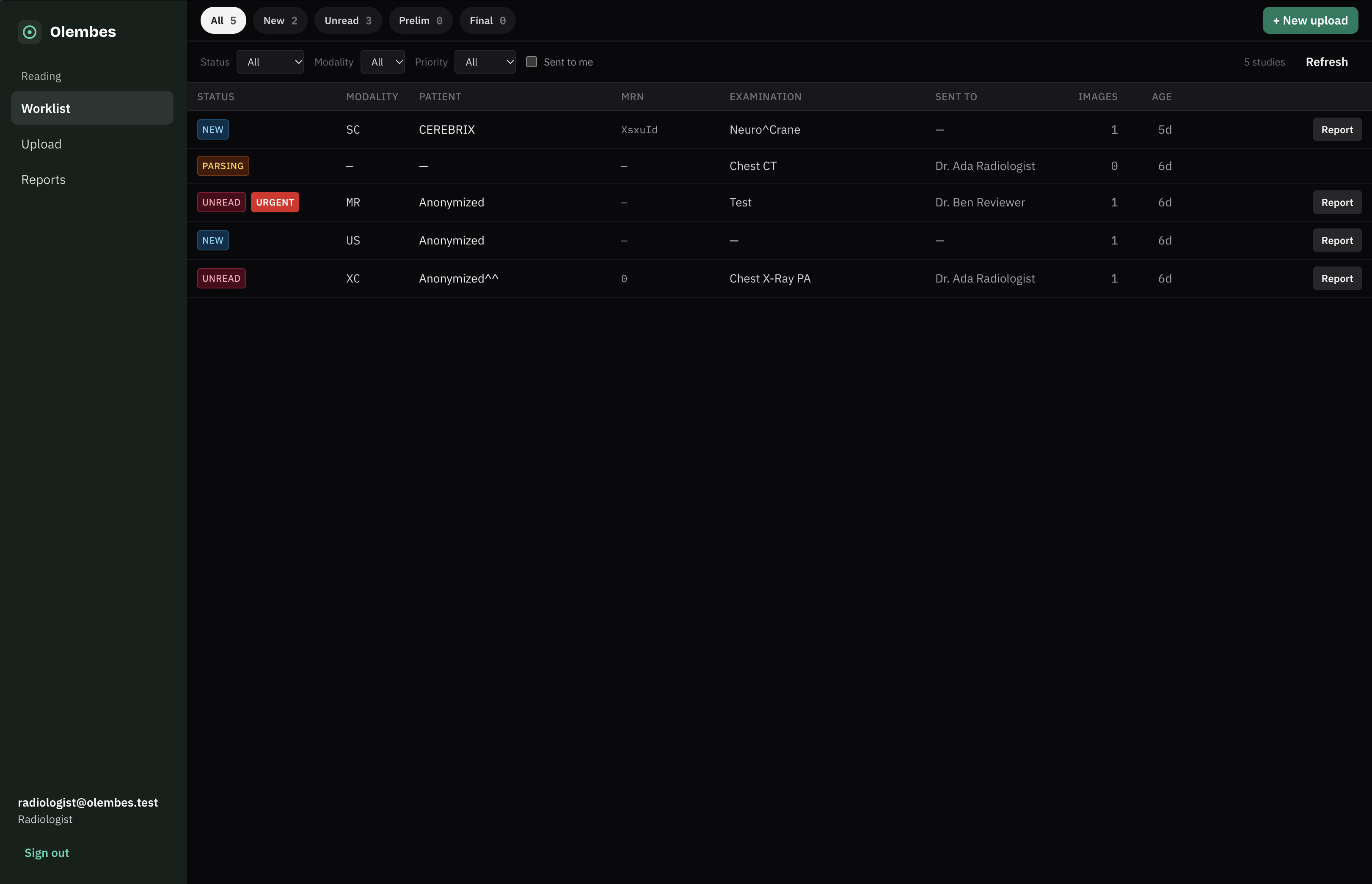
- Send for reporting. The radiographer attaches the clinical question, history and urgency, and chooses a radiologist.
- Read remotely. Radiologists use a desktop or web workstation with full diagnostic tools (window/level presets, measurements, annotations, MPR and 3D for CT), or the Android and iOS app over ordinary mobile data.
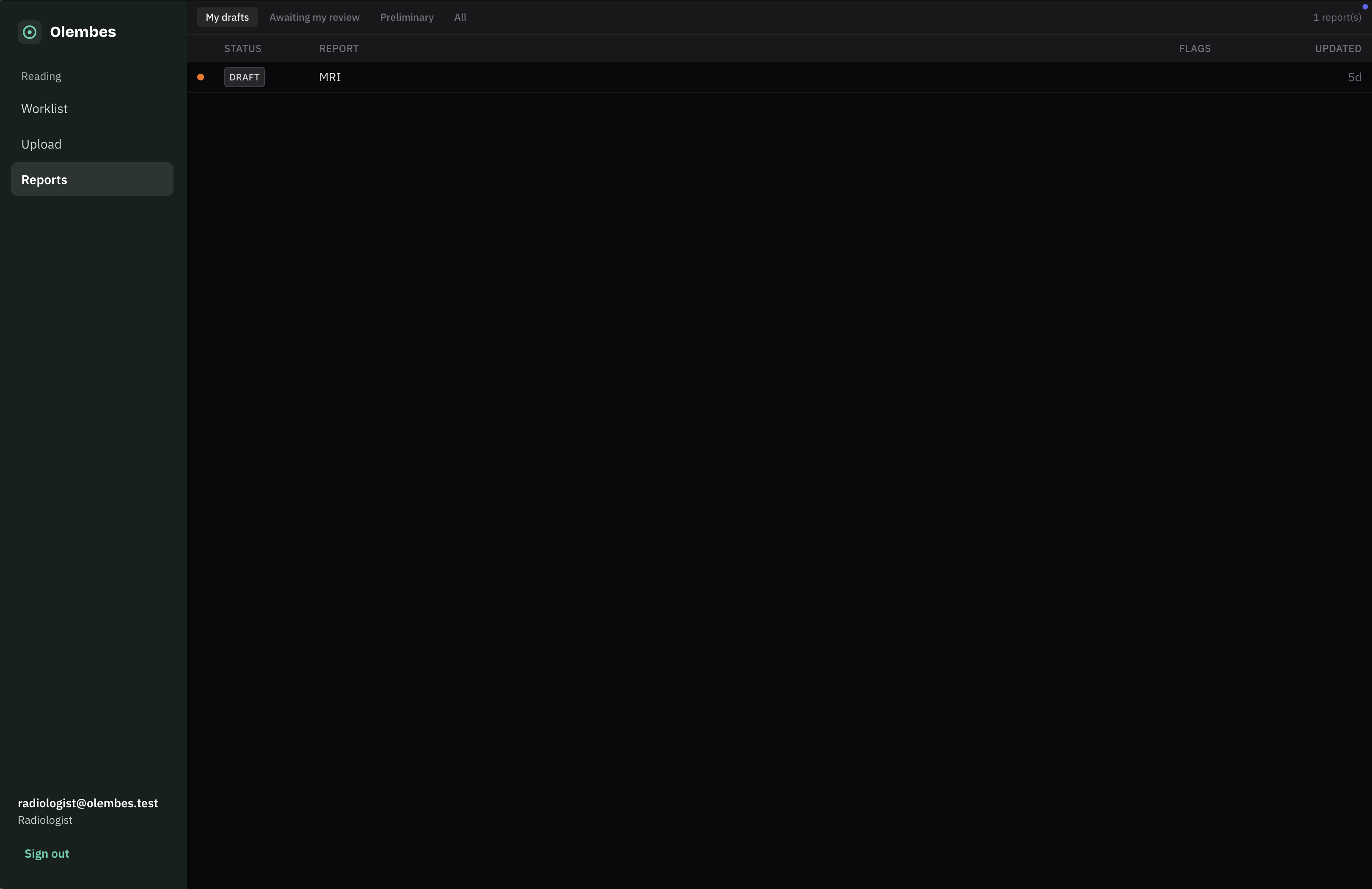
- Report and sign. Templates, live co-editing, preliminary and final sign-off, critical-finding flags, peer review (RADPEER), comments, addenda, PDF export and share links.
- AI assistance, radiologist in control. A locally hosted MedGemma model can pre-read a study and draft findings. Nothing enters a report without an explicit click, and a signed report can't be altered.
Five roles (platform admin, centre admin, radiologist, radiographer, referring doctor) keep each person's view focused, and every centre's data is kept separate.
How we built it
- Imaging gateway (Go): sits in front of an Orthanc PACS. It receives Orthanc webhooks, normalises study metadata into PostgreSQL, and processes jobs through Redis Streams, with an outbox pattern so events are never lost. Patient identifiers are encrypted with AES-256-GCM (HKDF-derived sub-keys) before they touch the database.
- Backend for frontend (NestJS): handles authentication, centres and staff, reports, real-time collaboration (Yjs over Hocuspocus), and the AI pipeline via Ollama running MedGemma.
- Radiologist workstation: Electron + Next.js + Cornerstone3D, with TanStack Query, Zustand and TipTap for structured reports, and live worklist updates over Server-Sent Events.
- Mobile app (Flutter): Riverpod, go_router, dio and Quill, with tokens stored in the iOS Keychain and Android Keystore.
- Deployment: a single EC2 instance behind Caddy for HTTPS, with all data in one Postgres volume. A Cloudflare Workers + Containers deployment kit is maintained as an alternative.
Challenges we ran into
- Uploads on 2G and 3G. A normal upload fails as soon as the network drops. We built resumable chunked uploads: the gateway stores each chunk and reports its offset, so a dropped connection costs one chunk, and sessions survive for 72 hours. We also gzip responses and give DICOMweb transfers a 15-minute timeout instead of the usual API limits.
- Viewing CT scans on a phone. Streaming raw pixels means hundreds of megabytes per CT. Instead, the app asks the archive to render each frame server-side (DICOMweb Retrieve Rendered) with the chosen window/level, through a tenant-checked proxy.
- Co-editing without Yjs on mobile. There's no production Yjs binding for Dart, and the API used to reject edits to any report that had a live session. We changed the backend to apply section saves into the live Yjs document, so phone and desktop users can edit the same report safely.
- Multi-tenancy inside Orthanc. Uploaded studies are tagged with tenant metadata, a Lua webhook routes them, and ingest refuses to file a study under a second tenant.
- DICOM edge cases. Files arrive in many transfer syntaxes, with or without the Part 10 preamble, sometimes nested three archives deep. We had to normalise uncompressed DICOM to Explicit VR Little Endian so it displays reliably, and fix a viewer crash that occurred when a study opened before Cornerstone had initialised.
- Running AI without a GPU. On our CPU-only test server, an analysis takes minutes, so the AI runs as a background queue and streams results instead of blocking the radiologist.
- Cost. Cloudflare Containers needed a paid plan, so we consolidated the whole stack onto a single affordable EC2 instance for testing.
Accomplishments that we're proud of
- A small team built a complete teleradiology platform covering ingest, viewing, reporting, AI drafting and administration, across web, desktop, Android and iOS.
- A real-world test with a diagnostic centre in Mowe, Ogun State: a radiographer sent scans through Olembes to a radiologist reporting remotely from Lagos. The centre offered to test it further in rural, low-network settings.
- Accepting photos of printed films, so even facilities with the oldest equipment can get a specialist report.
- Designing privacy in from the start: encrypted identifiers, per-centre isolation, an audit trail, and AI that never sends patient data outside our servers.
What we learned
- The scan is rarely the bottleneck; getting it to a radiologist is. Solving transport and workflow matters more than adding features.
- Designing for the weakest network makes the product better everywhere.
- AI in medicine needs guardrails built into the interface, not just a disclaimer: explicit insertion, visible limitations, and no changes after signing.
- Talking to radiographers, radiologists and facility owners shaped the product more than any technical decision did.
What's next for Olembes
- Production readiness: secure hosting that complies with the Nigeria Data Protection Act, managed encryption keys, automated tests and monitoring.
- Live pilots in Mowe, Ogun State, and Ikom, Cross River State, measuring report turnaround before and after Olembes.
- SMS and WhatsApp alerts when a report is ready, push notifications for critical findings, and uploading directly from phones.
- Validating the AI assistant against radiologists' reports on local cases.
- Per-report billing, so facilities pay only for what they use and radiologists earn from every report.
- Scaling to 20 facilities in the first year, then across Nigeria and into neighbouring West African countries.
Built With
- amazon-ec2
- caddy
- cloudflare
- cornerstone3d
- dart
- dicom
- docker
- electron
- golang
- medgemma
- nest
- next.js
- orthanc
- postgresql
- redis
- tiptap
- typescript
- websockets
- yjs
