-
-
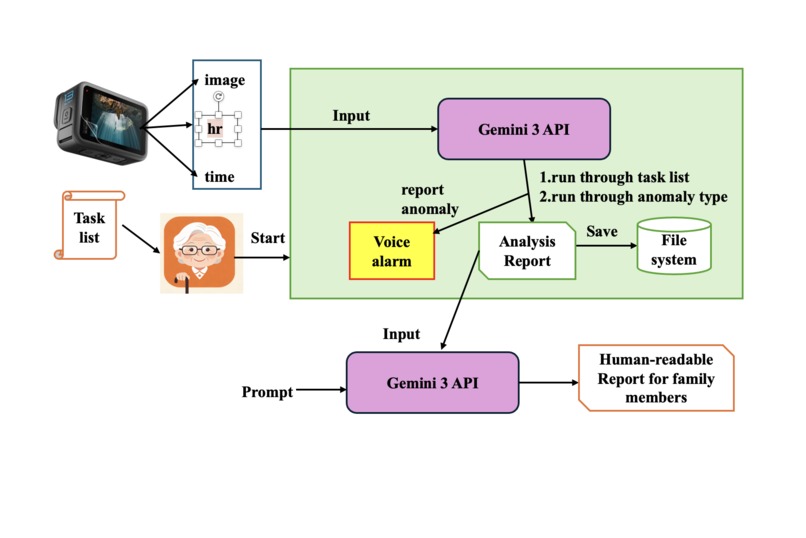
workflow
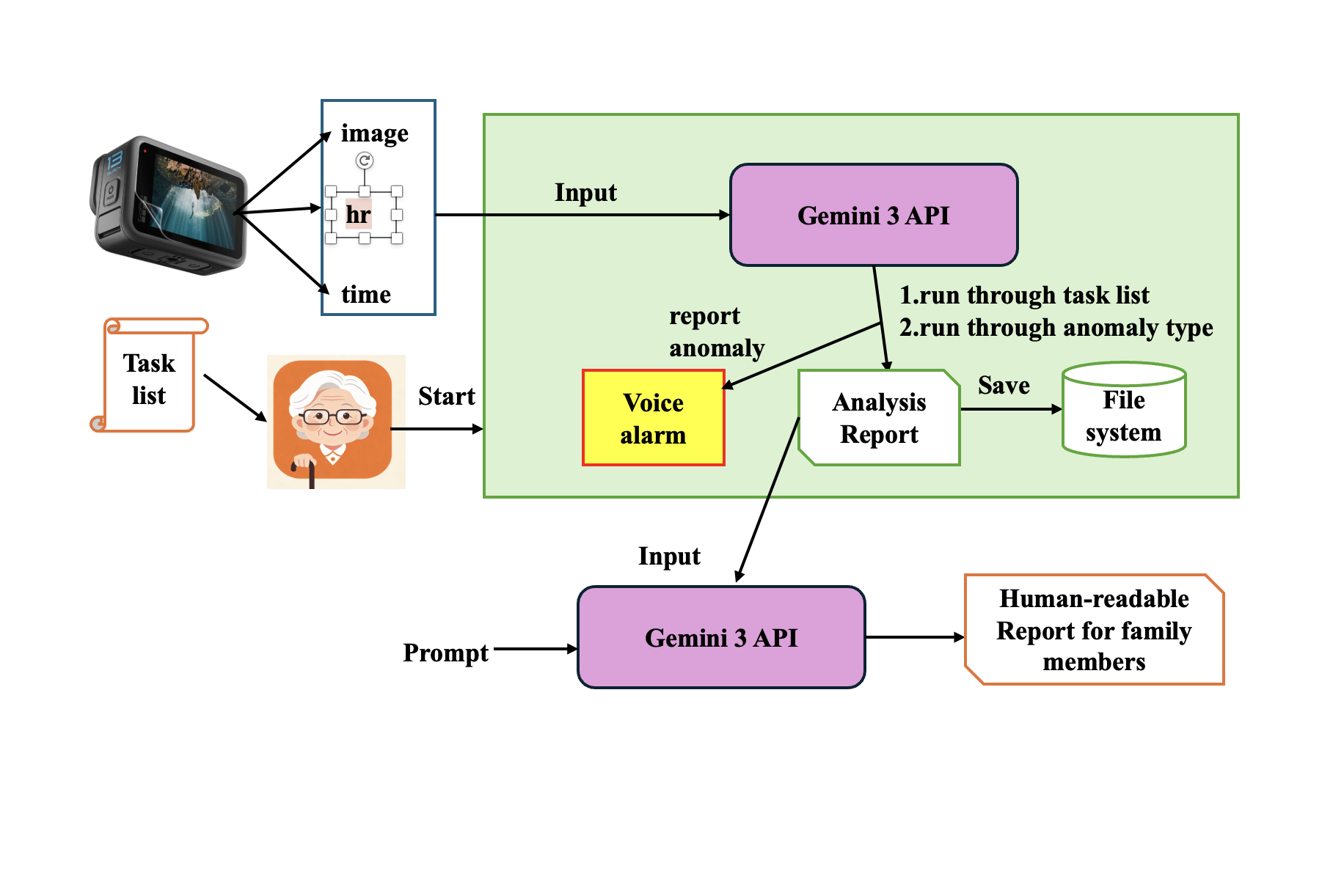
Inspiration:
This project started from a situation that many of us can relate to. In our families, there are elderly parents or grandparents who live alone. Their health may not be perfect: they may have heart conditions, limited mobility, or a higher risk of falling , yet they strongly prefer to stay in their own homes instead of moving into nursing facilities. For them, staying at home means independence and dignity.
For family members, however, this choice often comes with anxiety.Most of the time, we are not physically present. We rely on phone calls and messages to understand how they are doing. But very often, elderly people tend to reassure their families rather than tell the full truth. They say “I’m fine” even when they feel unwell, uncomfortable, or unsafe. Not because they are dishonest, but because they do not want to worry their children.
This creates a silent information gap. Families want to know whether their loved ones are truly safe when no one is around, whether they have fallen, whether their heart rate is abnormal, or whether something unusual has happened during the day.
What it does:
Our project is built to address this gap. By combining video signals and physiological data, the system generates structured and objective summaries of the elderly person’s condition. Instead of sending raw data or constant notifications, the system only raises alerts when something truly matters. Family members can define the elderly person’s daily routines, such as drinking water, taking medication, or resting, together with expected time windows.
The system evaluates video and physiological signals in the context of these routines, allowing it to detect when an activity is missing, delayed, or abnormal. This shifts monitoring from detecting isolated events to understanding daily life patterns.Family members receive a clear daily overview that reflects the elderly person’s real situation, rather than relying solely on self-reported reassurance.
How we built it:
We built the system in two main stages.
First, we developed an offline version to test the capabilities of Gemini. We used recorded videos to simulate different daily scenarios that elderly individuals may face, including normal rountine activities as well as potential anomalies like falls or abnormal heart rates.
Second, we designed an online pipeline that supports real-time transmission of video data from a phone and heart rate data from a smartwatch. This data streams is synchronized in time, allowing the system to monitor and reflect the elderly person’s condition in a consistent and meaningful way.
We chose to use a Gemini not for prediction, but for interpretation. The model helps translate complex, multi-modal signals into structured, human-readable summaries that family members can easily understand.
Challenges we ran into:
One major challenge was privacy and data security, especially when dealing with sensitive video and health data.
Through interviews and discussions with elderly users, we also found that some elderly individuals may feel insecure or uncomfortable being monitored by a camera. This forced us to rethink how to minimize intrusion while still ensuring safety.
Finally, we needed to design a system that is robust to both false positives and false negatives, since unnecessary alerts can cause anxiety, while missed alerts can be dangerous.
Accomplishments that we're proud of:
We are proud that our project demonstrates a realistic, real-life application that proves both feasibility and accuracy.The system is designed as a scalable base platform, which means it can be customized and extended based on the specific needs of different families, rather than being a one-size-fits-all solution.
What we learned:
Building Oldgogo taught us how to turn an abstract idea into a working system. We designed and implemented the project from scratch, learning how to connect data ingestion, model analysis, system validation, and user-centered design into one coherent pipeline. More importantly, we learned that building technology for elderly care requires empathy, not just technical skill.
What's next for Oldgogo:
Next, we plan to expand the system’s features and improve its robustness. We also aim to adapt the system to different operating systems and devices, enabling smoother integration with phones, wearables, and home environments in real-world use.

Log in or sign up for Devpost to join the conversation.