-
-
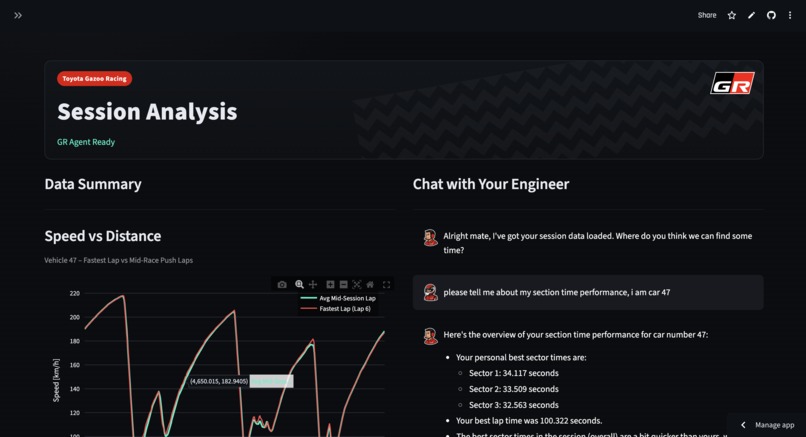
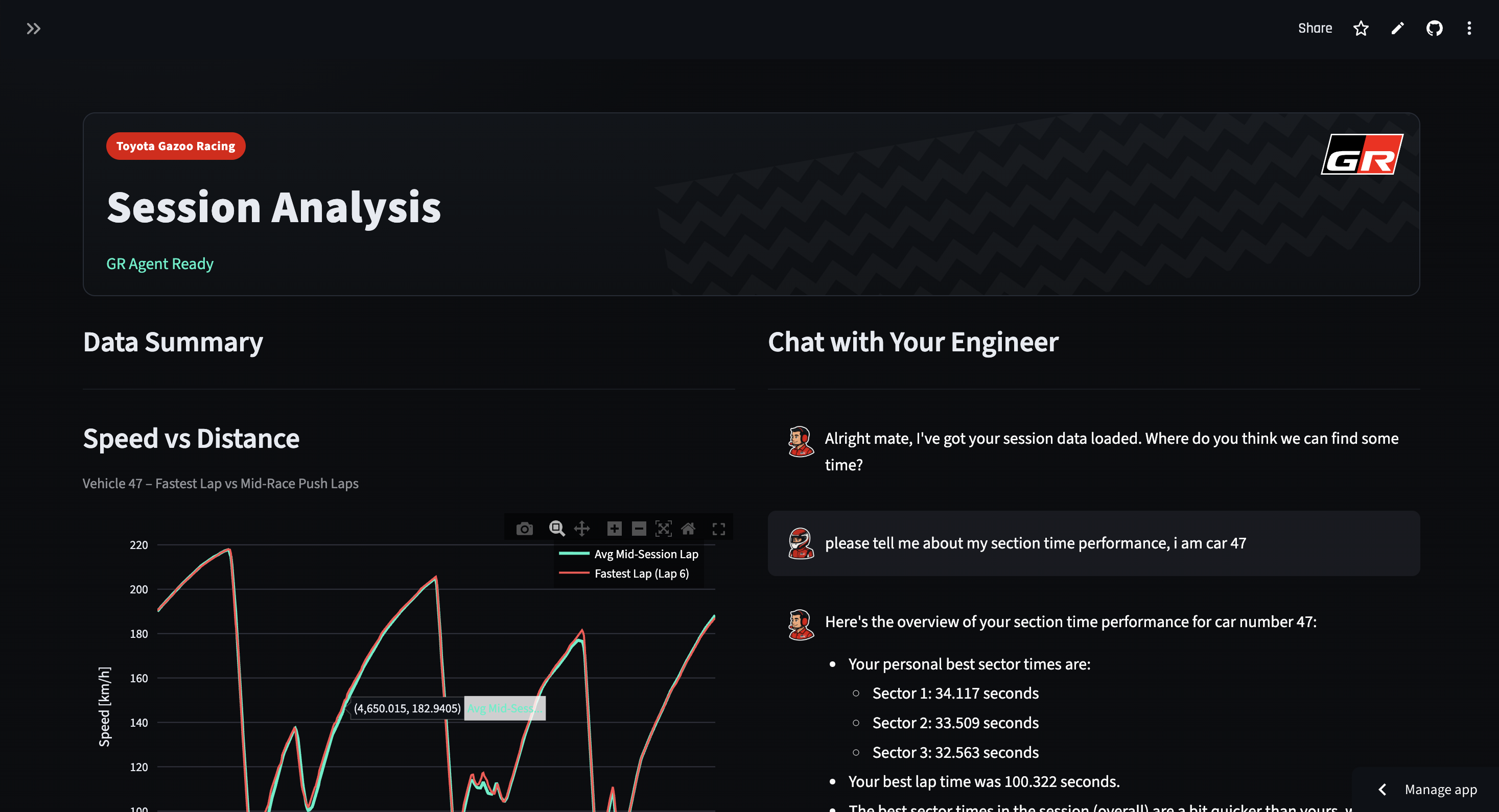
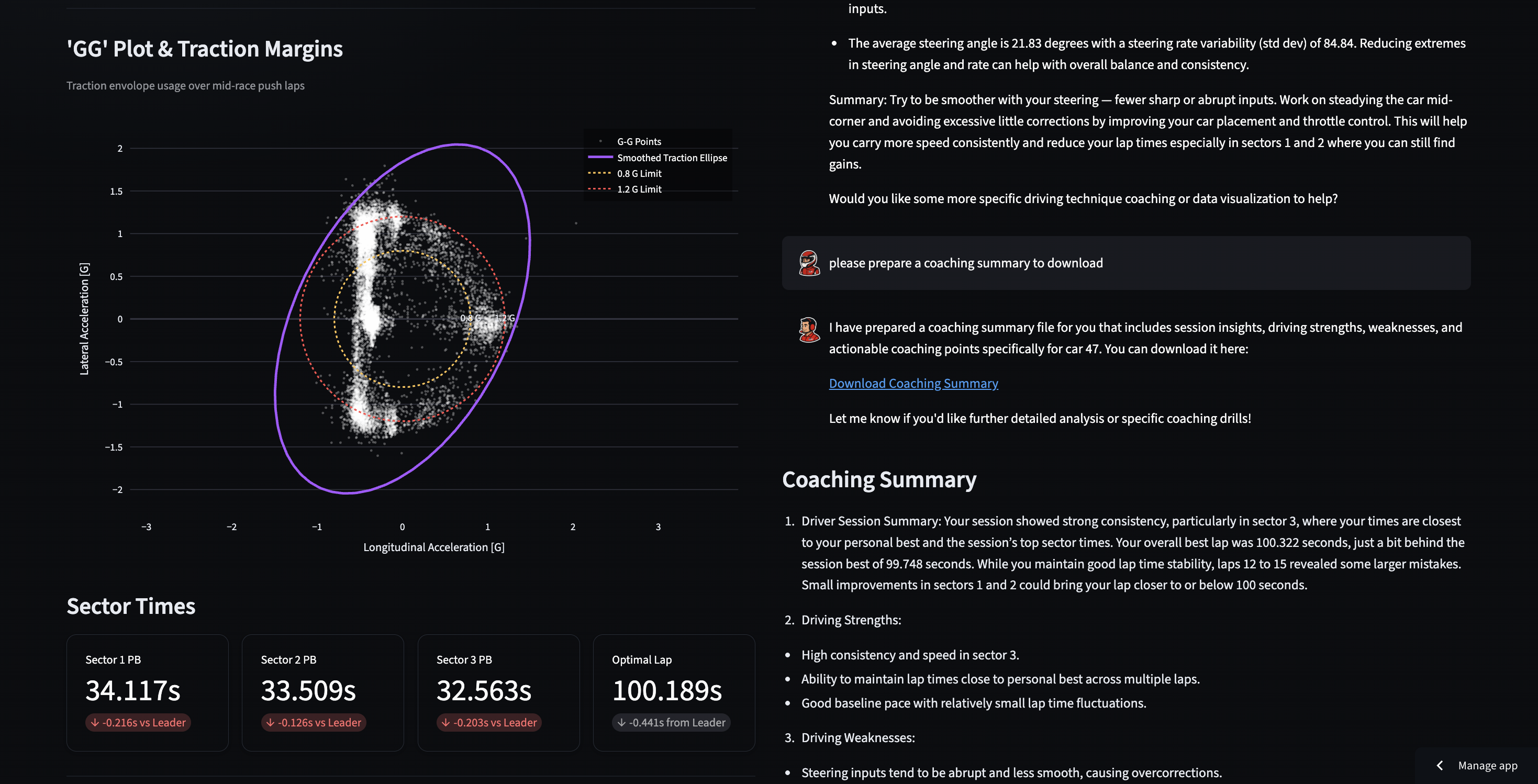
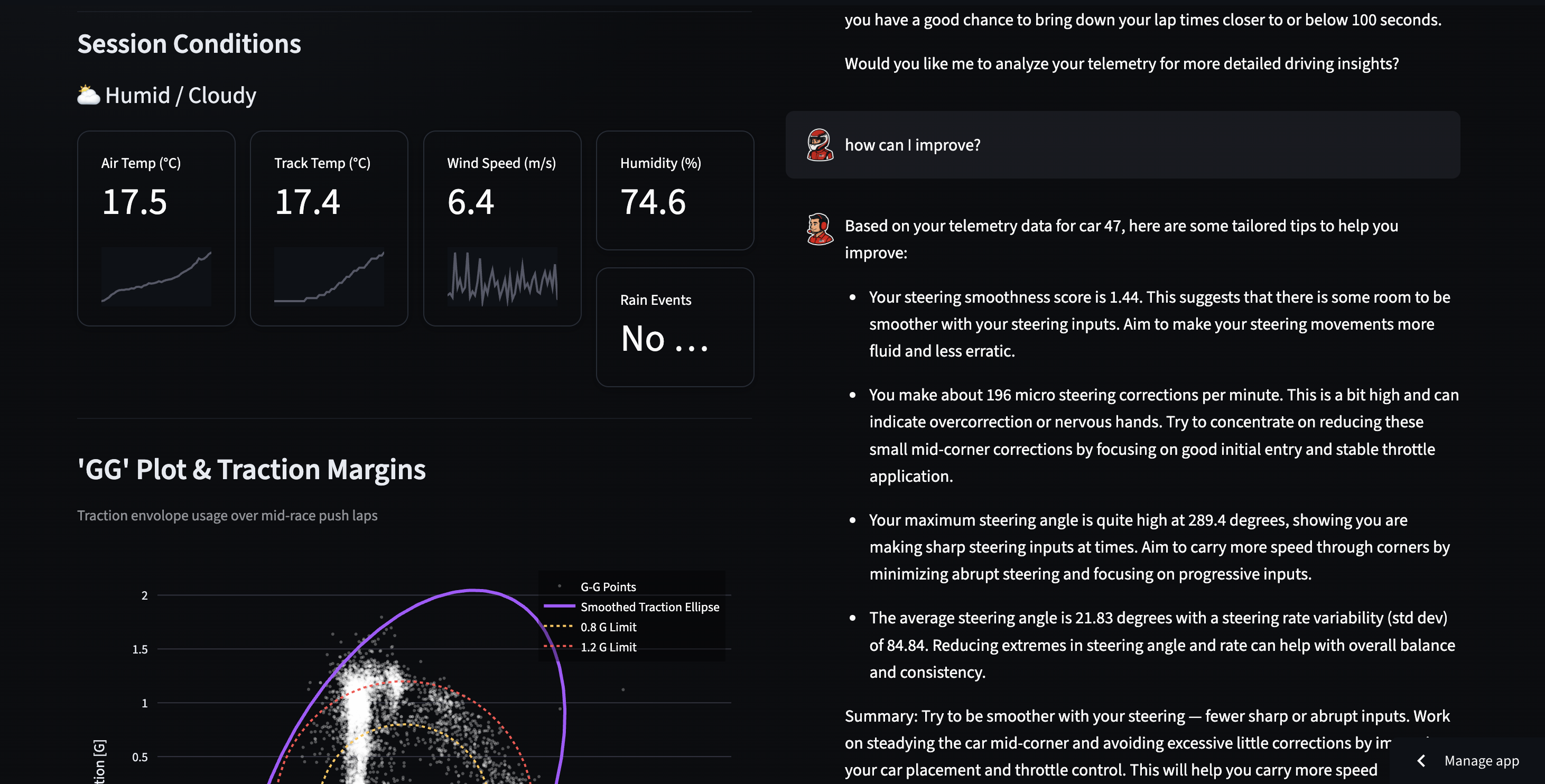
Left side telemetry summary plots that greet user (driver) when they upload their race data.
-
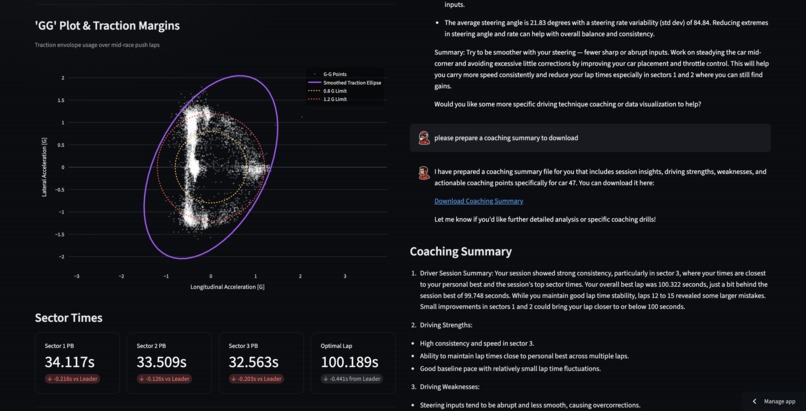
Finished with the session? Download a coaching summary with steps to improve in the next session
-
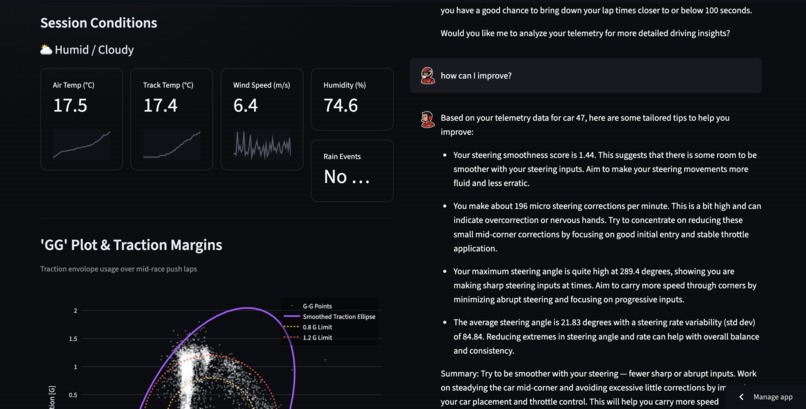
You can ask your race engineer about your telemetry data and they will coach you on how you can improve.
Inspiration
Most amateur GR-Cup teams don’t have a dedicated race engineer analysing their data or giving structured coaching. After researching typical team workflows, I realised how big this gap really is.
OK-GR was born from the idea of giving every driver their own AI race engineer, a tool that makes drivers and teams more competitive.
What it does
OK-GR is an AI-powered race-engineering assistant that:
- Automatically summarises race sessions, telemetry, and performance.
- Visualises key metrics (speed–distance traces, G-G circles, traction envelopes, key lap metrics).
- Lets you chat with your personal AI race engineer, who analyses your data and shows where time can be found.
In short: it brings pro-level driver coaching to amateur teams.
How we built it
I built the UI using Streamlit, enabling fast iteration in Python.
The AI core uses OpenAI’s ChatGPT, customised with a race-engineer persona and tool-calling for telemetry analysis.
Supabase stores large telemetry files as Parquet for extremely fast loading and filtering.
The entire stack; UI, data pipeline, AI agent, Supabase integration, and deployment, was engineered solo, from scratch and deployed on Streamlit Cloud.
Challenges we ran into
- Parsing messy real-world motorsport telemetry and normalising signals.
- Building robust summary functions and visualisations for large datasets.
- Integrating a customised OpenAI agent with real-time data processing.
- Handling multi-hundred-MB telemetry files within Streamlit Cloud memory limits.
- Debugging cloud deployment issues with large file loading and caching.
Accomplishments that we're proud of
This is the first full software product I’ve ever built end-to-end, including GitHub, backend/frontend structure, async data pipelines, and cloud hosting.
I built OK-GR in just a couple of days and learned an enormous amount doing it. I really enjoyed the process.
Seeing the system analyse real race telemetry and generate actionable coaching feedback was a huge milestone and I hope to work on more motorsport projects in the future.
What we learned
- Efficient handling of large datasets with .parquet, caching, and column-level filtering.
- Designing an LLM-driven tool-calling system for domain-specific reasoning.
- UX considerations for engineering tools: speed, clarity, and responsiveness.
- File structuring and debugging.
What's next for OK GR
- Integrate voice-to-speech coaching to allow hands-free interaction.
- Share the tool with GR-Cup drivers for real-world testing and see how we can itterate on OK-GR.
- I would like to also explore integrating OK-GR into consumer GR cars as a track-day training assistant.
Built With
- api
- openai
- python
- streamlit
- supabase

Log in or sign up for Devpost to join the conversation.