Inspiration
The inspiration for our project, OIML R-76 Intelligent Compliance Platform, comes from the need to simplify and improve the testing and certification process for Non-Automatic Weighing Instruments (NAWI). Traditional test report preparation involves manual data entry, calculations and documentation, which can be time-consuming and prone to human error.
We identified an opportunity to use software automation, artificial intelligence and digital verification to make this process more efficient, transparent and reliable.
What We Learned
While developing our solution, we explored the OIML R-76 recommendation, non-automatic weighing instruments, software-based report generation and the application of emerging technologies. We also explored how machine learning can help predict potential design failures, how statistical analysis can identify unusual data patterns and how blockchain can support digital certificate verification.
This project has helped us understand how to combine software engineering, data analytics and digital technologies to address a real-world industrial problem.
How We Built Our Project
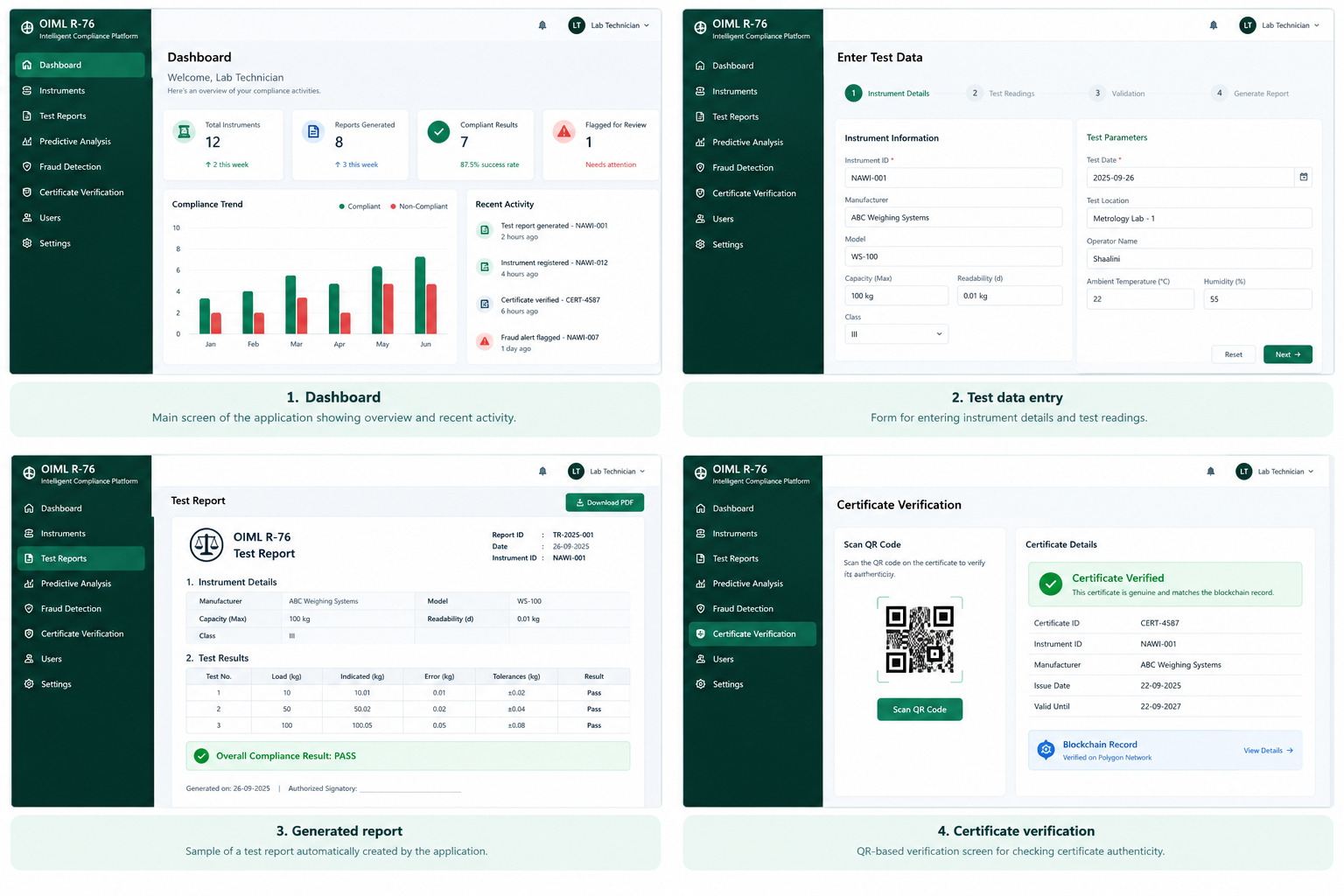
We designed the OIML R-76 Intelligent Compliance Platform as a modular software application. The proposed architecture uses React for the frontend and FastAPI with Python for the backend.
The platform is designed around four major modules:
- Automated Test Report Generation: Allows users to enter instrument details and test readings manually, validate the data, perform applicable compliance calculations and generate structured test reports.
- Predictive Design Analysis: Uses a proposed XGBoost machine learning model to estimate potential design-related testing failures and provide manufacturers with early insights.
- Fraud Detection: Uses statistical techniques, including Benford's Law where applicable, to identify suspicious patterns in test data for further investigation.
- Blockchain-Based Certificate Verification: Uses the proposed Polygon blockchain integration and QR codes to support certificate authenticity verification.
The application is designed to combine these modules into a unified platform, with standards-based calculations forming the foundation of the system.
Challenges We Address
One of the major challenges is implementing the OIML R-76 requirements accurately while making the application simple to use. Limited historical test data also presents a challenge for training and validating the machine learning model. Integrating certificate verification while maintaining data integrity and keeping the system practical for laboratory use are additional considerations.
Our approach is to develop the core report-generation functionality first, validate its calculations and gradually integrate the advanced modules. We also plan to use synthetic data for initial model development and evaluate the system through test cases before considering wider deployment.
Our Goal
Our goal is to develop a practical and scalable digital platform that reduces manual effort in test report preparation, supports early identification of potential design issues and improves the traceability and verification of test certificates. Through this project, we aim to contribute to the digital transformation of legal metrology.
Built With
- amazon-web-services
- docker
- fastapi
- github
- jwt
- kubernetes
- mongodb
- pandas
- polygon
- postgresql
- pydantic
- python
- qr-code
- rbac
- react
- react-native
- redis
- scikit-learn
- sqlalchemy
- tailwind-css
- xgboost

Log in or sign up for Devpost to join the conversation.