-
-
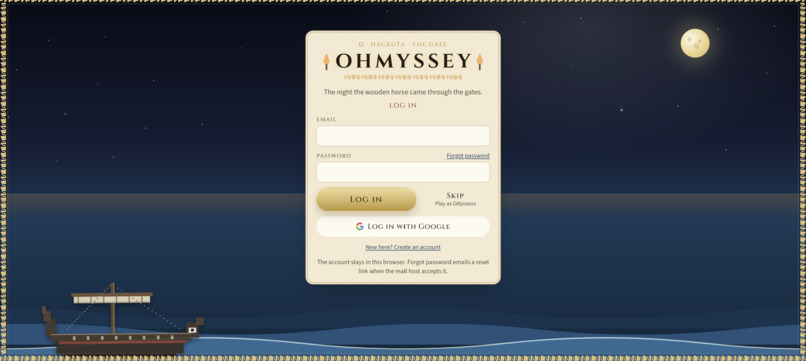
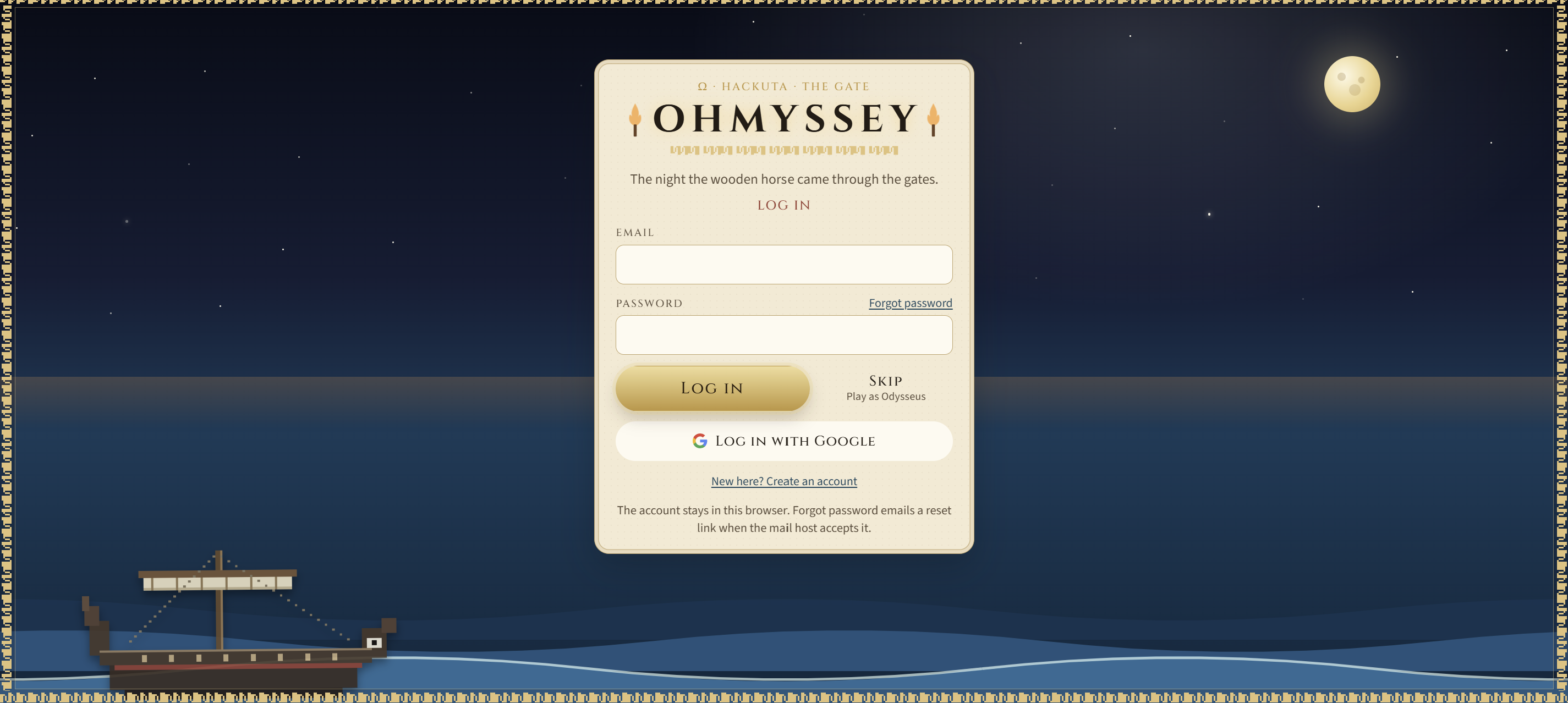
Login: The gate. Log in, use Google, or Skip to play as a guest.
-
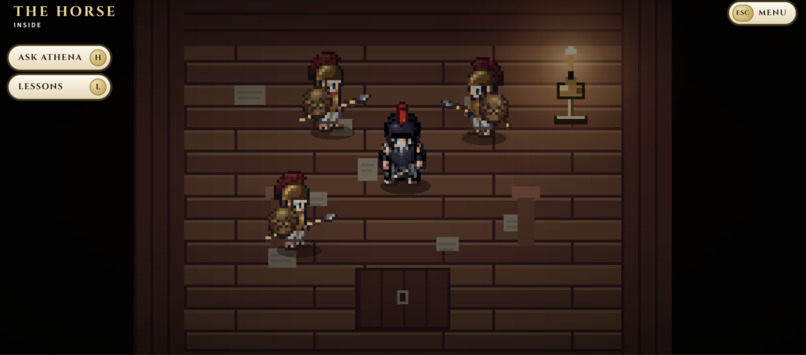
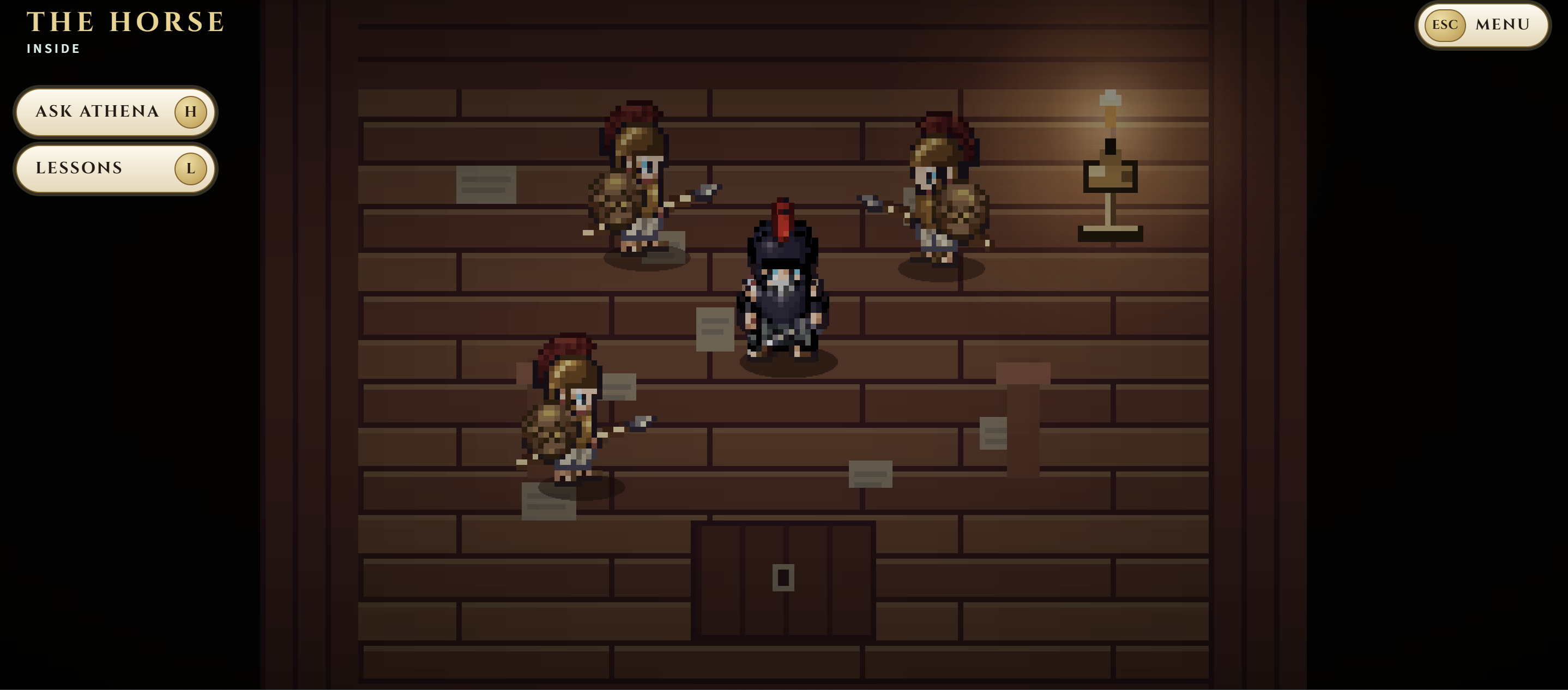
Inside the wooden horse. Answer to open the trap door.
-
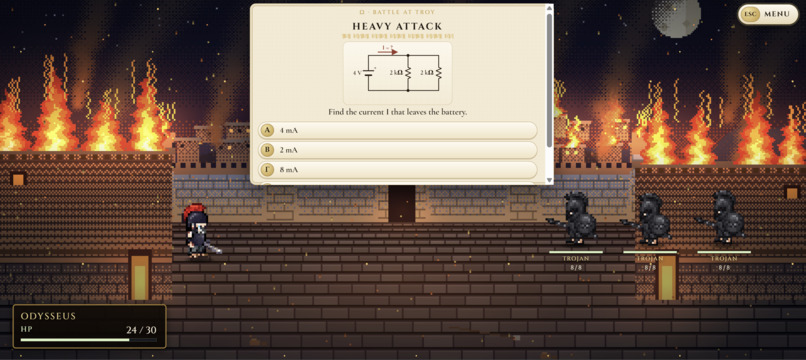
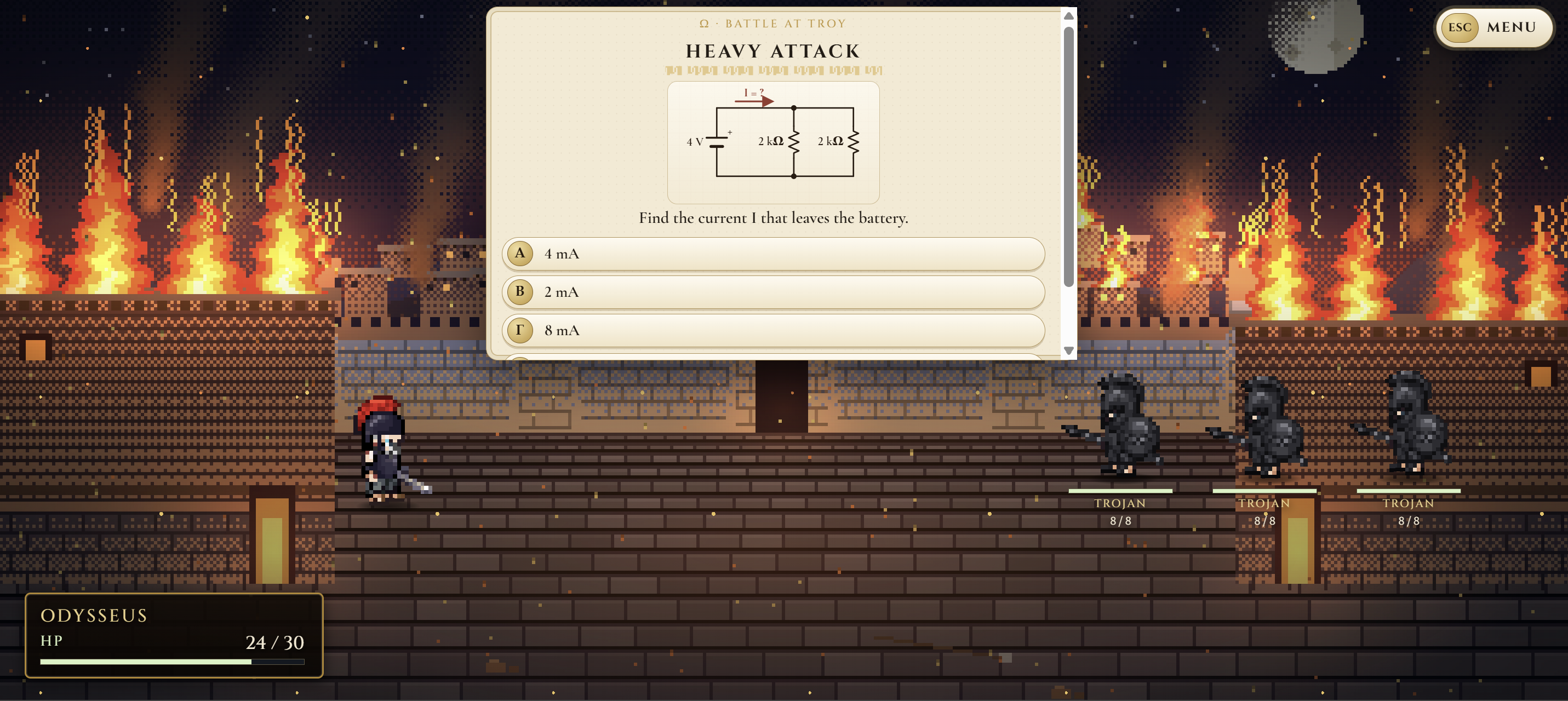
Answer right to strike. Miss, and a Trojan strikes back.
-
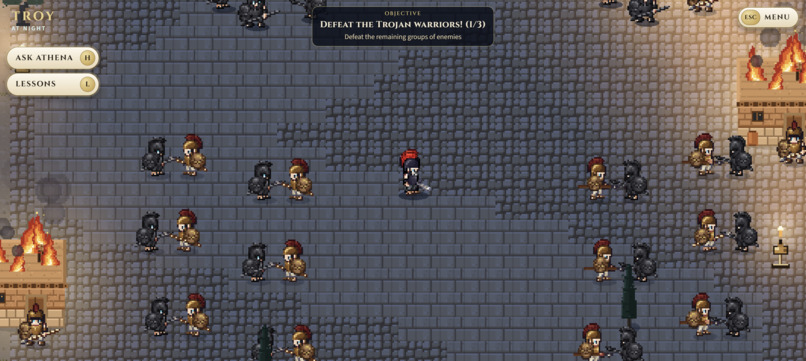
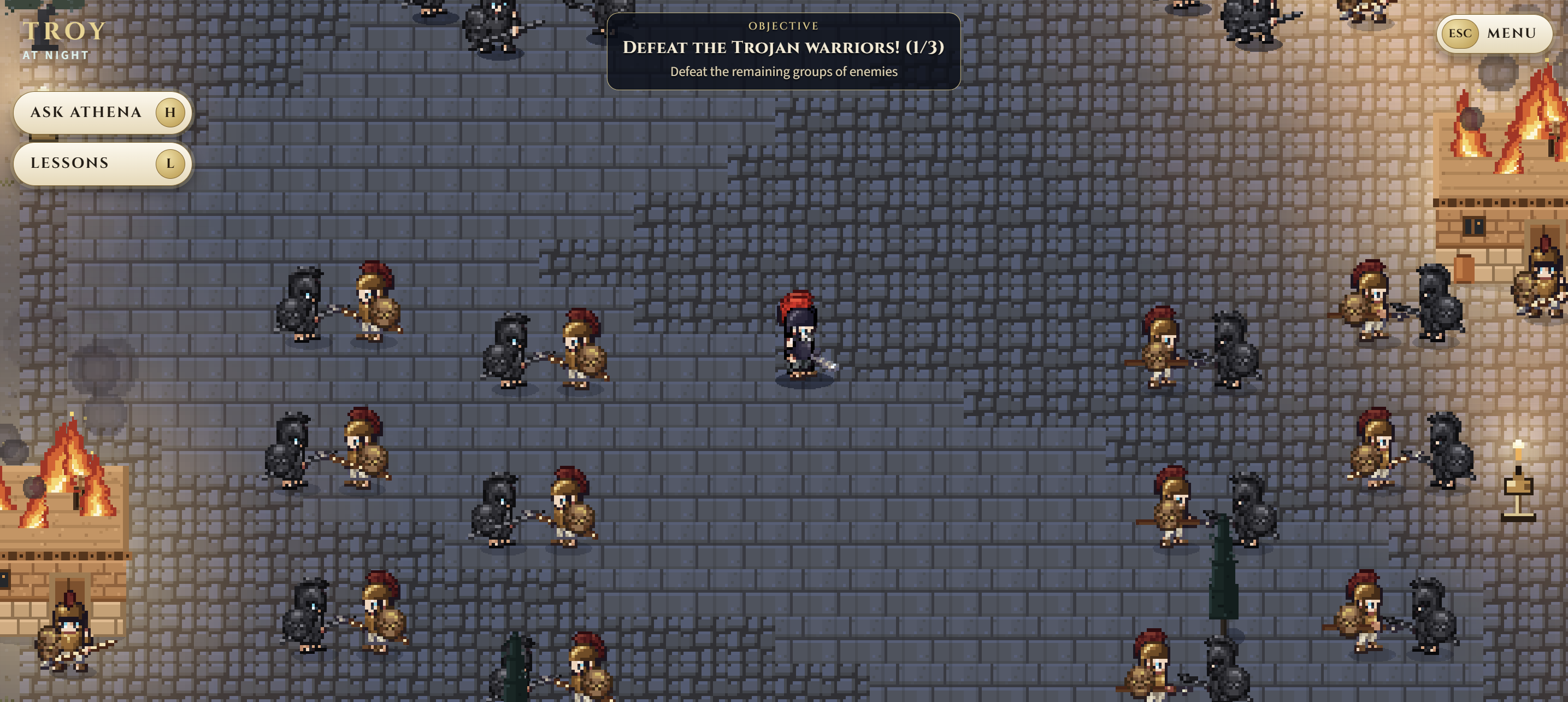
The gate has fallen. Clear the streets of Troy.
-
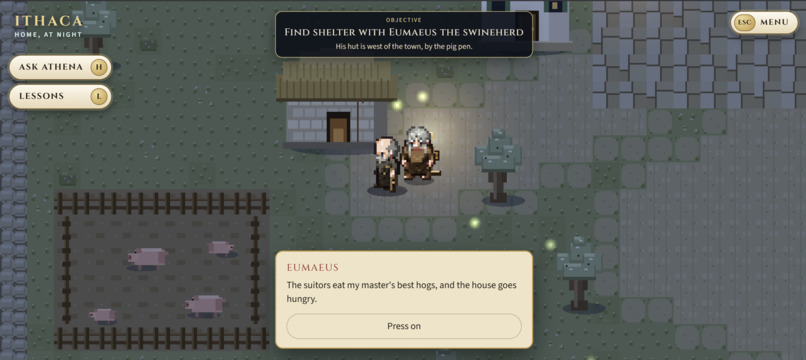
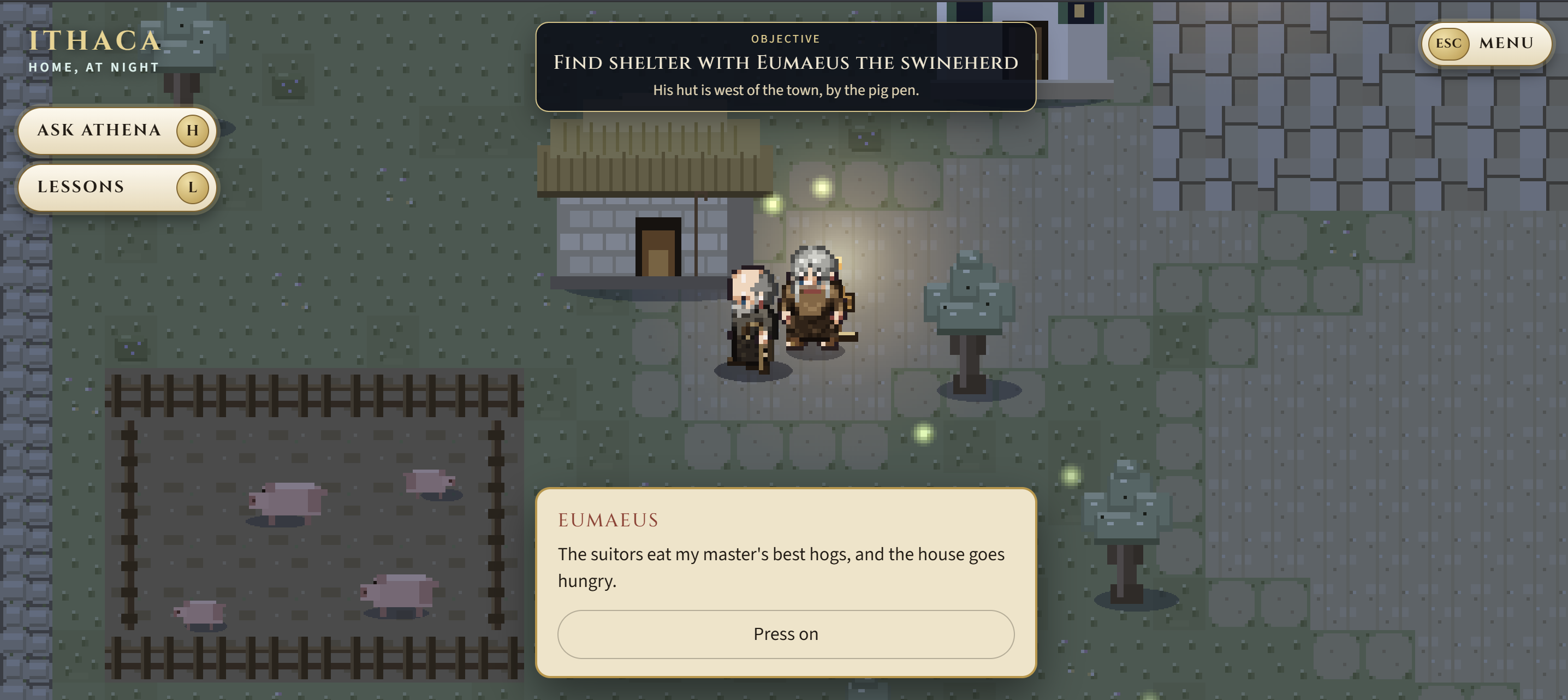
Eumaeus’s hut: Home in disguise, sheltering with Eumaeus.
-
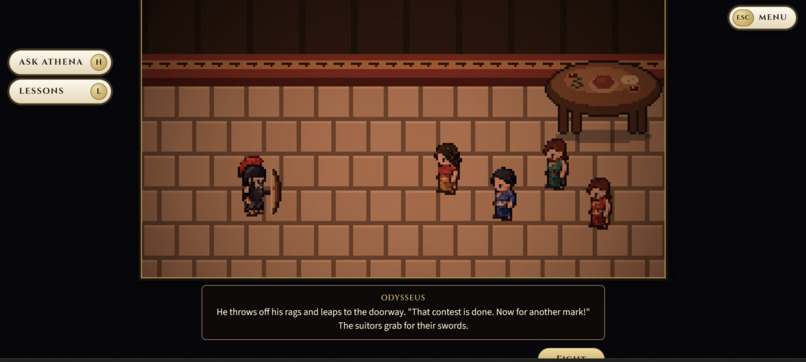
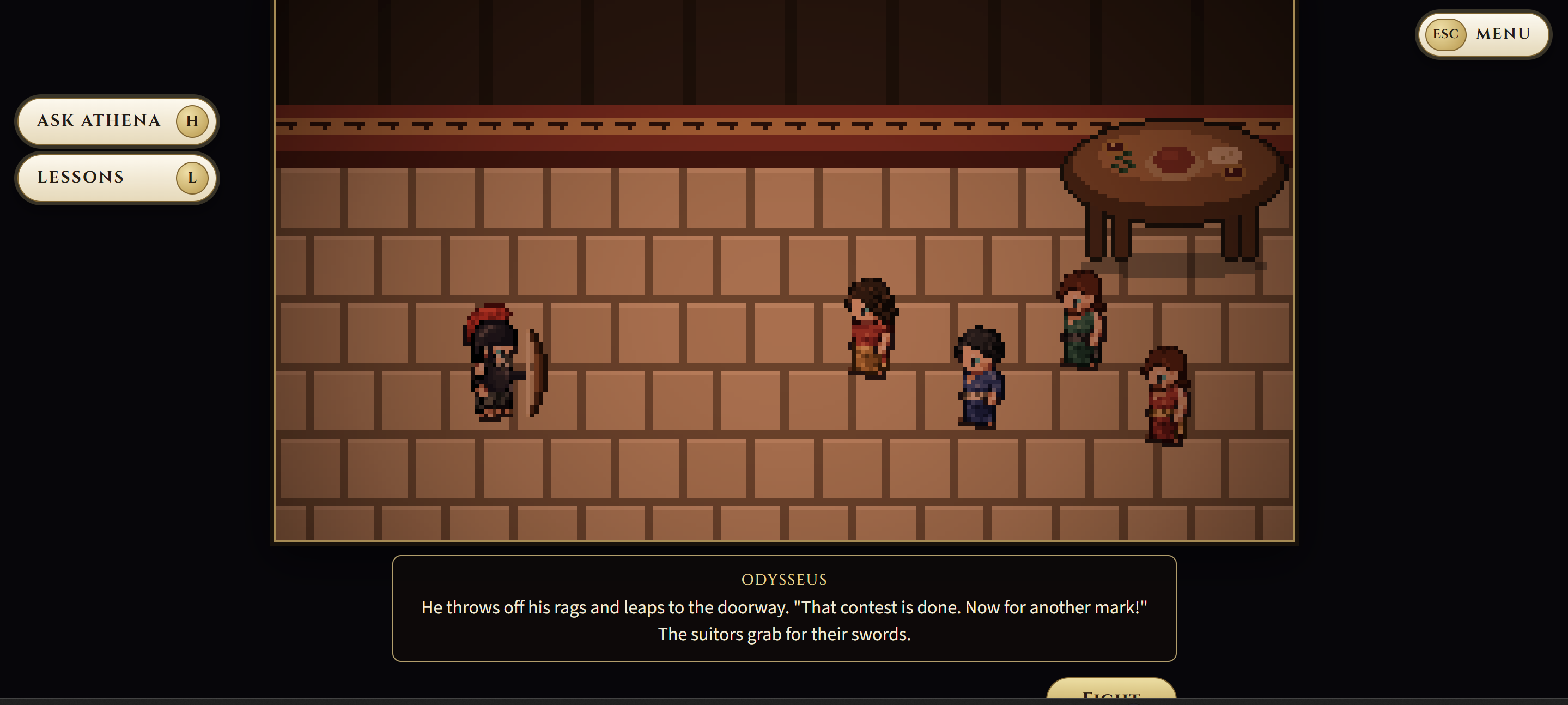
Bow and suitors: The contest is won. Now for the suitors.
-
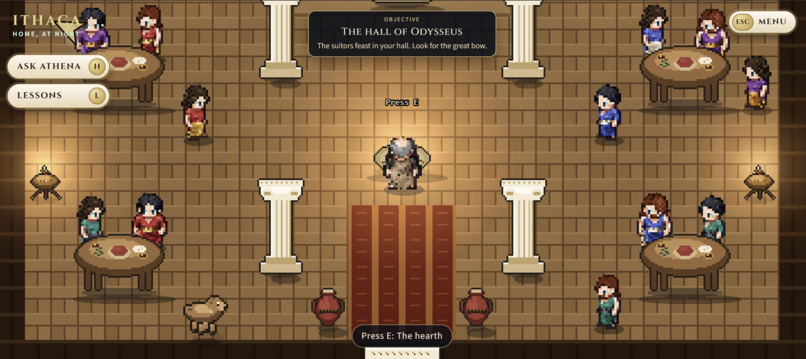
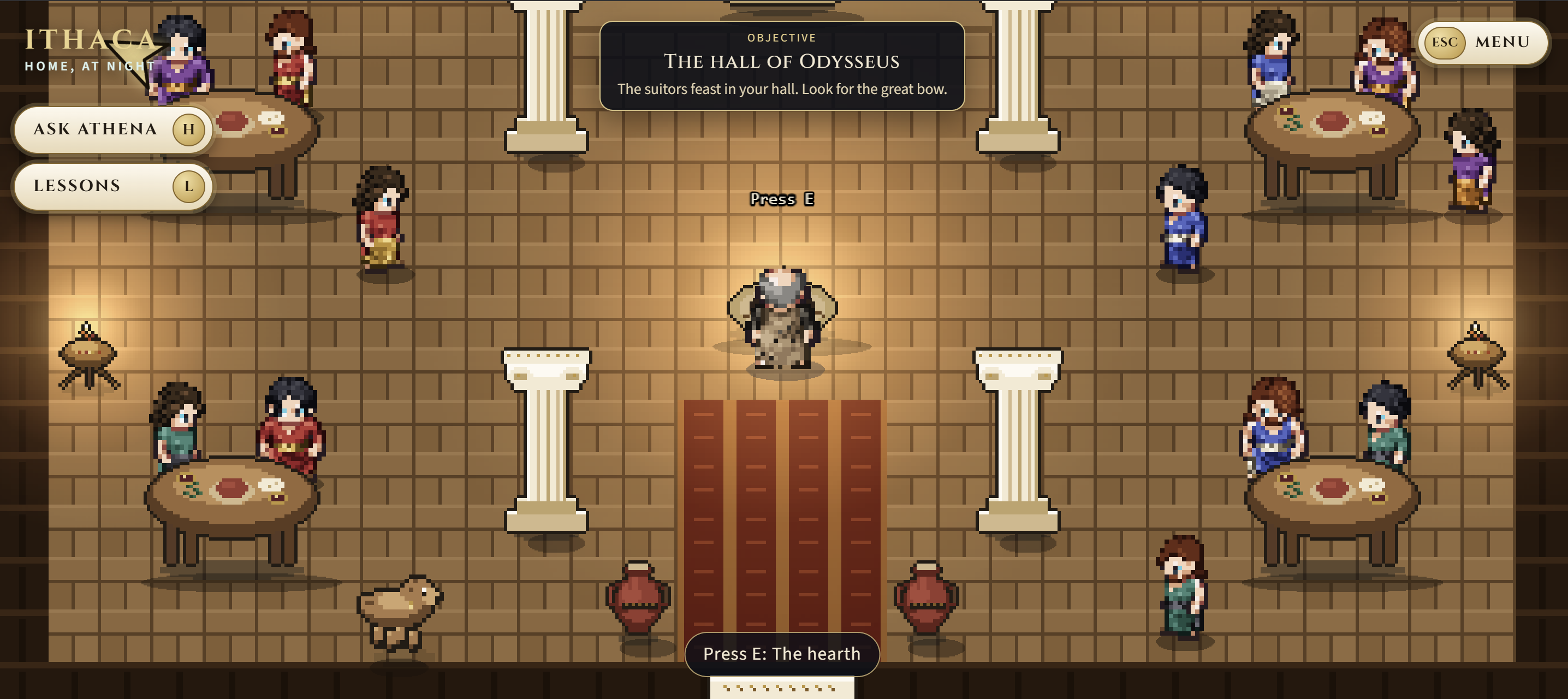
The hall: The suitors feast in your hall. Find the bow.
-
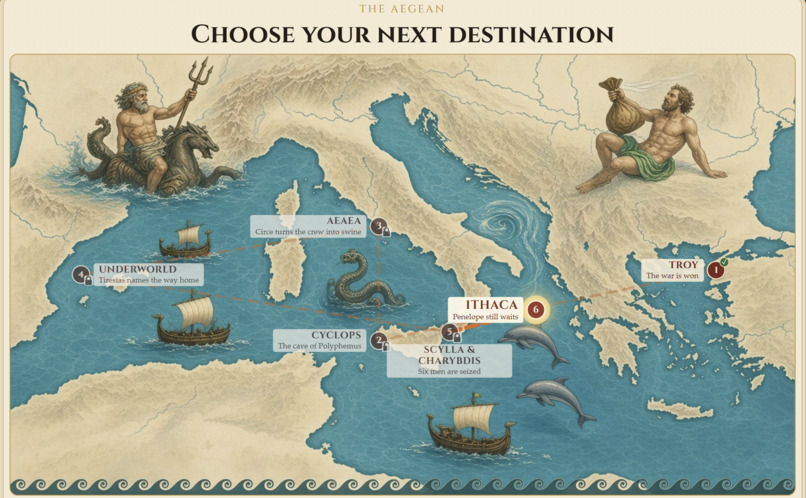
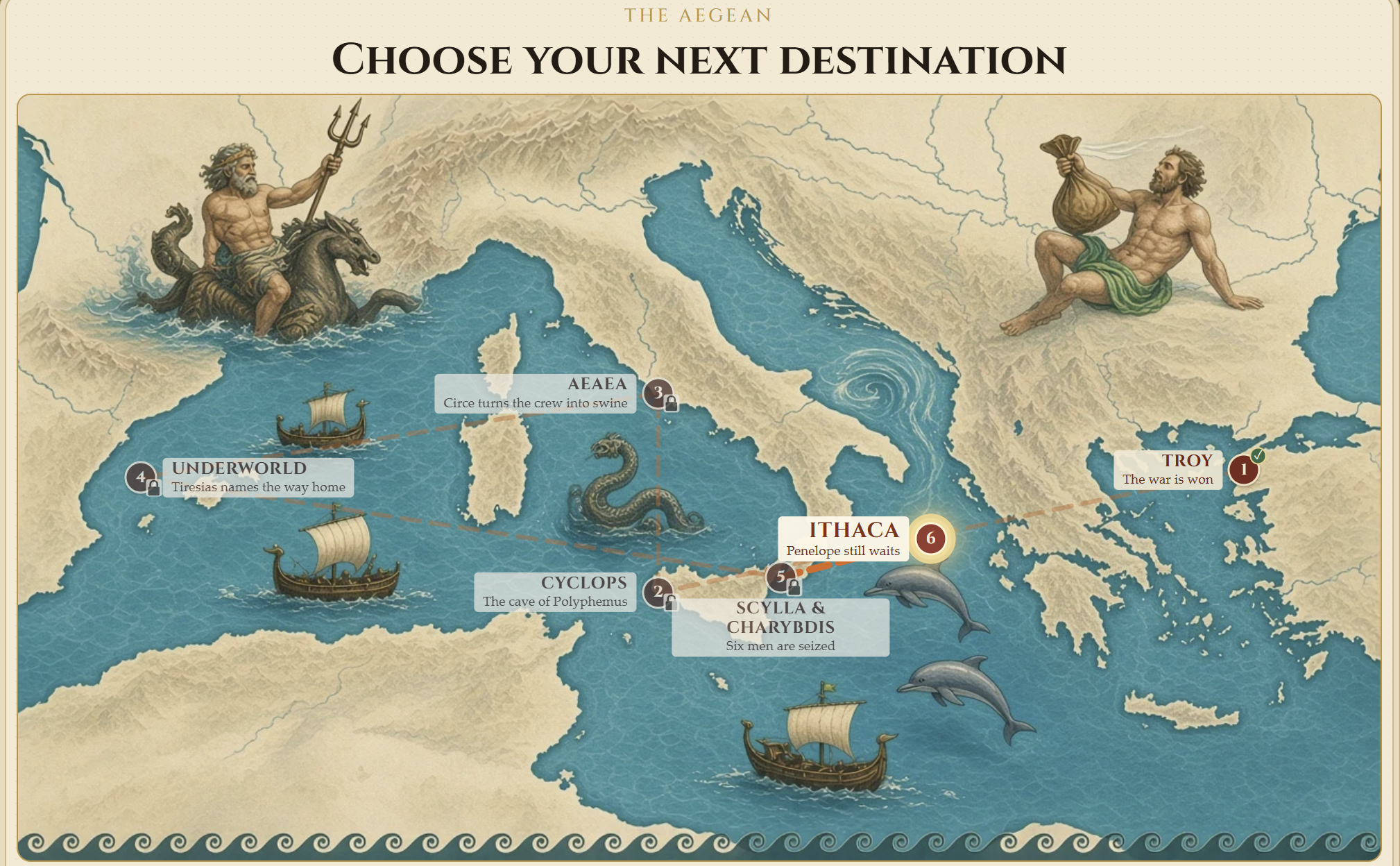
Journey map: Troy is won. Set sail for Ithaca.
Inspiration
Across STEM, students need to understand circuits, but for anyone who isn't an electrical engineering major, it's hard to get into. Circuits usually show up as V = IR on a whiteboard and a page of formulas, with nothing that makes them stick. We wanted a way to learn circuits that's actually fun.
This year's theme, Homer's Odyssey, gave us the idea: a hero who can't get home until he solves the problem in front of him. What if the problem was a circuit? So in Ohmyssey, Odysseus is stuck on the night Troy falls, and the only way home is electronics. Athena, his guide in the poem, became our tutor. She's the one character who's supposed to help you without doing it for you.
What it does
You play Odysseus through two levels that follow the poem:
- Troy: You start hidden inside the wooden horse. Answer a question to open the trap door, answer another to open the city gate, then fight three groups of Trojans in turn-based battles where every attack is a question. A Light Attack asks an easier question. A Heavy Attack asks a harder one and hits every Trojan at once.
- Ithaca: You wake on the beach, and Athena disguises you as a beggar (Book 13). You shelter with Eumaeus the swineherd, win the contest of the bow by getting three answers right in a row so the arrow flies through all twelve axes (Book 21), and fight the suitors in the hall, each named from Homer (Book 22).
Questions cover voltage, current, resistance, series and parallel circuits, LEDs, capacitors, and inductors. A typical Heavy Attack:
$$ R_{eq} = \frac{R_1 R_2}{R_1 + R_2} = \frac{(2\,\text{k}\Omega)(2\,\text{k}\Omega)}{4\,\text{k}\Omega} = 1\,\text{k}\Omega, \qquad I = \frac{V}{R_{eq}} = \frac{4\,\text{V}}{1\,\text{k}\Omega} = 4\,\text{mA} $$
Press H while you explore to ask Athena, who runs on Google Gemini. Ask her for the answer and she won't give it to you. She points at the idea instead. Press L for lessons, including a 555 timer lighthouse where you pick parts so the beacon blinks between 0.5 and 2 Hz:
$$ f \approx \frac{1.44}{(R_1 + 2R_2)\,C} $$
With R1 = 1 kΩ, R2 = 68 kΩ, and C = 10 µF, that's about one blink per second, the same as on a real breadboard.
How we built it
- React 18 + Vite for the screens: login, story cards, question cards, the journey map, and the Athena and Lessons overlays.
- Phaser 3 for the game world: walking, collisions, the horse, the burning city, Ithaca, and the battles. The Phaser scenes send events and the React screens answer them, so the game world never depends on React.
- Google Gemini (Flash-Lite) behind a Vercel serverless function. The API key never reaches the browser, requests are capped and rate-limited, and if Gemini is down, Athena answers from the lesson notes so the game keeps working.
- Exact formulas, not AI, grade every answer. Feedback is instant, and test scripts check the math, the answer keys, and that the right answer doesn't always sit in the same spot.
- Pixel art built from open-source LPC sprite layers using our own Python scripts: Odysseus, Greek and Trojan soldiers, Eumaeus, Telemachus, the beggar disguise, and twelve suitors.
- AI teammates: Jarvis (Grok Bot) helped plan, and Cursor and Claude Code agents helped build. Each agent was assigned its owner's folders, and they coordinated through one GitHub issue.
- Live at ohmyssey.tech and ohmyssey.study, both registered with GoDaddy.
Challenges we ran into
- Keeping Athena from giving answers. A helpful AI wants to give you the answer. We wrote two prompts, a strict Socratic one for puzzle hints and a warmer one for open chat, and made sure the AI never decides whether you're right. Code does.
- Making questions fair. At one point the right answer was always the first choice. We shuffle choices now, and a test checks that the right answer moves around and isn't always the smallest number.
- Pixel-art people. LPC sprites only face four directions, so the diagonals reuse the side views. Odysseus started out a head taller than everyone else, and the beggar disguise briefly had a second head.
- Walking through a city on fire. Walls, the sea, the temple, the horse, and dozens of dueling soldiers all have to block Odysseus without trapping him. We wrote a route check that makes sure he can always get from the beach to the plaza, and another that makes sure every "Press E" spot on Ithaca can be reached.
- Four people and several AI agents in one repo. Folder ownership rules and one shared message board kept us from overwriting each other.
Accomplishments that we're proud of
- Two full, playable levels that follow the actual poem, from the horse to the bow contest.
- Every door, every fight, and the bow contest are won with real electronics questions.
- An AI guide that teaches instead of answering, and a game that still works when the AI doesn't.
What we learned
- Working alongside Grok bots. Each of us paired with an AI agent, and we learned to coordinate them like teammates: each bot owned its own folders and posted updates on a shared GitHub issue, so they didn't overwrite each other's work.
- Building with Cursor. We used Cursor and its cloud agents to scaffold the app and speed up features, then reviewed and integrated what they produced.
- Vite. We learned how Vite serves and bundles a React app, and how to use its dev server to run our API routes locally, so Athena works on a laptop without exposing the API key.
- Phaser and React together. We got a Phaser game world and React screens to share one game by passing events between them.
