Inspiration
An electronics idea can be easy to describe and difficult to build. Turning “I want a button that controls a light” into a circuit board requires choosing components, understanding their connections, creating a layout, and checking the design.
We wanted the building process to also be a learning experience. Ohmni brings conversation, PCB generation, and component explanations into one workspace, helping people understand the hardware they are creating.
Our guiding idea: Build circuits. Understand why.
What it does
Ohmni helps users turn supported electronics ideas into PCB designs through conversation.
Users can begin in ASI:One by talking to our Fetch.ai agent, Ohmni PCB Guide. The agent clarifies requirements, presents a specific board proposal, and asks for explicit confirmation before starting generation.
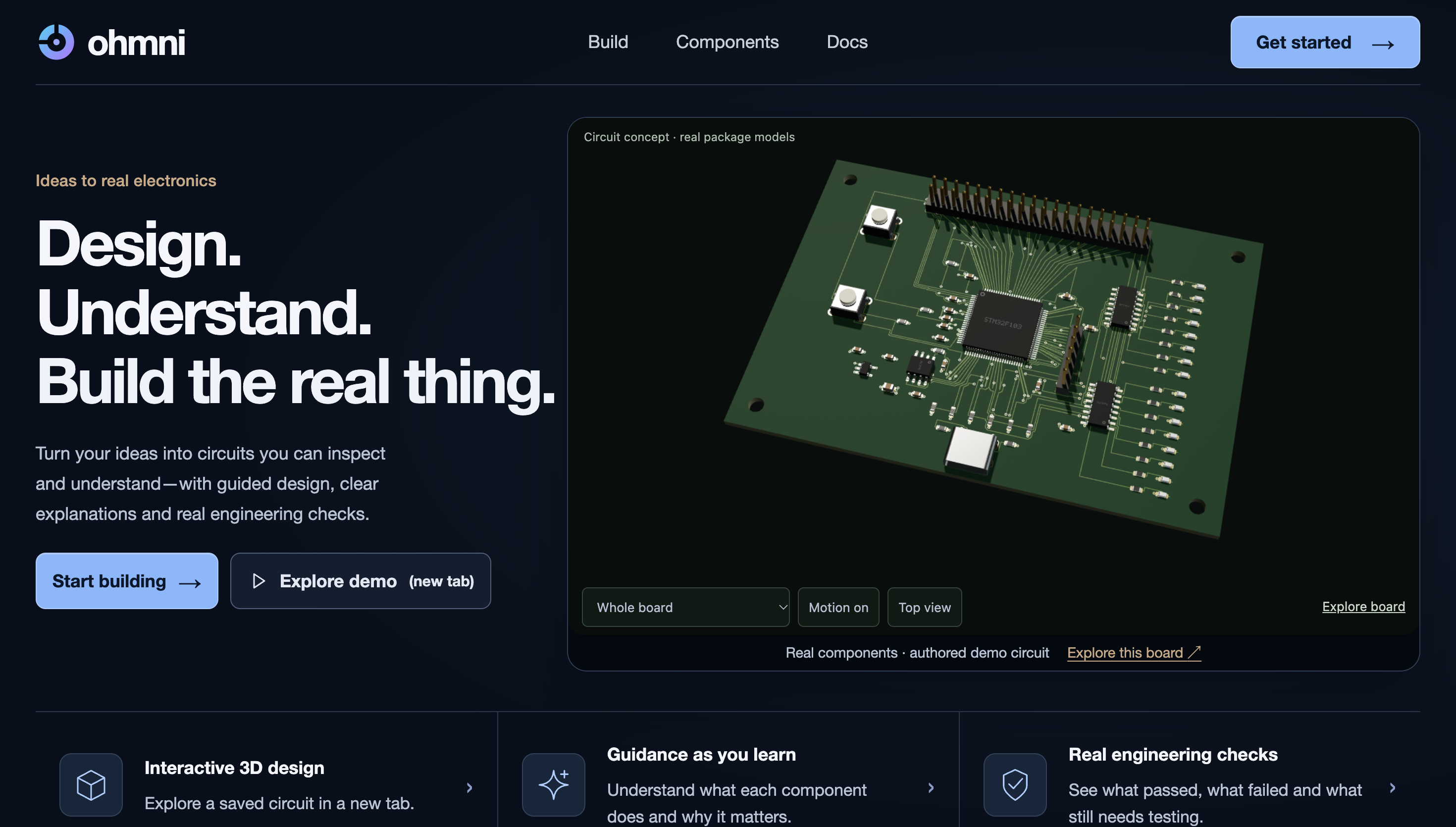
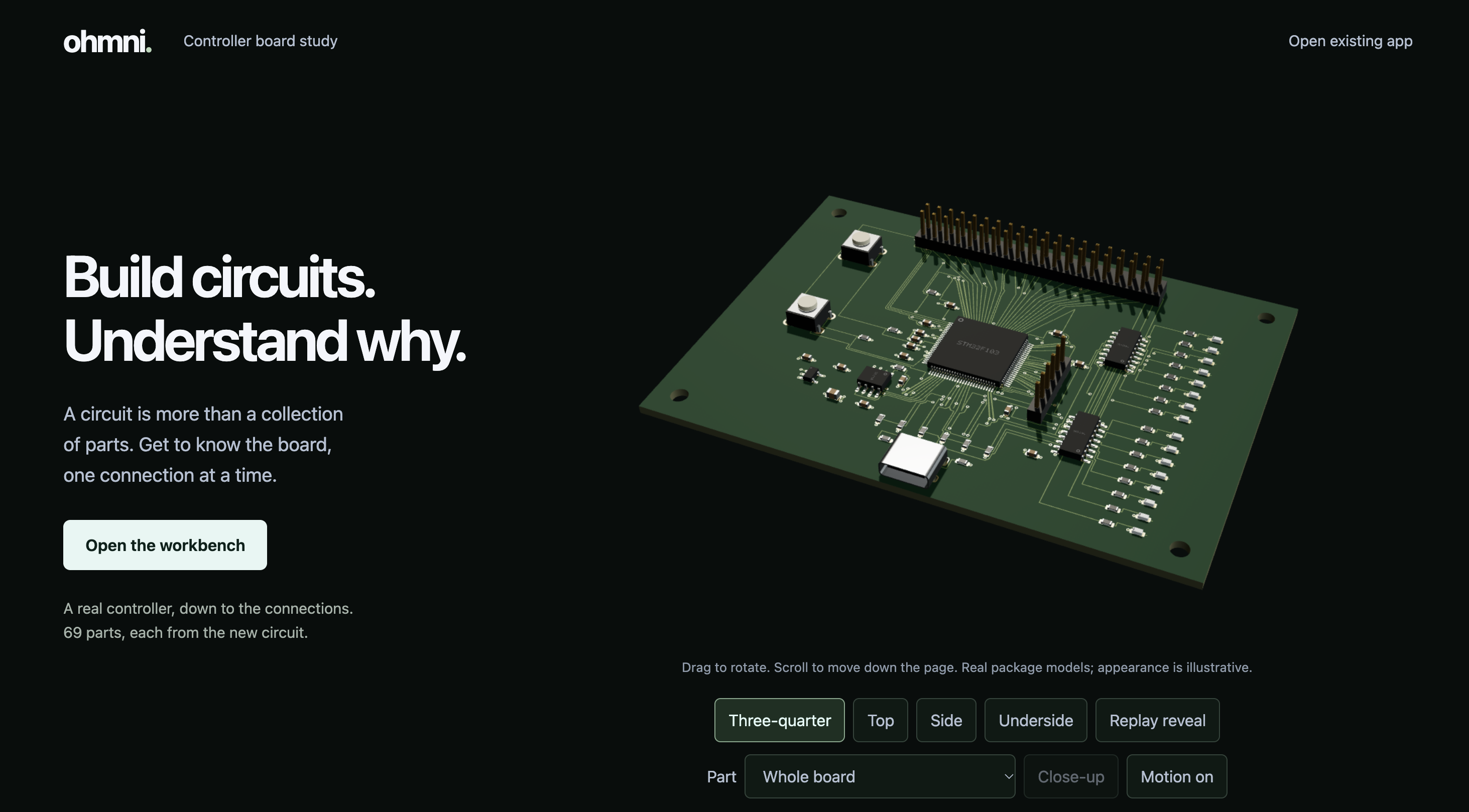
After generation, users can inspect the findings, download available design files, and open the same saved project in Ohmni’s main interface. There, they can explore the board in 3D, select components, ask questions about their roles, and request supported design changes.
Projects retain their revisions and conversations. Users can continue through Fetch chat or the Ohmni interface without manually transferring their design between them.
How we built it
We connected the existing Ohmni engineering engine to Fetch.ai using the uAgents SDK and its chat protocol. This connection routes messages from ASI:One to our backend and returns proposals, build progress, findings, and project links.
Claude, accessed through the Anthropic API, supports requirement interpretation, proposed edits, and component teaching. Ohmni’s engineering pipeline generates and checks designs using a supported component catalog, explicit design rules, and KiCad.
The web interface renders the generated board and connects component selections to a tutor that receives context from the actual project. Persistent storage keeps project revisions and conversations available across refreshes and service restarts.
Both interfaces share the same underlying project services, allowing a conversation in Fetch to continue as a visual learning and editing experience in Ohmni.
Challenges we ran into
One challenge was making conversational requests precise enough to build. A short answer such as “yes” needs the context of the question it answers. We worked on preserving that context while requiring a separate confirmation for the exact design being generated.
Another challenge was connecting chat to a complete workspace. Opening a board needed to preserve its identity, editing access, revision history, and component conversations. Changes made through either interface also needed to remain consistent.
We also had to keep engineering claims accurate. An AI explanation cannot establish that a circuit is electrically correct, and passing software checks cannot establish that a physical board works. Ohmni keeps failed checks, unsupported requests, and unknowns visible.
Accomplishments that we're proud of
- Connecting an ASI:One conversation to actual PCB generation and downloadable design files.
- Opening that same saved project in the main Ohmni 3D workspace.
- Supporting component teaching, persistent conversations, and revision-based editing.
- Testing browser interactions, saved projects, engineering checks, and artifact downloads.
- Keeping design evidence and limitations attached to generated results.
- Extending the project toward voice recording with microphone and microSD components, firmware, and digital simulation.
What we learned
A useful AI hardware tool needs clear boundaries between conversation, saved requirements, engineering checks, and physical evidence. Each part of the system needs a defined responsibility, and users need to understand what has actually been verified.
We also learned that teaching becomes more useful when it refers to the learner’s own board. Selecting a component and asking why it is connected that way makes the design itself part of the lesson.
Finally, a complete experience depends on continuity. Saved conversations, consistent revisions, and reliable transitions between chat and the visual workspace matter as much as generating the first board.
What's next for Ohmni
We want to expand the supported component library and project families while maintaining the same requirements for generation, visualization, teaching, editing, and verification.
Our voice-recorder expansion adds microphone and microSD support, firmware, and digital simulation. The next step for validating that hardware is physical prototype testing, including audio quality, power behavior, component fit, and recording reliability.
We also want to improve the learning experience with clearer explanations of signal paths, component choices, and design tradeoffs.
Generated designs remain subject to human engineering review and physical validation as we work toward making electronics more approachable and understandable.


Log in or sign up for Devpost to join the conversation.