-
-
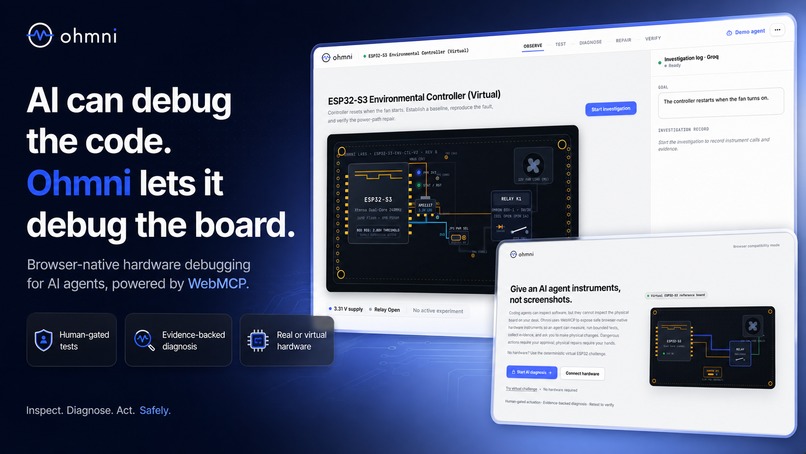
the landing page
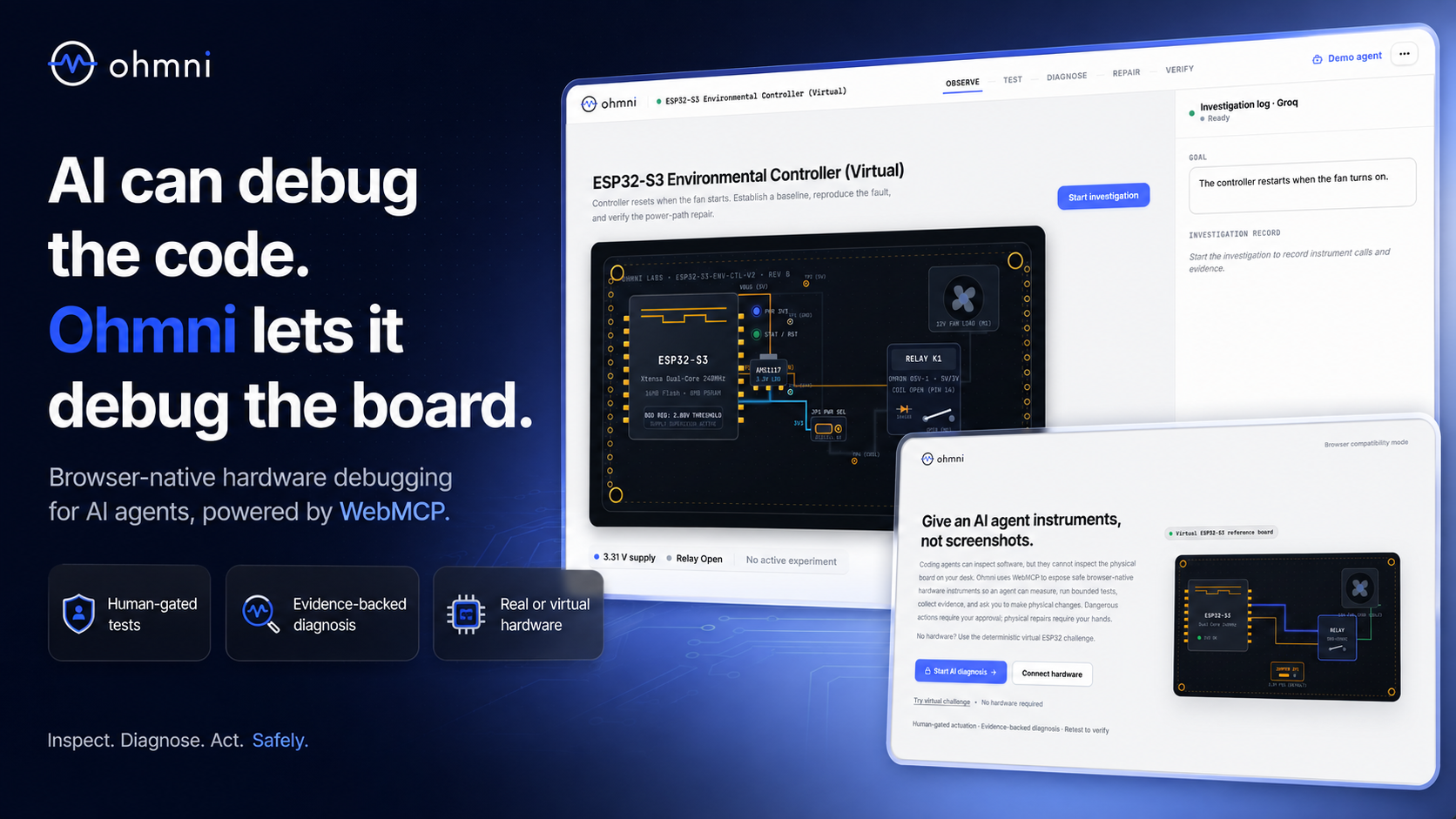
Inspiration
I’m learning robotics, and one of the most frustrating parts has been getting an AI to understand what is actually happening on the board in front of me. I was constantly taking screenshots, copying serial logs, and pasting telemetry into ChatGPT just to explain the physical world.
The WebMCP Challenge gave me a different idea what if the browser itself could become the bridge between the agent and the hardware?
Ohmni came from that. Using WebMCP and Web Serial, the agent can inspect the board through real tools in real time and you see the result of your action in front of you instead of relying on screenshots and copied logs.
What it does
Ohmni is a browser based hardware debugging workbench where AI agents and humans diagnose physical device problems together.
Using WebMCP, Ohmni exposes hardware capabilities as structured tools an agent can call directly. The agent can inspect reset history, measure supply voltage, read telemetry, run controlled diagnostic tests, collect evidence, and build a diagnosis from real measurements instead of guessing from screenshots or pasted logs.
For safety, read only tools can run autonomously, while actions that can affect hardware require explicit human approval. When a physical change is needed, such as moving a jumper or reseating a connection, the agent hands that step back to the human and then retests the device to verify whether the fix actually worked.
Ohmni also supports real hardware through Web Serial apis , alongside a deterministic virtual ESP32 environment that lets anyone experience the full diagnostic workflow without needing a physical board.
How we built it
We built Ohmni with React, TypeScript, Vite, and Bun, using WebMCP as the core interface between the AI agent and the hardware workbench.
Device capabilities are exposed through document.modelContext as structured tools. Read-only tools can run directly, while actions that may affect hardware pass through a human approval gate before execution. A device adapter handles both the deterministic virtual ESP32 environment and real hardware over Web Serial.
Telemetry is streamed into the browser in real time, and each diagnostic action produces evidence that the agent can use to form, test, and verify hypotheses. We also added dynamic tool registration, capability filtering, safe disconnect handling, and an evidence trail so the system stays useful, inspectable, and safe throughout the debugging process.
Challenges I ran into
The hardest part was making agent access to hardware useful without making it unsafe.
Some tools only read data, while others can actually change device state, so I had to design a clear safety boundary and pause physical actions for human approval.
Another challenge was making the diagnosis trustworthy. The agent should not simply guess the fault, so Ohmni hides the underlying problem, exposes only measurements and test results, and requires the diagnosis to be built from evidence.
Accomplishments that I am proud of
I built a full debugging loop instead of just a WebMCP demo, An agent can inspect the device, run controlled tests, collect evidence, form a diagnosis, ask the human to make a physical change, and then rerun the test to verify the fix.
And the diagnosis is not just a chat response. Ohmni keeps an evidence trail so every conclusion can be traced back to actual measurements and test results.
What i learned
i learned that giving an AI access to hardware is not just about exposing more tools. The real challenge is deciding what the agent can do autonomously, what requires human approval, and how every conclusion can be grounded in evidence.
WebMCP made that separation much clearer. It let us treat the browser as a trusted bridge between the agent and local hardware, while keeping the human in control of physical actions.
I also learned that the strongest agent workflows are collaborative: the agent measures and reasons, the browser enforces safety, and the human handles the physical world.
What's next for Ohmni
I want to grow Ohmni into a broader hardware debugging tool that works across more boards and devices.
The next step is expanding the Web Serial layer so more microcontrollers can connect over USB, expose their own diagnostic capabilities, and use the same WebMCP workflow for measurement, testing, human intervention, and verification.
Built With
- bun
- gpt
- react
- typescript
- vercel
- vite
- webmcp

Log in or sign up for Devpost to join the conversation.