-
-
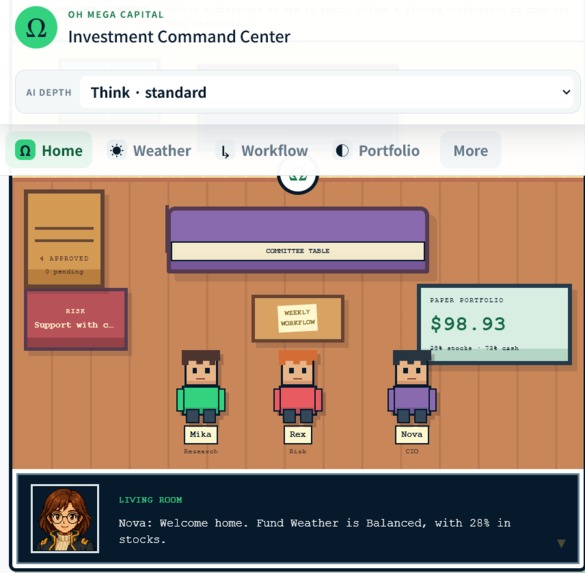
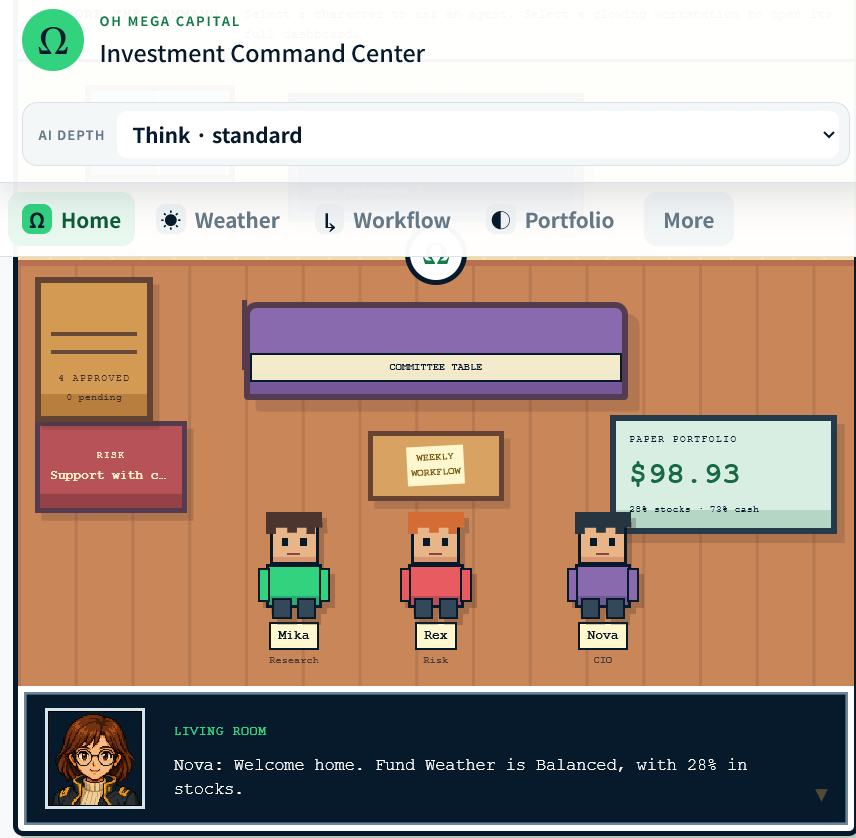
Screen shot of Oh Mega Capital
Inspiration
OH MEGA FUND began as a father-and-son science project. We wanted to explore a simple question: can artificial intelligence help an investment fund capture the growth of technology stocks while protecting capital during difficult markets? We chose technology and AI-related stocks in the United States and China/Hong Kong. These markets offer strong growth potential, but they also face risks from interest rates, regulation, currency movements, geopolitics, and market volatility. Our goal was to create an absolute-return investment process that combines real market data, AI research, independent risk oversight, and Human approval.
What it does
Inspiration OH MEGA FUND began as a father-and-son science project. We wanted to explore a simple question: can artificial intelligence help an investment fund capture the growth of technology stocks while protecting capital during difficult markets? We chose technology and AI-related stocks in the United States and China/Hong Kong. These markets offer strong growth potential, but they also face risks from interest rates, regulation, currency movements, geopolitics, and market volatility. Our goal was to create an absolute-return investment process that combines real market data, AI research, independent risk oversight, and Human approval. What it does OH MEGA FUND is a simulated AI investment committee and paper portfolio. It uses real stock data and current web research to estimate next-week return probabilities for US and China/Hong Kong technology stocks. The fund operates in three modes: Attach: 75% stocks and 25% cash Balanced: 50% stocks and 50% cash Lockdown: 100% cash Three AI agents work together: The Decision Agent analyzes prices, market signals, and current information. The Risk Agent independently challenges the investment recommendation. The CEO Agent judges the evidence and proposes the final allocation. The Human user approves or rejects each portfolio recommendation. The system also: Measures momentum, volatility, drawdown, relative strength, and liquidity Converts Hong Kong investments into US-dollar returns Searches for current market evidence and provides clickable citations Produces stock-level probabilities and expected returns Enforces cash floors and position limits Tracks paper holdings, transactions, NAV, and decision history Reviews portfolio performance and prediction accuracy Runs an automated weekly investment committee OH MEGA FUND is a research and simulation system. It does not connect to a broker or execute real trades.
How we built it
We started with a Python backtest using historical market data. The backtest compared a dynamically allocated fund with a fully invested technology-stock portfolio. It included US and Asian securities, defensive allocations, currency conversion, and performance analysis. We later made two major design decisions. First, we selected cash as the fund’s defensive asset. Cash made the downside-protection mechanism clearer and easier to control. Second, we replaced a continuous allocation dial with three operating modes. This made the fund’s positioning easier to explain, monitor, and govern. We then built the live application using: Python and market-data APIs for investment research and testing TypeScript for the investment engine and hard portfolio controls OpenRouter for the AI agents Web search for current news and macroeconomic evidence A persistent database for predictions, decisions, approvals, and portfolio history A responsive web interface for the investment command center Docker for portable deployment A weekly scheduler for automated committee reviews The current interface has three main areas: Today: current fund posture and the next required action Ask: live questions for the AI committee Portfolio: holdings, risk conclusions, and decision history
Challenges we ran into
One major challenge was obtaining dependable market data from multiple regions. US and Hong Kong securities use different currencies, trading calendars, ticker formats, and market conventions. We had to convert Hong Kong prices into US dollars and handle missing or delayed data carefully. Another challenge was making AI output consistent enough for an investment workflow. Each agent needed to return structured probabilities, expected returns, risks, catalysts, confidence levels, and sources. We also needed to prevent the AI from bypassing portfolio controls. Position caps, cash requirements, approved-security rules, and stale-data freezes are therefore enforced by software. Automation introduced another challenge. Weekly committee runs needed to avoid duplicate decisions and repeated portfolio changes. We created a forecast-week identifier so each weekly rebalance is processed only once. The interface became complicated as we added more features. We repeatedly simplified the design until the user could quickly understand: What is happening What needs attention What to tap next Why the committee reached its recommendation
Accomplishments that we're proud of
We are proud that OH MEGA FUND developed from a small backtesting experiment into a functioning AI investment committee. Our main accomplishments include: Building a real multi-agent investment workflow Combining quantitative signals with current web research Giving the Risk Agent an independent role Requiring Human approval for portfolio changes Enforcing portfolio controls directly in code Supporting US and China/Hong Kong technology investments Creating next-week probabilistic forecasts Recording evidence, recommendations, objections, and approvals Automating the weekly committee process Deploying the application in Docker and on a public server Simplifying a complex investment system into three main screens We are especially proud that the project combines financial thinking, software engineering, AI experimentation, risk management, and a father-and-son learning experience.
What we learned
We learned that an investment prediction needs more than a directional answer. It also needs a probability, an expected return, a confidence level, supporting evidence, and a clear record of what could go wrong. We learned that independent risk review is essential. The Risk Agent adds value by challenging concentration, weak sources, stale data, high turnover, and excessive confidence. We also learned that important controls should be enforced by software. AI recommendations can change, while cash floors, position limits, and approval requirements must remain consistent. Another important lesson was that interface simplicity matters. Adding more tools can increase the user’s workload. A useful command center should highlight one next action and keep supporting detail easy to access. Most importantly, we learned how different skills can work together in one project: Mathematics Finance Artificial intelligence Programming Research Risk management Product design Communication Teamwork
What's next for OH MEGA FUND
he next stage is to run the paper fund continuously and evaluate its decisions over a longer period. We plan to: Improve the calibration of next-week probabilities Compare forecasts with actual market outcomes Measure prediction hit rate and Brier score Study which signals improve returns Reduce unnecessary portfolio turnover Improve regional and security-level risk attribution Add clearer performance charts Expand the approved AI technology universe Strengthen market-data reliability Improve source-quality scoring Test more downside-protection rules Let the Risk Agent propose controlled monthly experiments Produce automatic weekly and monthly investment reports
Built With
- finance
- fund

Log in or sign up for Devpost to join the conversation.