-
-
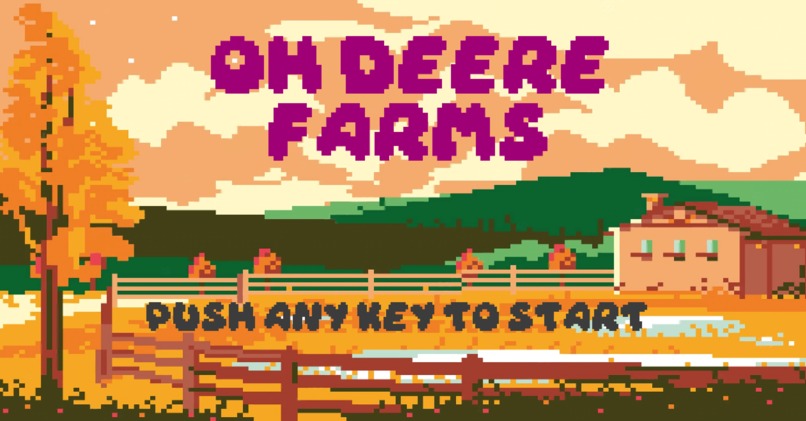
Start page
-
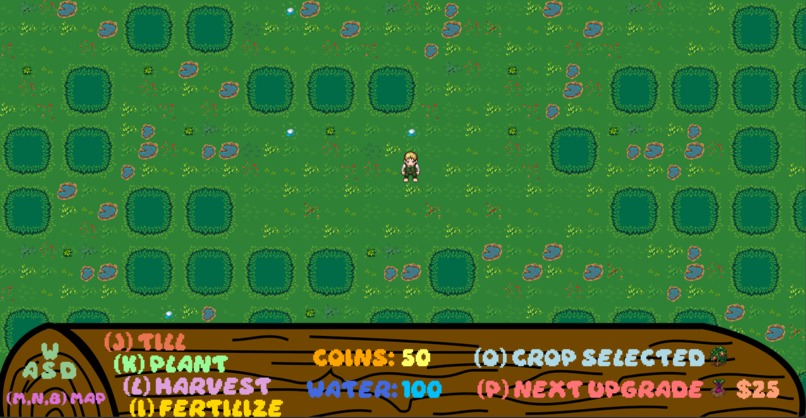
Gameplay interface
-
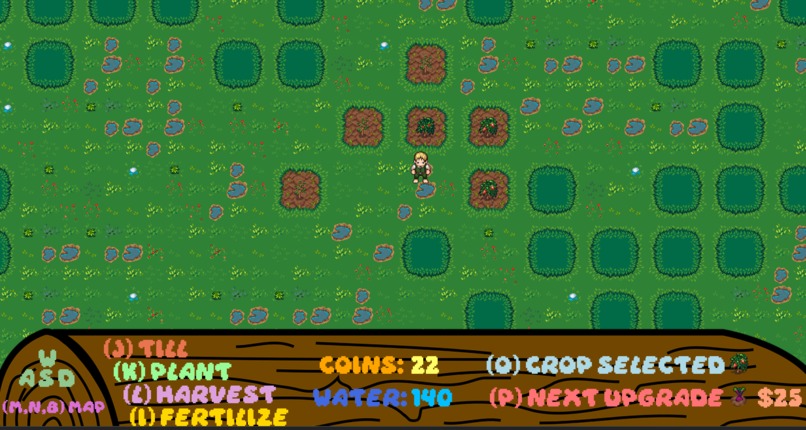
Growing crops


Inspiration
We were inspired to create Oh Deere Farms after seeing the John Deere challenge and wanting to create a fun, unique, and creative design for an innovative farming-simulator-esque game. Specifically, our tile mapping system was based on John Deere’s equivalent maps generated from real world data and modeled by a pin worn by one of their representatives.
What it does
Upon launch, our game procedurally generates a map that the player is able to navigate and farm via planting, fertilizing, and harvesting. Planted crops will automatically grow and develop in the background, even if the user is not nearby. The player’s goal is to reach 1000 coins by growing and farming different plants and using the profits to unlock new plants. With this, there are countless strategies to play through each game and, with the map ever-changing, each playthrough will be different than the last. In addition to coins, the player also has to keep in mind their water usage, as water is a crucial resource to allocate planting.
Additionally, we implemented 3 different soil-measurement maps to show various integral climate impacts of farming: tillage count, usage of the same crop, and fertilizer consumption. These 3 maps can be displayed using the B, N, and M keys and can be accessed at any time to show the abundant impacts of crop growth.
How we built it
Our game was built in 100% Python utilizing the PyGame package. Royalty-free sprites, music, sound effects, and art were retrieved from a variety of sources, including https://opengameart.org/ and https://bigsoundbank.com/.
Challenges we ran into
Challenges were inevitable for the development of this project. One major issue was rendering the tiles in frame. While it took several attempts, we ultimately brainstormed and designed an appropriate algorithm: keep the player in the middle of the map and move the background around them. Furthermore, the stress of a hackathon was a persistent obstacle, intensifying as the deadline approached. We, as a team, pulled an all-nighter to put the finishing touches on Oh Deere Farms. In total, the work time was about 25 hours over 2 days.
Accomplishments that we're proud of
We are proud of the amount of coding, game design, and overall participation in the limited that we were given. This has been the first ever hackathon that everyone on the team has participated in, and we are all very proud of each other for being able to face the adversity and challenges given and then overcame. Seeing our hard work, team synergy, and planning come to fruition to create a functional and enjoyable game was nothing short of amazing.
What we learned
First, we learned how to better work as a team. We resolved a lot of git merge conflicts and figured out how to best approach a problem. Additionally, we learned a lot about implementing PyGame, which we had never used before.
What's next for Oh Deere Farms and Team Timmy
In the future, we would like to make the rain amount be based on a variety of aspects, including, but not limited to, soil quality to teach users to care for the land impacts of crop grow and the ability for a sustainable future. Additionally, we would like to add more biomes that can impact the rain, crop types, and growth speed of different crops. This will ensure the app is more realistic and relatable to more people in different areas of the world; and require the users to be more adaptable to their strategies within the game.
In the future, Team Timmy plans to participate in more hackathons!
P.S. Fun fact: our team's name is Team Timmy as a reference to TIMMI, our game's UI rendering system. TIMMI stands for Totally Intended Modifiable Menu Interface.

Log in or sign up for Devpost to join the conversation.