-
Offside Desk: two sources, or one rumour said twice?
-
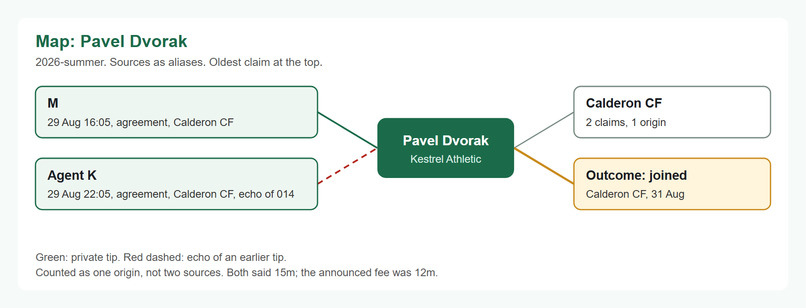
Output: two tips with nearly the same words, counted as one origin (expected result)
-
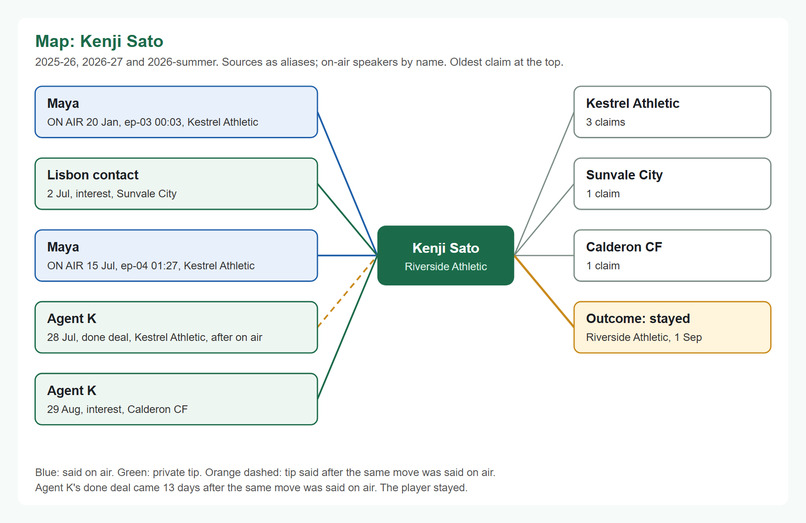
Output: podcast statements and private tips in one claim map (expected result)
-
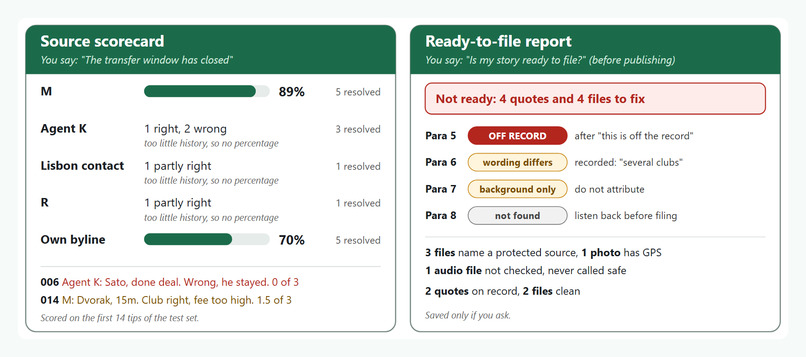
Output: source scorecard and ready-to-file report (expected result)
-
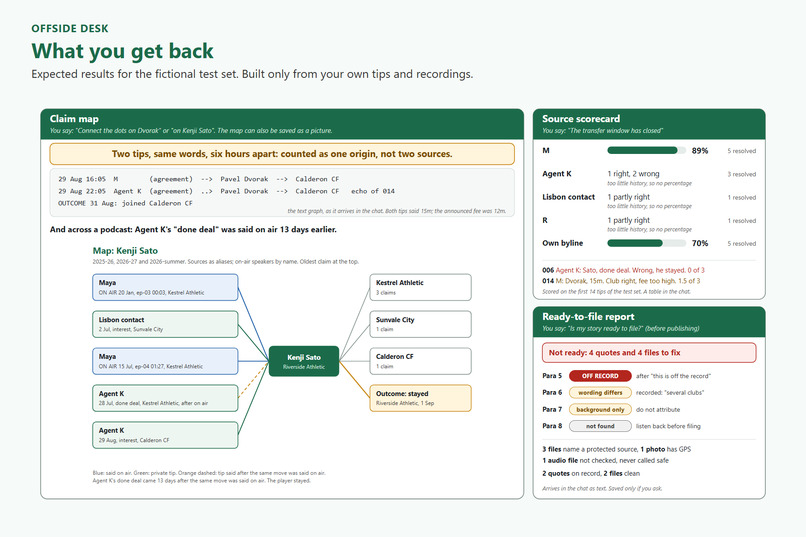
All three outputs on one page (expected results, fictional test data)
-
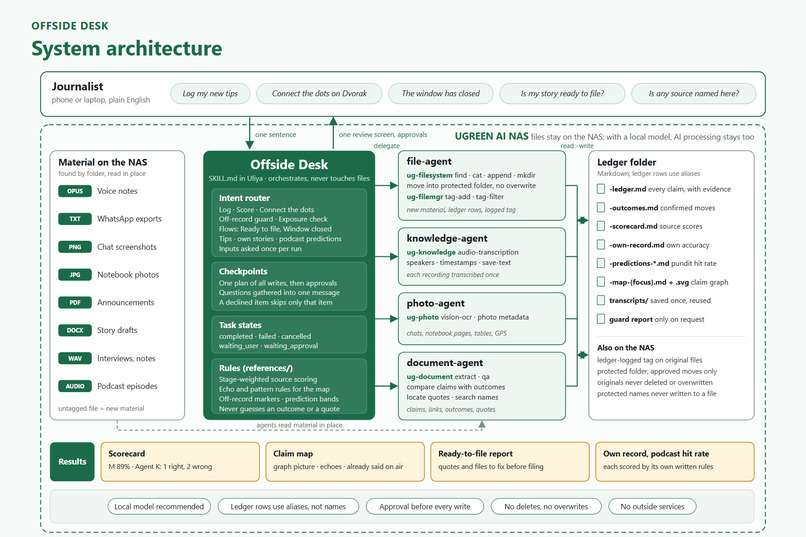
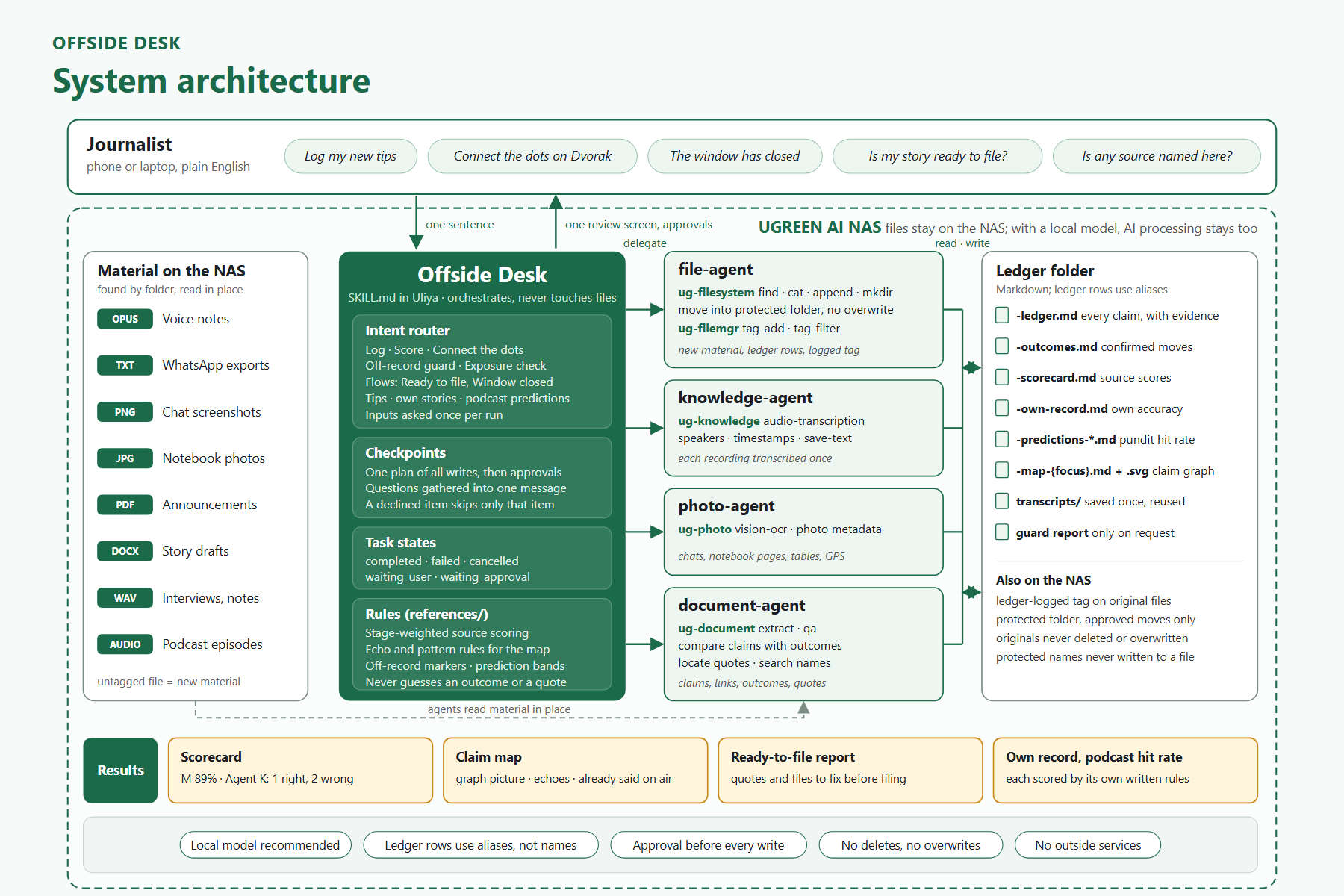
System architecture: Offside Desk orchestrates four Uliya agents through NAS CLIs; files stay on the NAS
-
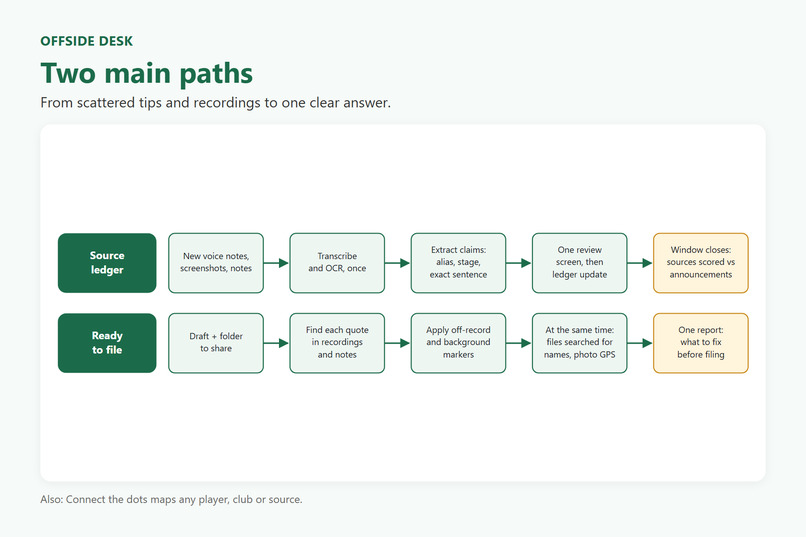
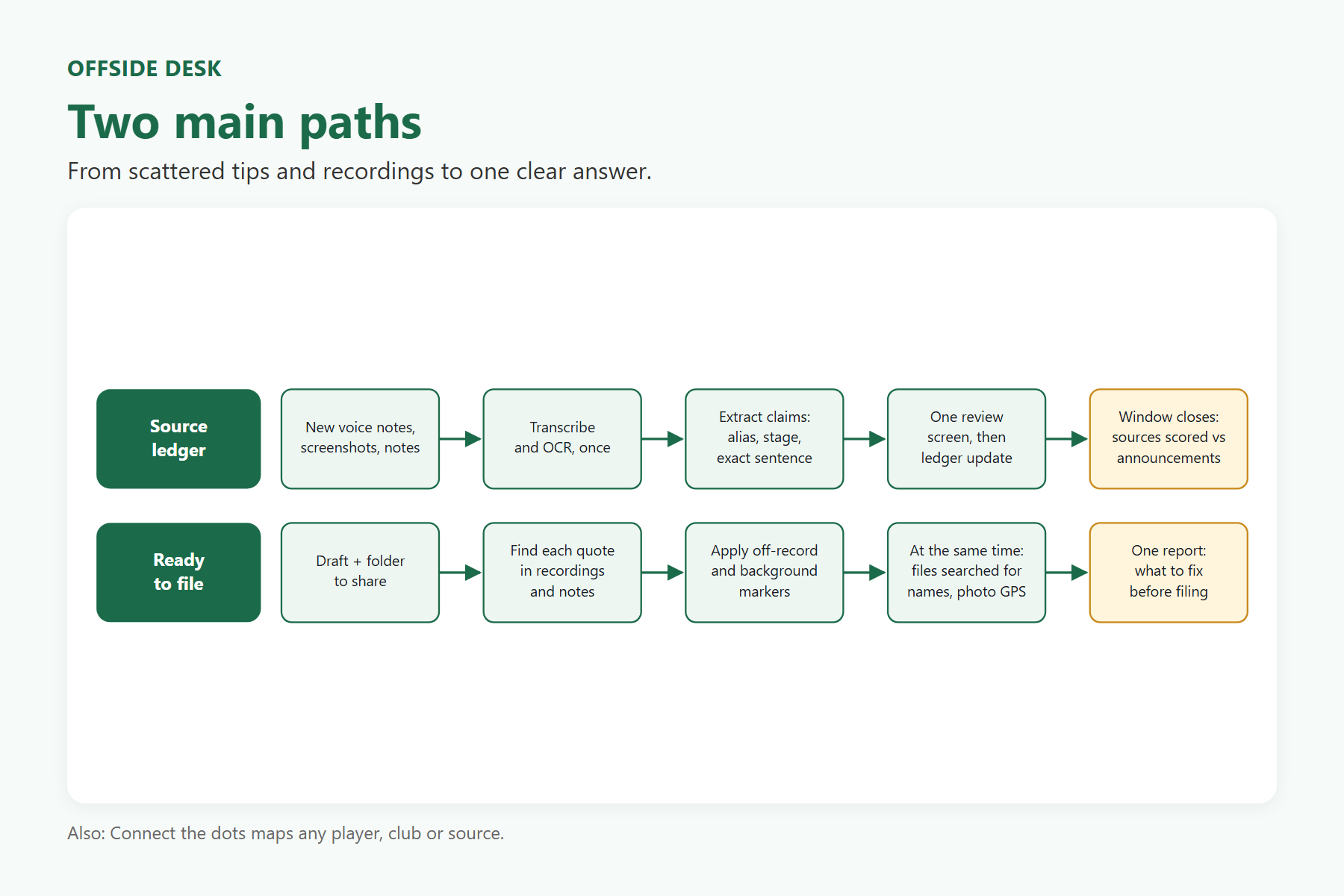
Two main paths: from scattered tips to one clear answer
Inspiration
Three nights before the transfer window shuts, 22:05. A football agent texts a reporter: "Dvorak joins Calderon, agreed." Six hours earlier, another source sent almost the same words. Are those two confirmations, or one rumour passed around?
To answer that, a football journalist has to remember who said what, and when.
I'm a football fan who watches a lot of football podcasts and shows. Claims fly around, and there's no easy way to check later who said what or who was right. I think journalists and podcasters could use that.
Keeping track of tips is slow, manual work.
- Tips arrive all day as WhatsApp messages, voice notes and screenshots.
- To check one, you scroll through old chats and listen to recordings again. A single podcast episode can run two hours.
- To know who was right last time, you'd have to keep a spreadsheet up to date by hand.
Under deadline, that work is easy to skip. Then the record lives only in the reporter's head. That is how a bad source can fool someone twice, and how a quote said off the record can slip into print. A University of Mainz study of German press reports from 2010 to 2013 found that nearly a third of Bundesliga transfer claims turned out wrong.
Offside Desk does the keeping track for them.
It is built for a NAS with a local model because this material is private. Much of it was said off the record, so it shouldn't be pasted into a cloud AI.
Football is a good place to start. The transfer window closes on a fixed date, so most tips end up checkably right or wrong. The off-record check and the exposure check already work for any reporter. Only the scoring is football-specific.
What it does
Offside Desk is a private evidence desk for football journalists, built as a Skill for UGREEN AI NAS. Its job is to connect the dots that sit scattered across chats, voice notes and notebooks.
- Log. It reads new voice memos, chat screenshots, notebook photos and notes, pulls out every transfer claim, and adds it to a ledger with the source alias, the stage (interest, talks, done deal) and the exact sentence it came from. The journalist confirms each row first. The material gets to the NAS the usual ways: phone photo backup for screenshots, a chat export for messages and voice notes.
- Score. After the window it compares the ledger with official announcements saved on the NAS and gives each source a record: a weighted score once there are five resolved claims, plain counts before that. A "done deal" that never happened costs more than a vague "interest".
- Connect the dots. It maps every claim about a player, club or source over time: who said it first, who contradicted it, how it ended. It catches echoes, when two sources send the same rumour in nearly the same words within two days, and counts them as one origin, not two confirmations. It also flags patterns worth asking about, like a source whose tips keep naming the same club. A new tip arrives with its source's record next to it.
- Off-record guard. It checks every quote in a draft against the saved interview transcript and notes, and flags anything said after "this is off the record", anything worded differently, and anything it can't find.
Exposure check. Before a folder is shared, it finds files that name a protected source or carry a photo's GPS location, and moves them aside only if the journalist approves each one.
Podcast memory. It logs what was said on a podcast or show, with the speaker and the minute. Those on-air claims go into the same map as the private tips. So when a "private" tip arrives two weeks after the same move was said on air, the map shows it was already public.
The map arrives in the chat as a text graph. When asked, it is also saved as a map file and as a graph picture that opens in any browser.
The same engine also scores the journalist's own published stories and the predictions made on air, each against what really happened.
What you get back
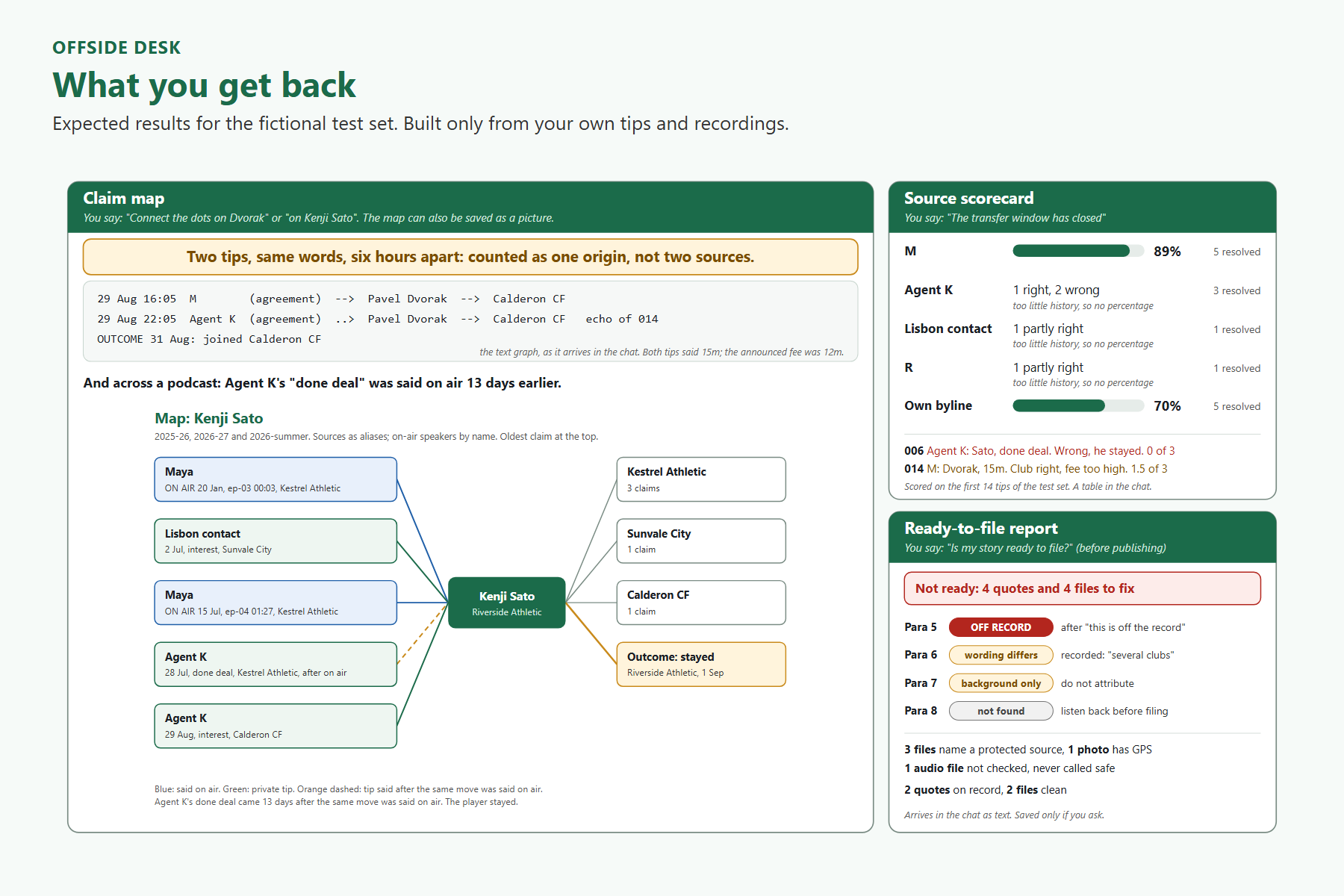
Every picture below is the expected result for the fictional test set.
"Connect the dots on Dvorak"
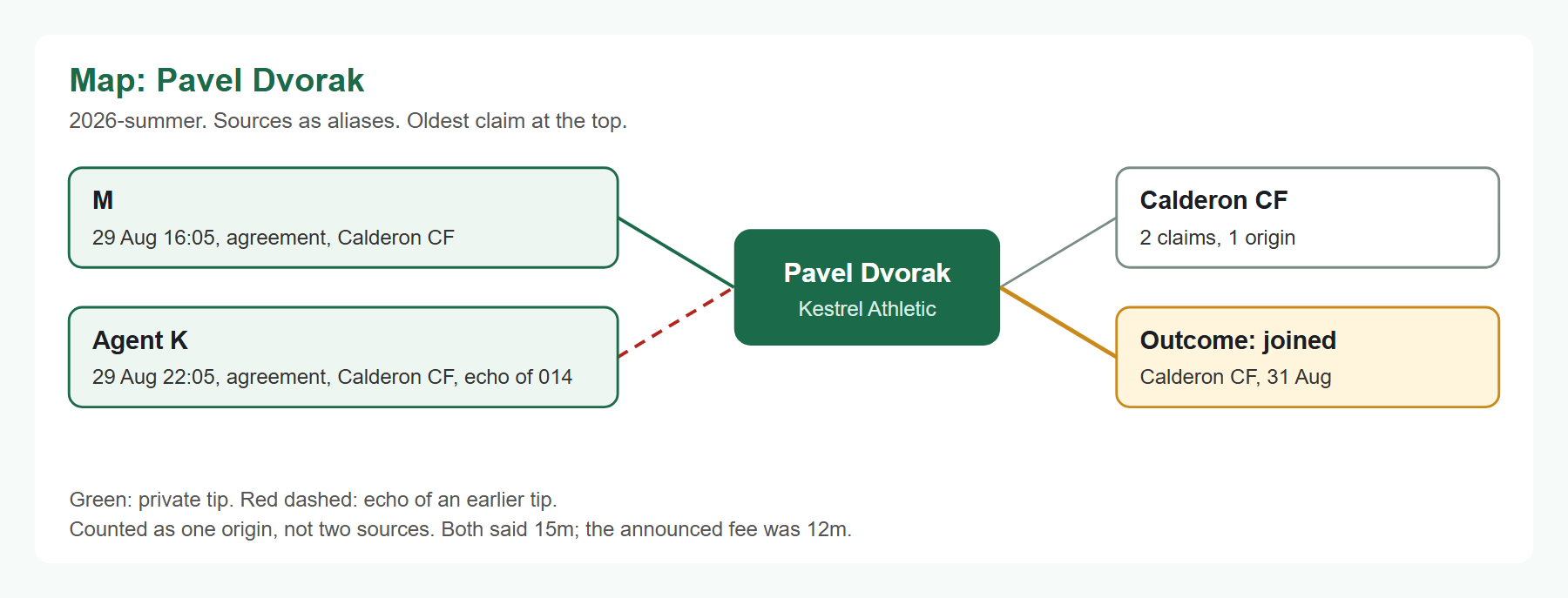
Two tips, same words, six hours apart. They are counted as one origin, not two sources. Both said 15 million; the announced fee was 12 million.
"Connect the dots on Kenji Sato"
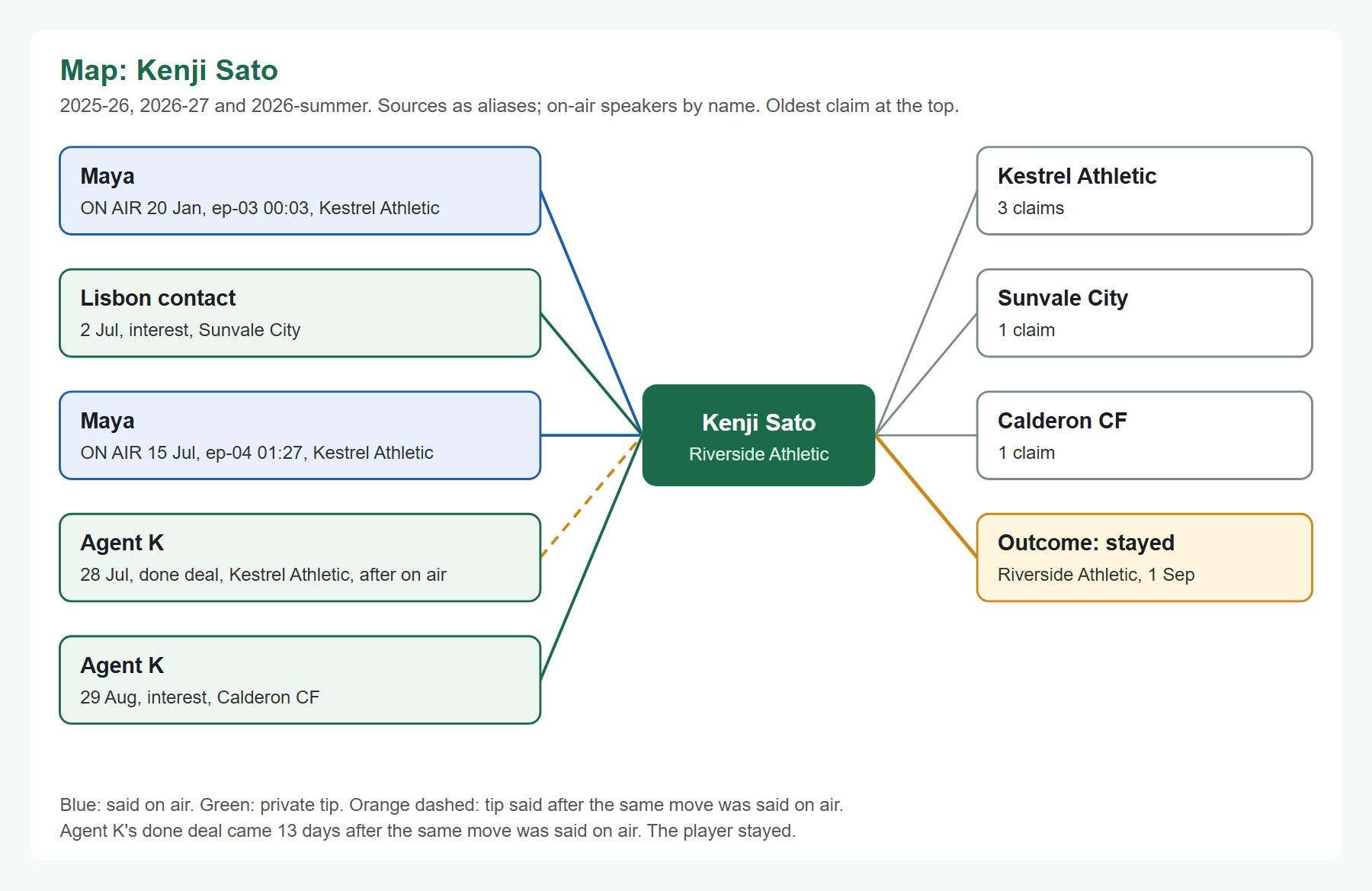
Agent K's "done deal" arrived 13 days after the same move was said on a podcast. The map arrives in the chat as a text graph and, when asked, is saved on the NAS as a picture.
"The transfer window has closed" and "Is my story ready to file?"
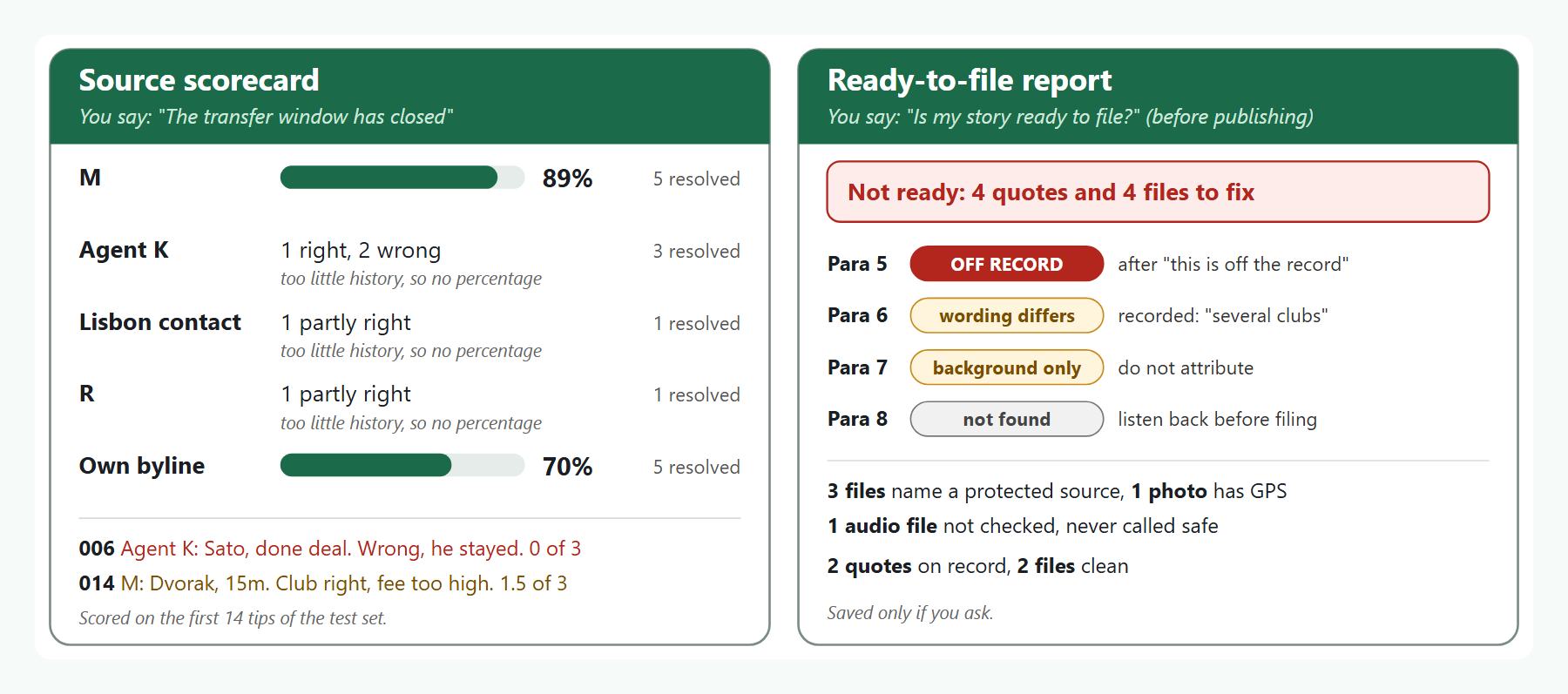
Among the sources, only M has enough history for a percentage. The draft has four quotes and four files to fix before filing. The scorecard arrives in the chat as a table and the report as text; they are drawn here for clarity.
Two shortcuts
Two flows do the repetitive work in one go:
- "Is my story ready to file?" runs the off-record guard and the exposure check together and returns one report: which quotes and which files to fix first.
- "The window has closed, score everything." reads the announcements once and scores every source and the journalist's own stories.
Before, that meant re-listening to the interview for every quote, scrolling back through chats, keeping a spreadsheet of tips and matching each one to the official announcement by hand. Now it is one sentence, the folders named once, one review screen, and then the approvals in a row.
How I built it
The Skill is plain Markdown that follows the Uliya Skill Development Standard: one SKILL.md and seven reference files for the formats, the rules, the graph template, setup and tests. It runs entirely on Uliya's built-in agents, so there is nothing extra to install. The parent Skill only delegates, to four of them. file-agent finds files, appends ledger rows and adds tags. knowledge-agent transcribes audio with speakers. photo-agent reads screenshots and photos. document-agent extracts claims and compares them with outcomes.
Scoring follows fixed rules in a reference file, not the model's opinion. Every write needs the user's approval, and nothing is deleted or overwritten. Ledger rows use aliases, not names; saved transcripts stay word for word.
I used Claude Code as a coding and writing assistant throughout: brainstorming, research, drafting the Skill files, the proposal and this page, building the fictional test data, and review passes. I set the direction and the scope, picked the name from suggested options, and reviewed the text. Every AI tool used is listed in the disclosures file inside the Skill.
Challenges
- Copying files to a NAS can reset their dates, so the Skill keeps "which files to read" apart from "when was this said".
- A local model has less capacity than a cloud one, so the Skill never makes it do the same work twice: each recording is transcribed once, saved, and reused.
- Scoring had traps. A source who says "talks" and later "done deal" should count once, and a claim made after the official announcement shouldn't count at all.
What I learned
Most of the work was deciding what the Skill must refuse to do. It must not guess an outcome, must not call a quote "on record" when it couldn't find it, and must not call a file safe when it couldn't read it.
Limits
- The ledger is as sensitive as the chats and recordings it is built from. It should live in an encrypted folder, and the journalist decides how long to keep it.
- Recording laws differ by country. The Skill never records anything, and the off-record check also works from the journalist's own written notes.
- "Already said on air" only knows the podcasts saved on the NAS. It has no web access.
Test data
Every club, player, source and journalist in the test set is made up. It has 48 files: voice memos, chat screenshots, two WhatsApp exports, articles, four podcast episodes, an interview and a draft, each with an answer key.
Built With
- markdown
- ugos
- ugreen
- uliya
