-
-
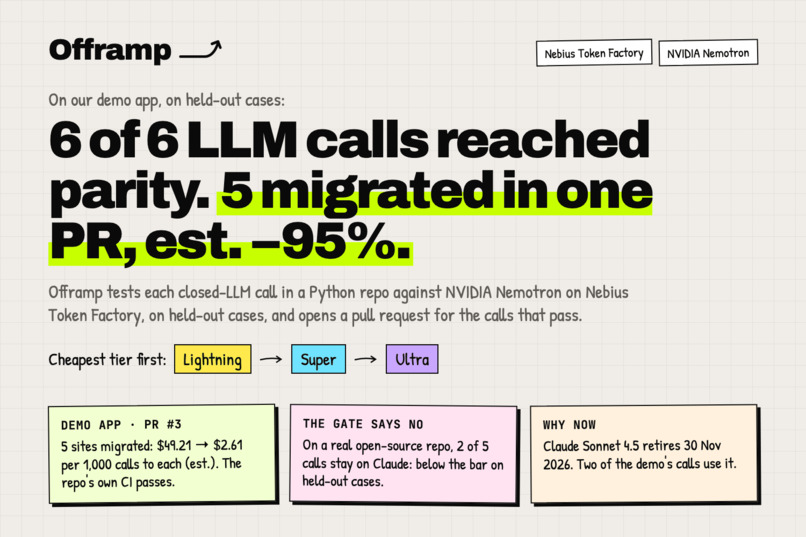
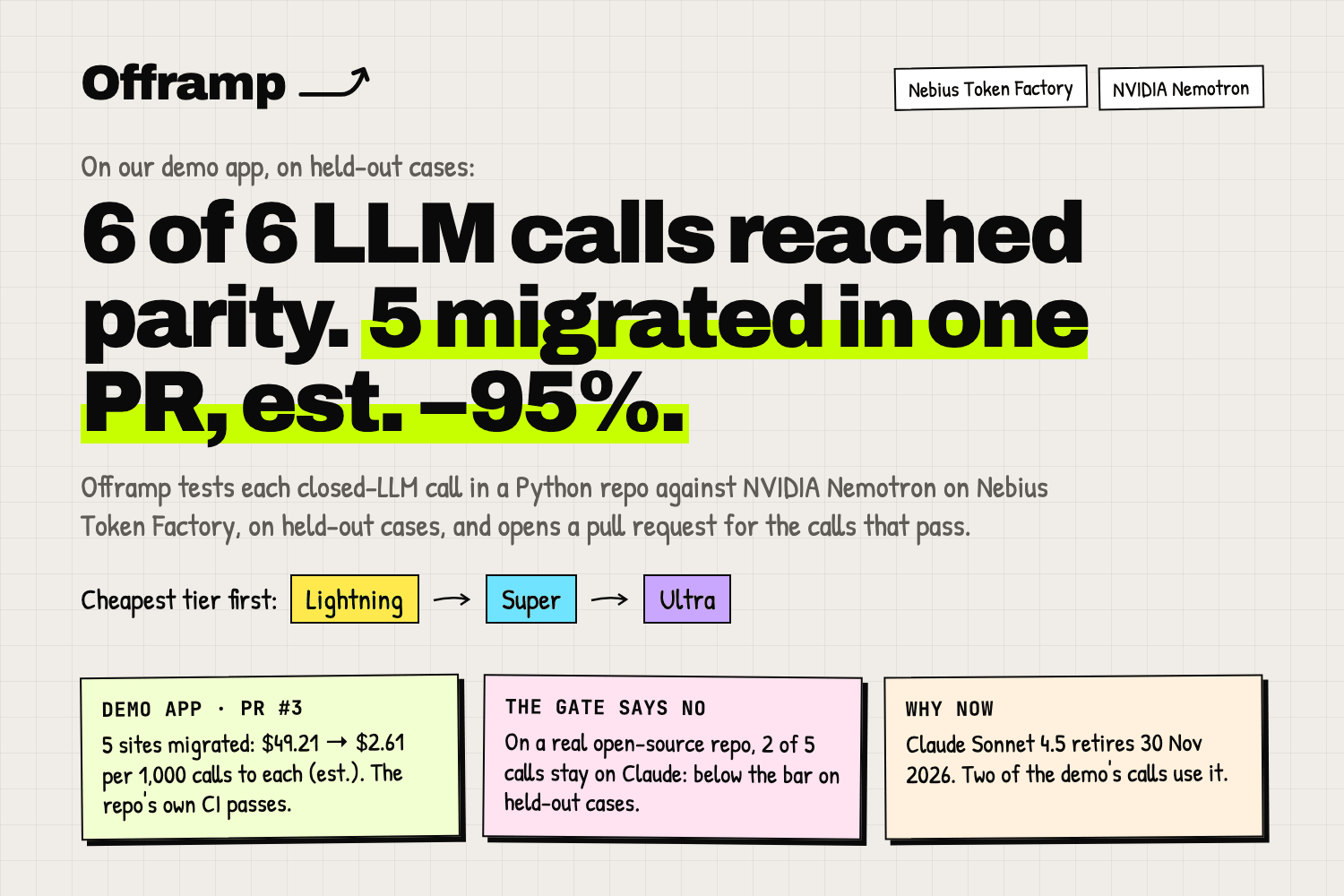
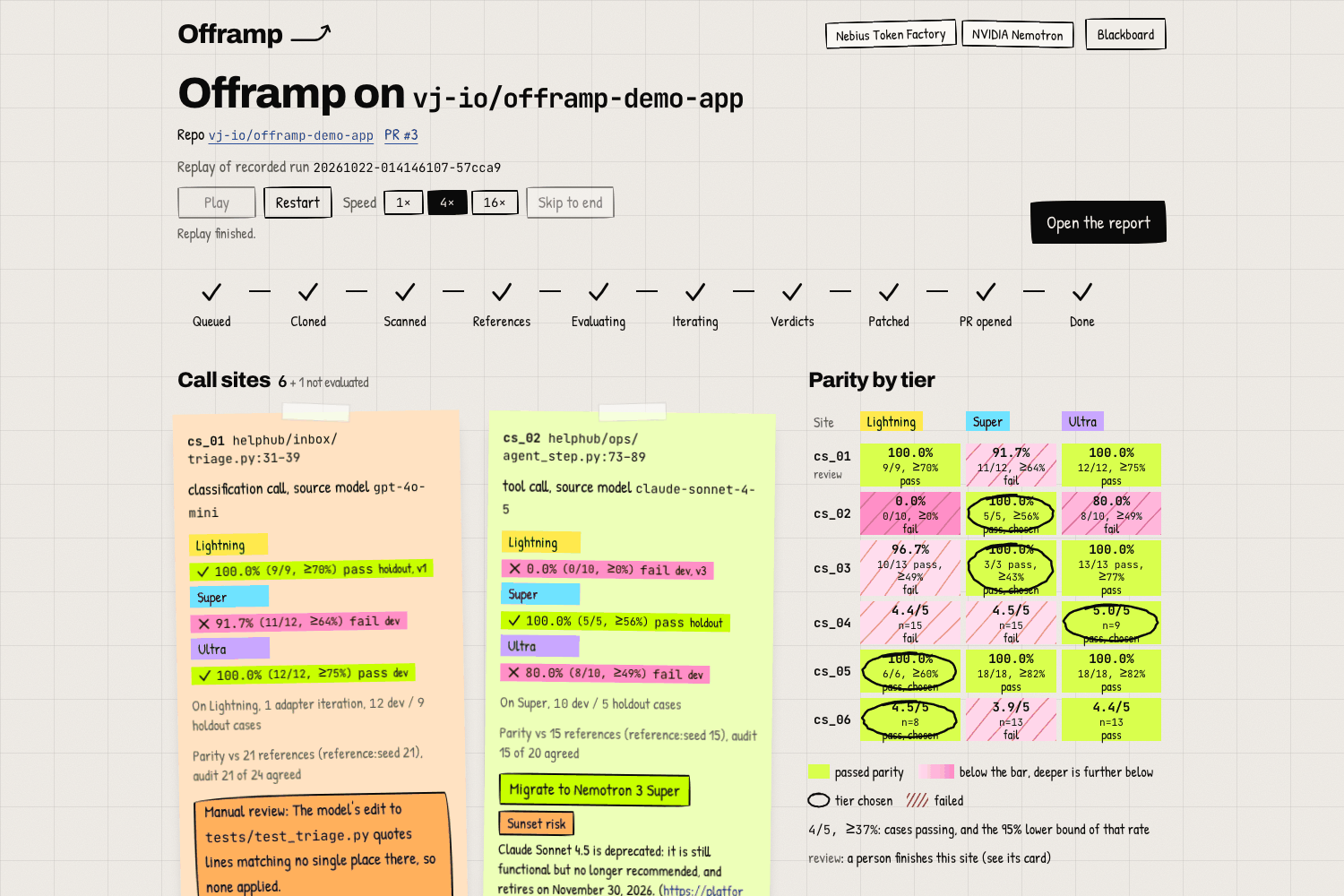
Our demo app: 6 of 6 LLM calls reached parity on held-out cases; 5 migrated to Nemotron in one PR, est. −95% on those 5.
-
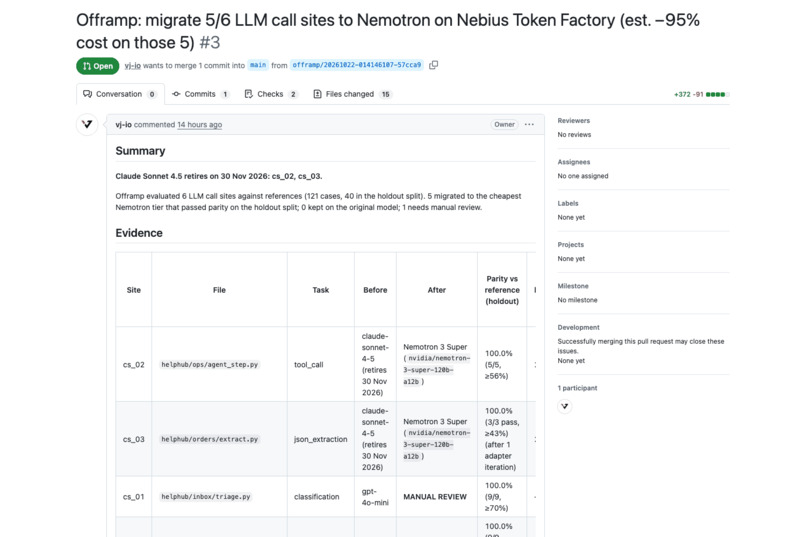
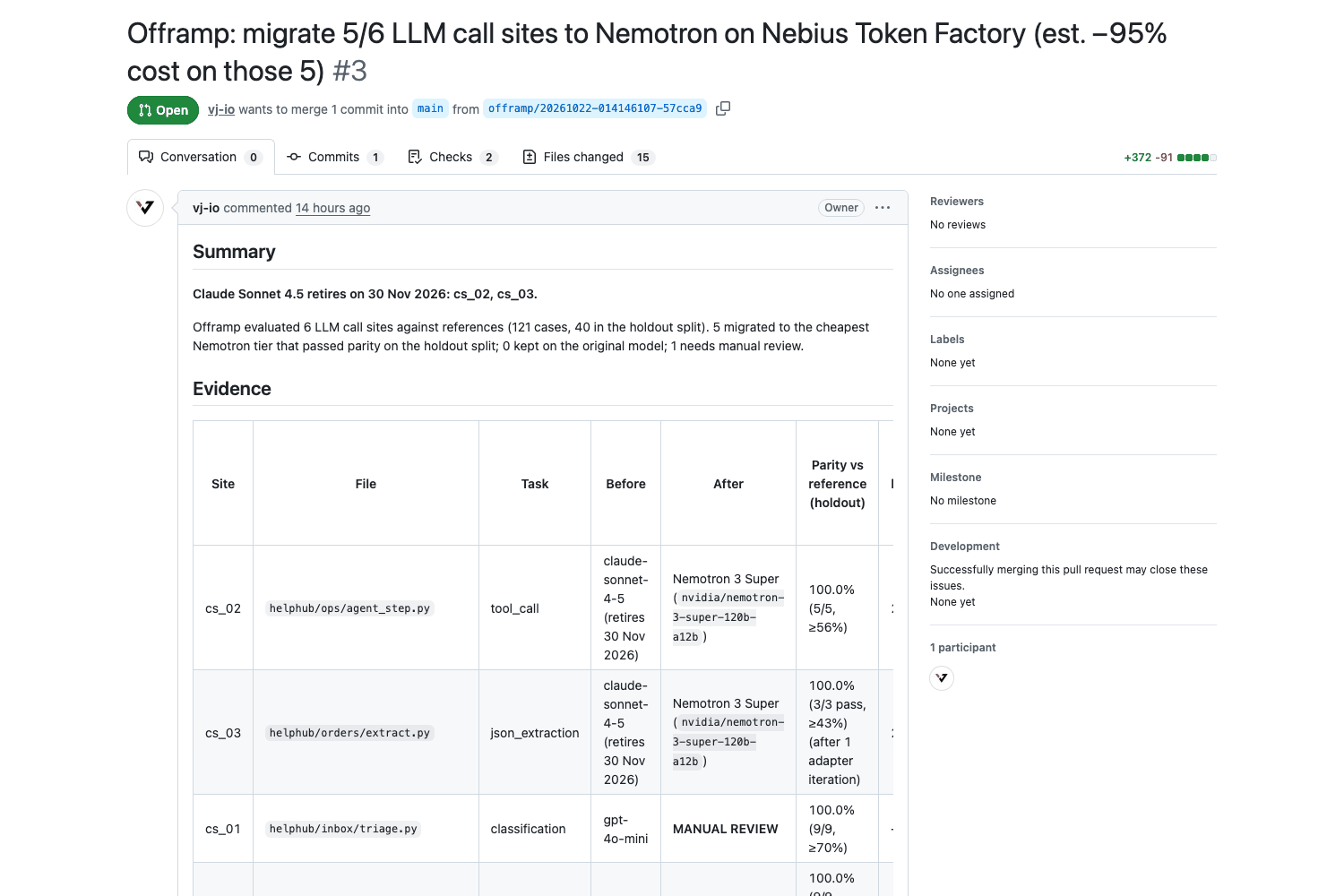
The pull request Offramp opened on the demo repo: retirement line, summary and evidence table. The repo's own CI passes.
-
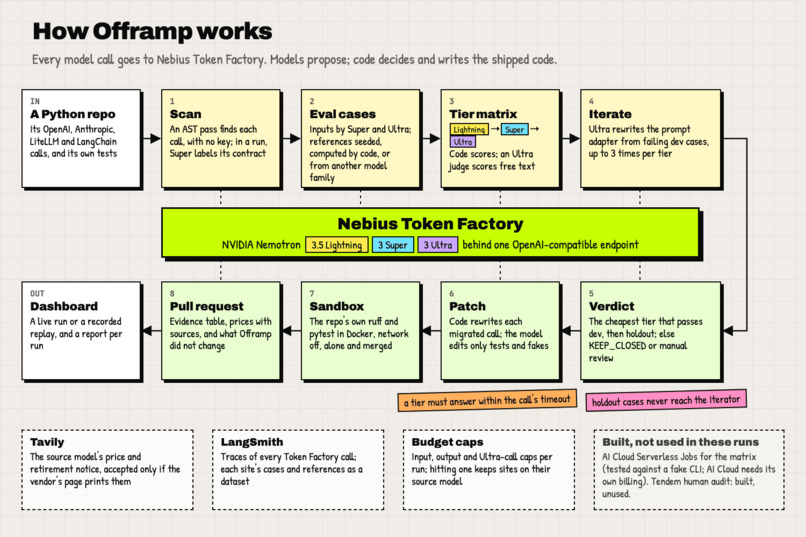
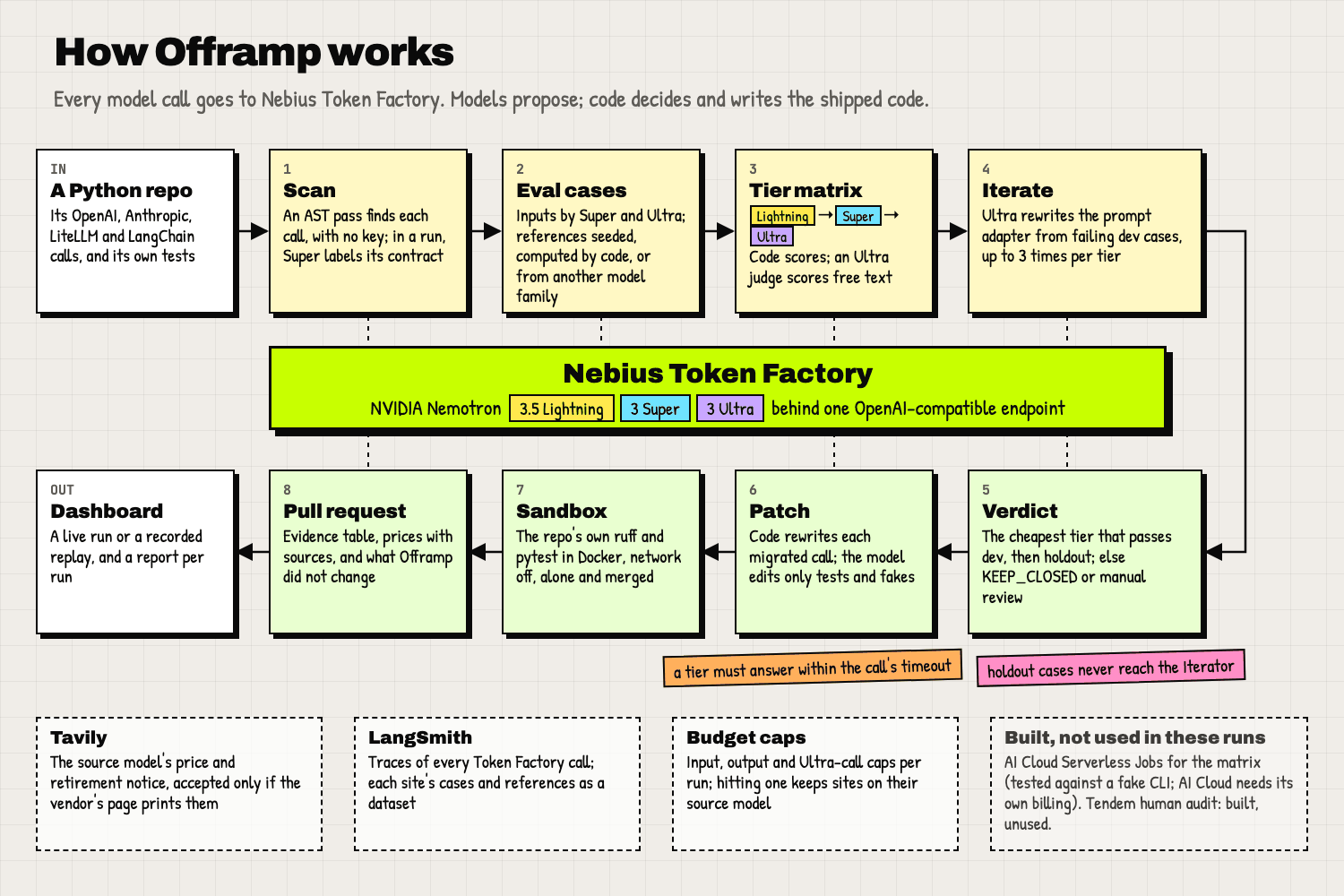
How Offramp works: every model call goes to Nebius Token Factory; models propose, code decides and writes the shipped code.
-
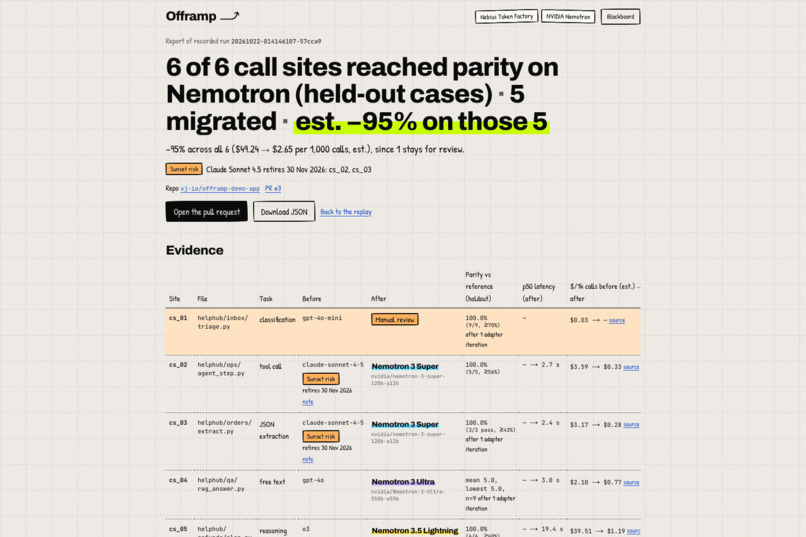
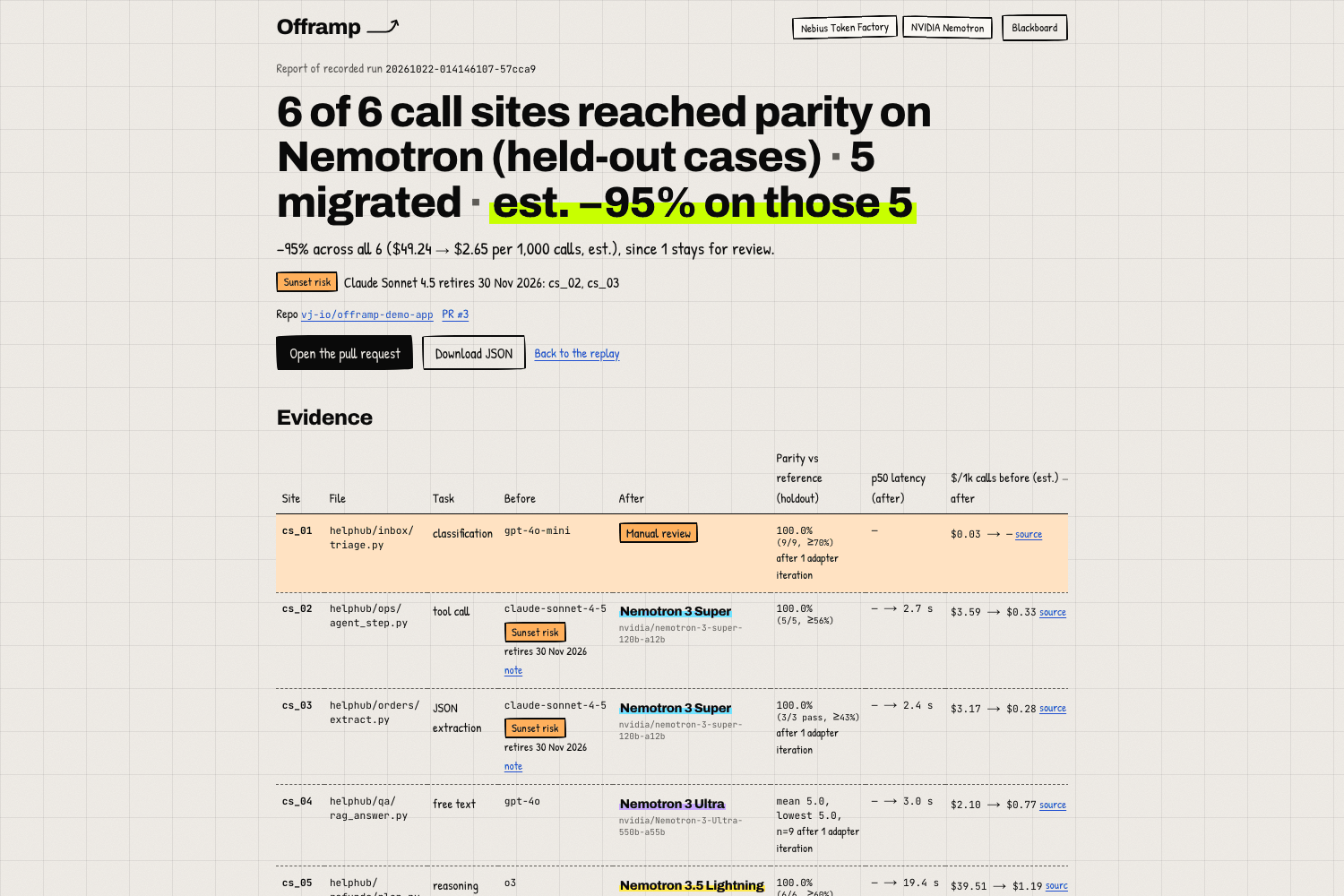
The report: 5 of 6 calls migrated, est. −95%, the Claude Sonnet 4.5 retirement date, and the evidence table.
-
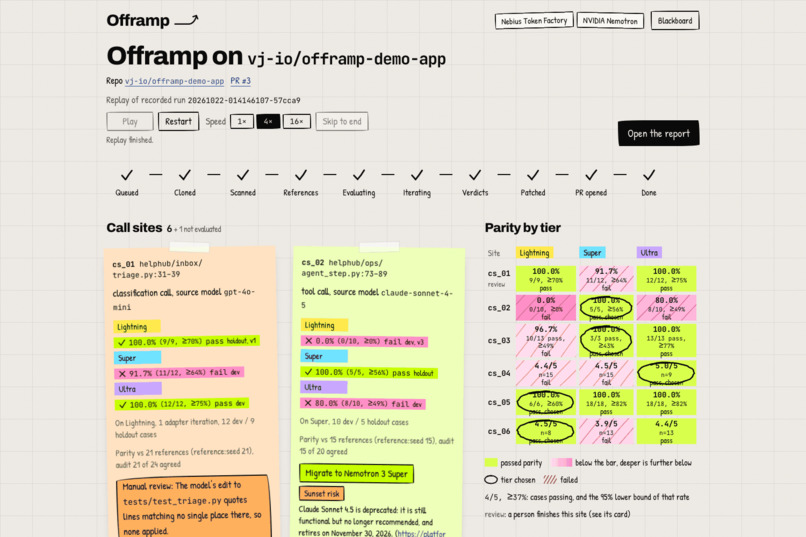
Done: the parity-by-tier grid, the chosen tier circled for each migrated call site, and PR #3 linked at the top.
-
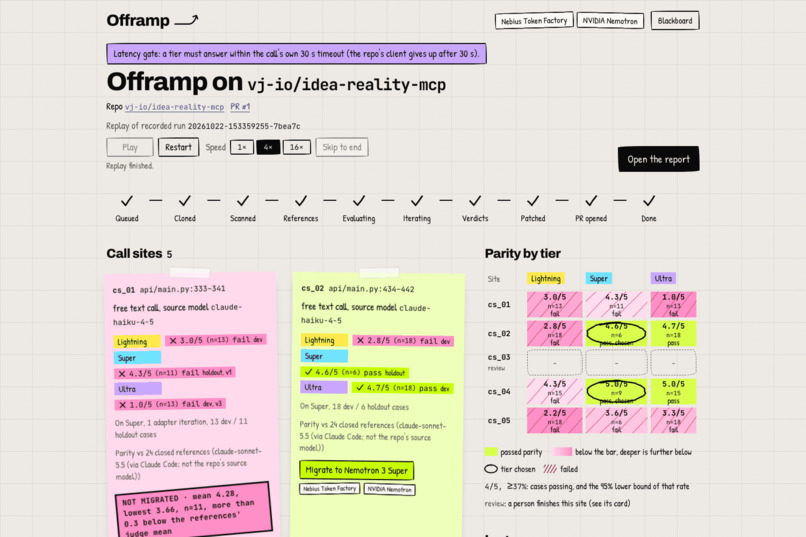
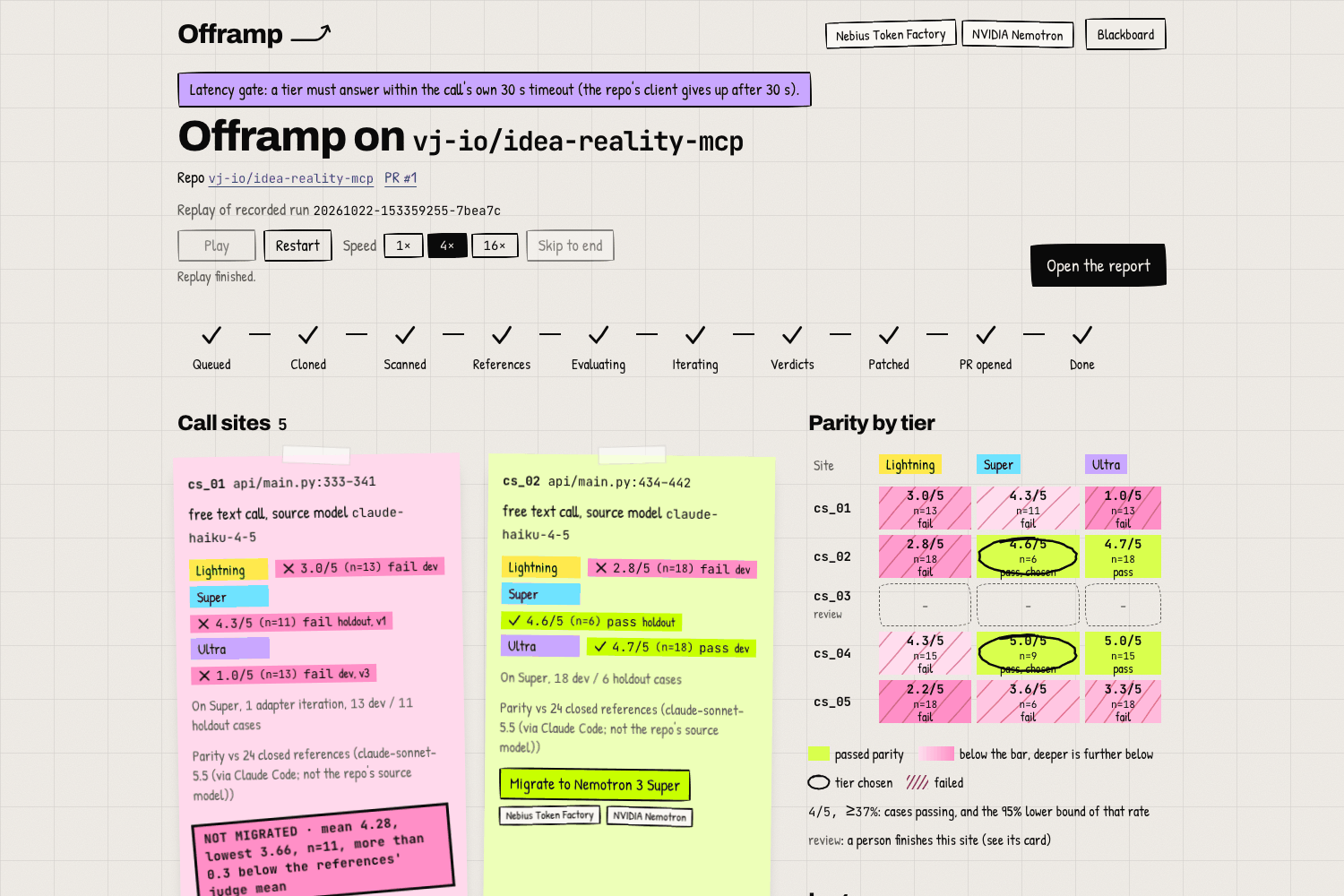
The open-source run: 2 calls migrate to Super, 2 stay on Claude, 1 needs a person; Lightning ruled out by the call's 30 s timeout.
-
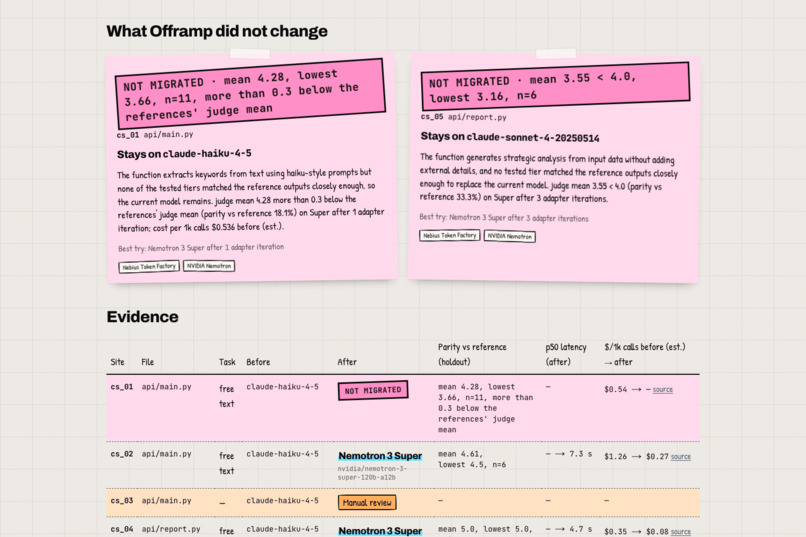
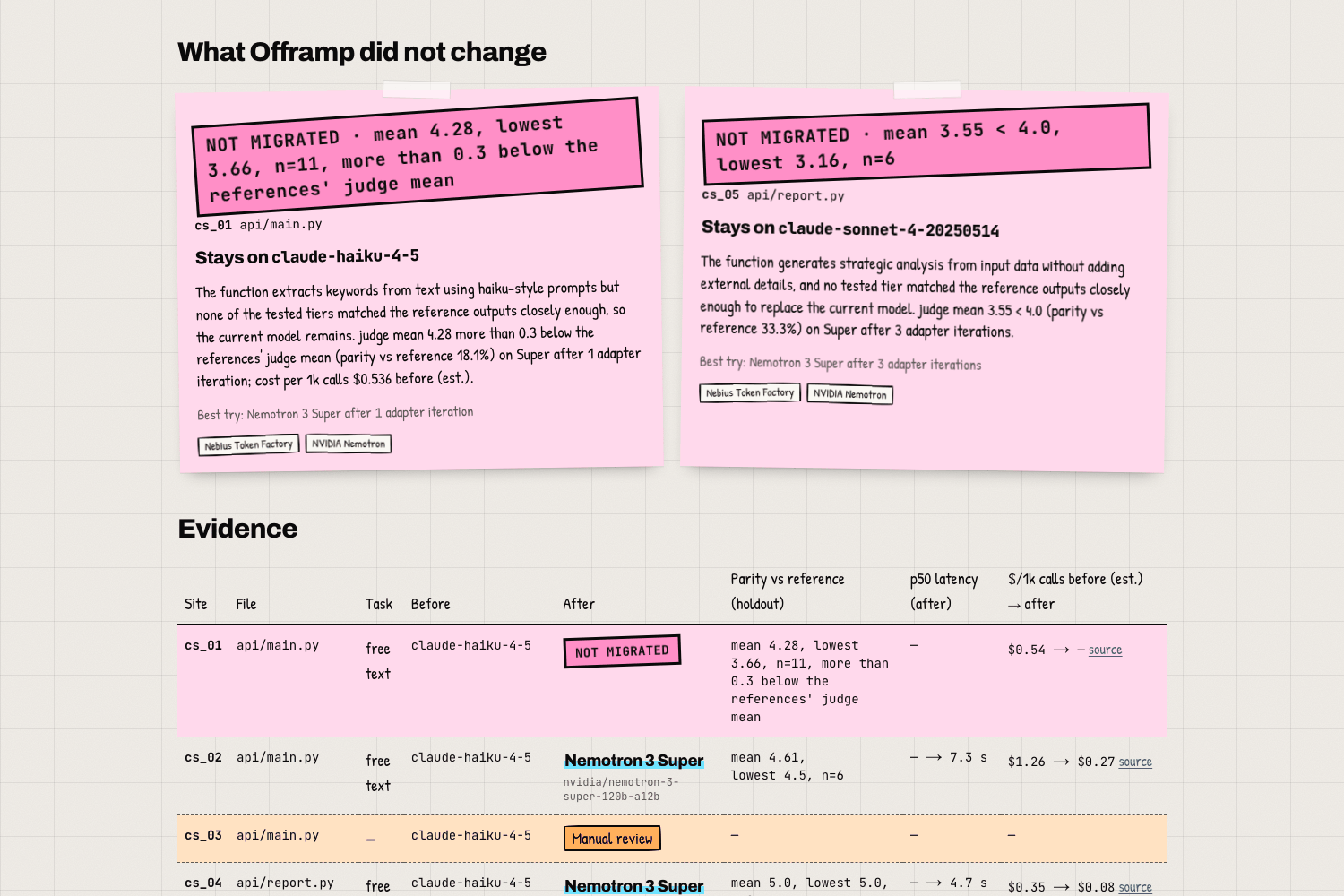
The gate saying no on a real open-source repo: two calls stay on Claude because Super fell below the bar on held-out cases.
-
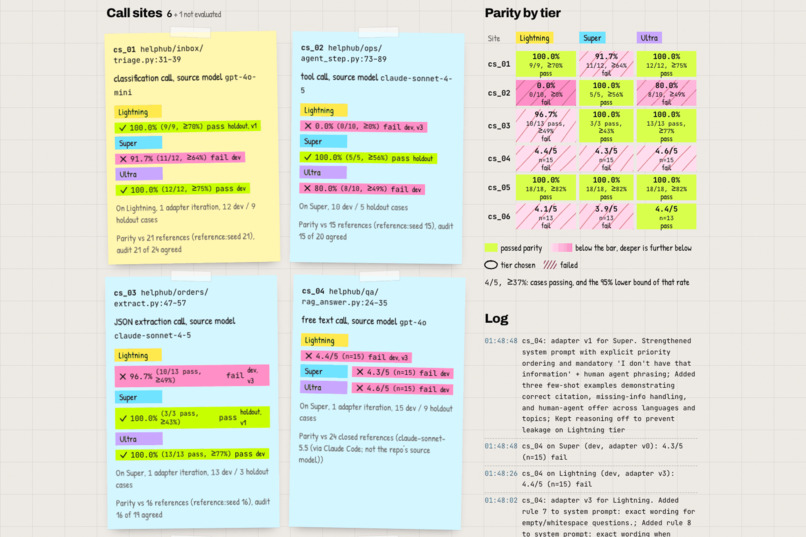
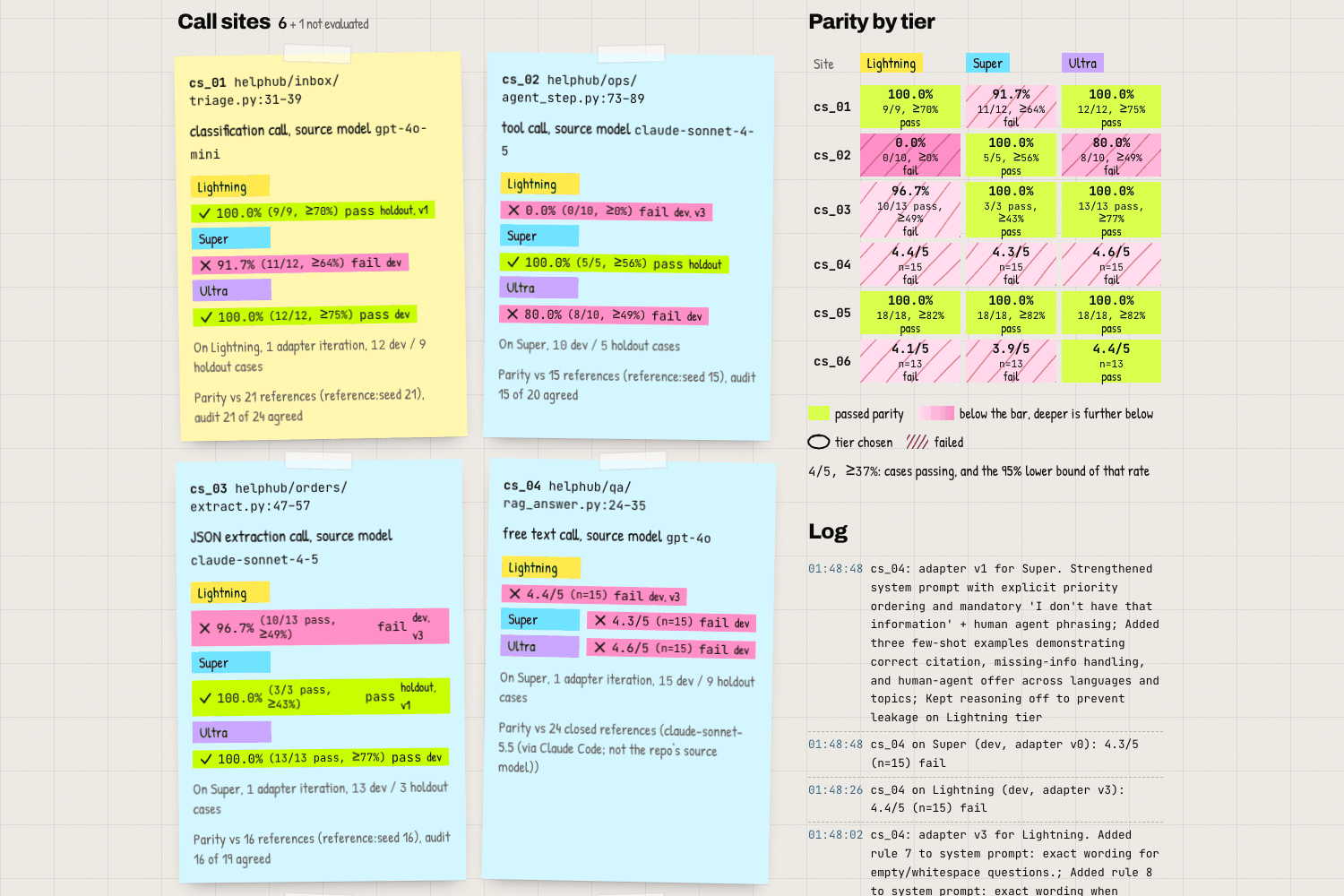
Mid-run: the RAG answerer failed on Lightning after three rewrites; Nemotron 3 Ultra has just written adapter v1 for Super.
In plain words
The problem. Many apps call paid AI models from companies like OpenAI or Anthropic, often from many places in their code. Moving those calls to a cheaper open model such as NVIDIA Nemotron can cut the bill sharply, and teams also have to move when a model they rely on is retired. But the cheaper model might quietly do worse: return data in a format the app cannot read, pick the wrong action, or give slightly worse answers. Checking every call by hand takes days, so most teams never switch.
What Offramp does. Point it at your code and it works like an automated tester. It finds every AI call, builds a small test for each one, tries the cheapest Nemotron model first and steps up to a bigger one only when it has to, and then opens a pull request (a proposed code change) for the calls that passed, with the evidence attached. When it cannot prove a call still works, it leaves that call alone or asks a person to look.
The result on our demo app. 6 AI calls checked. 5 moved to Nemotron, at an estimated 95% lower cost on those 5. 1 went to a person, because the model's fix would have deleted three checks from its test, and Offramp refused that. The app's own tests pass on the pull request.
In one sentence: Offramp moves an app's AI calls to a cheaper model only where it can prove they still work, and shows the proof.
Terms used below:
- Call site: one place in the code that calls an AI model.
- Tier: Nemotron comes in three sizes on Nebius Token Factory: 3.5 Lightning (smallest and cheapest), 3 Super, and 3 Ultra (largest).
- Parity: the cheaper model's answers agree with reference answers often enough to pass the bar for that kind of call.
- Held-out cases: test cases kept aside. Offramp tunes the prompt on the others and uses these only for the final check, so it cannot tune its way to a pass.
- Adapter: what Offramp sends the new model for one call: its prompt, examples, output format and whether it reasons first.
Inspiration
Moving a product off a closed LLM API sounds like a base-URL change, and teams have reasons to do it: price, vendor lock-in, and deprecations. Offramp's own Tavily lookup found that Claude Sonnet 4.5 retires on 30 November 2026, and two of our demo app's calls use it. A static scan of 30 popular public Python repos found 50 chat calls that name their model; 33 of them use a model its provider has retired or scheduled for shutdown. What stops teams from moving is risk they cannot see: JSON that no longer parses, tool schemas that drift, answers that are slightly worse. Nobody wants to migrate on a vibe check, and nobody has time to check parity call site by call site. We wanted a tool that does the checking and hands over a pull request a reviewer can trust.
What it does
In short: find the AI calls, test cheaper models on each, tune the prompt when one nearly passes, decide call by call, and write the code change. In more detail, pointed at a Python repo, Offramp:
- Scans for every OpenAI, Anthropic, LiteLLM and LangChain call with a deterministic AST pass, and Nemotron 3 Super labels each call's contract: classification, JSON extraction, tool call, free text or reasoning.
- Builds an eval set per call site, split into dev and holdout by a hash of the case id. Expected outputs are reference answers: seeded (the expected label, record or tool call is chosen first, and Super writes an input that implies it), computed by code, or, for free text, written by Claude Sonnet 5.5, a different model family. Seed references are audited blind; the free-text ones were not audited.
- Runs a tier matrix on Nebius Token Factory: Nemotron 3.5 Lightning, then Nemotron 3 Super, then Nemotron 3 Ultra. Deterministic scorers check schemas, labels, tool names and arguments, and numeric answers; an Ultra judge scores free text.
- Iterates. When a cheaper tier fails on dev, Nemotron 3 Ultra reads the failing cases and rewrites the adapter (prompt, few-shot examples, schema, reasoning switch), up to 3 times per tier; a rewrite identical to one already tried ends that tier's rewrites early. The Iterator never sees holdout cases.
- Decides per call site: migrate to the cheapest tier that passes dev and then holdout, keep the source model when no tier does, or hand the site to manual review. When the call sets a timeout, a tier must also answer within it.
- Patches and opens a PR. Code rewrites each migrated call, and Nemotron edits only the tests and fakes that pinned the old provider. The repo's own ruff and pytest run in a network-off Docker sandbox, and any site whose patch cannot be verified goes to manual review with the exact reason. The PR carries an evidence table, how parity was measured, failing cases, prices with their sources, and a "What Offramp did NOT change" section.
A dashboard shows it live: stage stepper, call-site cards, a parity-by-tier grid, the log and a report page.
On our demo app (a small support-desk app with six chat calls on gpt-4o-mini, gpt-4o, o3, claude-sonnet-4-5 and claude-haiku-4-5), Offramp evaluated 121 cases, 40 of them held out. All 6 call sites reached the parity bar on a Nemotron tier. 5 migrated in one pull request: two Claude Sonnet 4.5 calls to Super, the RAG answerer to Ultra, and the o3 refund planner and the Haiku summariser to Lightning. The demo repo's own CI passes on that PR. Estimated cost per 1,000 calls to each site falls from $49.21 to $2.61 on the 5 migrated sites (−95%), and from $49.24 to $2.65 across all 6 (−95%). The o3 site is most of the "before"; without it, the other five sites (four migrated, plus the ticket classifier at its source model's price) go from $9.74 to $1.46 (−85%). The sixth site, the ticket classifier, went to manual review: the model's edit to its test would have dropped three asserts, so Offramp refused it.
The gate saying no. Rerun with a team policy of "no Ultra", Offramp kept the RAG answerer on gpt-4o: Lightning and Super both failed the dev split, Super with a best judge mean of 4.45, more than 0.3 below the references' mean.
On a real repo. We forked mnemox-ai/idea-reality-mcp, an MIT-licensed MCP server we did not write, and ran Offramp on the fork. Of its five async Anthropic calls, two migrated to Super (PR on the fork; est. −78% on those two), two stay on Claude because Super fell below the bar on held-out cases, and one needs a person because its prompt is built at runtime. Lightning was out on every site it was tried on: its median answer took 64.3 to 97.5 s that day, and the repo's own client gives up after 30 s.
Try it on your own code: the scan needs no key. Run uvx --from git+https://github.com/vj-io/offramp offramp scan . or paste a GitHub URL at https://offramp-seven.vercel.app/scan.
How we built it
In short: a Python backend runs the steps above, every model call goes to Nemotron on Nebius Token Factory, models propose while code decides and writes the shipped code, and a web dashboard replays each run.
- Backend: Python 3.12 with FastAPI, Pydantic and SQLModel; a run is a state machine that streams its events over server-sent events.
- Models: every inference call in Offramp's code goes through one client, the OpenAI Python SDK pointed at Nebius Token Factory. Nemotron 3 Super and Nemotron 3 Ultra are the agents (labelling, case generation, adapter, iterator, judge, patch writer, PR prose), and Nemotron 3.5 Lightning, Super and Ultra are the models under test. Structured calls use
temperature=0,json_schemaoutput, an explicitenable_thinkingswitch and a per-agent token cap. - Cache as cassettes: every response is stored by a hash of model, messages and parameters. Cache hits are free, a finished run can be replayed from the cache without a new call, and the test suite replays real Token Factory output without a key. The exception is the open-source PR run
20261022-153359255-7bea7c: a bug deleted judge replies it would need, and it is fixed for later runs. - Budget guardrails: caps per run on input and output tokens and on Ultra agent calls; hitting one keeps the affected sites on their source model instead of crashing.
- Patching: an AST rewrite writes the evaluated request into each call site as literal keyword arguments, and a check rejects any model edit to a non-test file. The target repo's own checks run in Docker with the network off, on the repo's tracked files only.
- Partners: Tavily looks up each source model's published price and deprecation notices at run time, and a price is accepted only if the cited page prints it next to that exact model. LangSmith traces every Token Factory call and keeps each site's cases as a dataset. Claude Sonnet 5.5, run through Claude Code during the build, wrote the free-text references and blind-audited the seed references, so Nemotron never grades its own gold.
- Dashboard: Next.js and Tailwind CSS on Vercel's free tier. The recordings replay entirely in the browser, and
/scanruns the static scanner in a Python function.
Challenges we ran into
In short: we had no keys for the paid models we were replacing, Nemotron 3 Super was not reliable at rewriting app code, and a real project exposed bugs our demo never did.
- No closed-model keys. We had only hackathon credits, so the source models' own outputs could not be recorded. We defined parity as agreement with reference answers (seeded, computed by code, or written by Claude Sonnet 5.5 for free text), labelled every reference with where it came from, and audited the seed references blind with a different model family.
- Super was unreliable at writing shipped code to a spec. Asked to rewrite call sites from the evaluated adapter, Super's patches were rejected on 5 of 6 sites. We moved the call-site rewrite into deterministic code and let the model edit tests only. That took the demo from 1 patched site to 3, and later fixes to the repair loop took it to 5.
- A real repo broke our assumptions. The first two runs on the open-source repo found five bugs in Offramp: repeated eval cases leaking across the dev and holdout splits, an Ultra budget spent on the wrong work, a degenerate adapter (one word repeated about 750 times) that passed the metric, parity measured without the call's own 30 s timeout, and a judge reply cut at
max_tokensthat the cache kept serving. We fixed each, with tests, before the run that opened the PR. - Nemotron and Token Factory specifics: reasoning is on by default and its tokens count toward
max_tokens; Lightning withtool_choice="required"looped until the token cap; and on 2026-10-22 Lightning answered about 50 times slower than on 2026-10-19 for replies of the same size.docs/FEEDBACK.mdhas priorities, evidence and repro steps. - AI Cloud billing. Running the eval matrix as a Nebius AI Cloud Serverless Job needed a payment card and a $25 top-up, separate from the Token Factory credits. We built the job path and tested it against a fake CLI, but it never ran on Nebius.
- Small holdouts. With 3 to 11 holdout cases per site, one miss moves parity by 9 to 33 points, so the report shows n and a Wilson 95% lower bound for every site.
Plan versus shipped. Our PRD is public, so here is where we fell short of it:
| Planned | Shipped |
|---|---|
| A baseline recorded from the original closed model | No: parity is against references, because we had no OpenAI or Anthropic key. The recorder exists and is tested with fake clients |
| Paste a repo URL on the website, watch it live, get a PR | Partly: the website plays recordings and runs the keyless scan; live runs need a local API and your own key, because hosting them needs paid compute |
| The eval matrix as a Nebius Serverless Job | Built and tested against a fake CLI, not run on Nebius (AI Cloud needs separate billing) |
One KEEP_CLOSED row in the main demo, from the o3 site |
No: that site passed on Lightning in every demo run. KEEP_CLOSED shows in the no-Ultra run and on the real repo instead |
| Human audit of references through Tendem | Built, not used |
| Everything else (scan, tier matrix, iteration, verdicts, a real PR, Token Factory and Nemotron throughout) | Shipped |
Accomplishments that we're proud of
- A demo run that ends in a real, green pull request: 6 call sites, 121 cases, 5 migrations, each with evidence, and one honest "a person should look at this" instead of a test edit we could not trust.
- A real open-source repo, where Offramp said no to two of five calls and said why, in numbers.
- Offramp writes every change to application code itself; Nemotron edits only tests and test fakes, and the PR lists the test files each model edit touched.
- Every number on screen and in the PR is rendered from run artifacts. Costs are labelled as estimates with their price source and date, and latency before migration is shown as not measured.
- All of it cost $4.13 of the $25 Token Factory grant by our spend counter: $3.51 over 15 pipeline runs, plus case generation and cassette recordings.
- Judges can watch all three recorded runs at https://offramp-seven.vercel.app with no login and no keys, or scan their own repo there.
What we learned
- Deterministic scorers should decide wherever they can.
json_schemaand tool calling worked on all three Nemotron tiers, so only free-text sites needed a judge. - The cheapest tier is often enough, but not always: on the demo, three sites passed on Lightning (one of them then went to manual review), two needed Super, and the RAG answerer needed Ultra after three adapter rewrites on Lightning and one on Super failed (Super's next two rewrites repeated that one).
- Let models propose and code decide. Every allowance for model edits to shipped code reopened a way for unverified changes to slip through; restricting the model to tests closed it.
- A real repo is worth more than a polished demo. Two runs on one found five bugs that our demo app never triggered.
- Honest labels matter more than flattering numbers: "est.", "parity vs reference", "manual review" and the scope of every cost figure.
What's next for Offramp
- Run the eval matrix as a Nebius AI Cloud Serverless Job once billing allows, and host the API.
- Runtime capture for prompts built at runtime, which the static scan cannot render.
- Closed-model baselines for teams that have their source-model keys.
- Human audit of references through Tendem.
- Use the eval sets Offramp builds as fine-tuning data for the calls that stay on a closed model.
Built With
- claude-code
- docker
- fastapi
- github
- langsmith
- nebius-token-factory
- nemotron-3-super
- nemotron-3-ultra
- nemotron-3.5-lightning
- next.js
- nvidia-nemotron
- openai-python-sdk
- pnpm
- pydantic
- python
- react
- sqlmodel
- tailwind-css
- tavily
- typescript
- uv
- vercel

Log in or sign up for Devpost to join the conversation.