-
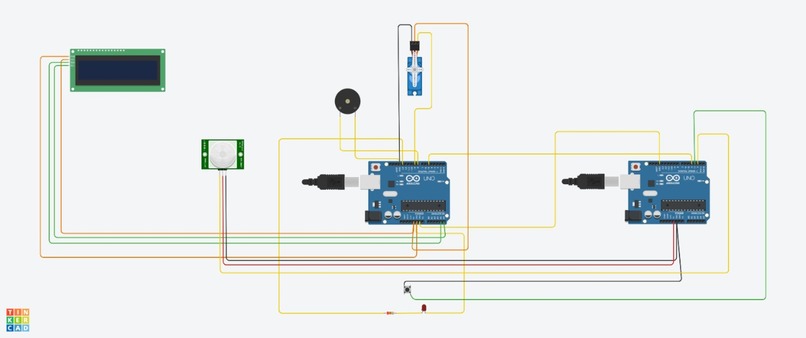
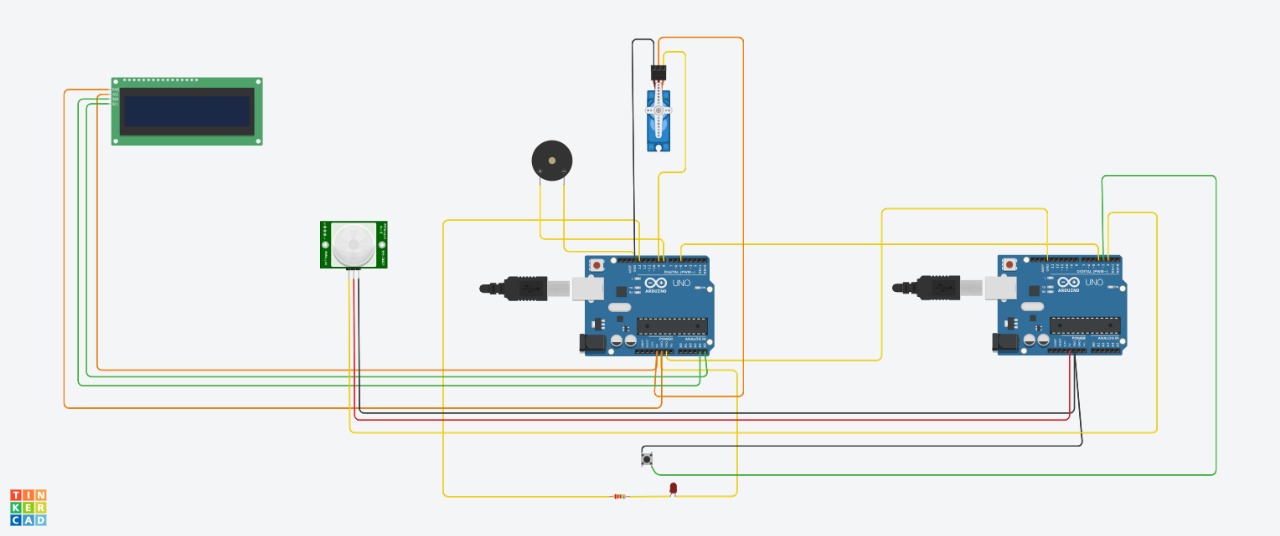
Photo of TinkerCad with substitution components as some components are not available in TinkerCad
Inspiration
Most smart security systems today are designed with the assumption that the internet is always available. During our research, we realized that in real-life situations—such as network failures, power cuts, or emergency conditions—many “smart” locks become unusable, leading to safety and accessibility issues. This inspired us to rethink smart security from a resilience-first perspective.
The idea behind this project was to build a smart door lock system that continues to function even without internet connectivity, ensuring reliability, privacy, and security at all times.
What the Project Does
The Offline-Based Smart Lock System is a secure access control solution that uses face recognition as the primary authentication method while operating entirely offline. The system locally detects and verifies authorized users and unlocks the door without relying on cloud servers or external internet services.
To ensure modular and reliable communication between system components, MQTT-based local messaging is used. Once authentication is successful, a control signal is sent to unlock the door through an actuator mechanism. This design ensures uninterrupted operation and reduced security risks associated with cloud dependency.
Design Choices and Component Substitutions
While designing the project, certain practical and academic constraints influenced our implementation choices. In a real-world deployment, the system would use an ESP32-CAM module for on-device face recognition, a relay module, and a 12V solenoid or electronic strike lock. However, due to simulation and demonstration limitations, some components were substituted with equivalent logical representations.
The ESP32-CAM face recognition process was simulated using sensor-based triggers and user input to represent successful authentication.
MQTT communication, which would normally occur over local Wi-Fi, was emulated through direct signal-based communication between microcontrollers to demonstrate the publish–subscribe logic.
A servo motor was used in place of a high-power solenoid lock to safely visualize the locking and unlocking mechanism during simulation.
Cloud-based services were intentionally excluded to maintain the project’s offline-first design philosophy.
These substitutions were made solely for demonstration and testing purposes while preserving the functional behavior, security logic, and architectural intent of the real system. The final design remains scalable and can be deployed with actual hardware components without altering the core workflow.
How We Built It
The system architecture consists of two logical units:
- A face recognition unit responsible for detecting and validating users
- A controller unit that handles decision-making and lock control
Local MQTT communication is used to securely transmit authentication status between these units. The project was simulated and tested using microcontroller-based setups to demonstrate real-world behavior such as detection, authentication, and door unlocking.
Security concepts such as secure boot and flash encryption were incorporated at the design level to ensure that stored data and firmware remain protected from tampering. The system was designed to be simple, cost-effective, and easy to explain—without compromising functionality.
Challenges We Faced
One of the biggest challenges was designing a system that balances simplicity and security while remaining fully offline. Simulating real-world face recognition behavior without full hardware support required careful abstraction and logical design. Another challenge was ensuring clear communication flow between modules without introducing unnecessary complexity.
Through iterative testing and simplification, we were able to refine the system into a stable and explainable architecture suitable for real-world deployment.
What We Learned
This project helped us understand the importance of offline-capable IoT systems, local data processing, and secure device communication. We learned how protocols like MQTT can be used effectively even without cloud infrastructure, and how security features such as encrypted storage and secure boot enhance system reliability.
Most importantly, we learned that “smart” systems should prioritize availability and safety, not just connectivity.
Future Scope
In the future, this system can be extended with optional cloud synchronization for logging and analytics when the internet is available. Additional biometric methods, mobile notifications, and advanced intrusion detection can also be integrated while keeping the core system offline-capable.


Log in or sign up for Devpost to join the conversation.