Product update — Murimi Fara Planner (October 2026)
Murimi Fara is growing into a practical offline-first agricultural support ecosystem with two complementary tools:
1. Murimi Fara — Offline AI Farming Advisor (Windows desktop). The advisor runs a local language model and retrieves guidance from a Zimbabwe-focused agricultural knowledge base. It supports crop and livestock questions, local-language farming terminology in English, Shona and Ndebele, and offline Fall Armyworm photo analysis. Farmers can also use its browser interface over a laptop's local Wi-Fi network without an internet connection.
2. Murimi Fara Planner (Android). This is a separate, released mobile application that helps households and farmers measure their available maize/food reserves, livestock feed and water; estimate how many days these resources will last; identify likely shortages before harvest; calculate additional amounts needed; and compare practical resource plans. It includes family/communal-farming and commercial-farm planning views, season simulations and options to consider when supplies are insufficient. Calculations use quantities entered by the farmer and work offline, with data kept on the phone. It does not predict weather or market prices.
Download Murimi Fara Planner on Google Play: https://play.google.com/store/apps/details?id=com.fambai.goho
Why the Advisor and Planner belong together
Farmers need both answers to agricultural problems and a way to plan scarce resources. The Advisor helps a farmer understand a possible pest, crop or livestock-health issue and the precautions or next steps to discuss with an extension officer or veterinarian. The Planner helps that farmer assess whether food, water and animal feed will last until a target date or the next harvest, and what gap must be addressed.
For example, the Planner might show that stored livestock feed will last only 20 more days. The farmer could then use the Advisor to explore locally relevant feed-management questions and when to seek expert help. Combining decision support with transparent resource calculations can help farmers act earlier, especially where mobile data and expert access are limited.
Current integration status: Both tools work independently today. The Android Planner is not yet automatically connected or synchronized with the desktop Advisor; the shared offline workflow described below is a future development plan, not a feature claimed as complete in the original hackathon build.
Future development plan
- Validate in the field: Pilot both tools with Zimbabwean farmers, agricultural extension officers and partners; improve the accuracy, clarity and practicality of recommendations.
- Make the tools work together offline: Explore voluntary data exchange over a local Wi-Fi network or phone hotspot, so a farmer's resource summary can inform the desktop Advisor without needing mobile data or cloud services.
- Turn shortages into actionable guidance: Link Planner alerts (for example, insufficient water or feed before harvest) to relevant, knowledge-grounded Advisor explanations and safe options, while keeping calculations transparent and advising human review for high-stakes decisions.
- Improve accessibility: Expand Shona and Ndebele support, simplify farmer-facing interfaces and test on affordable, lower-specification devices.
- Expand responsible agricultural intelligence: Enrich the local knowledge base, add carefully tested crop and livestock image-analysis capabilities, improve uncertainty handling, and work toward a more unified Murimi Fara experience.
The vision is for Murimi Fara to help a farmer understand today's agricultural problem and plan for tomorrow's resources, even without internet access.
Inspiration
Cloud-hosted LLMs require stable fibre, sustained electricity, and ongoing API fees — none of which are guaranteed for a smallholder farmer, extension officer, or agri-dealer in rural Zimbabwe. Meanwhile, tick-borne cattle diseases alone account for 20-30% of recorded cattle deaths annually in the country, and farmers often lack fast access to a vet when symptoms first appear. We wanted to put expert-level triage and crop advisory directly on the laptop already sitting in these communities — no connectivity required.
What it does
Offline AI Farming Advisor is an on-device LLM that runs entirely locally on an 8GB laptop and helps with two core tasks:
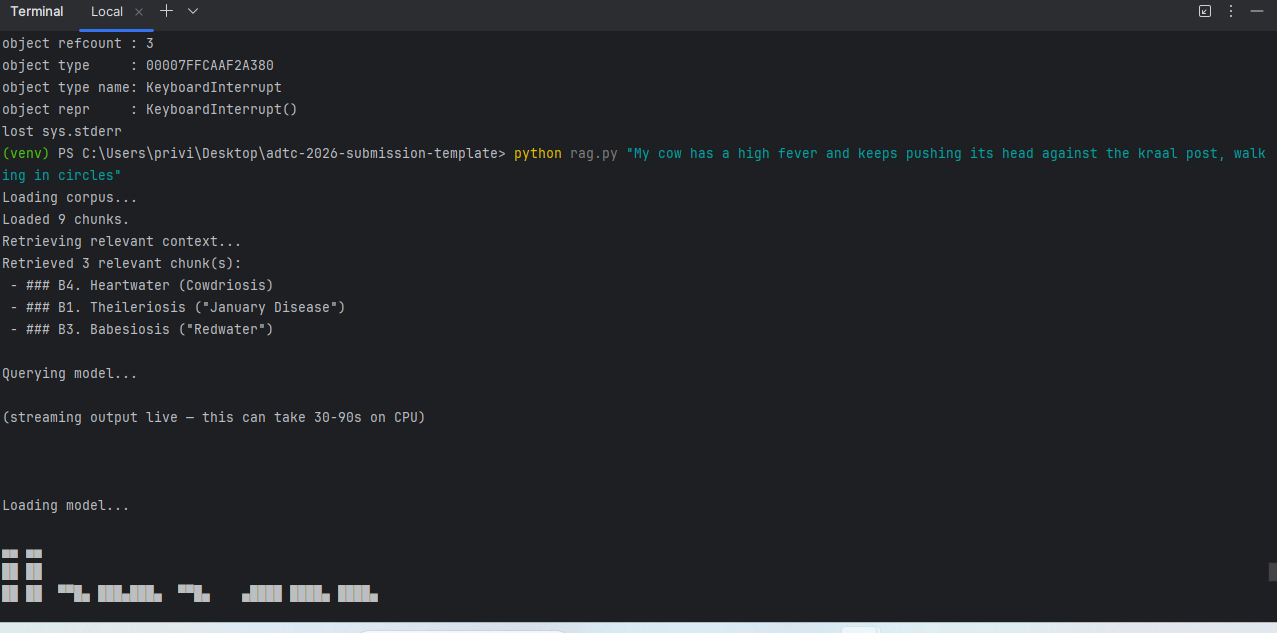
Livestock disease triage — a farmer describes symptoms (fever, unusual behavior, discoloured urine, etc.) and the model identifies the likely condition (e.g. theileriosis, gallsickness, redwater, heartwater), flags urgency, and recommends next steps including when to contact a vet. Crop advisory— pest/disease identification and planting-window guidance tailored to Zimbabwe's Natural Regions (I-V), since correct advice in one region can be wrong in another.
Every answer is grounded in a locally-stored knowledge base of verified Zimbabwe-specific agricultural and veterinary information — not just the model's general training data.
How we built it
Model:Qwen2.5-3B-Instruct, quantized to GGUF (Q4_K_M) to fit comfortably within the 7GB RAM budget on the ADTC Standard Laptop profile. Inference: llama.cpp, CPU-only, matching the integrated-graphics-only hardware spec. Knowledge grounding (RAG): a hand-curated corpus covering cattle tick-borne diseases, fall armyworm, Natural Region planting guidance, and [poultry/goats — fill in what you completed], retrieved locally at inference time with zero external calls. Validation: the ADTC profiler, run repeatedly to check throughput, peak memory, and thermal behavior against the reference hardware target.
Challenges we ran into
Getting the download pipeline working cleanly on Windows vs. the Ubuntu 22.04 reference environment," "Balancing corpus depth against the 6-day build window," "Making sure the model gives appropriately cautious answers (recommending a vet) rather than overstating confidence on serious symptoms.
Accomplishments that we're proud of
A model that runs fully offline, grounded in real Zimbabwean agro-ecological and veterinary data rather than generic agricultural text — built to be genuinely usable by someone with no internet access and no technical background.
What we learned
RAG design
What's next for Offline AI Farming Advisor for Zimbabwe
Expanding the knowledge base to cover more livestock (goats, sheep in more depth), more crops, and additional languages (Shona/Ndebele support), plus exploring a lightweight LoRA fine-tune on the local corpus to further improve accuracy.


Log in or sign up for Devpost to join the conversation.