Inspiration

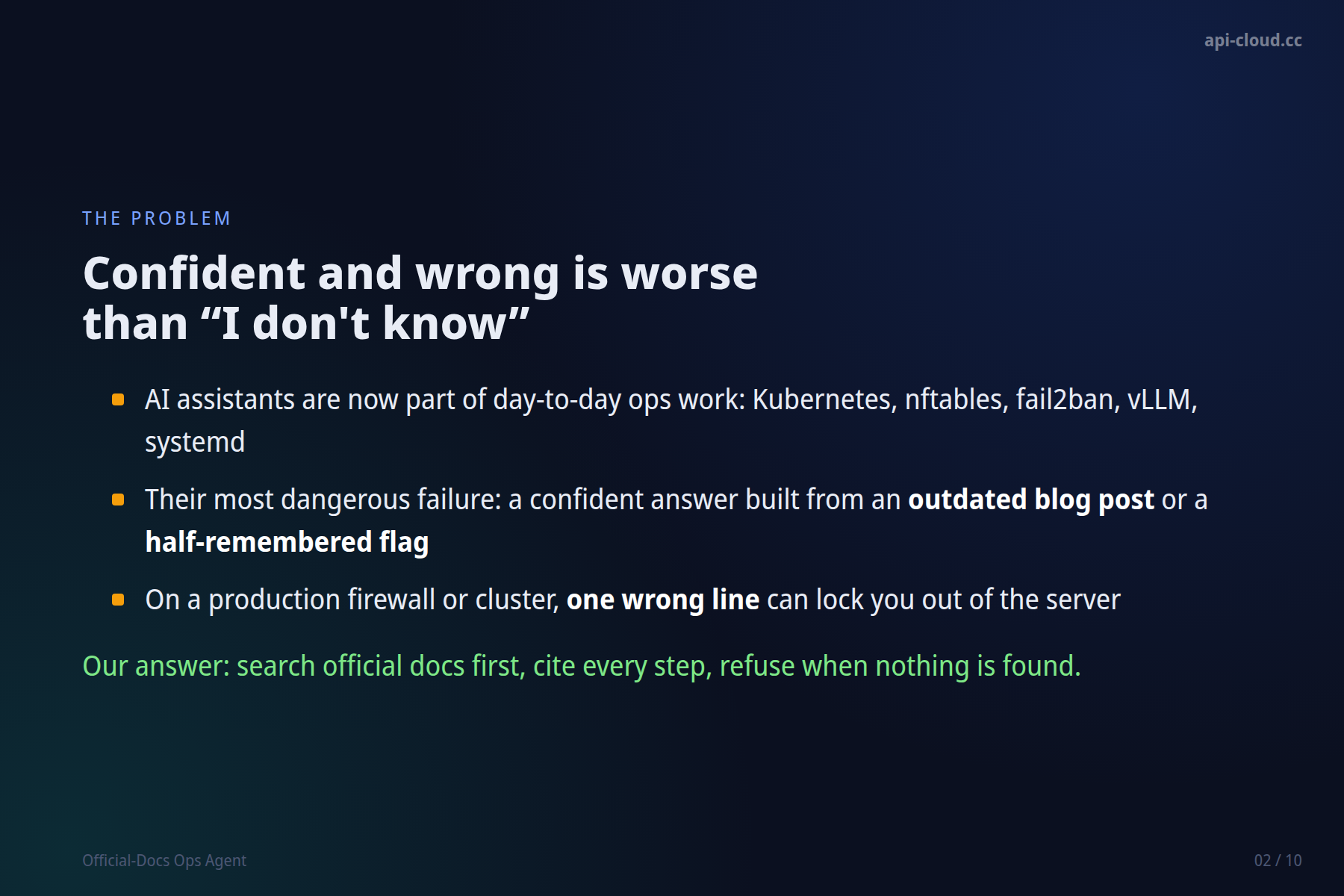
AI coding assistants and autonomous agents can answer technical questions extremely quickly, but speed does not guarantee correctness.

For infrastructure, cloud, networking and software engineering tasks, an incorrect command, an outdated configuration example, or documentation from the wrong software version can cause real operational failures.

Web search also introduces noise: unofficial tutorials, old blog posts, duplicated content and answers without clear provenance.

We wanted to build a reusable evidence layer for AI agents — a service that prioritizes official technical documentation and exposes that knowledge through the Model Context Protocol (MCP).

Instead of asking an AI model to simply "search the web and guess", the agent can request structured evidence from trusted documentation sources first.


What it does

Official Docs MCP is an MCP-based knowledge retrieval backend for AI agents.

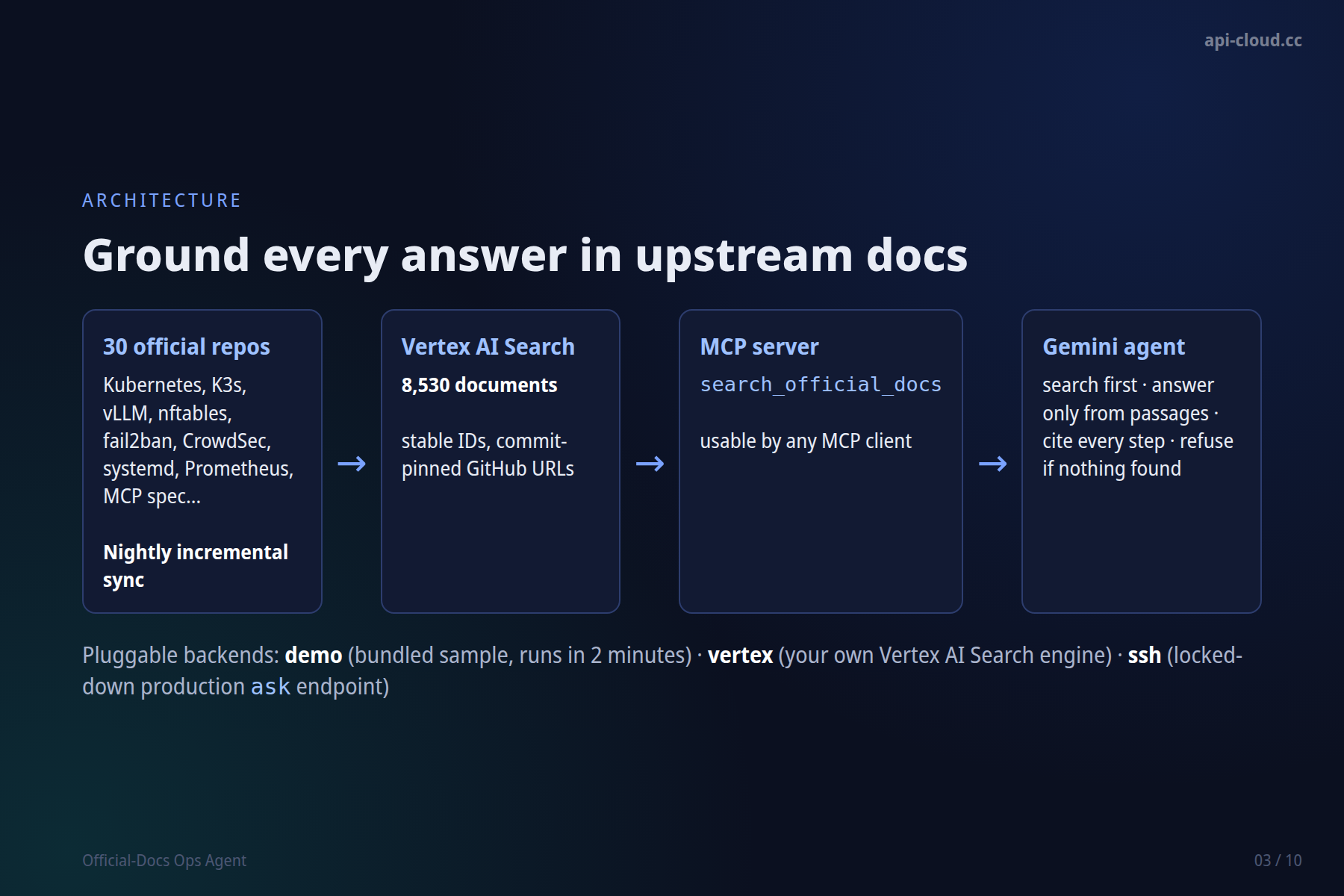
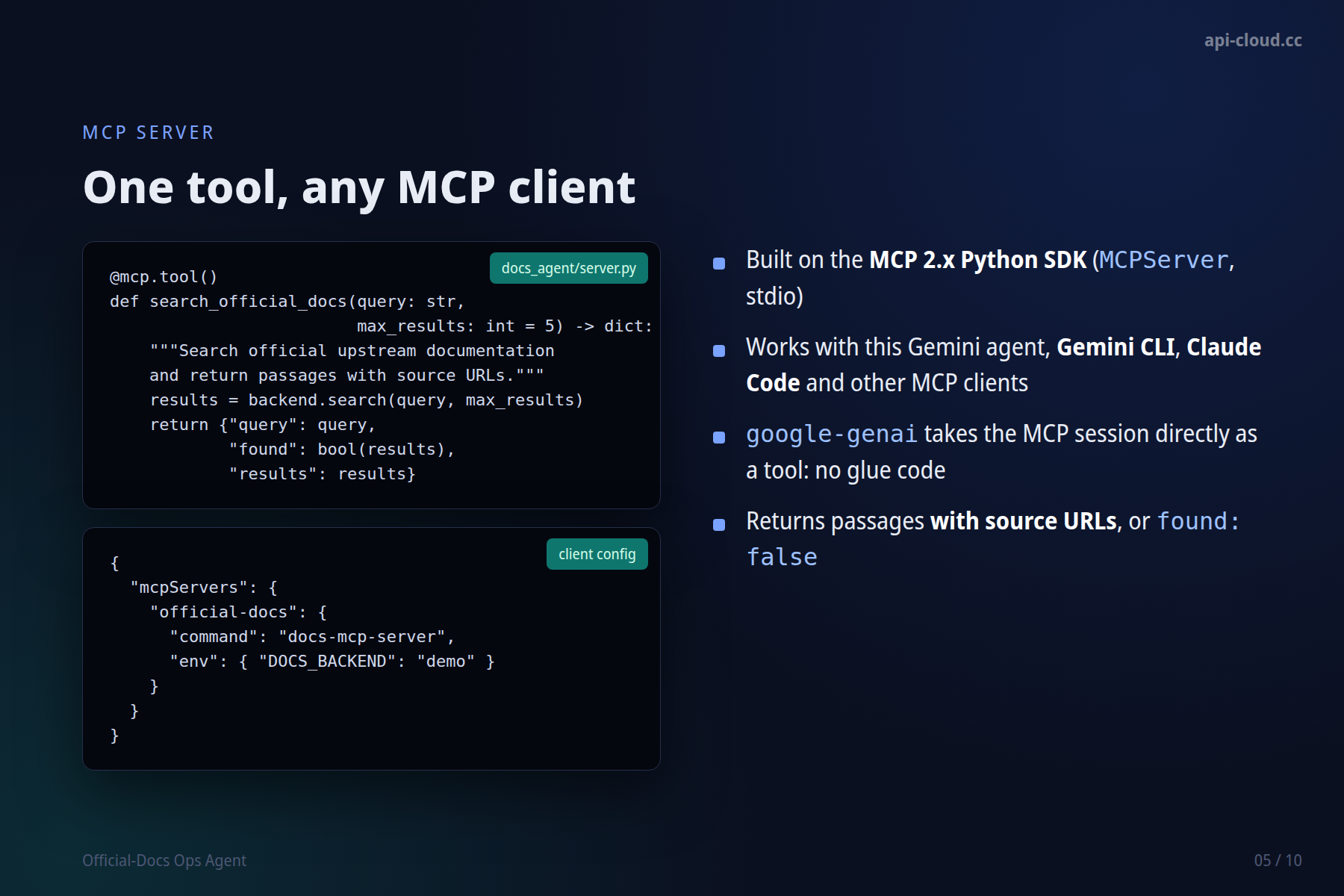
It collects and indexes official technical documentation, then exposes document retrieval as MCP tools that can be used by AI clients and coding agents.

The workflow is:

Official documentation → document ingestion → search/index layer → MCP server → AI agent

When an agent receives a technical question, it can query the MCP server and receive relevant official documentation together with source information that can be used to verify the answer.

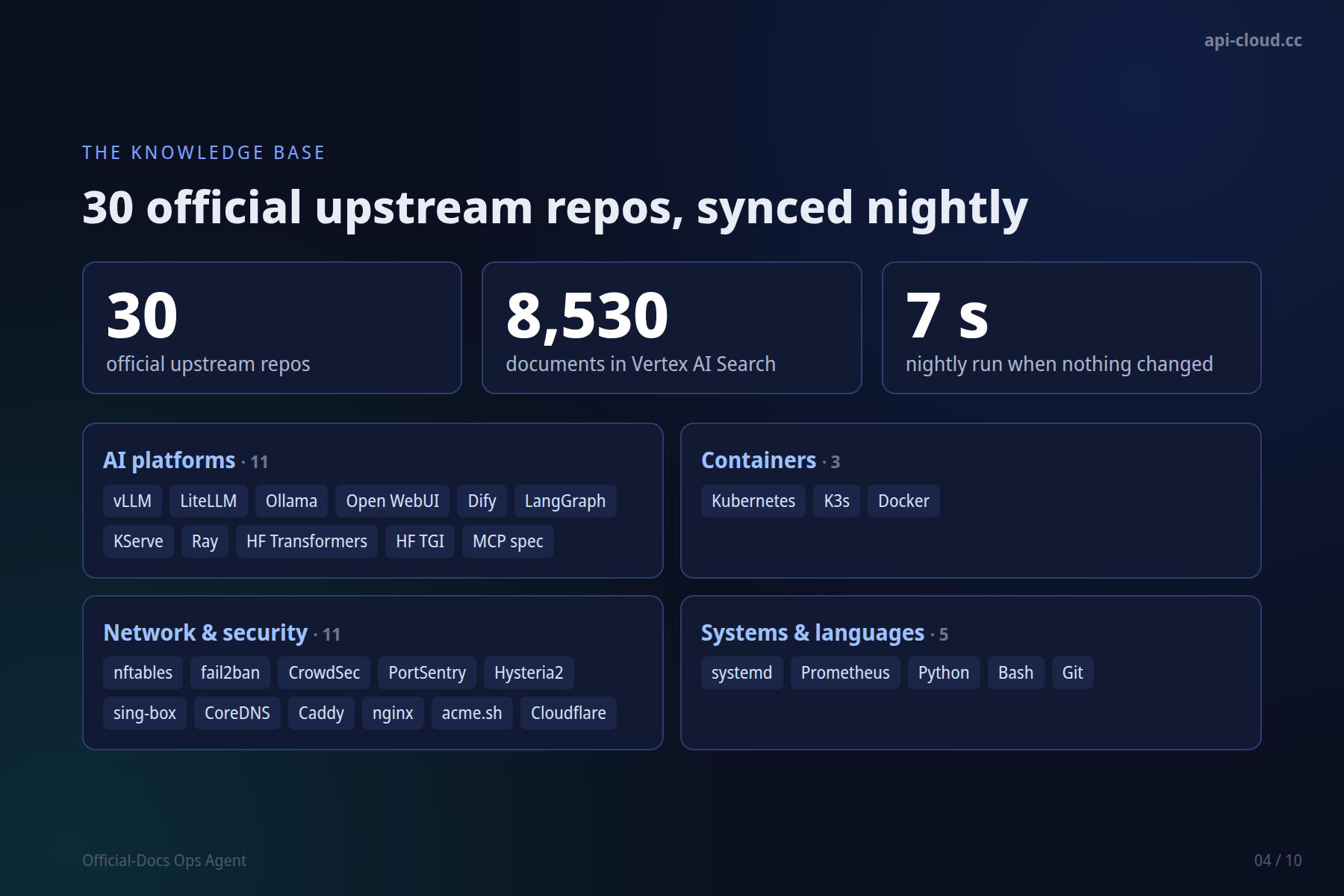
The current proof-of-concept contains approximately 30 official GitHub documentation sources and more than 8,500 indexed documents.

The project is designed to support AI clients such as:

  • Gemini
  • Claude
  • Codex
  • Grok
  • other MCP-compatible agents

The MCP layer keeps the knowledge backend independent from any single model provider.


Why MCP

Without MCP, every AI client would require a separate integration with the documentation search backend.

MCP provides a standard interface between the AI agent and the knowledge service.

This allows the same retrieval backend to serve multiple models while keeping document ingestion, indexing, source validation and retrieval logic centralized.

Conceptually:

                 Gemini
                   |
                 Claude
                   |
User → AI Agent → MCP → Evidence Service
                   |          |
                 Codex        |
                   |          v
                 Grok    Search / Index
                              |
                              v
                    Official Documentation

Built With

Share this project:

Updates

posted an update —

Elevator pitch

An MCP evidence layer that syncs 30 official doc repos into Vertex AI Search, so Claude, Codex, Gemini and Grok check grounded, commit-pinned citations before they answer.

Who it's for

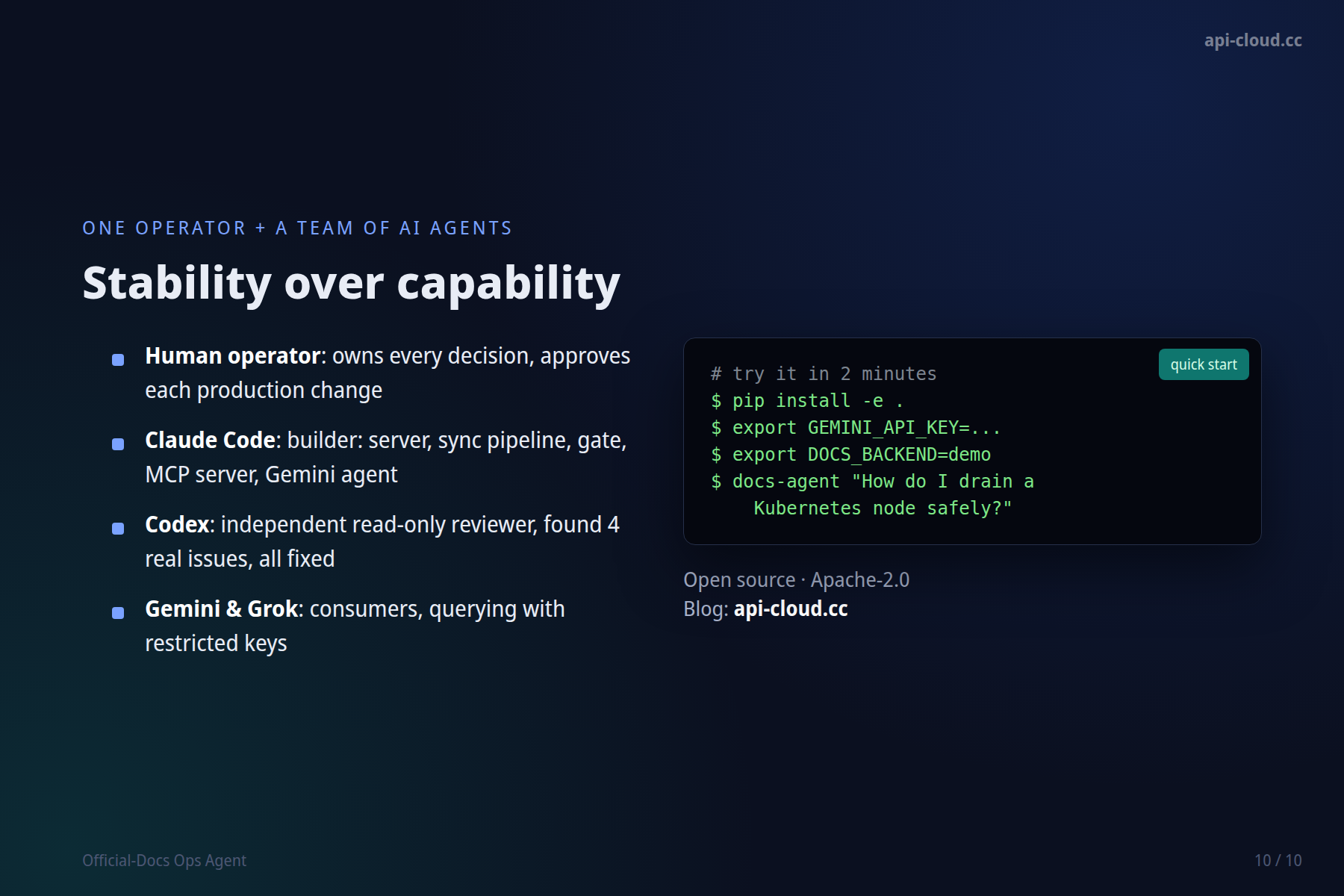
The first users are AI agents, not people. In my daily work several coding agents (Claude Code, Codex, Grok, Gemini) collaborate on infrastructure tasks: plan → design → verify → implement → re-verify. Each agent's CLI has a rule that requires one knowledge-base check before it finalizes a web-researched technical answer. The check is mandatory; what to adopt is the agent's own decision. The human operator orchestrates the agents and approves every production change.

It is built for teams that want an internal, compliant AI platform where every agent shares the same trusted evidence source, paid for by cloud credits instead of AI subscription quota.

Results (real output)

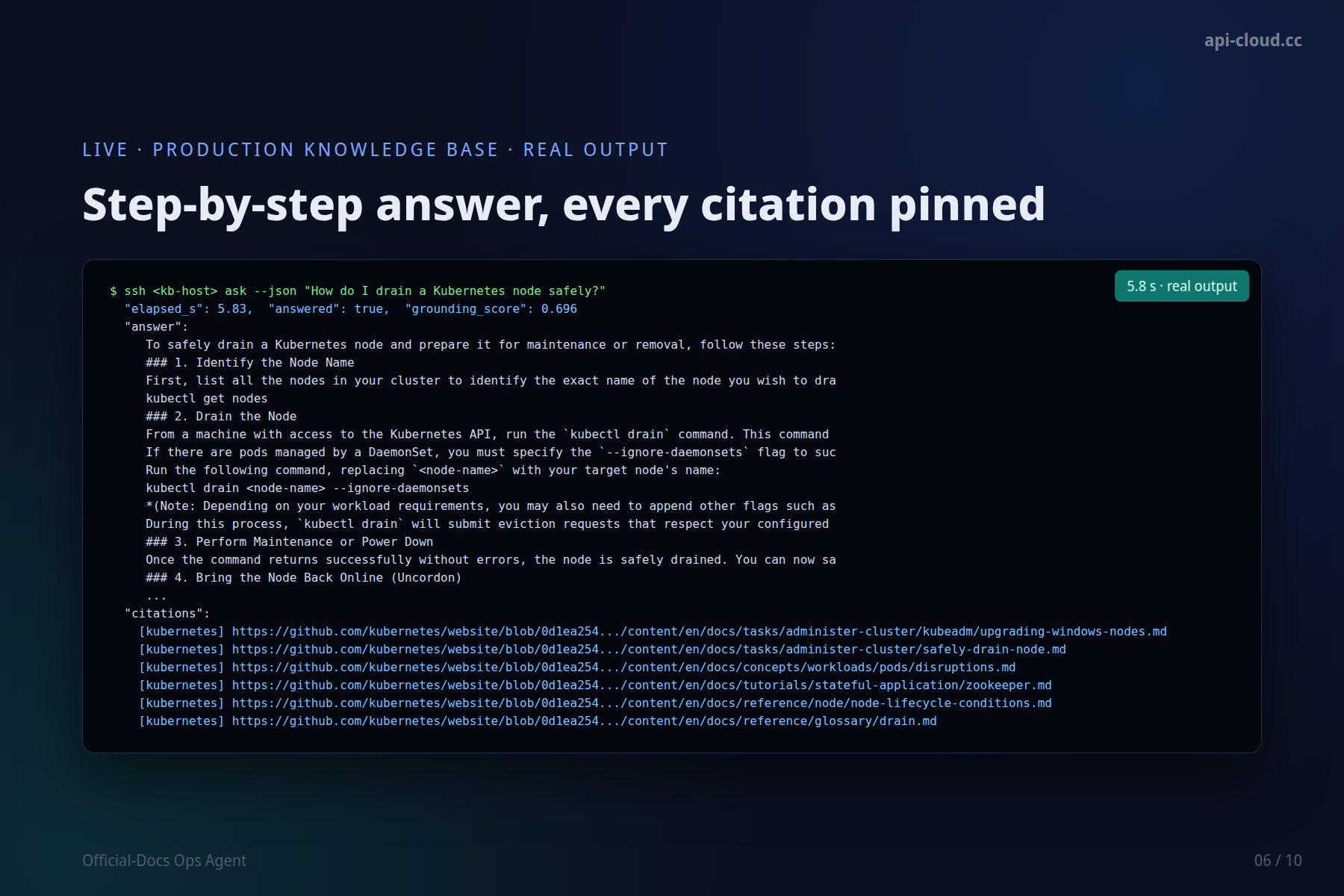
  • In-scope question: grounded step-by-step answer in under 6 seconds, every citation pointing to the exact file in the upstream repo, pinned to a commit.
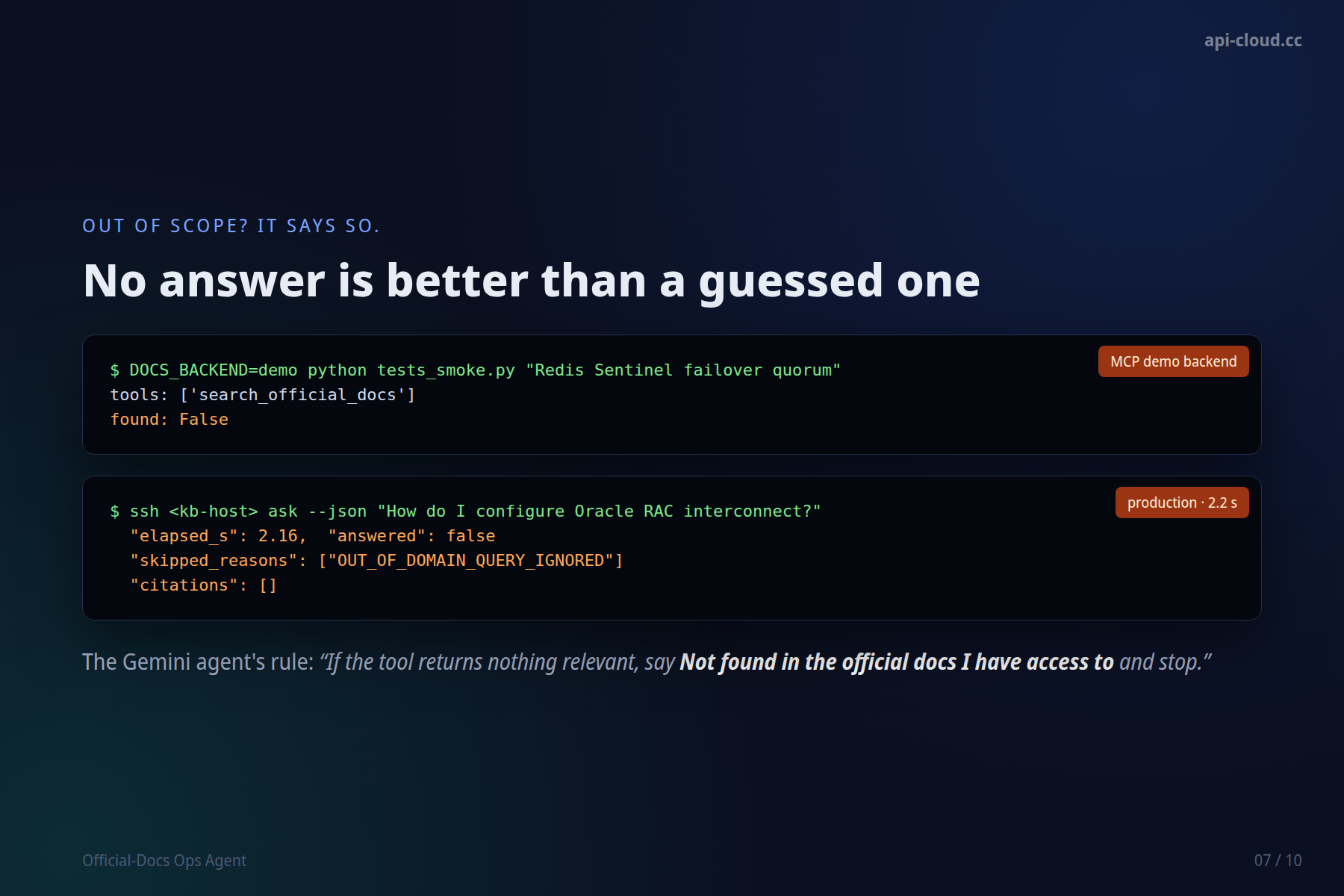
  • Out-of-scope question: "out of domain", no answer, no citations, no guessing.
  • Usage is audited from the server log (one line per call with the agent's identity), never from an agent's self-report.

What I learned

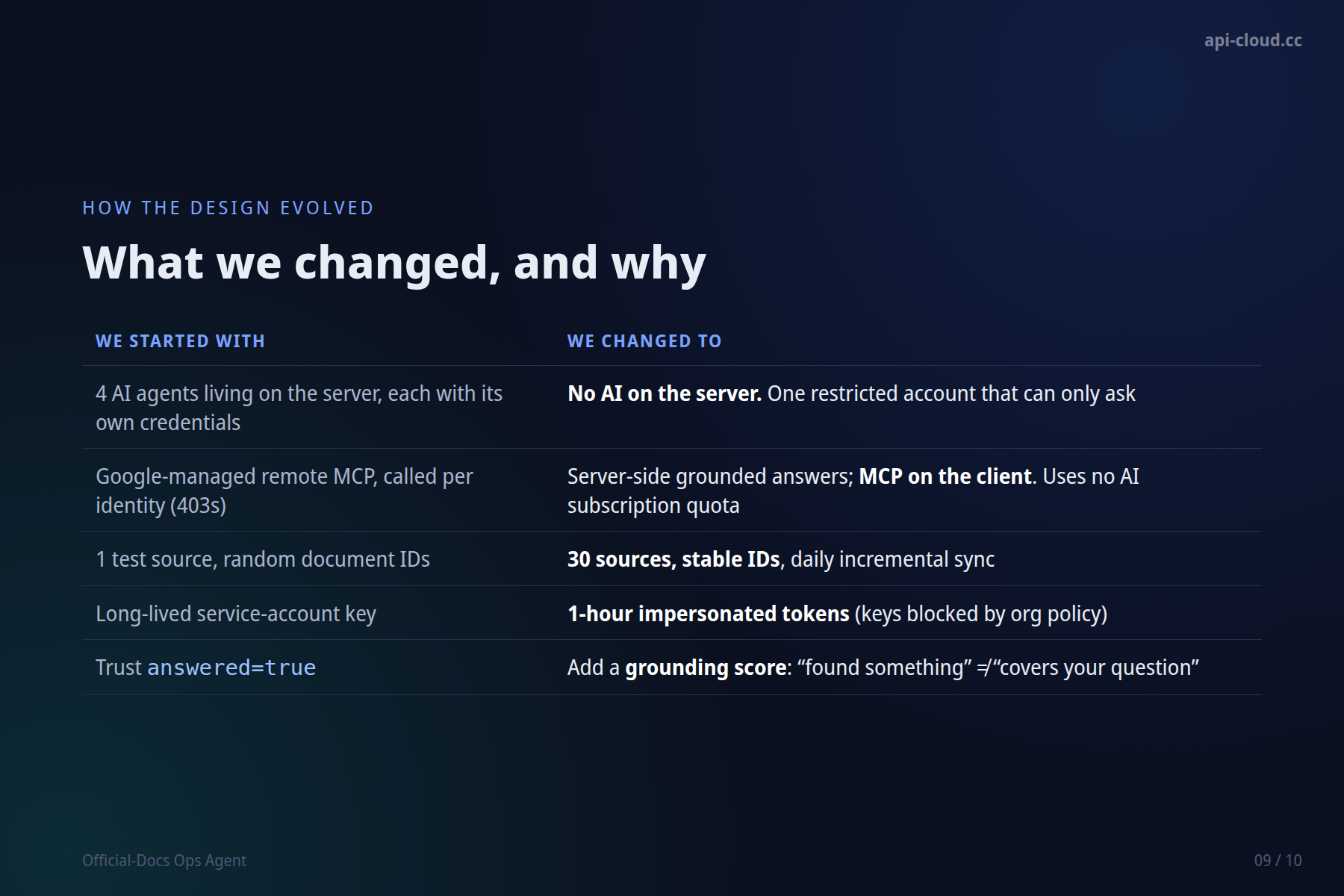
  • Mandatory consult beats "official docs only".Forcing answers to come only from the docs was too rigid. Requiring the check but letting the agents judge, then cross-verifying between agents, works better.
  • Identity is the hard part. Four AI agents living on the server, each with its own credentials, was fragile. One locked-down account that can only ask, with one key per agent, is simpler and auditable.
  • "Answered" is not "covered".A question can return something related without really covering it. A grounding score and honest "not covered" tags matter.
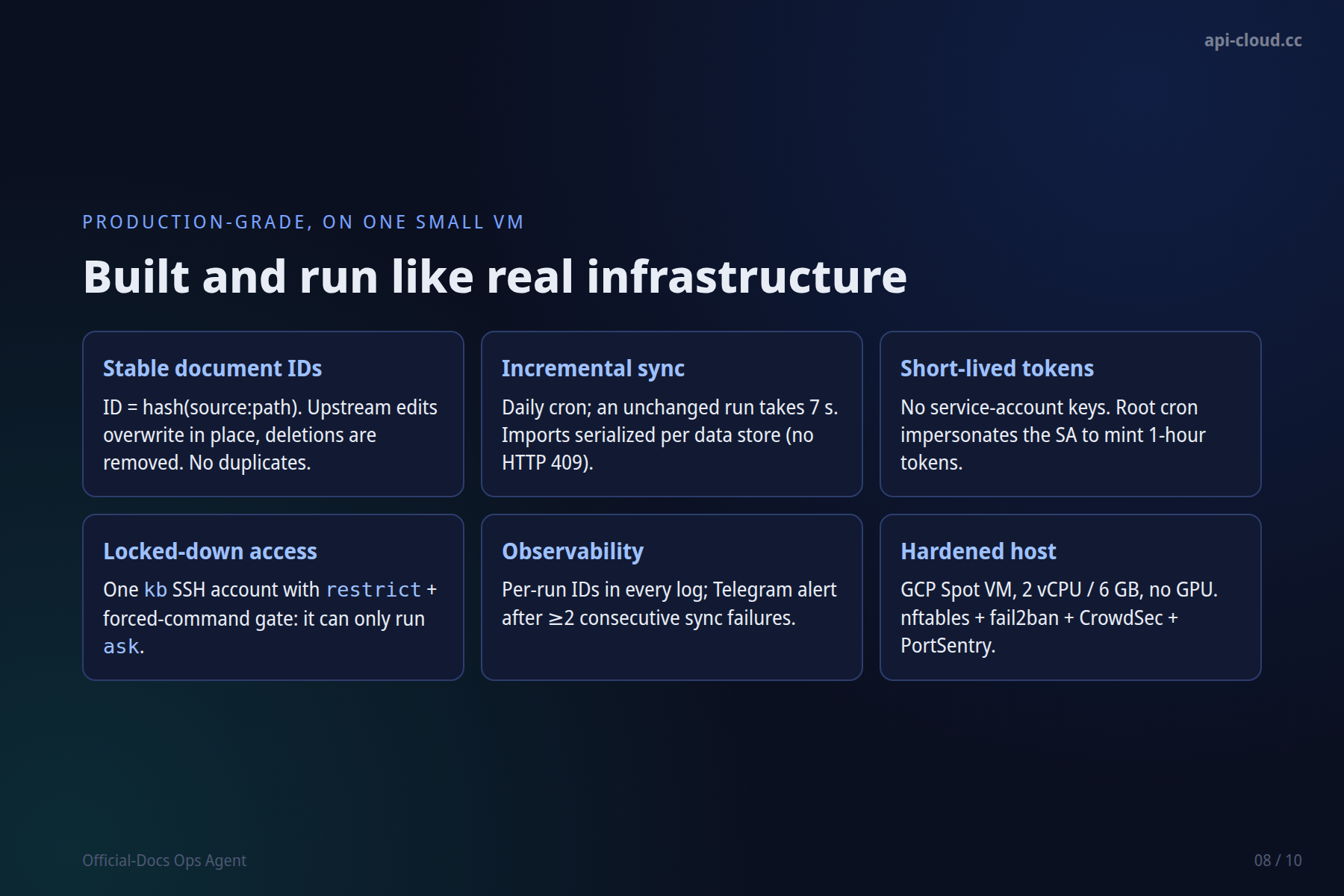
  • Boring engineering wins:stable document IDs, serialized imports, short-lived tokens, per-run IDs in every log.

Built during the hackathon

All code and infrastructure (knowledge base, sync pipeline, restricted ask access, per-agent rules, MCP server and Gemini agent) were built Oct 1–3, 2026, within the submission period. Planning docs (scope, PRD, spec) were written with the Devpost Learn Skill Pack templates after the build and are in the repo's devpost/ folder.

v0.1 is live, and the planning docs are in the repo.

  • Planning docs added: devpost/scope.md, prd.md, spec.md (Devpost Learn Skill Pack templates), including how the design changed during the build.
  • The knowledge-base check now runs for all four agents in my workflow (Claude Code, Codex, Grok, Gemini). Each call is logged on the server with the agent's identity.
  • 10-image gallery added: architecture, the 30 sources, live answer, out-of-scope refusal, design evolution.

Next: a stricter shared rule. An agent may tag a claim "consistent" only if the cited passage supports that exact claim, not just the topic.

Demo: https://youtu.be/l67ilza4aGk Repo: https://github.com/pittzhang20260507/gemini-mcp-docs-agent

Log in or sign up for Devpost to join the conversation.

Submission history