Inspiration
You send a photo to a seller, a landlord or a school. The picture shows a living room. The file can also say where it was taken (GPS to a few metres), which phone took it, that phone's serial number, the exact time, the owner's name and a thumbnail of the picture before you cropped it. PNG screenshots and AI images can carry the prompt or settings used to make them. Most people never see this.
What it does
Offframe is a browser-only tool for JPEG, PNG and WebP files (including animated WebP and WebP with transparency). It:
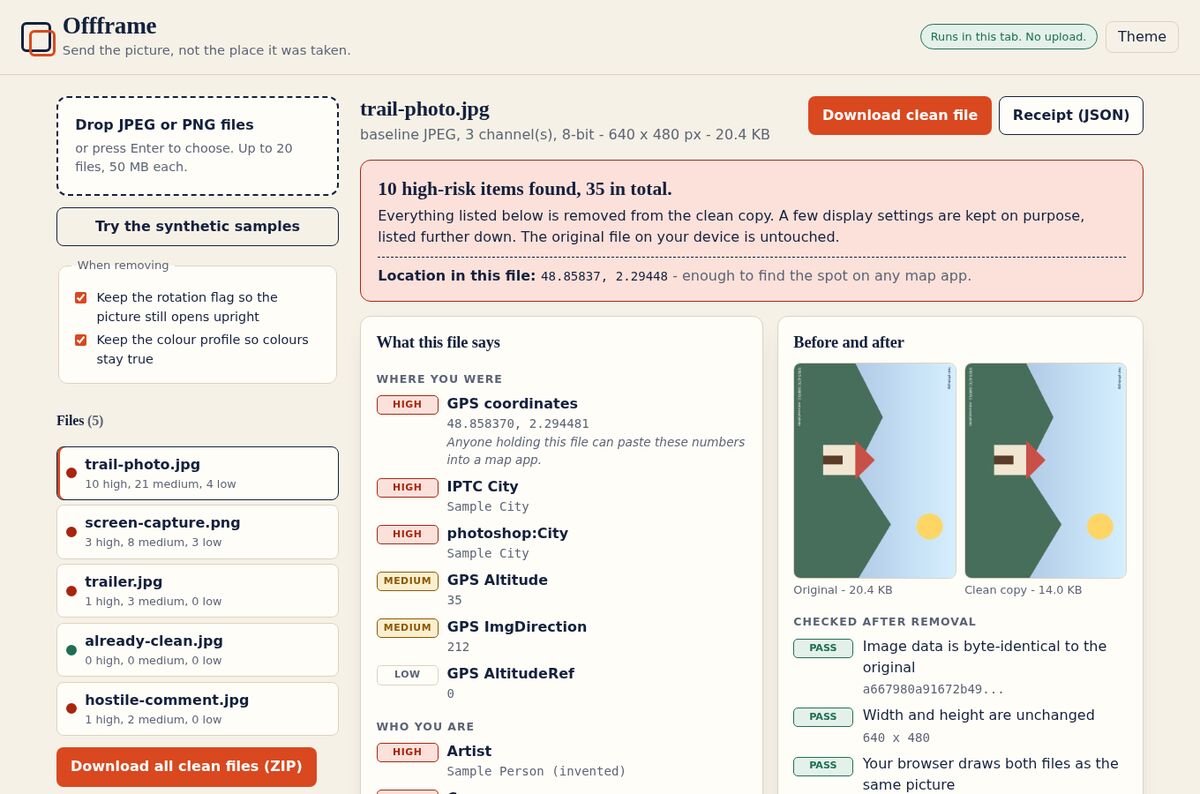
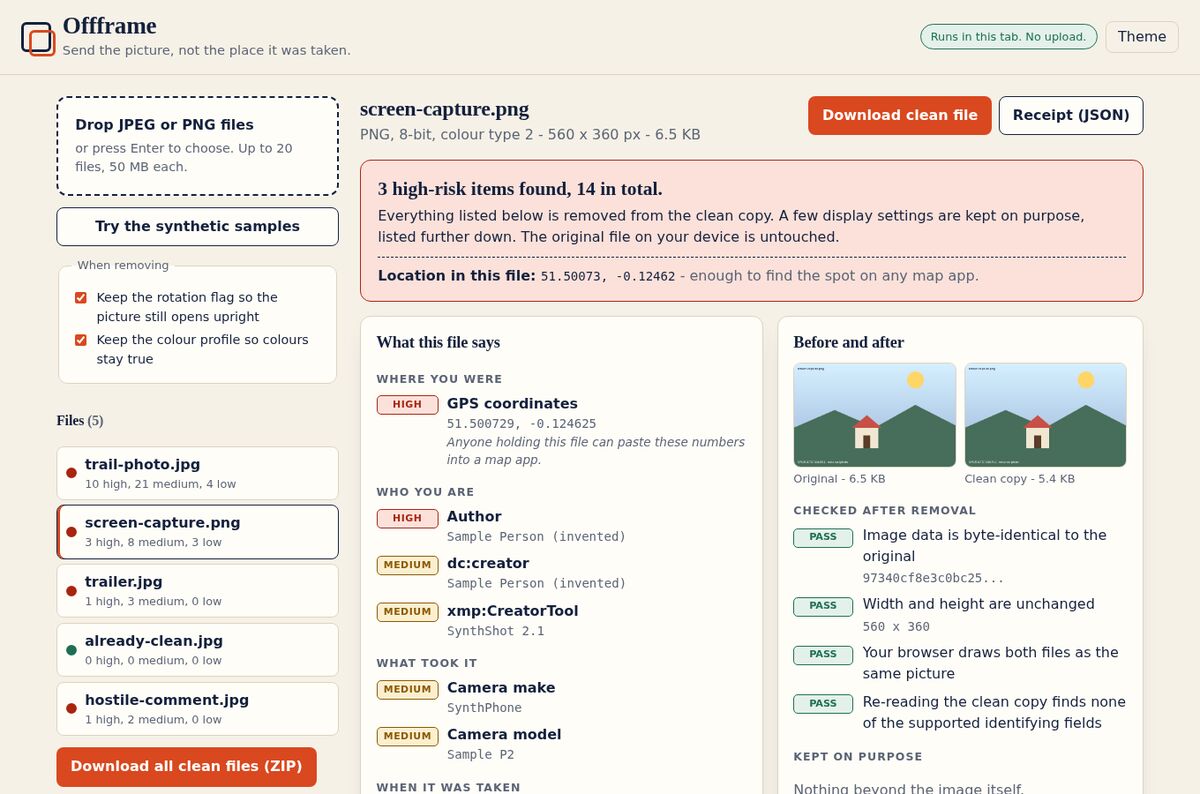
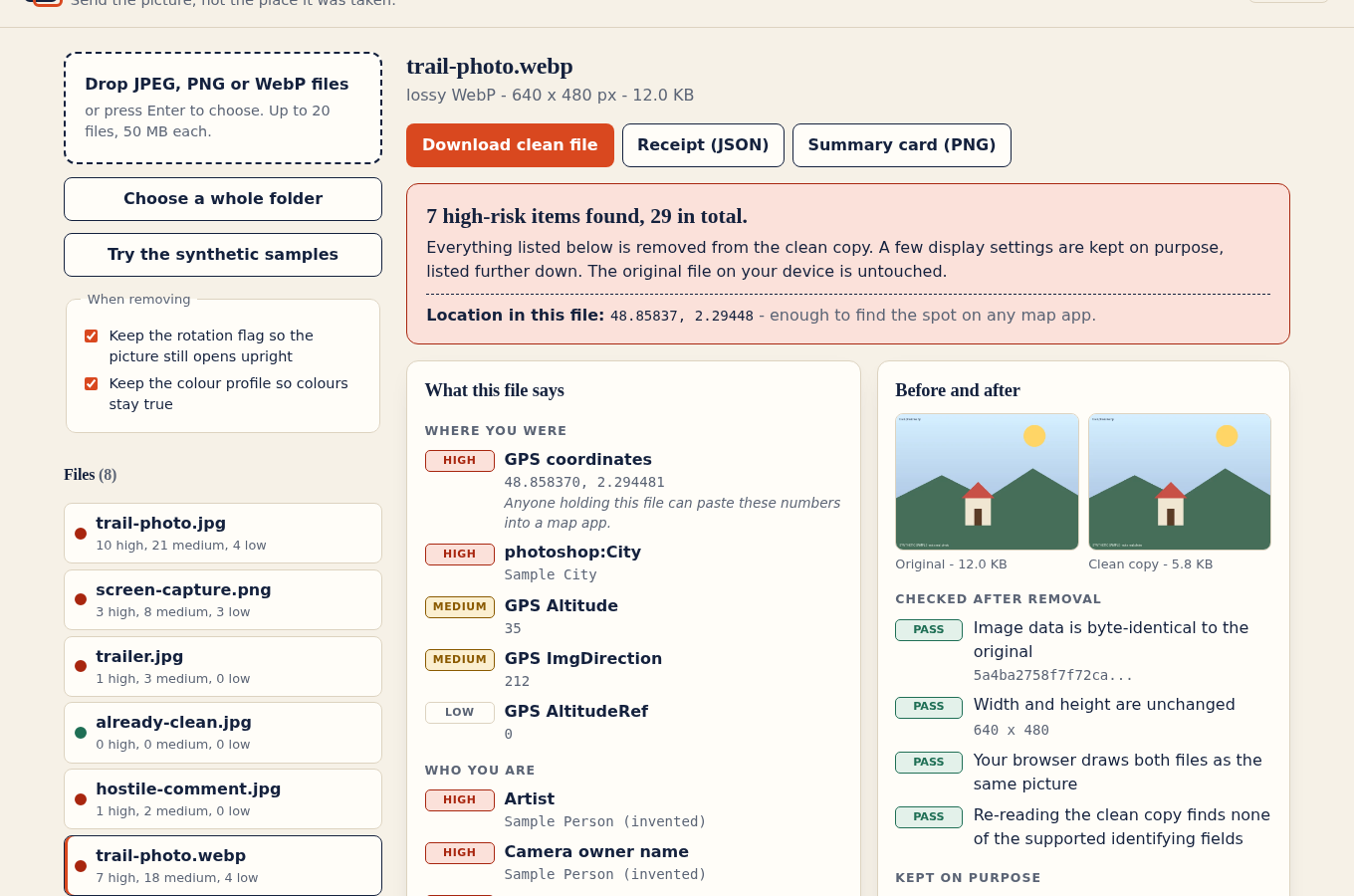
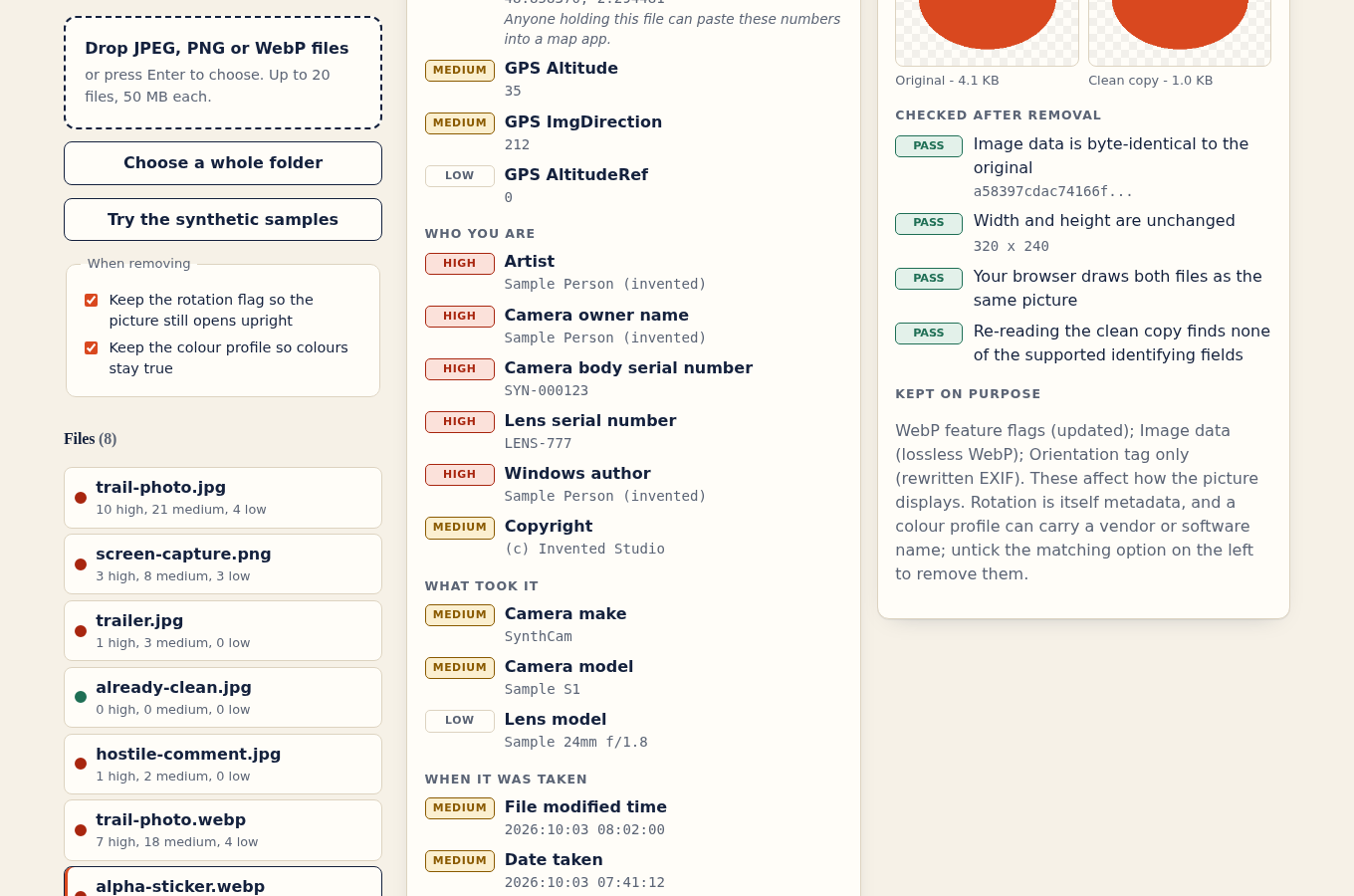
- Audits the file and lists each finding in plain words, ranked high, medium or low risk.
- Removes the metadata it recognises (EXIF, XMP, IPTC, PNG text, time and EXIF chunks, WebP EXIF/XMP chunks, and bytes hidden after the end of the image) without re-encoding the picture, so there is no quality loss.
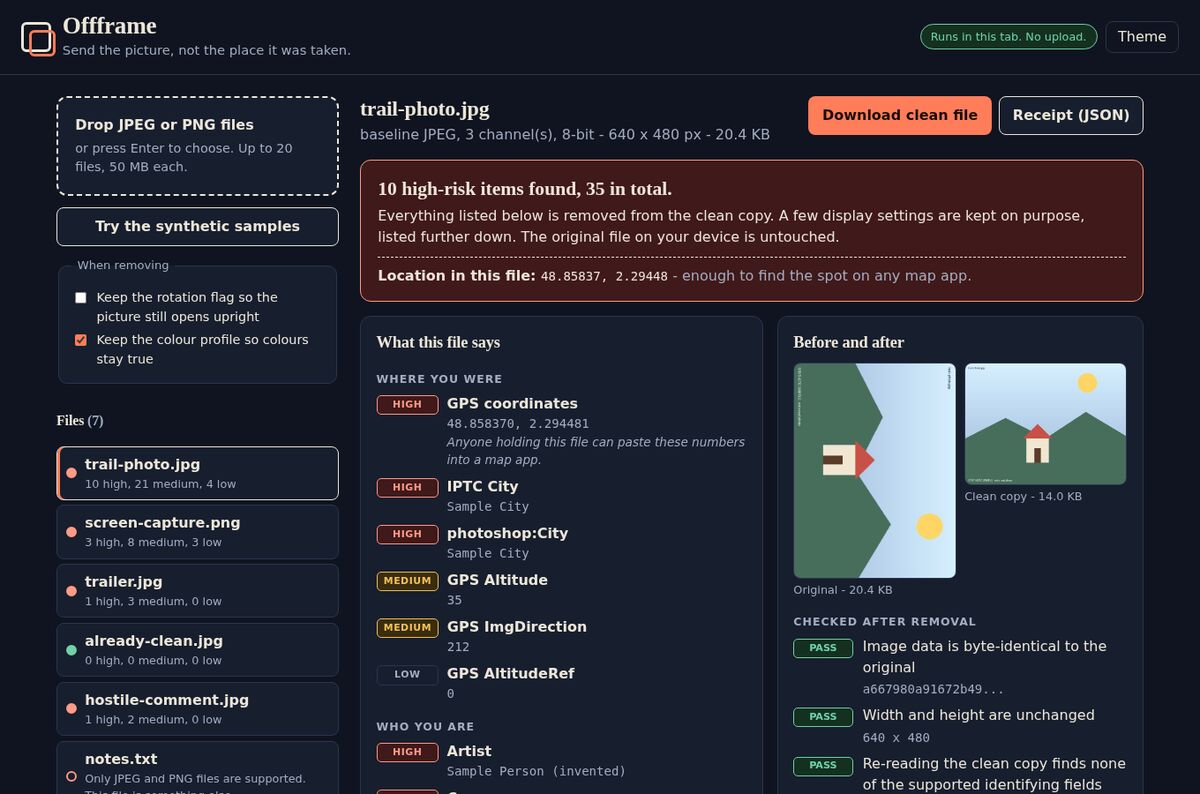
- Checks its own work: the image-data hash is identical, the dimensions match, the browser draws the same picture, and a re-read confirms that the supported identifying fields are gone. It shows what was cut and what was kept.
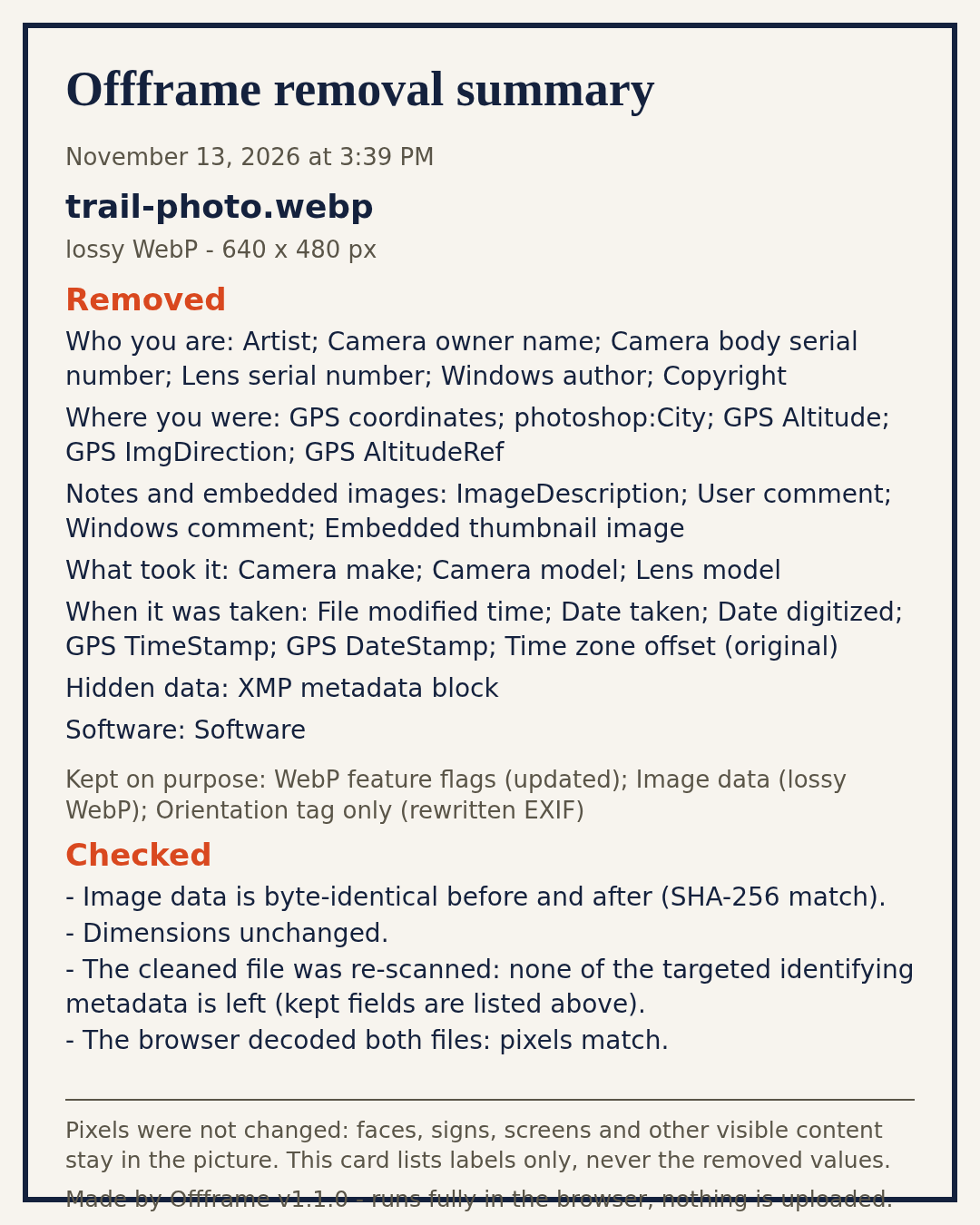
- Hands back the clean file, a JSON receipt that holds hashes and field names (never the removed values), and a shareable summary card (a PNG drawn locally) that says in plain words what was removed and kept for that file. Batch mode handles up to 20 files at once, picked one by one or as a whole folder (unsupported files inside are skipped, not uploaded), and gives a ZIP.
Nothing is uploaded. There is no server, no account and no network call. A strict content security policy blocks outbound requests, and a browser test proves it.
One safer outcome. The sample trail-photo.jpg carries GPS coordinates, an owner name, a camera serial number, a timestamp, XMP, IPTC, a comment and an embedded thumbnail. After Offframe, ExifTool finds none of those fields, and the image data hash is identical before and after. The WebP sample shows the same: GPS, owner and camera fields gone, VP8 image data byte-identical.
One limitation. The pixels are not touched. A face, a street sign, a house number or a screenshot of a private page stays in the picture. Offframe is not a forensic guarantee. It also keeps some metadata on purpose: the rotation flag (so the photo is not shown sideways in viewers that honour it), the colour profile (which can carry a vendor or software name) and display chunks (PNG transparency/gamma/pixel density, WebP transparency and animation). Both optional keeps can be turned off, and the page lists exactly what was kept for each file.
How we built it
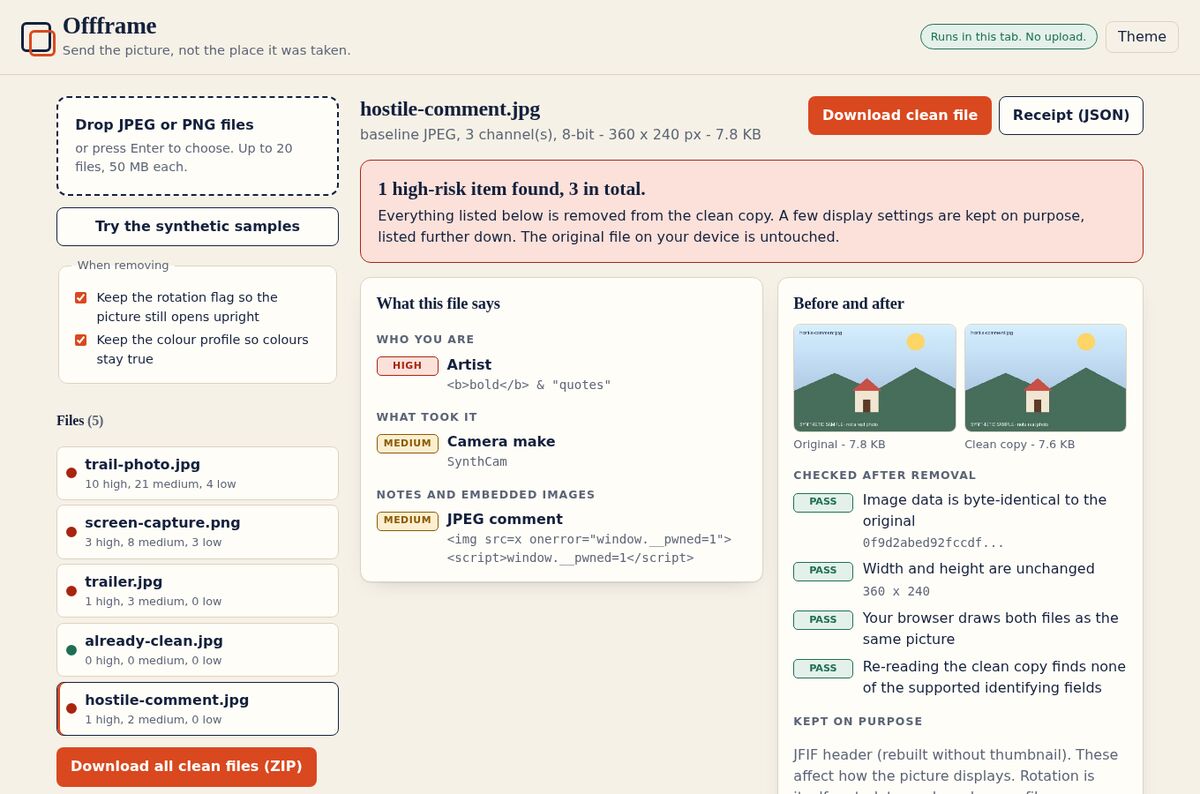
Vanilla JavaScript with zero runtime dependencies. engine.js has its own JPEG segment walker, TIFF/EXIF reader (both byte orders, loop and bounds guards), XMP and IPTC parsers, PNG chunk walker with CRC checks, and a strict WebP RIFF walker that refuses truncated or trailing-garbage files, rewrites VP8X feature flags after stripping, and keeps animation and alpha chunks intact. Stripping copies kept segments and chunks byte for byte. app.js renders every metadata value with textContent only, so hostile text in a file is shown as text and never run. A small stored-ZIP writer handles batch download, and the summary card is drawn on a canvas locally.
Tests: 37 engine and fuzz tests (including 6,000 seeded random mutations of the fixtures), 23 checks that use ExifTool and Pillow as independent checkers, and a full Chrome UI test (downloads verified with ExifTool, receipt has no values, hostile markup stays inert, folder picking skips unsupported files, no off-origin requests, no horizontal overflow at 390 and 320 px, keyboard access). Two behaviours were verified directly in Chrome 158: the stripped animated WebP renders identically frame for frame, and browsers apply rotation flags in JPEG and PNG but ignore them inside WebP files, which is why the WebP warning logic differs.
Challenges
Deciding what could honestly be claimed. We say "supported identifying fields", not "all metadata", and the summary card lists the kept fields per file instead of promising a universal wipe. Keeping the rotation flag without leaking anything else. Finding exact boundaries of JPEG scan data so the hash check is meaningful. Learning that ExifTool cannot write WebP metadata (fixtures are built with Pillow), and that browsers disagree by format on rotation flags. Making hostile and broken files fail safely.
What we learned
"Removed" needs a precise definition. Independent checkers (ExifTool, Pillow) catch things your own parser would miss. Format support is a behaviour matrix, not a decoder checkbox: WebP orientation, animation and alpha each had to be tested in a real browser, not assumed. The wording in the interface is part of the safety design.
How to try it
Open the live app, click "Try the synthetic samples", pick a file in the list, read the findings, download the clean copy and its summary card. Or run it locally: python3 -m http.server 8000 in the repo and open http://localhost:8000. No build step. All sample data is synthetic: GPS points are public landmarks, and every person, owner name and serial number is invented.
Credits and AI assistance
Requested by M J Anthony; an AI assistant selected the technical approach and produced the implementation, tests, demo and documentation. The app's own source was written during the build window (started 13 November 2026) and no earlier project code was reused. The app has no runtime libraries. Pillow and ExifTool (fixtures and independent checks), Playwright with Chrome (UI test) and ffmpeg (video) were used as tools, and the demo narration is AI text-to-speech. Metadata strippers already exist (ExifTool and many web apps). Offframe's angle is the visible verification and the value-free receipt. An unrelated studio uses the name offframe.net; there is no connection.
What's next
HEIC support (needs a full decoder, so it is refused rather than converted today), a command-line mode that reuses the engine, and a separate optional face-blur tool.
Built With
- css
- exif
- html5
- javascript
- privacy
