Odyssey
Inspiration
Everyone starts with motivation: a new fitness target, a study plan, a personal project, or a career goal. The difficult part is not creating the plan—it is remaining consistent after the excitement fades.
Most productivity tools reduce progress to a list of checkboxes. They can tell users whether a task was completed, but they do not always make a goal feel connected to daily effort. When people miss a day, they often feel they have failed completely and abandon the plan.
We wanted to build an experience that makes progress feel visible, rewarding, and realistic. Odyssey is inspired by the idea that every major goal is a journey: users should not have to face the final destination all at once. They should only need to see the next meaningful quest.
What it does
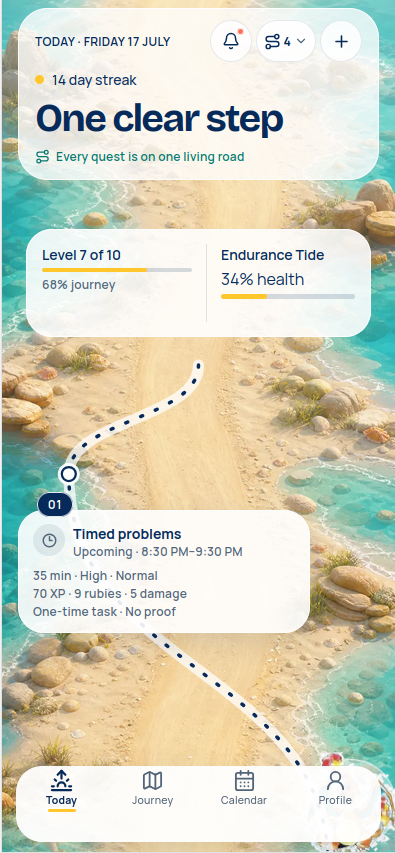
Odyssey is a gamified habit tracker and calendar that transforms long-term goals into structured daily quests.
A user begins by creating a goal and describing their destination, deadline, current starting point, and available time. Odyssey then uses AI to propose a ten-level roadmap containing suggested habits and tasks. The roadmap is not automatically forced on the user; it is an editable proposal, so users remain in control of their own journey.
Users can schedule recurring habits and one-time tasks in the Odyssey Calendar. Every quest can include a priority level, deadline, recurrence pattern, and planned intensity. The Daily Quest Board then keeps the most important work visible, helping users focus on what they need to do today.
When a quest is completed, users record the actual effort as Light, Normal, or Intense. They can build individual habit streaks and an overall Odyssey streak. Completing work earns XP, rubies, rewards, boosts, cosmetics, and progress toward larger milestones.
Odyssey represents roadmap milestones as mini-bosses at levels 3, 6, and 8. The user's final goal becomes the final boss. This creates a clear connection between completing a small task today and making visible progress toward a much larger ambition.
The app is designed to be accountable without being punishing. A missed quest may affect available rewards or break a streak, but it does not erase earned XP, completed roadmap levels, or previously defeated boss health. A missed day remains honest, while the next useful step remains clear.
How we built it
We built Odyssey as a mobile application using React Native, Expo SDK 57, and TypeScript. This stack allowed us to create a modern cross-platform experience while maintaining a strongly typed and maintainable codebase.
Supabase is used as the core backend platform. It handles authentication, application data, user goals, quests, task completions, rewards, roadmap progress, and notification preferences. Supabase Storage is used for photo-proof uploads when users choose or need stronger accountability for a habit.
Privacy was an important part of the design. User goals, completion history, rewards, and proof images are private to the account owner. We use Supabase's row-level security and storage isolation approach to protect user data.
For AI planning, we use AIto generate personalized roadmap proposals. The AI can help turn a broad goal into manageable levels, habits, and tasks. However, users review and edit the proposed roadmap before activating it. AI credentials remain on a protected server-side boundary and are never included in the mobile application.
We also integrated device and in-app reminders to help users remember upcoming and overdue quests. The product design follows a minimal beach-themed visual direction, creating a calm and open environment while still making the journey feel adventurous.
Challenges we ran into
One of the biggest challenges was balancing productivity with gamification. We wanted Odyssey to feel fun and motivating, but not distracting or overly complicated. The game system needed to encourage real effort rather than turn meaningful habits into empty point collection.
Another challenge was defining fair progress rules. Users should feel accountable for missed tasks, but they should not feel that a single bad day destroys weeks or months of work. We addressed this by separating streaks and quest rewards from permanent progress such as XP, completed roadmap levels, and defeated boss health.
AI planning also required careful design. A generated roadmap can be useful, but it should never take control away from the user. Odyssey therefore treats AI output as an editable plan rather than an automatic decision.
Finally, handling reminders, recurring schedules, deadlines, overdue quests, actual intensity, photo proof, and privacy requires reliable data modeling. We focused on keeping these states distinct so that the app can accurately reflect a user's real progress.
Accomplishments that we're proud of
We are proud that Odyssey is not just a habit tracker or just a game. It combines planning, scheduling, accountability, motivation, rewards, and long-term goal progress in one connected experience.
We created a full journey model: users can create goals, receive editable AI roadmaps, schedule daily quests, track priorities and intensity, build streaks, earn rewards, and defeat mini-bosses before reaching their final goal.
We are especially proud of the “progress without punishment” approach. Rather than deleting a user's previous achievements after a missed day, Odyssey protects meaningful progress and helps users return to their journey.
We are also proud of the privacy-first technical foundation. Sensitive user information, including personal goals and photo proof, is protected through authenticated access, row-level data isolation, and secure storage.
What we learned
We learned that productivity is not only about task management. People need a reason to care about completing a task, especially when their larger goal feels far away. Showing the relationship between a daily quest and a long-term destination can make consistency more achievable.
We learned that AI is most useful when it supports decision-making instead of replacing it. An AI-generated roadmap can reduce the difficulty of getting started, but the user must always be able to review, edit, and own the plan.
We also learned that thoughtful progress design matters. Streaks can be motivating, but they can also discourage users if they are treated as the only form of success. Preserving earned progress creates a healthier and more sustainable experience.
What's next for Odyssey
Our next step is to make roadmaps more adaptive. We want the app to respond intelligently when users miss a week, change their availability, complete work faster than expected, or adjust their deadline.
We also plan to expand analytics so users can better understand their consistency, habit performance, intensity patterns, and overall goal progress over time.
Future improvements include richer reward customization, more personalized reminders, additional roadmap templates, stronger accountability options, and deeper visual progression throughout the journey.
Ultimately, we want Odyssey to become a trusted companion for people working toward meaningful goals—not just a place to track tasks, but a place where they can see how every small action moves them forward.
Built With
- aiplanning
- appdevelopment
- dailyroutine
- expo.io
- goaltracker
- habittracker
- reactnative
- supabase
- typescript


Log in or sign up for Devpost to join the conversation.