-
-
ODDOL
Inspiration
With the growing availability of open data sources, it is time that online learning makes the most of these sources allowing students to easily experiment, verify, improve and interact with them and build quick and shareable dashboards with other students.
Problem
During the COVID-19 crisis, a lot of data has been released around the world daily. Most of these are not properly curated and therefore not easily findable. Most of our current online learning approaches make use of some pre-fabricated data. They may help explain some topics, but the students and online learners learn very little about the real social and economic impacts from these prepared datasets. Therefore, online learning must be driven by open datasets.
Secondly, even if some open datasets are used by a small group of researchers, their usage may not be known to other online learners. It is essential to know the purpose, usage, and the results obtained by the data analysis. Not only will this help the online instructors to prepare and improve their courses with interesting real-life use cases but also help the students verify as well as improve already published research works. Therefore they need to be curated considering the choice of licenses, purpose, use, etc.
Finally, there must be a possibility to contribute and curate new datasets obtained from the data analysis results as well as new experimental results.
Solution: ODDOL
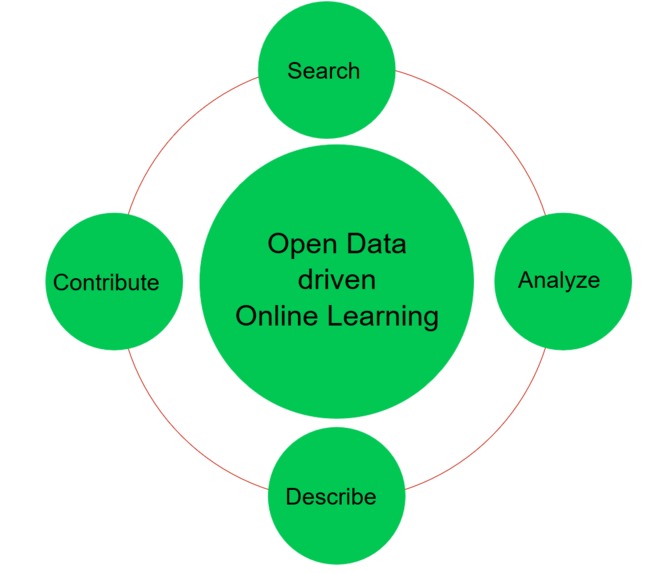
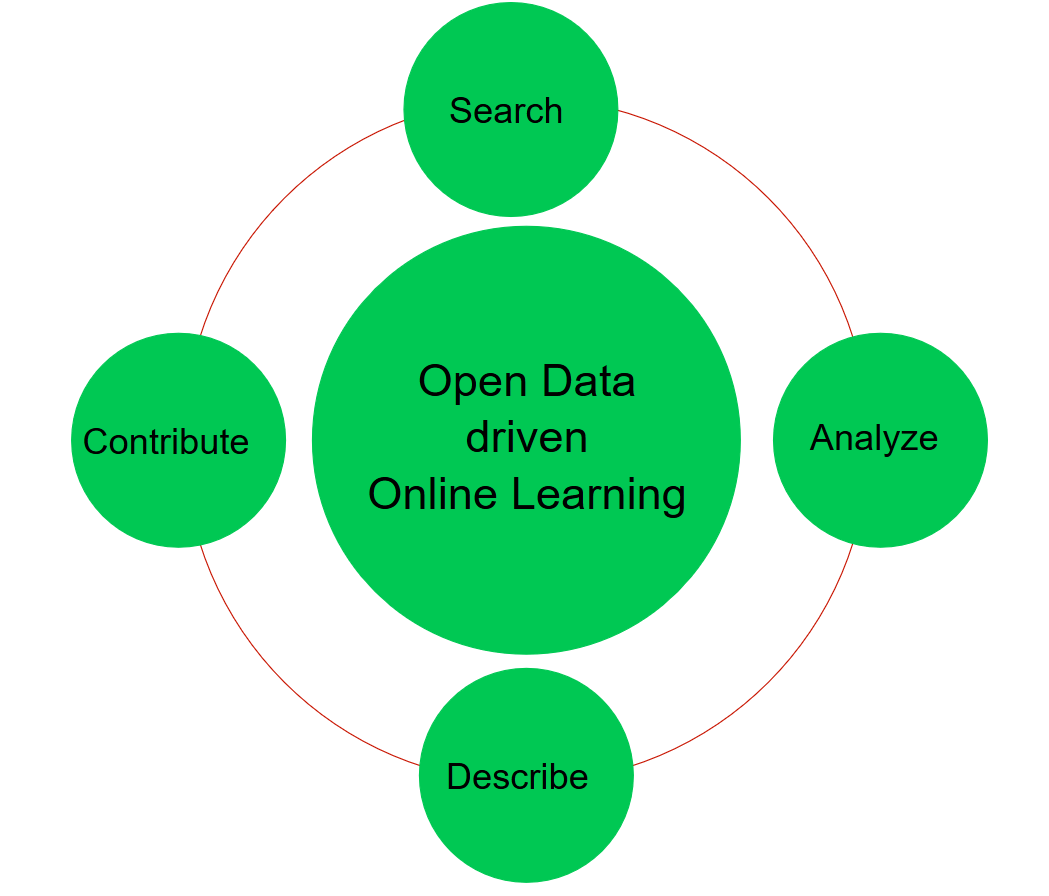
ODDOL revolves around four principles for making the best use of open data.
- Search
- Analyze
- Describe
- Contribute
It helps the users search the datasets based on the license, help them analyze their existing uses and purposes, use them for their projects, describe their use as well as help them contribute in the form of curation of new experiment datasets and results.
Tools used
- Wikidata
- HTML, Javascript, Nodejs, CSS
- SPARQL
- Mediawiki API
- Material design
- Shape Expressions (ShEx)
- Python
What you have done during the weekend
- Architecture, Models and demo for an open dataset use: Design
- Building open models on Wikidata for the following related to data sources
- dataset: https://www.wikidata.org/wiki/EntitySchema:E207
- SPARQL endpoint: https://www.wikidata.org/wiki/EntitySchema:E208
- API endpoint: https://www.wikidata.org/wiki/EntitySchema:E209
The solution’s impact to the crisis
ODDOL ensures that the curation of open data by the community members achieves the following
- lessons from others' experiences
- maximum data reuse
- verifiability of results
- improvements and possible corrections
The necessities in order to continue the project
- Automated annotation linking datasets and results
- Periodic open dataset usage reports
- Analysis of results based on algorithms
- Ability to edit and describe a dataset and write a report directly on the platform
- Integration with other applications like Zenodo, Figshare, etc.
- Easy access on mobile devices
The value of your solution(s) after the crisis
The current crisis has shown the importance of open data and the need to understand the decisions taken by the policymakers around the world. This transparent nature of open-data and decisions driven by open data will continue to play a major role even after the crisis. Thus community-driven approach to use, curate, publish and contribute open data needs to be supported.
Built With
- css
- html
- javascript
- opendata
- python
- wikidata


Log in or sign up for Devpost to join the conversation.