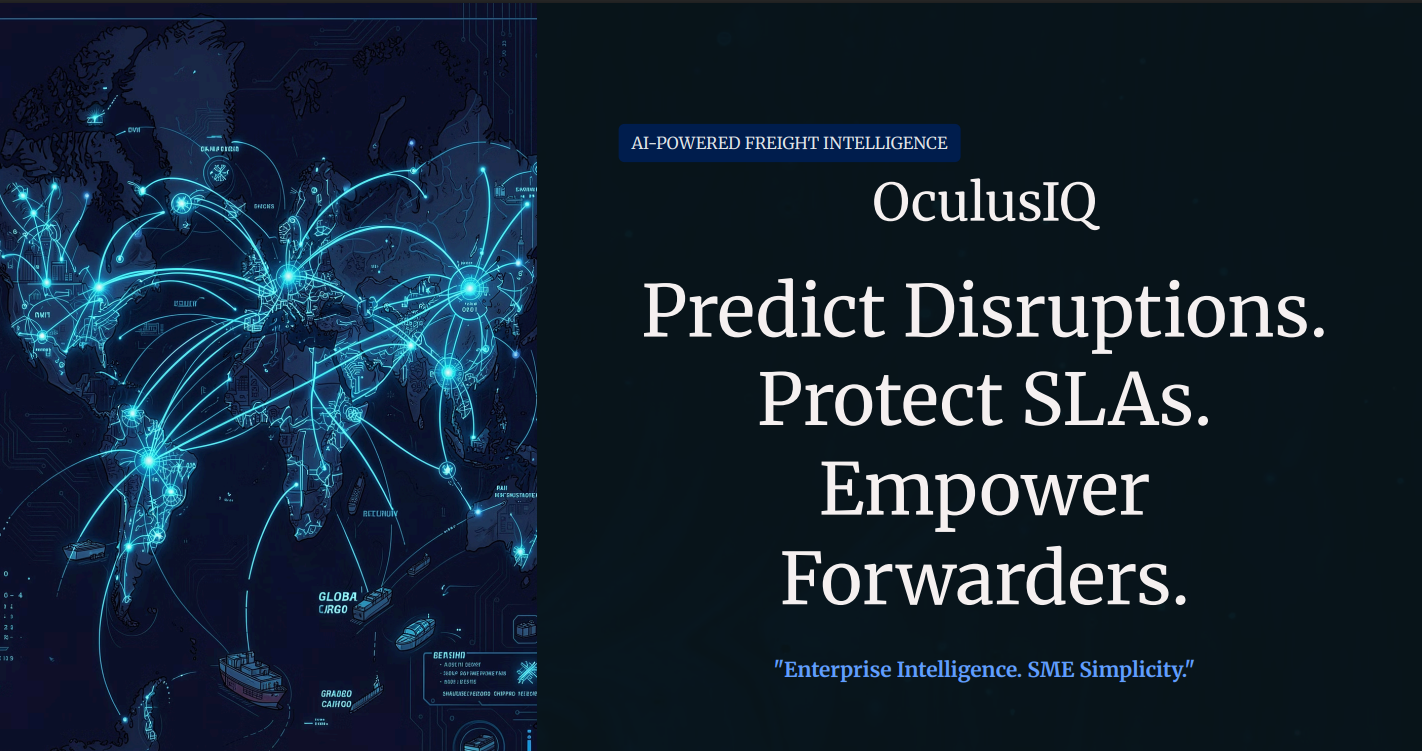
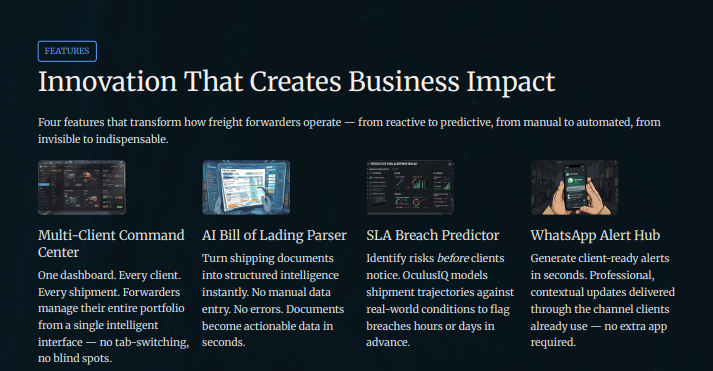
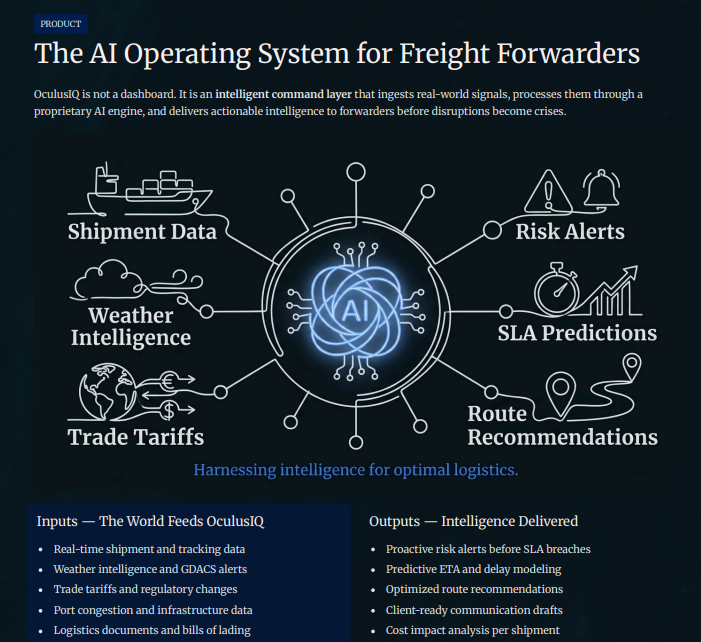
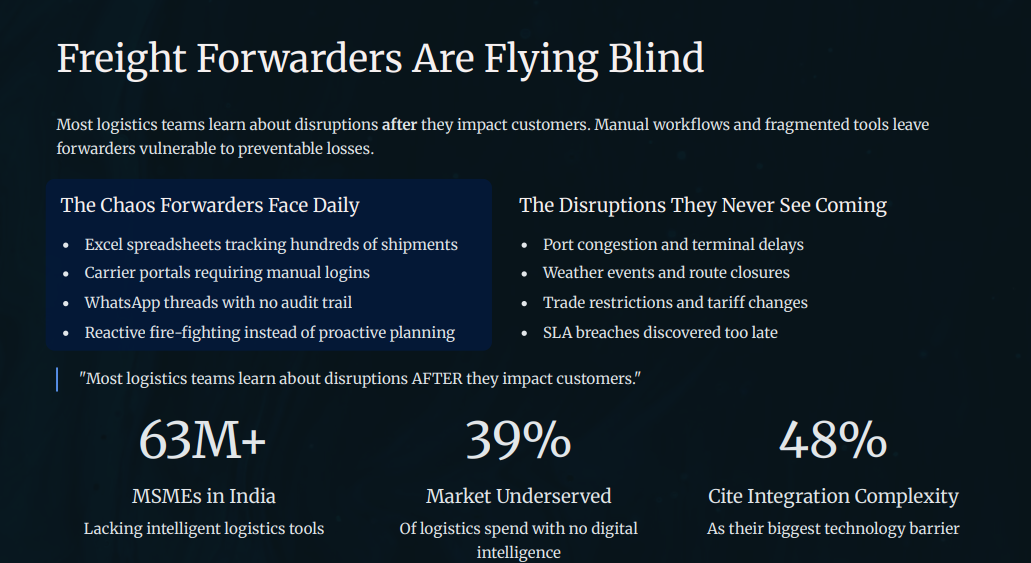
OculusIQ isn't another dashboard.
It's a team of specialized AI agents that continuously monitor operations, identify disruptions, estimate impact, recommend actions, and communicate decisions before problems become business losses.
Six agents.
One shared operational memory.
One objective:
Protect business continuity.
Drop operational data into OculusIQ and the platform automatically:
✅ Identifies operational risks
✅ Predicts SLA breaches
✅ Estimates disruption impact
✅ Extracts intelligence from documents
✅ Simulates response scenarios
✅ Generates recommended actions
✅ Creates stakeholder-ready alerts
Instead of reacting to disruptions, teams get the opportunity to prevent them.
🎯 The Product Brief We Built Against (Step 0)
Imagine you're an Operations Manager.
You manage suppliers.
You manage shipments.
You manage production schedules.
You manage deadlines.
And every morning starts the same way:
"What's going to break today?"
Success for OculusIQ meant solving that problem.
Our definition of success:
- Detect disruptions before they affect operations.
- Explain why the disruption matters.
- Estimate business impact.
- Recommend mitigation actions.
- Deliver decisions instead of dashboards.
- Never force users to manually connect data sources.
If we achieved those six goals, we believed we would have built something genuinely useful.
🚨 What It Does (The Story)
A shipment leaves a supplier.
Three days later a severe weather event develops.
A critical route is affected.
The supplier misses a milestone.
Production schedules become vulnerable.
Most systems would simply show data.
OculusIQ starts a conversation.
Agent 1 — The Watcher
The Risk Intelligence Agent continuously scans:
- Operational activity
- Supplier dependencies
- Shipment status
- Weather systems
- External disruptions
It doesn't ask:
"What happened?"
It asks:
"What could happen next?"
The agent creates an operational risk profile and writes it into shared memory.
Agent 2 — The Forecaster
The SLA Prediction Agent never re-reads the original data.
Instead it recalls the Watcher's findings.
Using disruption severity, dependency chains, and operational context, it estimates:
- Delay probability
- SLA risk
- Production impact
- Escalation urgency
The result is not just a warning.
It's a forecast.
Agent 3 — The Economist
A disruption rarely creates a single problem.
It creates financial consequences.
The Cost Intelligence Agent recalls previous findings and evaluates:
- Alternative routes
- Tariff impacts
- Supplier alternatives
- Cost implications
Operations teams don't just learn what is happening.
They learn what it will cost.
Agent 4 — The Archivist
Critical knowledge often hides inside:
- Bills of Lading
- PDFs
- Invoices
- Procurement records
- Logistics documents
The Document Intelligence Agent transforms unstructured files into structured operational memory.
Knowledge becomes searchable.
Reusable.
Actionable.
Agent 5 — The Strategist
Now the platform has:
- Risk intelligence
- Cost intelligence
- Operational intelligence
- Document intelligence
The Operations Agent combines everything.
It answers:
What should we do next?
Not what happened.
Not what might happen.
What should happen.
Agent 6 — The Communicator
The final challenge is always communication.
The Communication Agent converts operational intelligence into:
- Stakeholder alerts
- Executive summaries
- Operational reports
- Recommended actions
The right people receive the right information at the right time.
🧩 Why Multiple Agents?
Because complex decisions require specialized expertise.
Each OculusIQ agent owns a specific responsibility.
No agent works alone.
Every agent contributes intelligence to a shared operational memory layer.
Every downstream decision is built on upstream context.
This creates:
- Better reasoning
- Less duplication
- Explainable decisions
- Faster analysis
- Stronger recommendations
The system doesn't just answer questions.
It develops operational awareness.
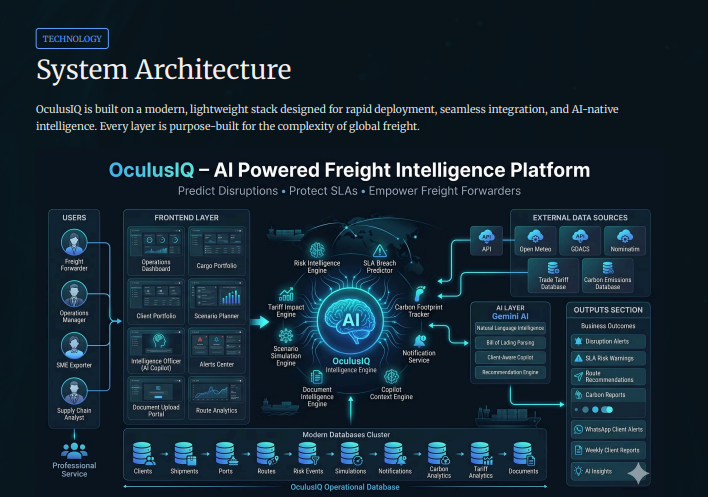
🏗️ Agent Architecture & Exact Handoffs
Operational Data
        ↓

Risk Intelligence Agent
        ↓
Shared Memory

SLA Prediction Agent
        ↓
Shared Memory

Cost Intelligence Agent
        ↓
Shared Memory

Document Intelligence Agent
        ↓
Shared Memory

Operations Decision Agent
        ↓
Shared Memory

Communication Agent
        ↓

Decision • Action • Alert
Nothing moves directly agent-to-agent.
Everything moves through shared memory.
This guarantees:
- Traceability
- Explainability
- Context preservation
- Agent independence
- Scalable collaboration
🔄 The Self-Learning Loop
OculusIQ doesn't simply monitor.
It learns.
Every disruption.
Every recommendation.
Every outcome.
Every decision.
These become new operational signals.
The platform continuously improves its understanding of:
- Risk patterns
- Supplier behavior
- Disruption impact
- Operational bottlenecks
Each run makes the system smarter than the last.
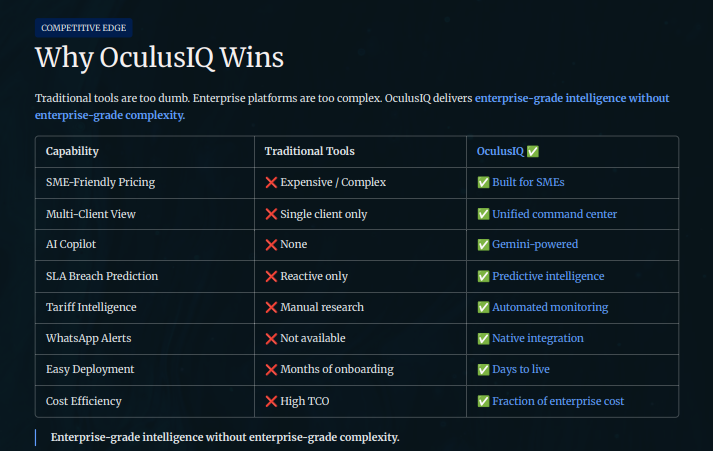
🚀 What Makes OculusIQ Different?
Most tools answer:
What happened?
Some tools answer:
What is happening?
OculusIQ answers:
What happens next?
What should we do about it?
Who needs to know?
That's the difference.
🛠️ How We Built It
Frontend
- React
- Vite
- Recharts
Backend
- FastAPI
- Python
- SQLite
AI Layer
- Google Gemini AI
- Multi-Agent Architecture
- Shared Memory Layer
- Context Handoff Engine
- Decision Intelligence Framework
External Intelligence
- Open-Meteo
- GDACS
- Nominatim
🏆 What We're Proud Of
- Built a true multi-agent system.
- Implemented memory-based collaboration.
- Created explainable operational intelligence.
- Integrated real-world disruption signals.
- Developed AI-powered document understanding.
- Designed an architecture focused on decisions, not dashboards.
Most importantly:
We built a system that helps organizations prevent problems instead of simply reporting them.
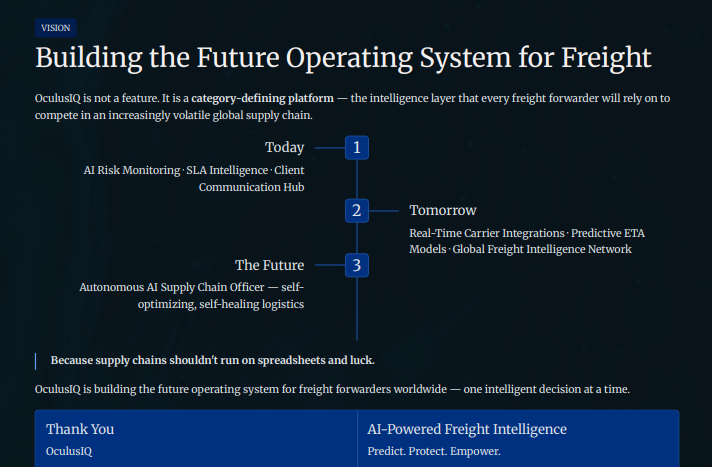
🔮 What's Next?
Next-generation OculusIQ will introduce:
- Long-term memory
- MCP integrations
- Autonomous planning agents
- Digital twins
- Predictive inventory intelligence
- Enterprise workflow automation
Our vision is simple:
Every organization deserves an AI operations team that never sleeps, never misses a signal, and never stops learning.
Built With
- fastapi
- gdacs-api
- google-gemini-ai
- javascript
- nominatim-geocoding-api
- open-meteo-api
- python
- react
- recharts
- rest
- sqlite
- vite

Log in or sign up for Devpost to join the conversation.