🐙 Project Story: OctoMind
💡 Inspiration
In today’s digital world, people express emotions mostly through text — in messages, posts, or chats — yet these emotions often remain unnoticed or misunderstood.
I wanted to create something that could understand human emotions from text and make interactions with technology feel more human.
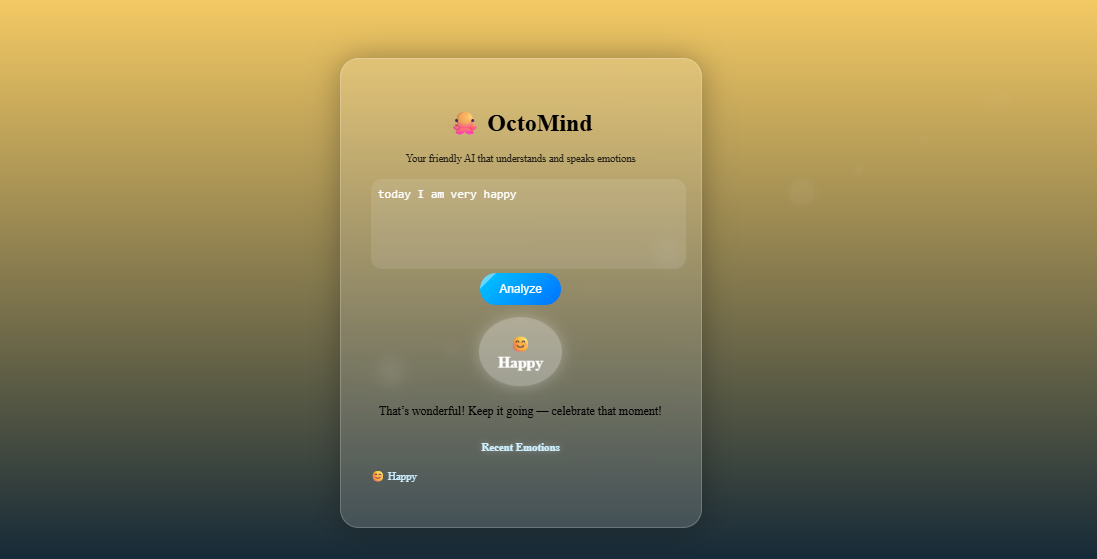
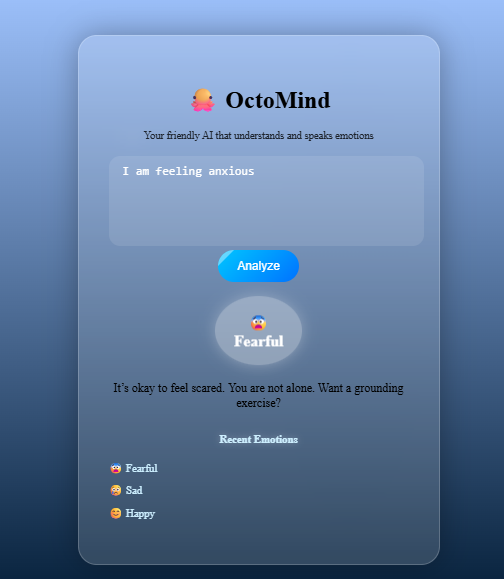
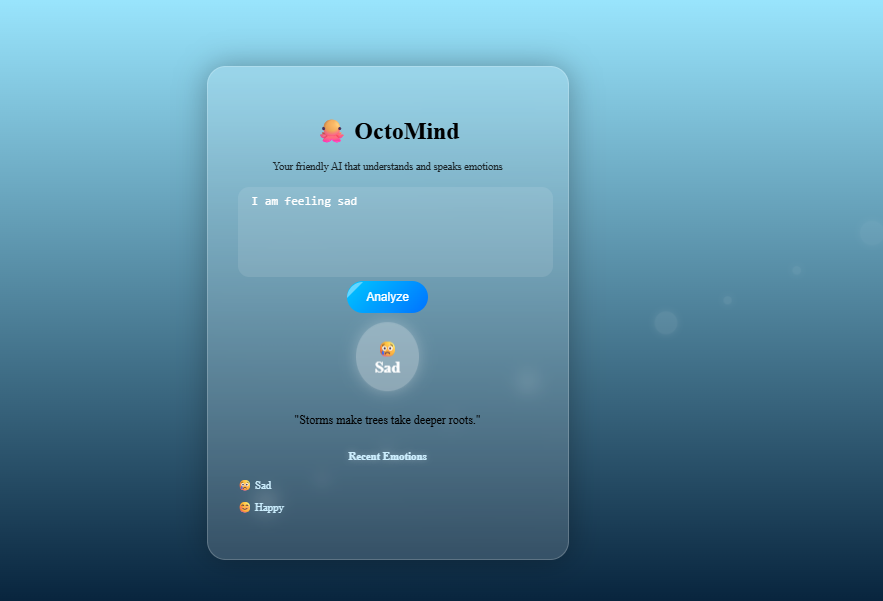
That’s how OctoMind was born — a simple but smart web app that detects emotions from text input.
🧠 What I Learned
During this project, I learned:
- How to integrate Flask (Python backend) with a frontend built using HTML, CSS, and JavaScript.
- Basics of Natural Language Processing (NLP) and how it can be used for emotion detection.
- How to send and receive data between frontend and backend using HTTP requests.
- Structuring a complete web app and deploying it to GitHub properly with a professional README.
🏗️ How I Built It
I started by designing a simple and clean web interface using HTML, CSS, and JavaScript.
Then, I built a Flask backend in Python to process the input text.
The text data is passed from the frontend to the backend, where an NLP-based model analyzes it and returns the detected emotion.
The detected emotion is then displayed instantly on the webpage with smooth transitions for a better user experience.
⚙️ Tech Stack
- Frontend: HTML, CSS, JavaScript
- Backend: Python (Flask)
- Libraries: Flask, TextBlob (or similar NLP library)
🚧 Challenges I Faced
Every project has challenges, and OctoMind was no different:
- Integrating the frontend with the Flask backend correctly took some trial and error.
- Managing real-time emotion detection and keeping the interface smooth at the same time.
- Creating a clear and readable UI that looks good but doesn’t distract from the main purpose.
- Debugging connection issues between JavaScript and Flask routes.
💡 Future Improvements
- Add voice emotion detection.
- Improve accuracy using deep learning models.
- Provide suggestions or motivational quotes based on the detected mood.
🏁 Conclusion
Building OctoMind was an amazing learning experience!
It helped me understand how machine learning concepts can be applied to real-life emotional intelligence systems.
In the future, I plan to enhance it with voice or facial emotion detection and make it more interactive.
“Technology should not only be smart — it should also be emotionally aware.”


Log in or sign up for Devpost to join the conversation.