Inspiration
Most productivity tools assume you can carefully plan your whole day. In reality, life feels more like an octopus with too many things in too many tentacles: work, studying, side projects, life admin, health, family…
When you finally have 60–90 minutes free, you often don’t know what to do first. You open your task manager, get overwhelmed, maybe reorganise tasks a bit… and the session is half gone.
We wanted something extremely small and honest:
“Given this messy list and this amount of time, what is a realistic micro-plan I can actually follow right now?”
That’s how OctoFocus was born: a tiny “octopus brain” that turns chaos into a short, focused session plan.
What it does
OctoFocus is a micro-planner for short work or study sessions.
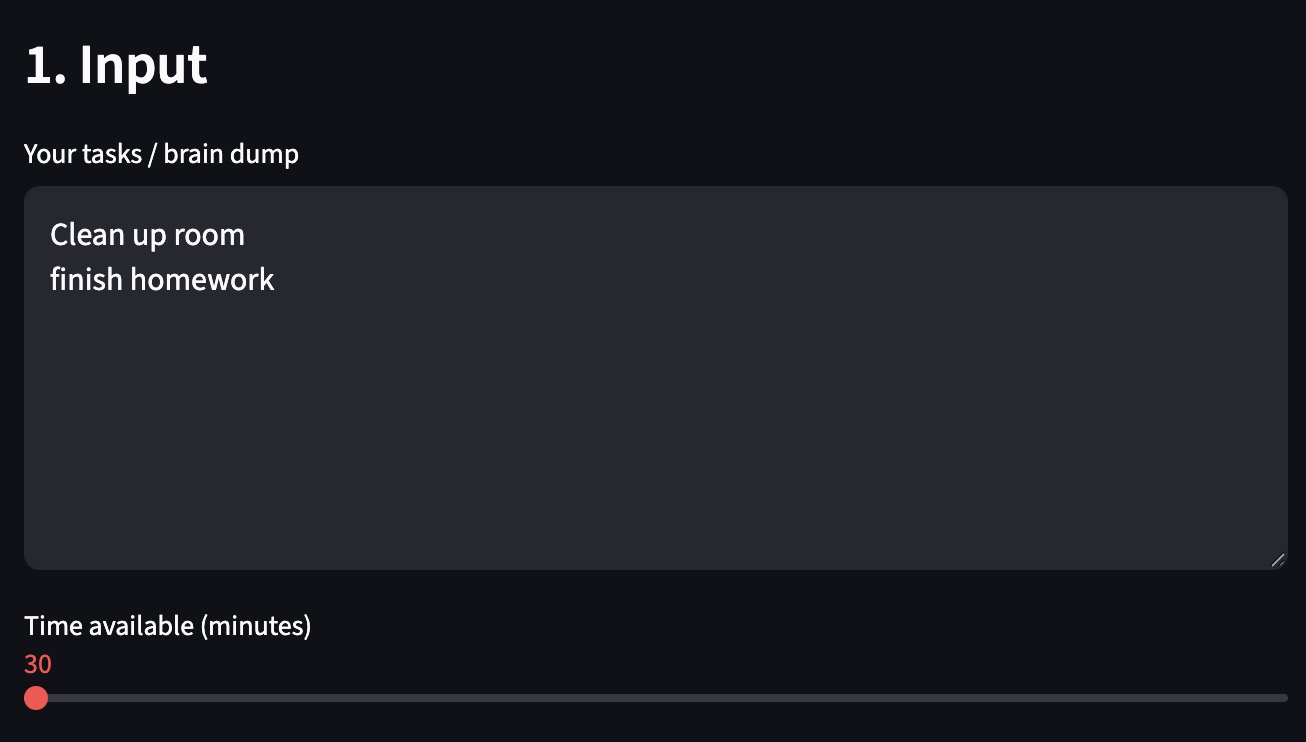
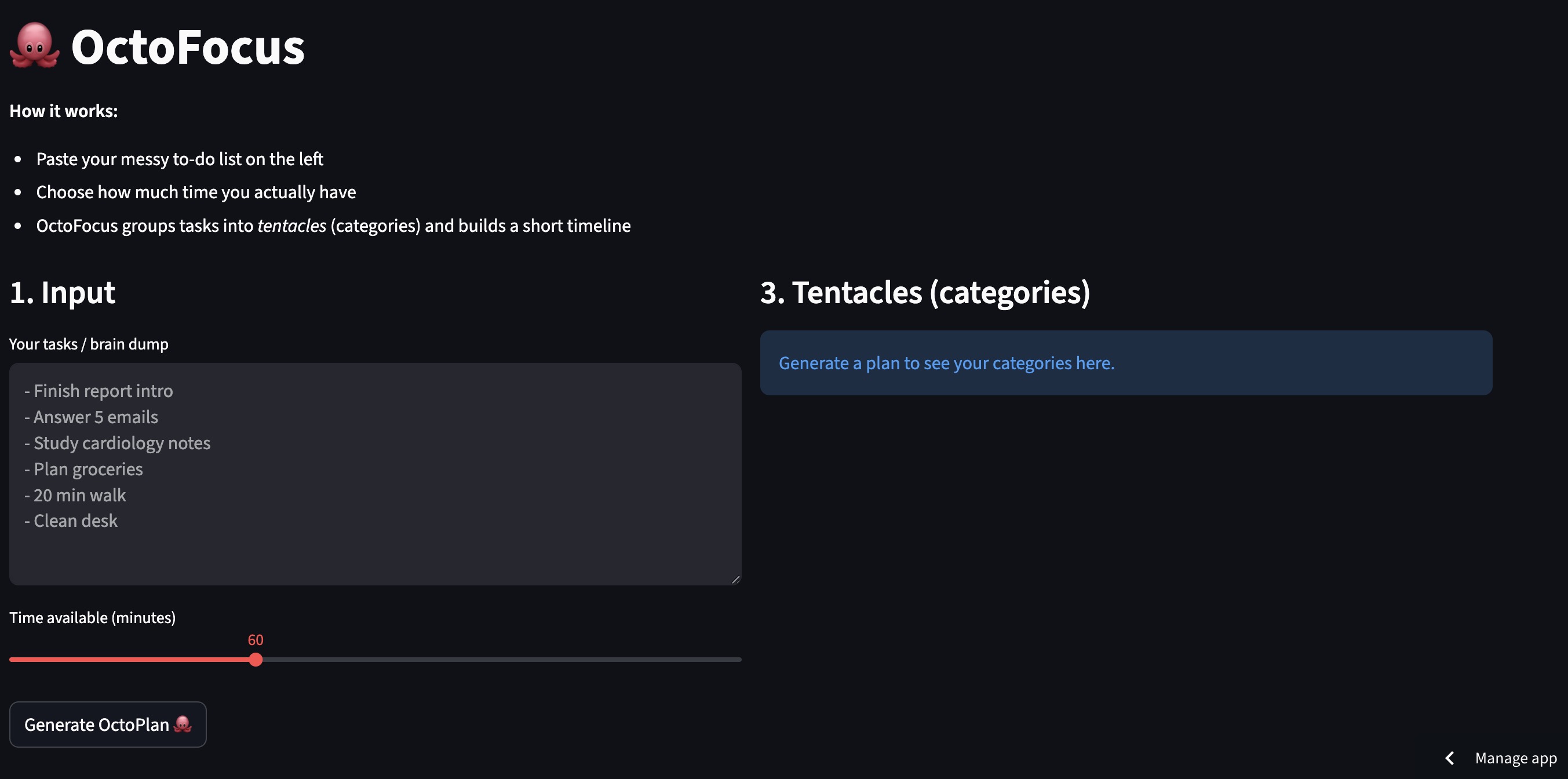
- You paste your messy to-do list (bullets or plain text).
- You choose how much time you really have (30–120 minutes).
- The app:
- parses your tasks,
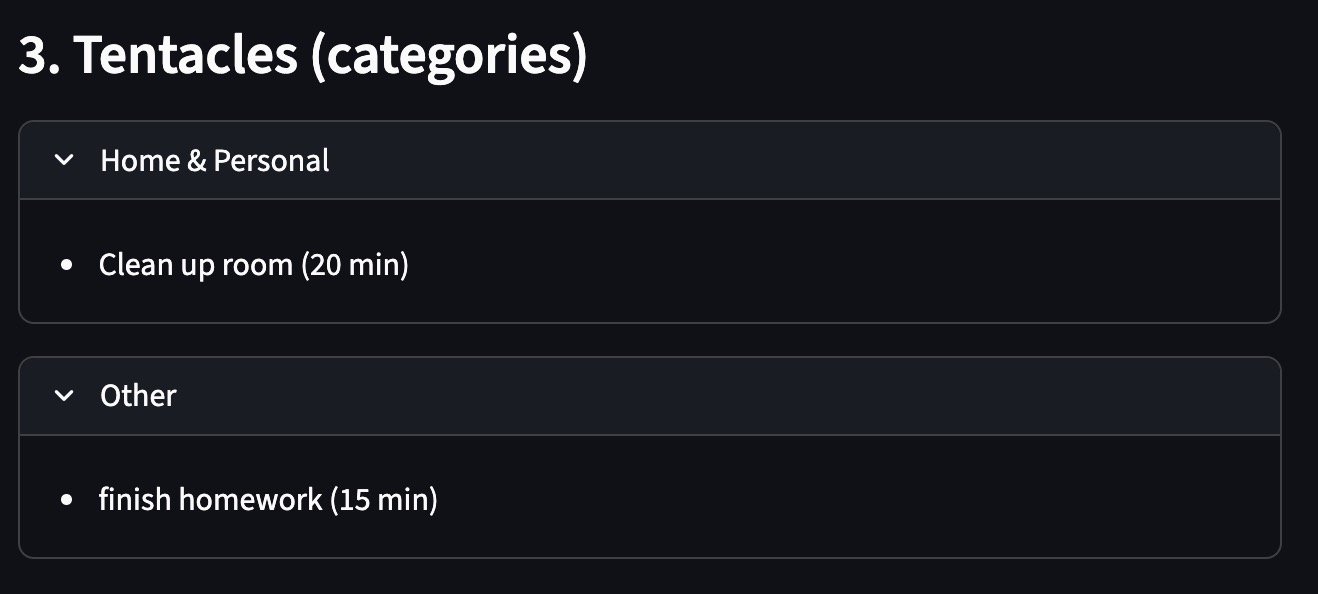
- assigns each one to an octopus “tentacle” (categories like Deep Work, Admin & Communication, Learning, Health, Home & Personal, Other),
- estimates how long each item might take,
- builds a timeline that fits inside your available time.
The UI shows:
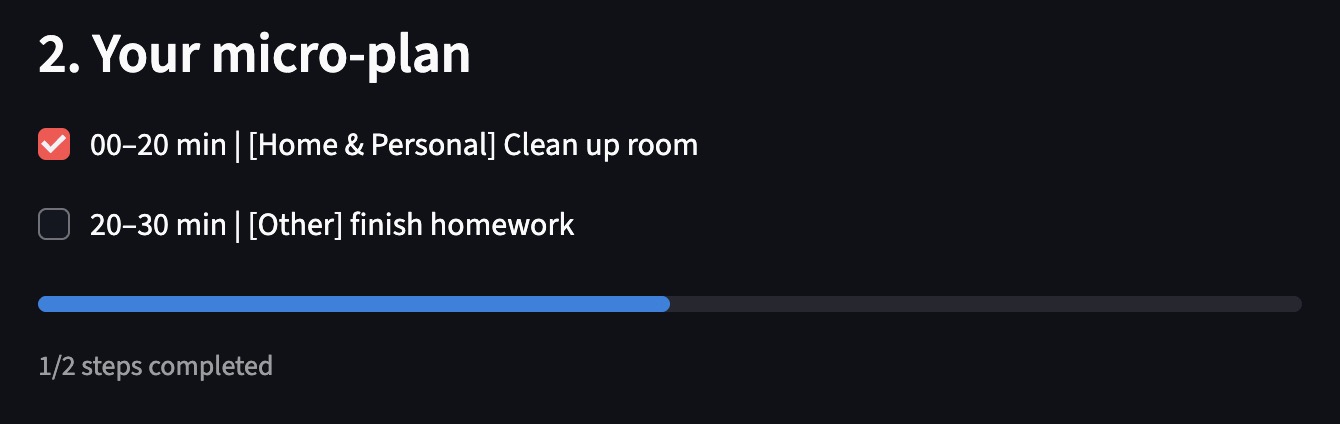
- a timeline of steps with checkboxes and a progress bar on the left,
- tentacles (categories) on the right, grouping related tasks.
The goal isn’t to plan your entire week. It’s to answer a single question:
“What should I focus on in the next 1–2 hours?”
How we built it
We wanted the project to be simple to run but structured like a “real” app.
- Streamlit powers the front-end and back-end in one file:
app.py. A small Python package
octofocus/contains the logic:settings.py– category definitions, priorities and default durations,models.py–dataclassmodels for tasks and timeline steps,parser.py– turns raw multiline text into individual task lines,categorizer.py– keyword-based categorisation and duration estimation,planner.py– the core planning engine that builds a timeline given tasks and available time,__init__.py– clean public interface (create_plan).
Tasks are classified into categories using simple keyword rules.
Durations are estimated using heuristics (e.g. emails ≈ 10 min, deep work ≈ 25 min).
The planner sorts tasks by category priority and fills the timeline until there is no time left.
Everything runs locally with just Python + Streamlit, so it’s easy to clone and try.
Challenges we ran into
- No external AI:
We couldn’t rely on an LLM API, so we designed rules that still feel “smart” and useful. Making the categorisation output look intentional instead of random was a fun constraint.
Accomplishments that we're proud of
- Delivered a fully working micro-planner that:
- runs entirely offline,
- has a clean, minimal UI,
- actually helps decide what to do in the next 1–2 hours.
- Structured the project like a tiny product:
- separate modules for parsing, categorisation, and planning,
- clear data models and configuration,
- easy to extend with new categories or smarter logic.
- Kept the experience focused:
- one text area, one time slider, one button,
- immediate, visual output with a progress bar and tentacles.
What we learned
- You can get surprising value from a rule-based engine if you tune the categories and heuristics to match real behaviour.
- A tiny tool that answers one very specific question (“What now, in the next 60 minutes?”) can be more helpful than a huge “do everything” productivity suite.
- Streamlit is perfect for: go from idea → working web app → shareable demo extremely fast, while still keeping code organised.
What's next for OctoFocus - Tentacle Time Planner
There are several directions to grow this MVP:
User-defined tentacles:
Let people create and reorder their own categories, and tune priorities to match their style (e.g. favour Health or Learning).Export & integrations:
- Export the micro-plan as Markdown or a calendar event.
- Integrate with tools like Notion, Obsidian, Google Calendar.
Session history & insights:
Track completed sessions and show stats like:
how often you actually schedule Deep Work vs Admin vs Health, and gently nudge you towards a healthier balance.


Log in or sign up for Devpost to join the conversation.