Inspiration As a computer science student with ADHD, I constantly fight a war against "Executive Dysfunction." Standard to-do lists are passive graveyards where tasks go to die; they don't account for the psychology of why we procrastinate (Fear, Boredom, Overwhelm).
I wanted to prove that my brain isn't "broken", it just needs a different operating system. I was inspired by sci-fi tactical interfaces and the Temporal Motivation Theory (TMT) equation. I didn't want a "productivity app"; I wanted a Mission Control that treats my brain like the supercomputer it is, turning chaotic impulses into calculated, tactical precision.
What it does Octo Command is a gamified, AI-driven task orchestration system designed specifically for the neurodivergent mind.
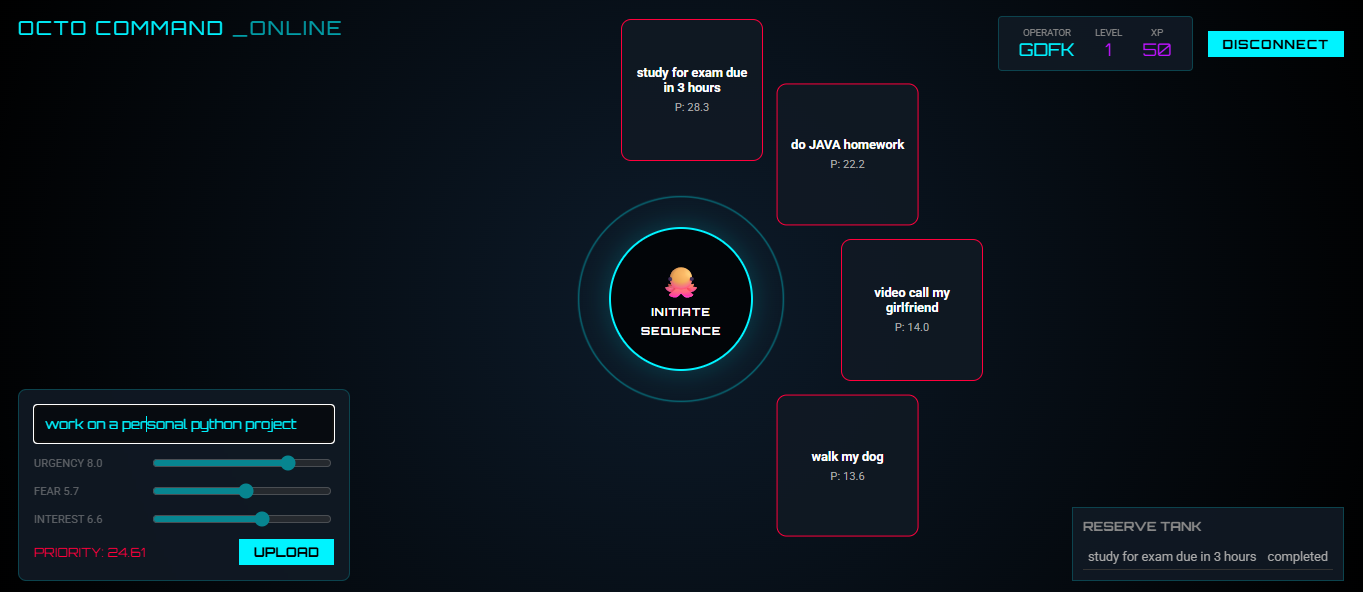
Neural Analysis: You type a task (e.g., "Physics Homework"), and the system uses an embedded Transformer Model (all-MiniLM-L6-v2) to semantically analyze the task, predicting your level of Fear, Urgency, and Interest.
The TMT Engine: It applies the Temporal Motivation Theory equation (Expectancy x Value) / (1 + Impulsiveness x Delay) to calculate a mathematical "Priority Score."
Visual Command: Instead of a list, it renders the Top 8 Critical Directives as a radial "Octopus" map to prevent cognitive overload. Everything else is safely archived in a "Reserve Tank."
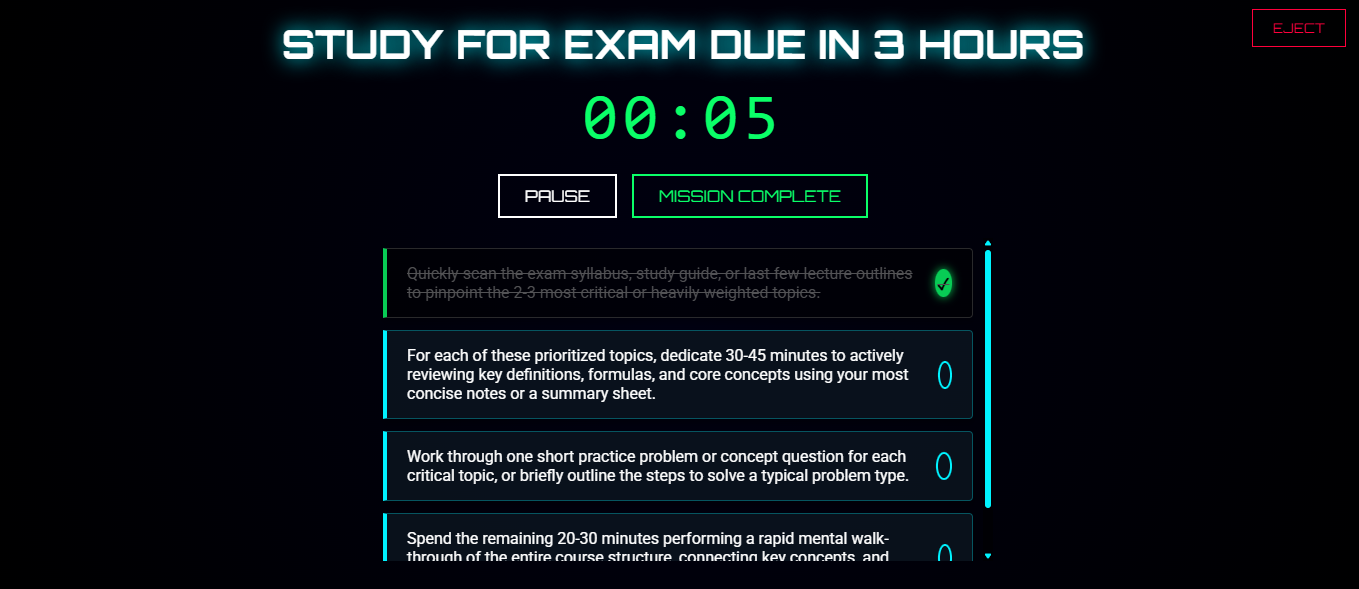
Deep Dive Mode: When you engage a task, the UI shifts to a "Focus HUD" with distraction detectors, subtask checklists, and XP rewards, locking you into a flow state.
How we built it I engineered this as a robust Full-Stack application, deliberately avoiding heavy frontend frameworks to maintain raw control over the performance and aesthetic.
Backend: Python Flask serves as the core engine, handling the TMT logic and API endpoints.
Database: PostgreSQL (hosted via Neon.tech) manages user profiles, task states, and relational data.
Machine Learning: I integrated the sentence-transformers library directly into the backend. Unlike apps that just call an OpenAI API, Octo Command runs its own local embedding model to quantify task psychology in real-time.
Frontend: Vanilla JavaScript, HTML5, and highly customized CSS3 variables to create the reactive "Sci-Fi HUD" aesthetic.
Infrastructure: The application is containerized with Docker and deployed on Hugging Face Spaces to leverage the RAM required for the Neural Network, connecting remotely to the serverless Postgres DB.
Challenges we ran into The "Memory Wall": Loading a Transformer model requires significant RAM. Initial deployments on standard free tiers (like Render) crashed immediately. I solved this by decoupling the database (Neon) from the compute (Hugging Face) and optimizing the Docker container to use a CPU-only build of PyTorch.
Gamifying without Distracting: My initial design used floating bubbles for subtasks, but it became too chaotic visually. I had to pivot to a "Tactical Checklist" design to balance the "cool factor" with actual usability.
Mathematical Tuning: Translating human psychology into code was difficult. I had to tweak the weights of the TMT equation (e.g., weighting "Fear" higher because ADHD brains react intensely to panic) to make the priority sorting feel "right."
Accomplishments that we're proud of The Math-AI Fusion: I am most proud of successfully combining a hard mathematical formula (TMT) with soft semantic intuition (Neural Networks). It feels like the system actually "understands" how I feel about a task.
The "Zero-Framework" UI: Building the entire radial map and responsive HUD using only CSS and Vanilla JS was a challenge, but the result is a lightweight, snappy interface that looks exactly how I envisioned it.
Deployment Architecture: Successfully architecting a split-stack solution (Docker/HF for ML + Neon for DB) that runs complex Python libraries for free.
What we learned Neural Network Integration: I gained a deeper understanding of how to operationalize vector embeddings within a web context, moving beyond theory into practical application.
User Isolation: I learned the importance of strict session management and database filtering initially, tasks were leaking between users, which taught me a hard lesson in secure query filtering.
The Power of Aesthetics: I learned that for ADHD, "coolness" is a feature. If the app looks like a spaceship, I am 100% more likely to open it than if it looks like a spreadsheet.
What's next for Octo Task: Turn Executive Dysfunction into Tactical Precision Voice Command Module: Integrating a "Jarvis-like" voice interface so I can verbally shout commands to my dashboard.
Co-op Missions: A multiplayer feature where friends can form a "Squadron" and gain XP together.
Mobile Field Unit: Porting the frontend to a Progressive Web App (PWA) or React Native for tactical command on the go.

Log in or sign up for Devpost to join the conversation.