-
-
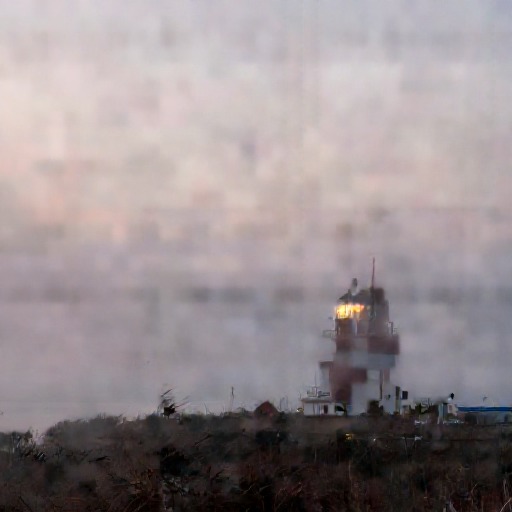
canonical lighthouse image
-
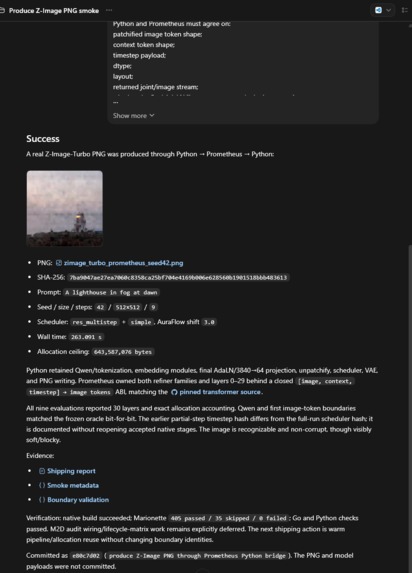
Codex session that produced the image
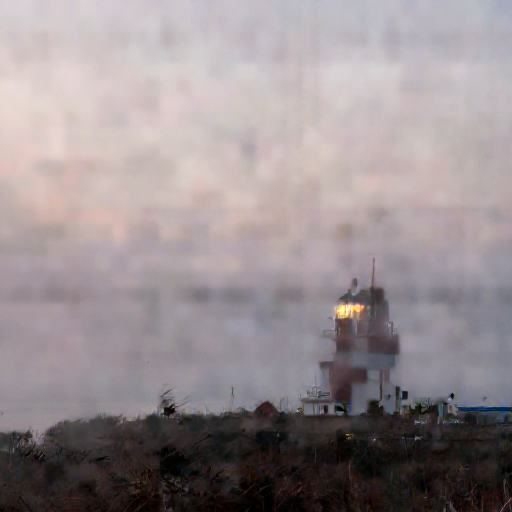
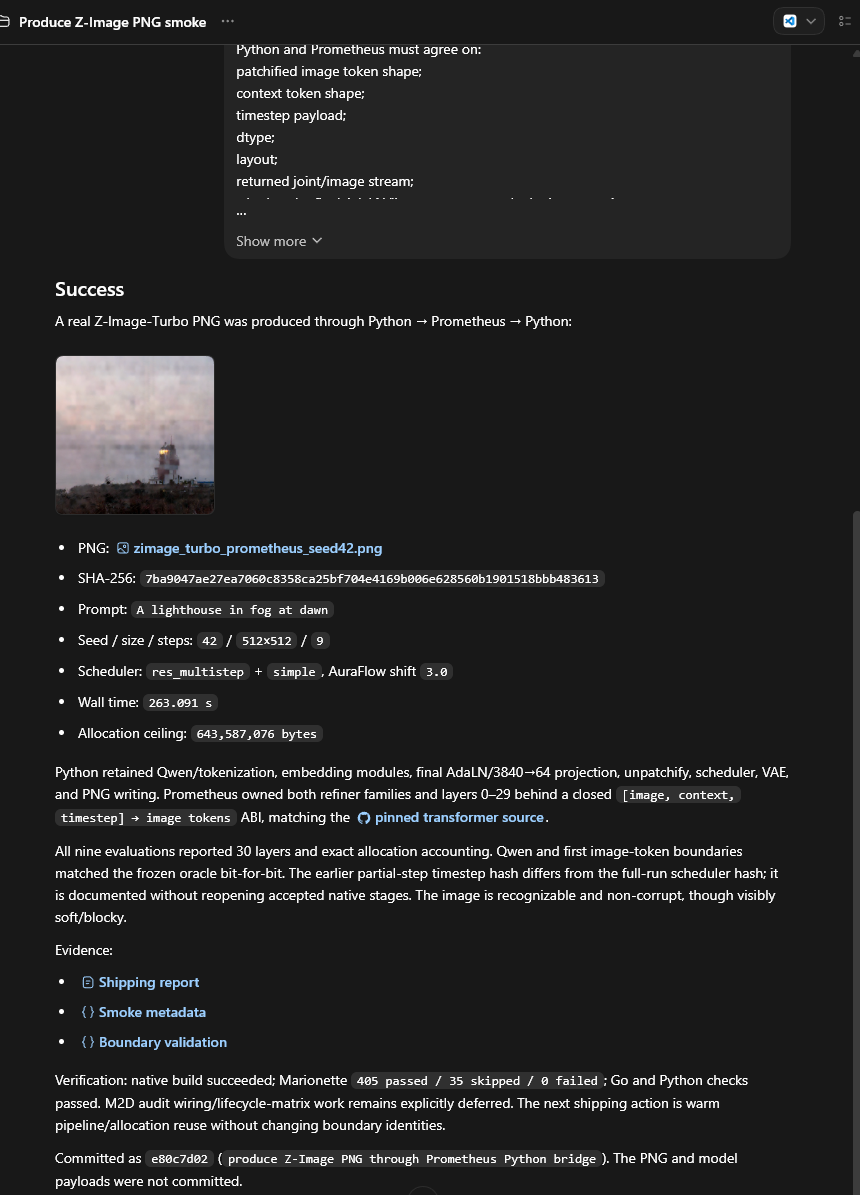
Inspiration
We wanted an execution substrate that treats a trained model as a compiled program: explicit manifests, payload identities, custom shader/kernel routes tailored specifically for each weight, numerical authority, and reproducible hardware evidence instead of an opaque load-and-run call. The idea is that people should not need to cosplay GPU compiler engineers and manually implement manage memory allocation and scheduling when they just want to run a model and get an output.
What it does
Prometheus executes the complete heavy BF16 Z-Image-Turbo transformer—two noise refiners, two context refiners, and 30 main layers—across all nine evaluations of one image workflow. It is not quantized at all; the full 12 GB weight runs on an 8GB VRAM RTX 3070.
How it was built
Model manifests compile into native descriptors and SDSL-V (custom shader language) routes. Immutable BF16-source weights live in system memory; persistent FP32 activations remain on the GPU; active and prefetched windows stream only the next authorized package. SDSL-V runs through typed semantics, VD-MIR, HLSL, DXC, and validated SPIR-V; Vulkan 1.4 is production policy.
How ChatGPT/Codex was used
GPT 5.6 agents are treated as team members in an engineering group: I directed product, architecture, priorities, constraints, and acceptance. Persistent reviewer ChatGPT agent acted as team lead, retained context, generated design prompt, and reviewed handoffs. Fresh Codex tasks implemented bounded work, built, tested, inspected failures, and left reports and JSON evidence. This was human-directed, evidence-gated engineering, and the Build Week spike across 83 commits was just a part of the project as the full Oct repo was authored entirely by Codex across thousands of commits.
Challenges
The central challenge was executing a 12.31 GB checkpoint on an 8 GiB GPU while preserving numerical and route authority. Explicit ownership, bounded prefetch, profiling, deterministic output, and regression evidence made optimization safe. A lot of testing and experimentation were done which resulted in some counterintuitive results regarding GPU kernel optimization, as more complex kernels has shown to be slower than simple ones in a variety of circumstances.
Accomplishments
Complete transformer integration; bounded streaming/prefetch; 263.091-to-165.051-second observed full-image progression through continuous optimization across multiple boundaries; C/C++ build via OctMake productionization; SDSL-V graphics compilation; Vulkan 1.4 admission; compiled Oct experimental investigation on Z-Image Turbo model direct via Codex 5.6 Sol across 20 milestones in one single session; and direct tensor-hardware feasibility evaluation.
What is next
Build reusable compiled reactors and separately authorize whole-transformer and final-image FastMixedPrecision work. The FastMixedPrecision projected full-image figure is not presented as measured.## Inspiration

Log in or sign up for Devpost to join the conversation.