Ochre: Clear Business Direction for Independent Artists
Inspiration
Artists are expected to build a business around their work, but most business advice starts with a list of things they should be doing. Build a website. Post consistently. Raise prices. Start an email list. Approach galleries.
I ran into the same problem with my own art. The advice was easy to find. Knowing which advice fit my practice, and what I should work on first, was much harder.
That experience is common. Artists lack a system that can truthfully help them know what to prioritize and where they were stuck, based on the career they are trying to build.
What Ochre does
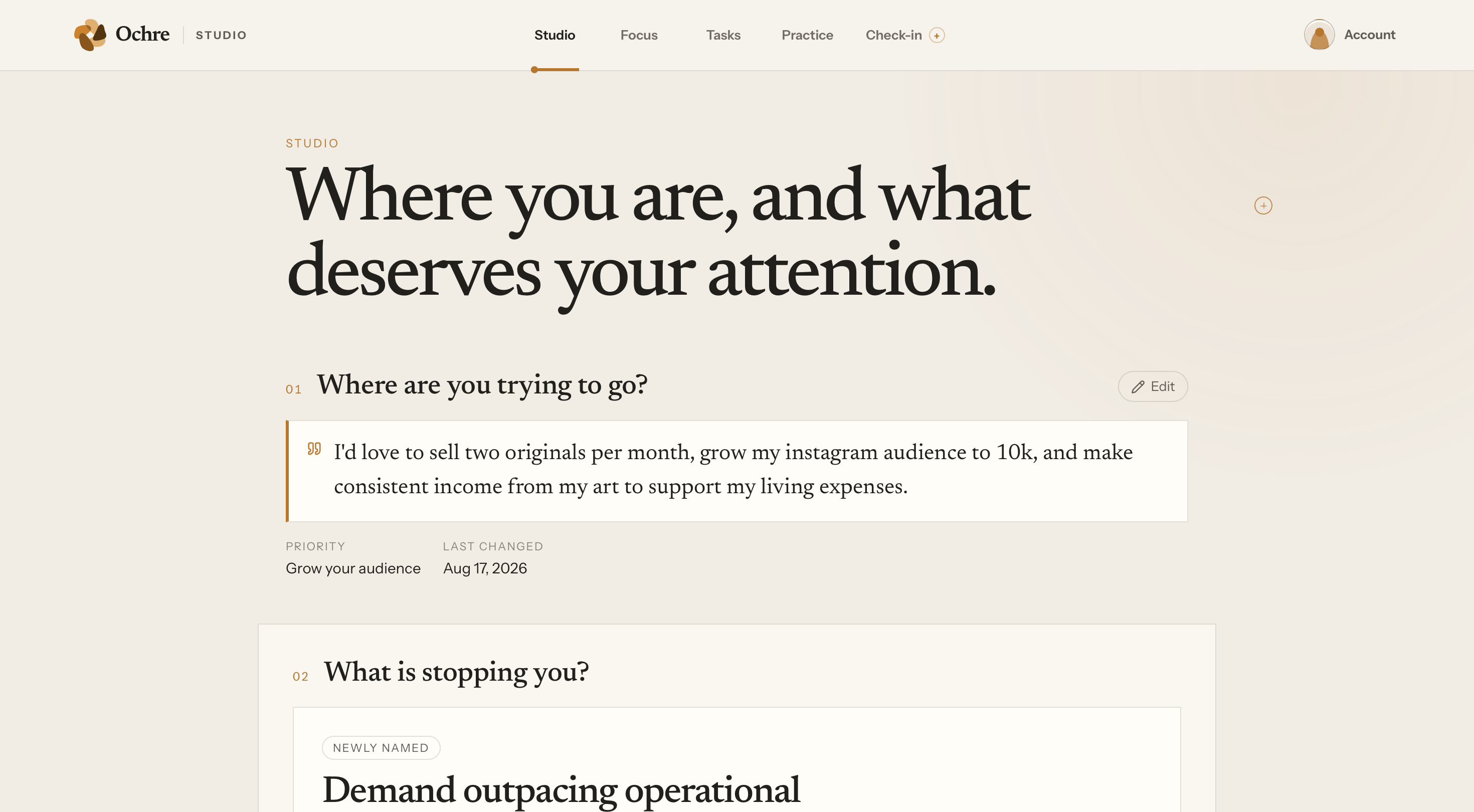
Ochre is a decision system for independent artists. It learns about the artist's practice and goals, looks at how the business works, what has been tried and what capacity the artist has. It then identifies their current biggest constraint and gives them a a set of working tasks to address that.
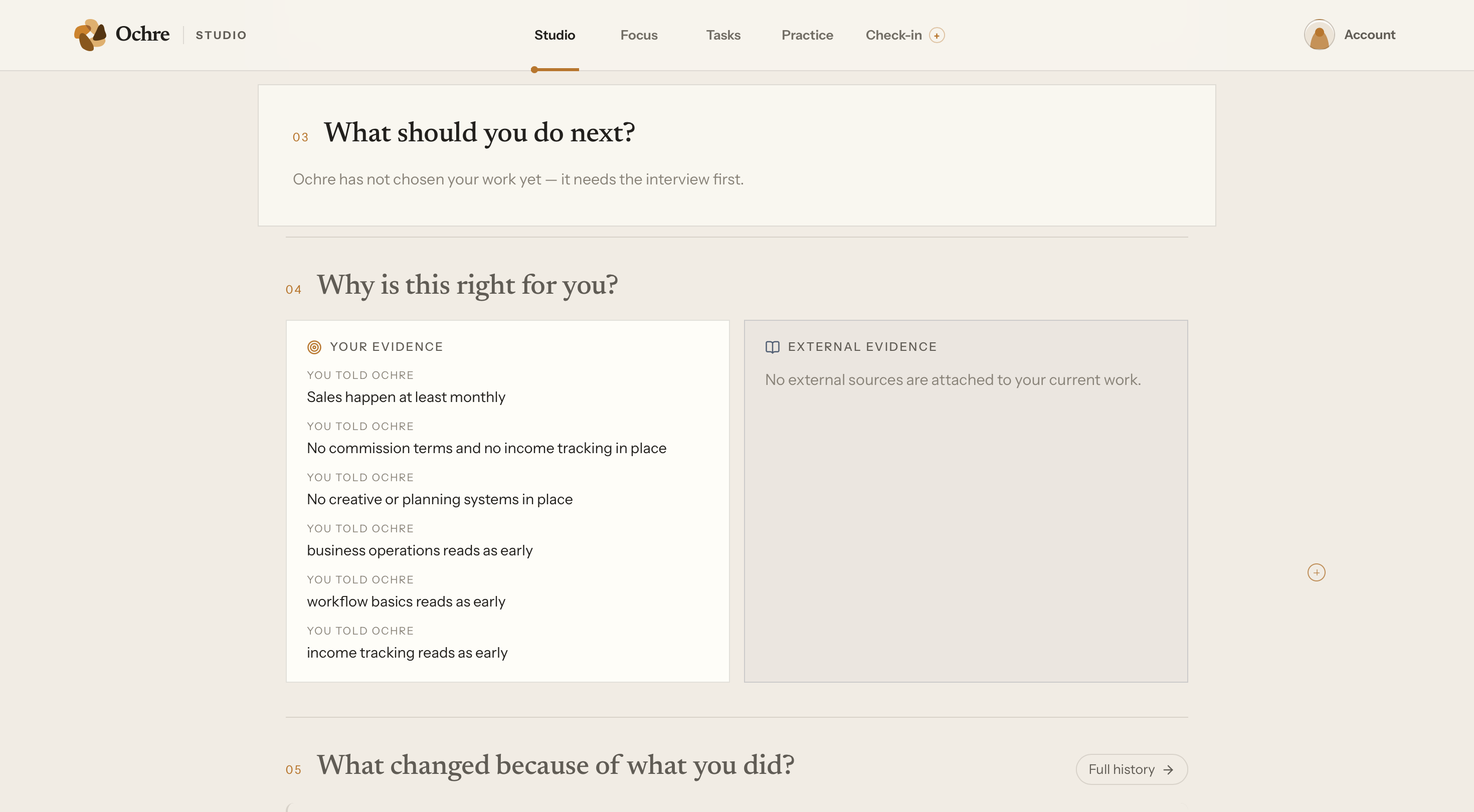
Completing a task is not treated as progress. Each action has an observation window and an outcome question that defines what success would mean. The outcome reported by the artist becomes new evidence. Ochre reassesses the situation and can keep, retract or replace its direction.
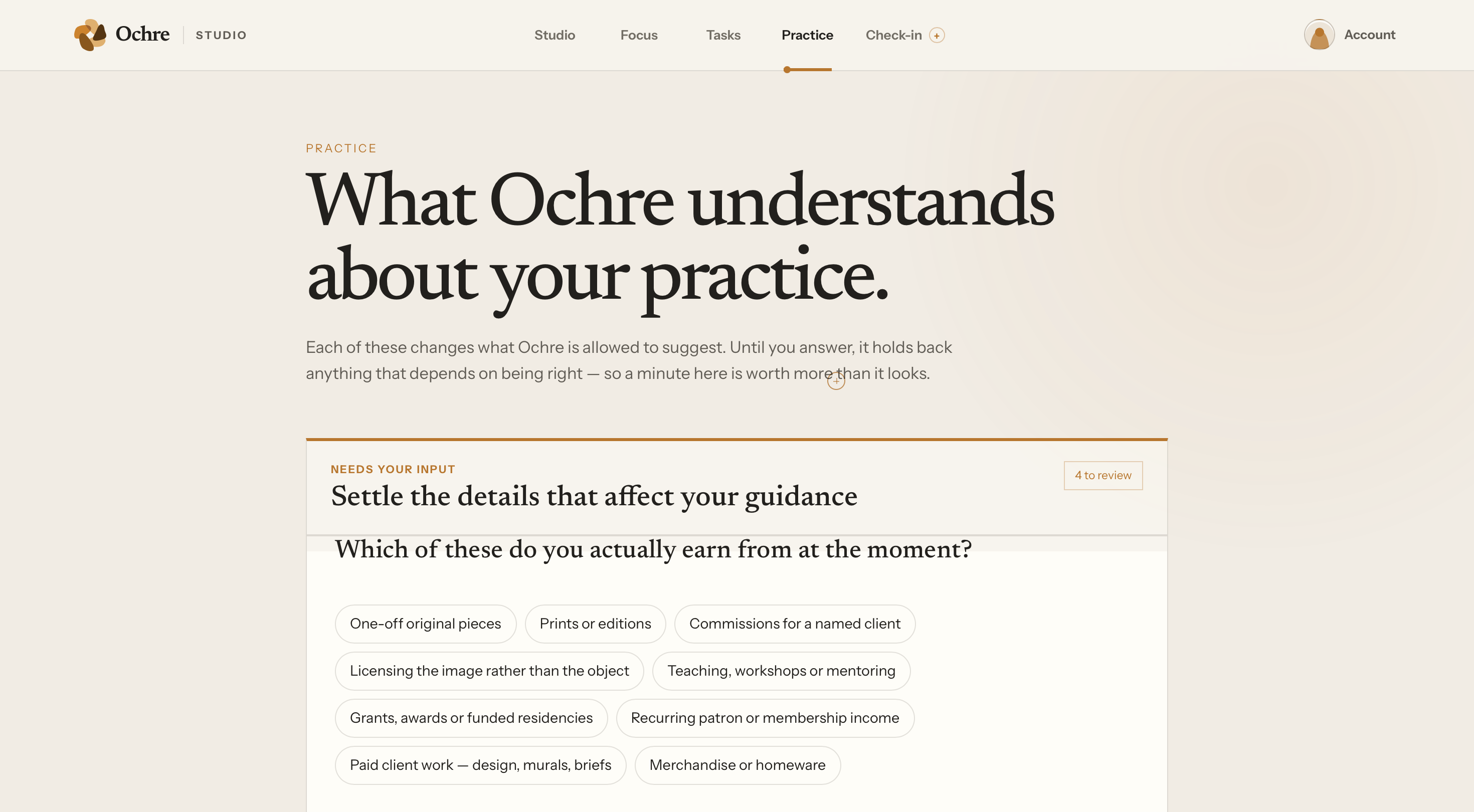
The artist can correct important readings. If Ochre does not have enough evidence to name a constraint, it says so with a certainty value.
How the system works
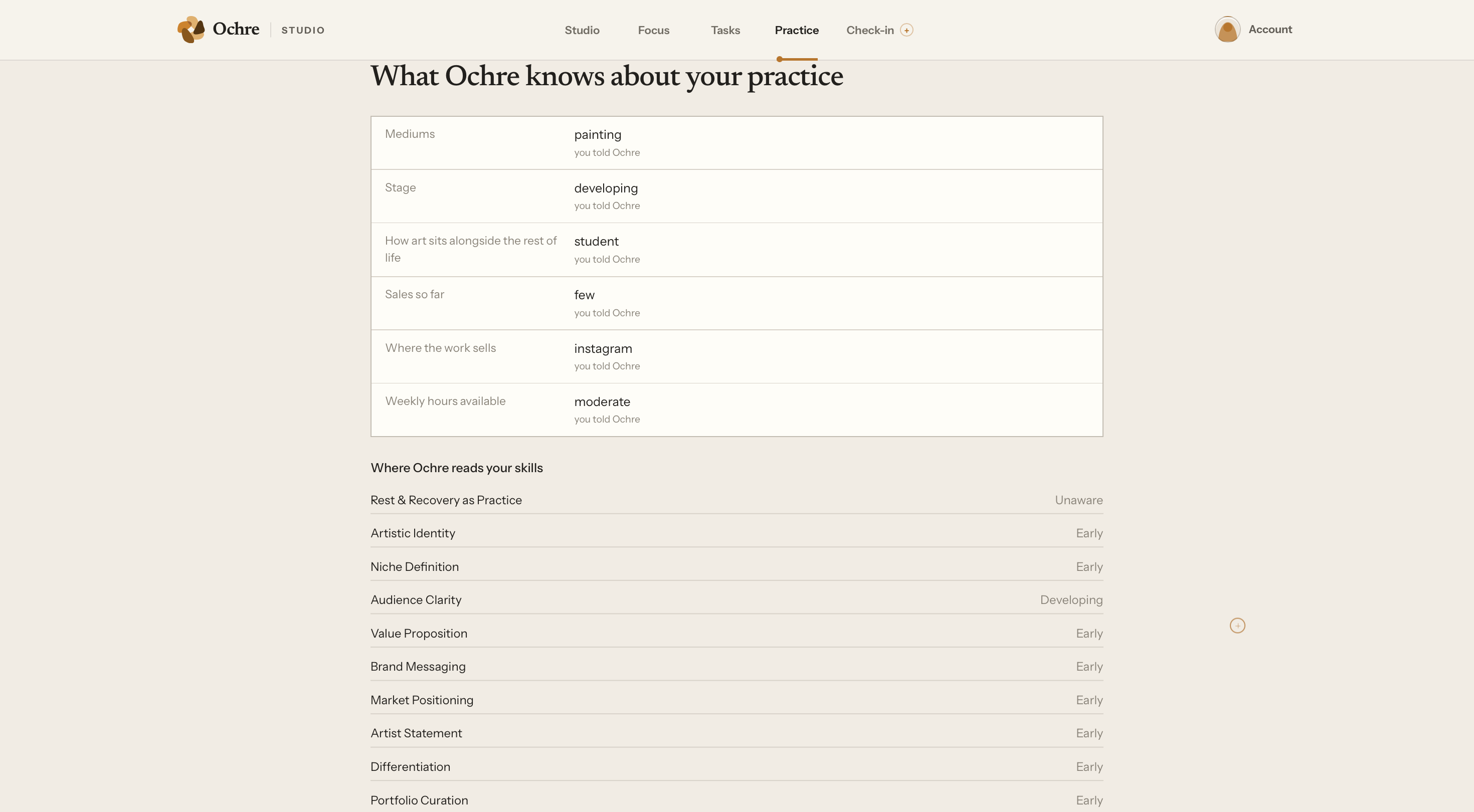
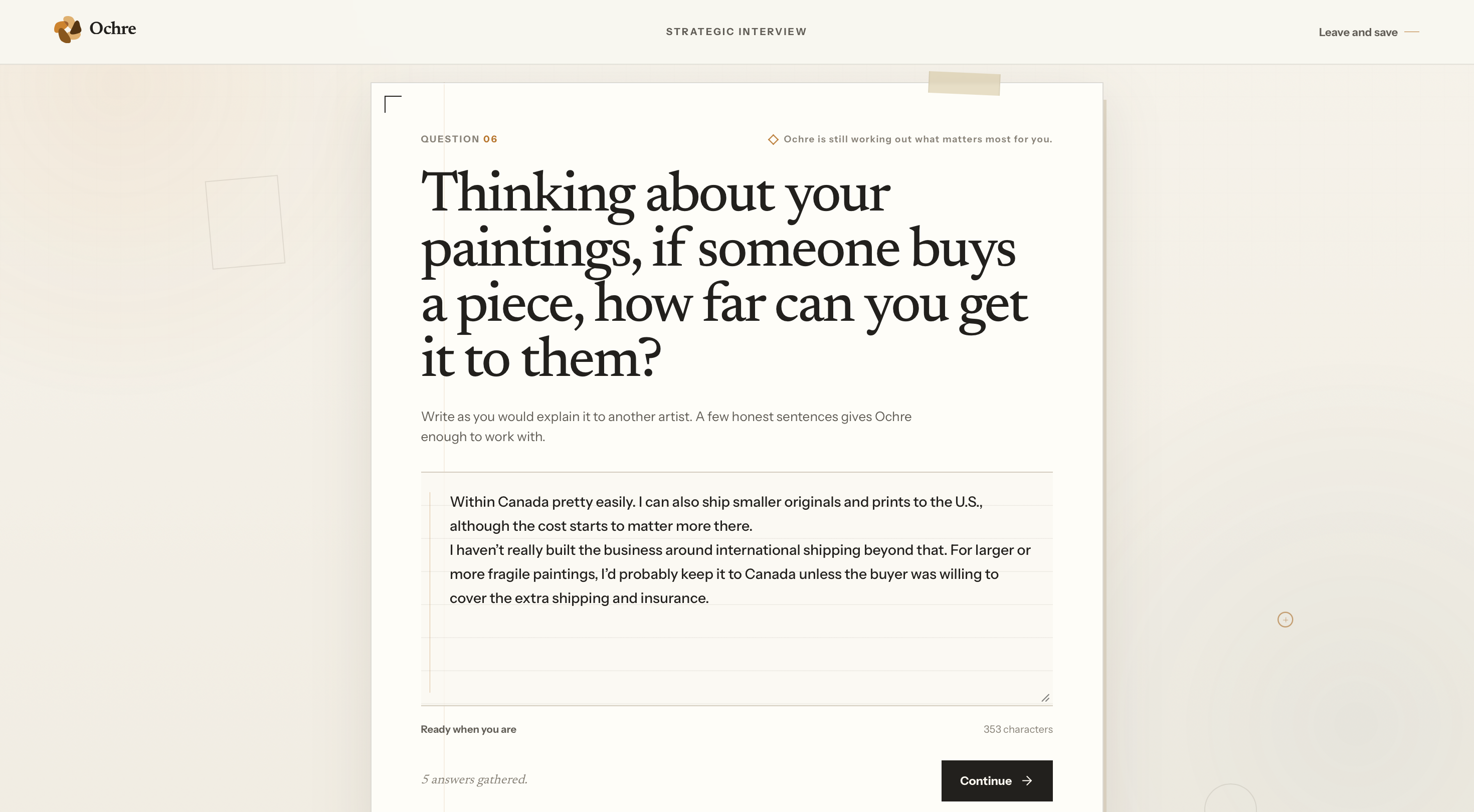
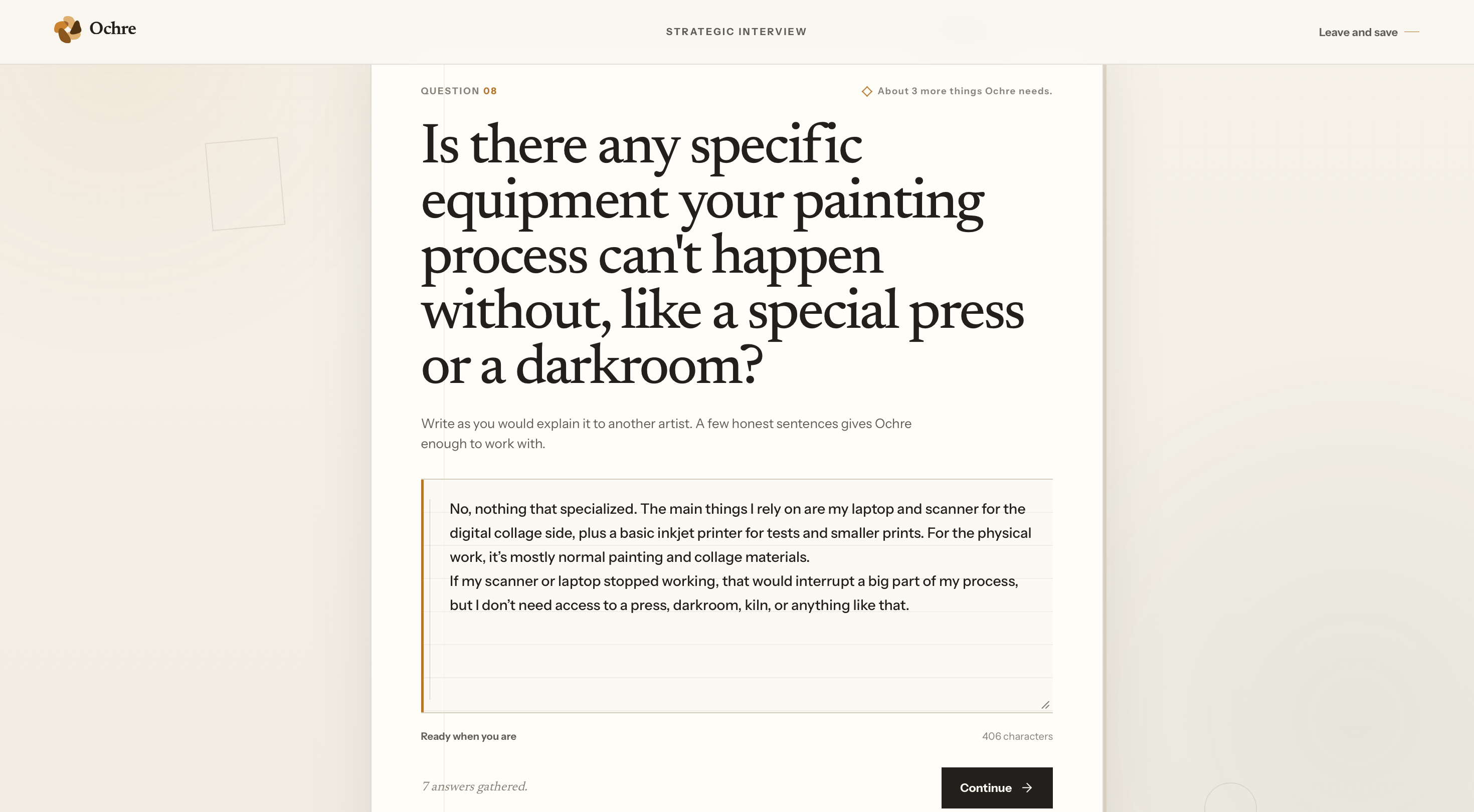
Ochre keeps a persistent Artist State after the onboarding. Each fact has a source, a confidence level and a confirmation status. An adaptive Gemini interview asks questions based on unresolved information needs.
A competency registry and dependency graph help Ochre understand what is already in place. A reviewed knowledge corpus supplies external evidence. Retrieval happens after the current constraint is selected. Hard applicability filters remove advice that does not fit the artist.
The diagnosis engine uses authored rules to decide the constraint. AI does not choose the winning constraint. Action selection system also checks prerequisites, contradictions and evidence before giving the tasks.
Gemini handles work that needs language understanding. It runs parts of the interview and extraction process, retrieves relevant evidence and writes the user-facing explanation. It also adapts action wording and writes weekly reports.
AI can read messy human context. Decision reules and evidence corpus are currently human authored, in process of being automated.
AI-native operations
AI also runs much of what the business requires at this stage. Agents support founder reporting through a daily digest of metrics. They handle churn re-engagement, onboarding retention, behavioral analysis and payment recovery.
For marketing, the Outreach Agent researches an organization and crawls first-party sources. Gemini extracts evidence and helps qualify the lead. The system verifies claims and accepts contact information only when the address was observed in source material. The agent chooses a recipient strategy and drafts the email. A founder approval is required before a first cold email can leave the system. After sending, Gmail replies are ingested. Gemini extracts questions and relationship signals. Policy updates the relationship state and decides what follow-up work is due.
As a solo founder, I also used AI in product development, including claude code and codex to build and audit the codebase under tests and human review.
What I learned and Challenges I faced
Key Learnings:
Collecting more information does not mean the system understands the artist. My first version generated a roadmap from a large amount of mostly unstructured data, which didn't improve th eproduct, but made the retrieval harder.
Personalization has to come from persistent, structured understanding. Ochre needs to remember what is true about the artist, what has already been tried, what is uncertain and what has changed, which led to the system to artist state.
Completing a task is not evidence that it worked. The system needs to observe what happened afterward and use that outcome to decide whether its direction was right.
Most of all, I learned that real artist testing catches problems that architecture, tests and my own assumptions cannot.
The hardest non-technical problem has been user acquisition. I started content and partnership outreach late, with little social-media experience. I also encountered concerns regarding generative AI in some communities I reached. Ochre has to earn trust by being precise about what AI does and by keeping the artist in control.
Vision
My two-year goal is to make Ochre a reliable business intelligence system artists can trust over time. I am already working on building integrations that replace manual self-reporting, making sales agents that track task outcomes, and collecting enough data to eventually turn this into a ML pipeline that gets evidence data from the artists themselves.
The goal is not to turn artists into better administrators. It is to give the business enough structure that more of their time can go back to the work.
Built With
- framer-motion
- google-cloud
- next.js
- postgresql
- react-native
- scss
- supabase
- typescript
- vertex-ai


Log in or sign up for Devpost to join the conversation.