Inspiration
The idea arrived during Billie Eilish's concert film, Hit Me Hard and Soft: The Tour. "Ocean Eyes" was playing, and the ocean visuals on stage raised the idea.
I was learning agentic coding, and my curiosity became the project: could one person with no coding or 3D background carry the whole thing through — research, visual references, models, content, and the web experience itself — and end up with a real product, not just a prototype or a demo?
It started as an experiment. Then I built the first model, began reading seriously about how these creatures actually survive, and found myself deeply drawn to them. At some point OceanEye stopped being an experiment and started to carry meaning, and responsibility. The full editor's note is on the site.
What it does
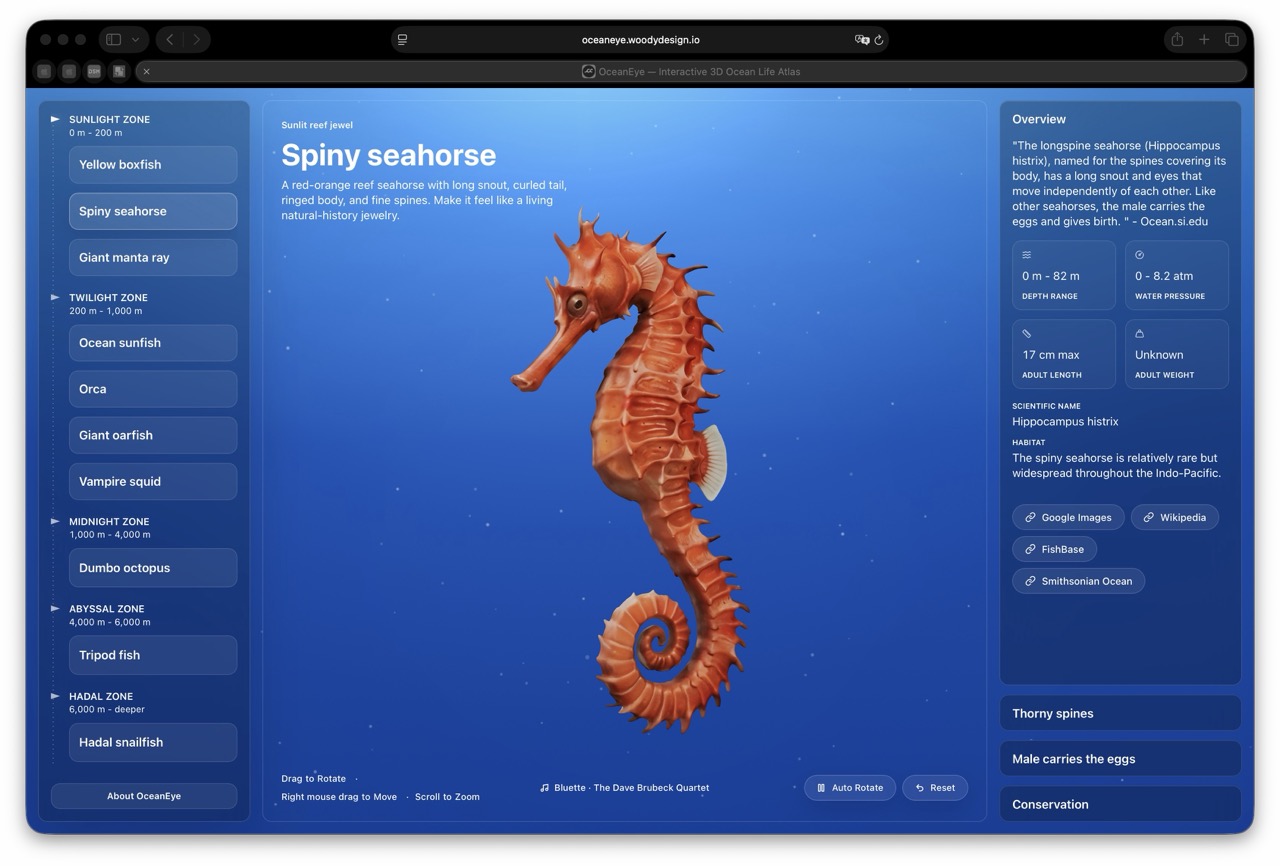
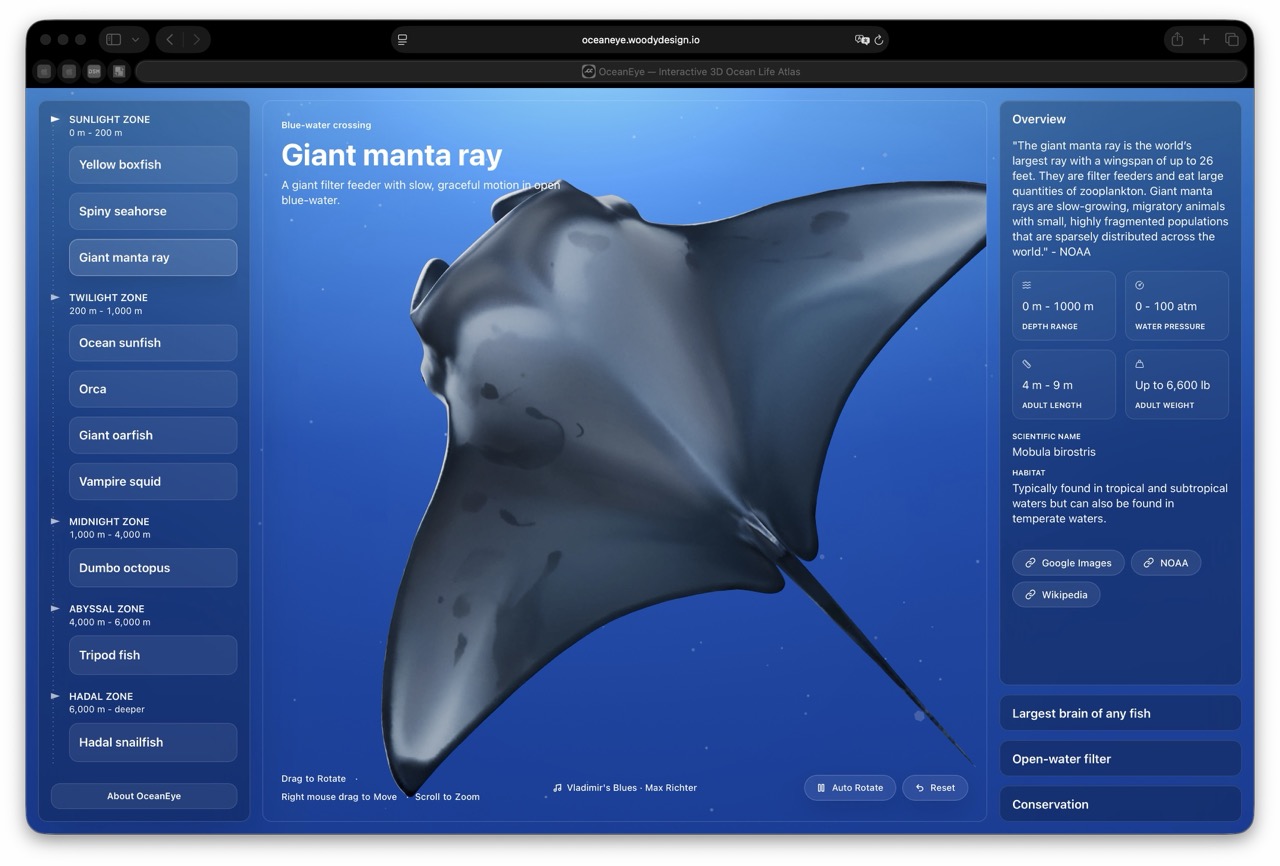
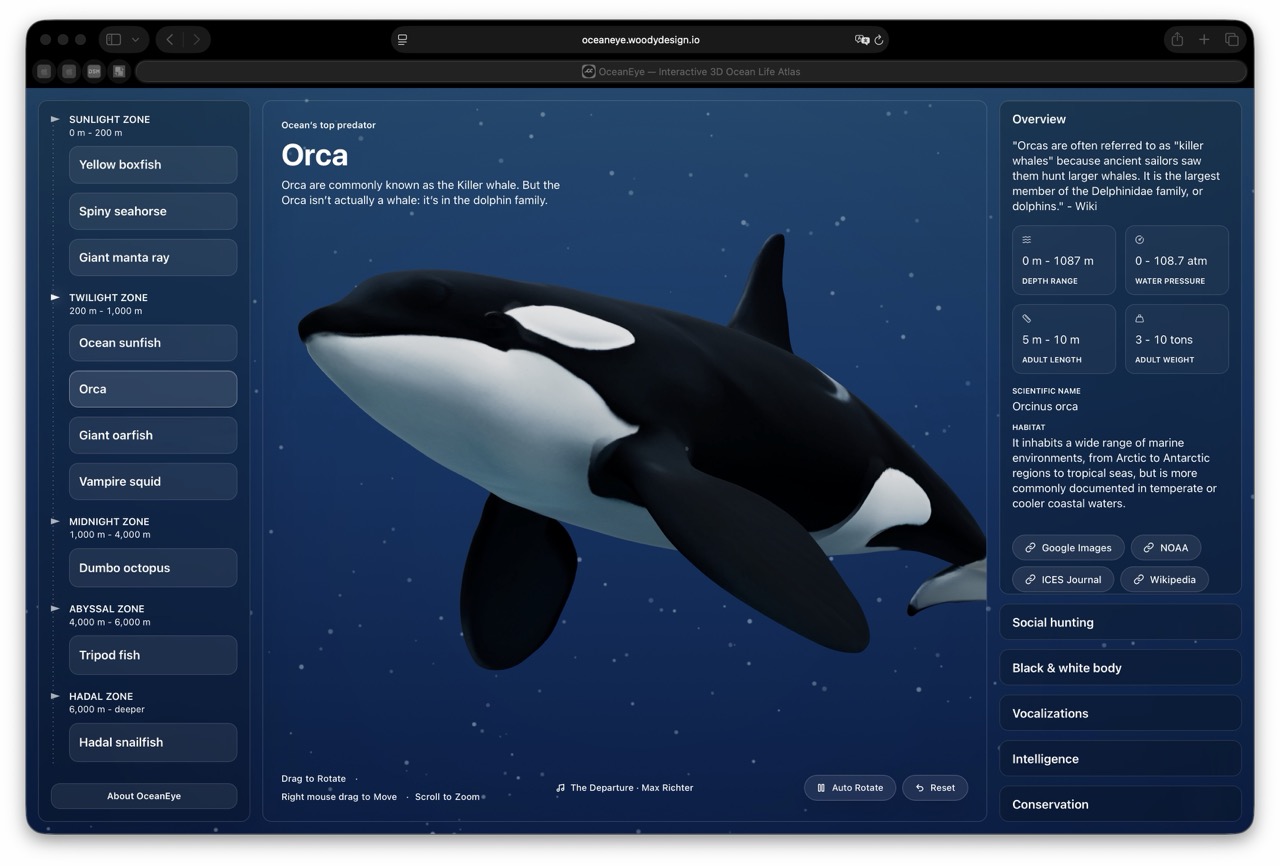
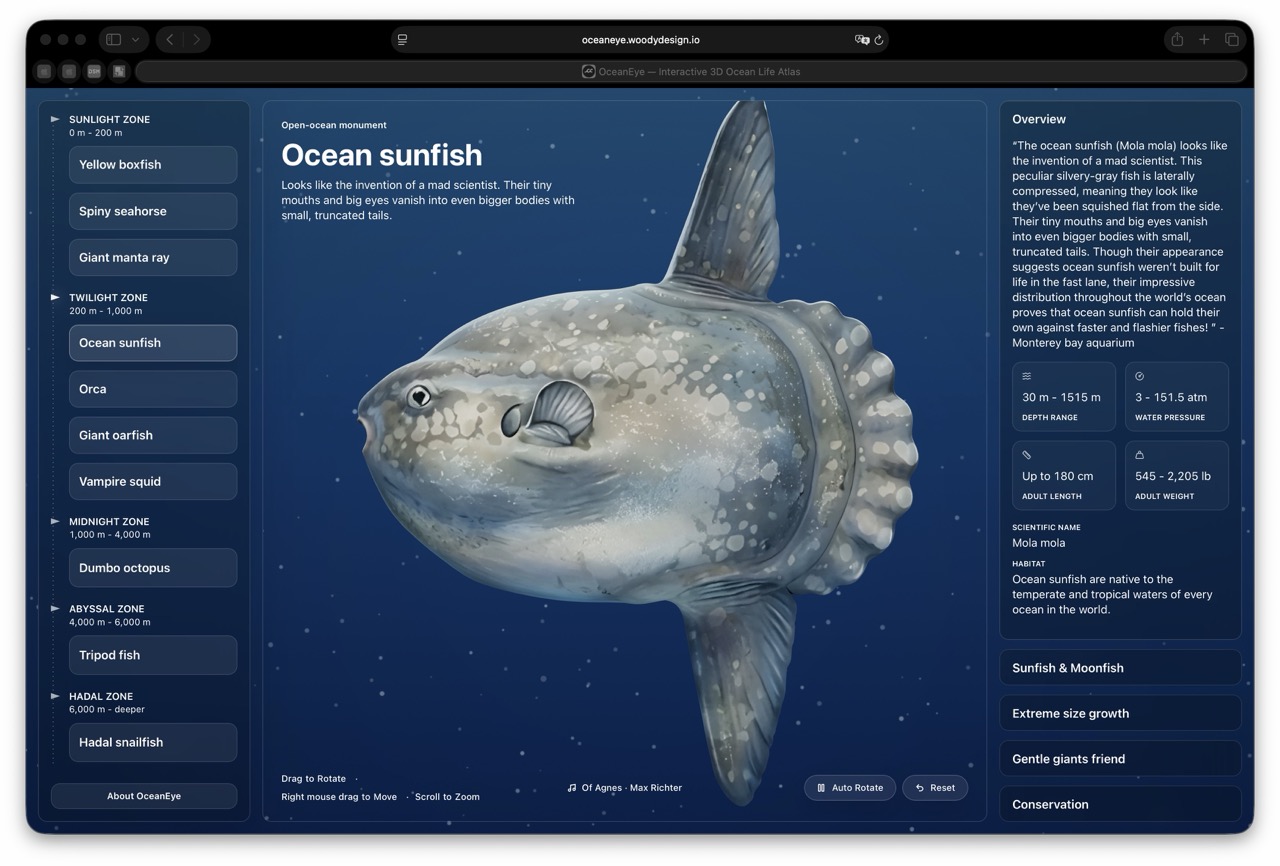
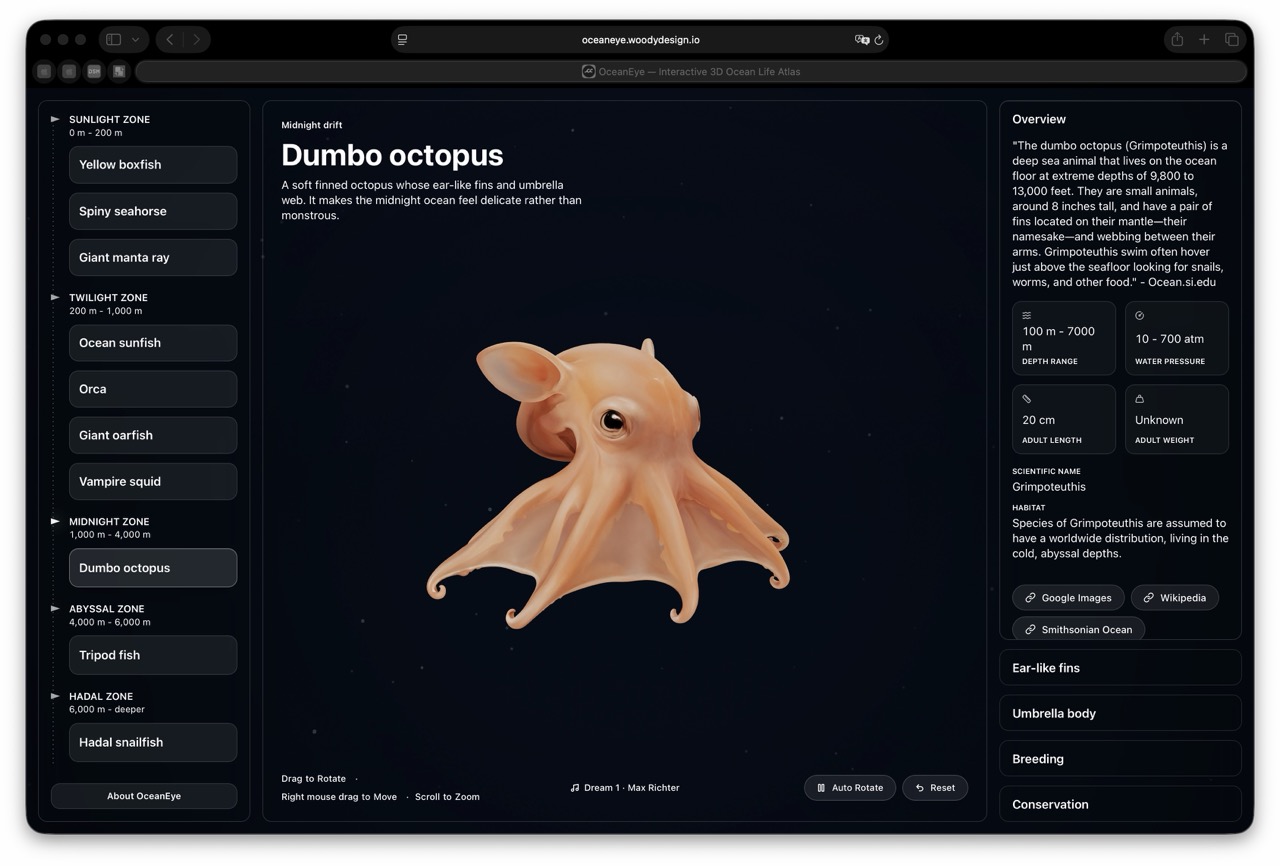
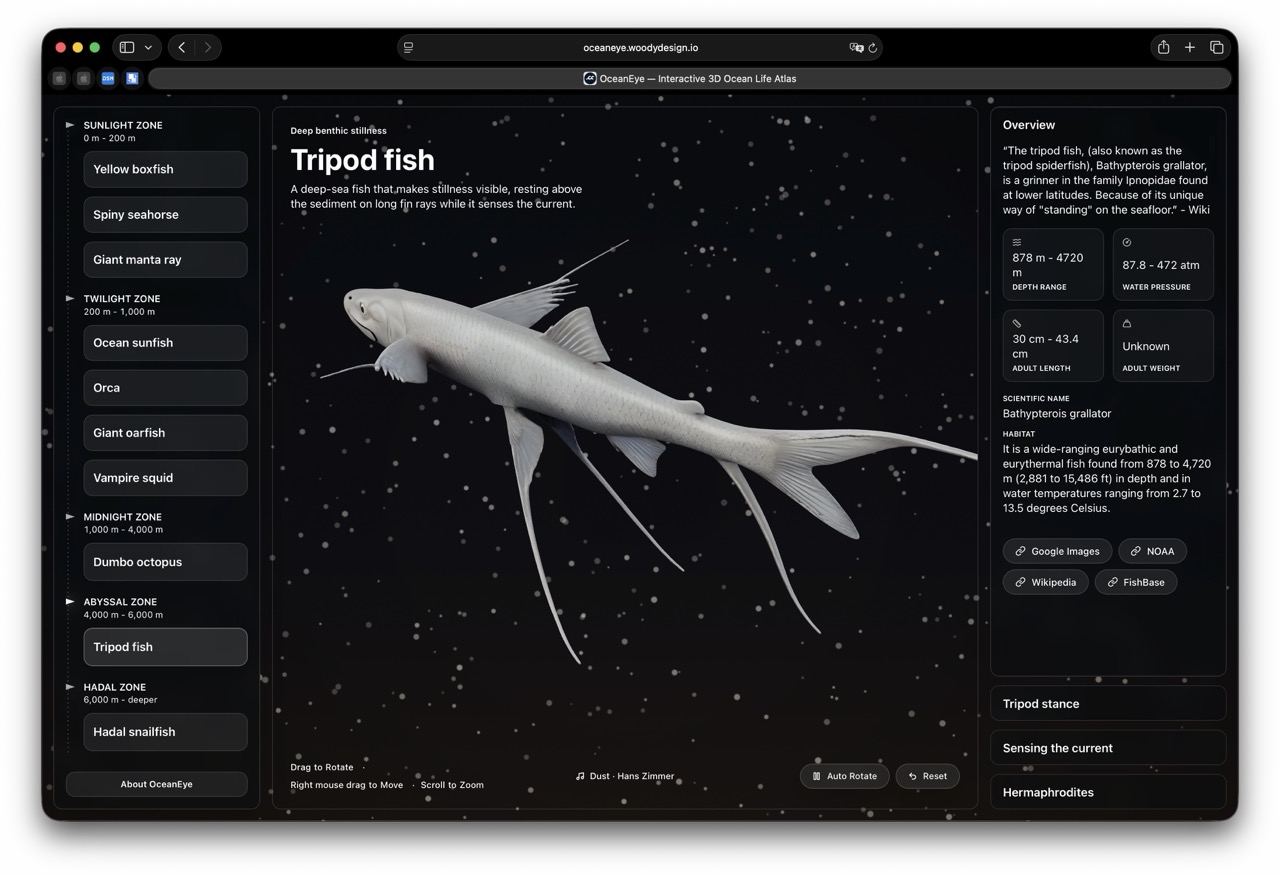
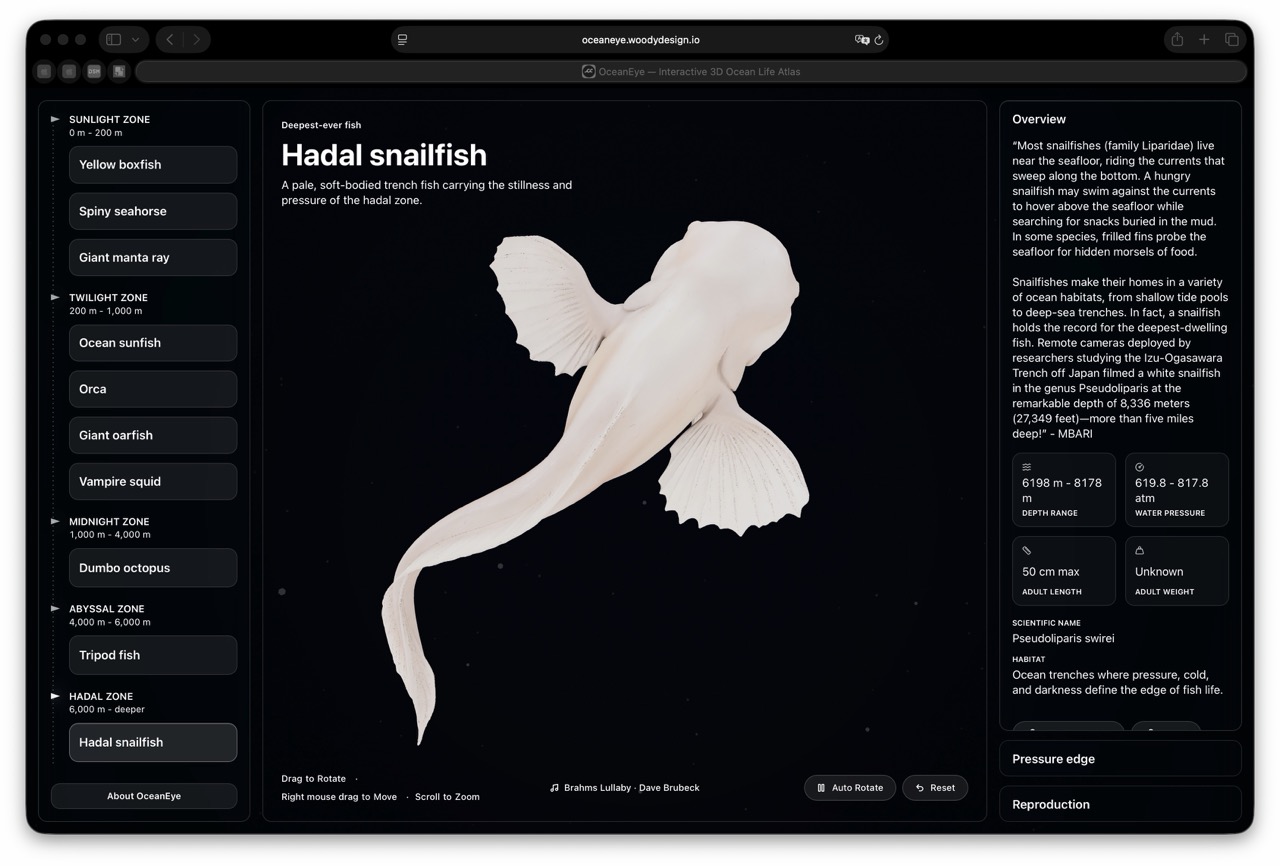
OceanEye is a 3D atlas of ocean life. User dive through five depth zones, from sunlight to hadal, and meet ten creatures. Each one is an interactive 3D model with curated insight cards, and every card carries source links.
There is no AI at runtime — the site ships pre-made JSON and compressed 3D models. That's deliberate: every fact on every card was researched and checked before it went live, not generated on the fly.
How I built it
Codex wrote every line of production code and every model-reference prompt — nothing was downloaded from an asset store. I made core judgement: what to build, what looks right, and what content to publish.
Every creature goes through the same pipeline:
- Deep research on the species
- Study of visual references: natural-history illustration and scientific imagery
- Reference images generated from GPT's prompts, then a 3D model generated from those references with Hyper3D Rodin
- Web compression: Draco geometry + KTX2 textures, self-hosted decoders
- Editorial: research, write, and source-check the insight cards
- Camera setup: a recorded viewing angle for each card
The newest creature, the vampire squid, shows how much of that pipeline GPT-5.6 can now carry on its own: it did the species research, wrote the prompts for the reference images, compress the model, positioned the cameras, aligned the final card content with me, and handled the development and deployment.
Challenges I ran into
- Transparency defeats AI 3D generation. The barreleye and Enypniastes models both failed — glass-like bodies are still beyond Rodin, or at least beyond my skill with it.
- Eyes go wrong easily. I regenerated the dumbo octopus several times and its eyes are still not quite right. The tripod fish's eye came out too large, almost cartoonish.
- Style is hard to hold. Getting AI to fully understand the illustrative style I wanted — and keep it consistent from every camera angle — took many rounds of iteration.
- Fact-checking is the real cost. Sources disagree, depth ranges especially. I spent about a week cross-checking, and some details still had to stay marked as approximate.
Accomplishments I'm proud of
Most AI-built projects stop at the demo: a fancy visual out of one or two prompts. OceanEye went the other way — three weeks and more than forty long AI sessions spent making sure every design decision has a reason, with science or facts behind it. It ships as a real product: live site, e2e tests, dual licensing, per-model provenance docs, and issue templates so anyone can submit a science correction.
What I learned
This was my first time building a complex web application, and the biggest thing it gave me is confidence in human–AI co-creation. With the right division of work, the result can reach a place neither side could have reached alone.
Before this project I knew very little about ocean life. Building it taught me that nature finished the design work long before I started: the color of a body against the light from above, the mechanics that let something survive crushing pressure. Every feature is a solution, refined over millions of years. Designing shaders to imitate water and light turned out to be a way of studying those solutions.
What's next for OceanEye
I want OceanEye to become a genuinely open atlas — a Wikipedia-like, contributor-driven 3D encyclopedia of ocean life. If it sparks even a little curiosity about the ocean and our blue planet — and moves anyone a step closer to protecting them — it has done what it was meant to do.

Log in or sign up for Devpost to join the conversation.