Inspiration
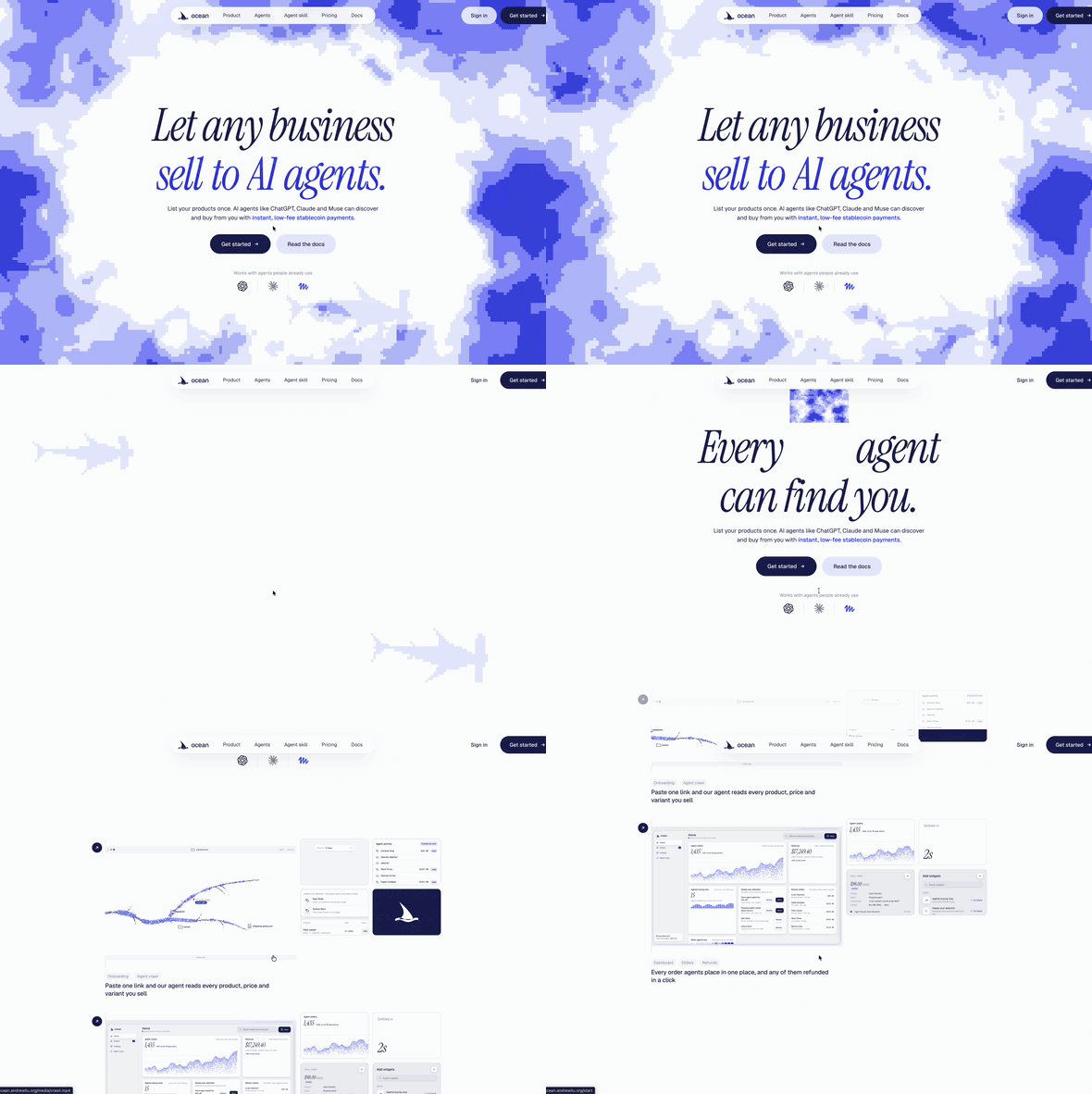
AI agents are changing how people interact with the internet. People are already using assistants like Muse, ChatGPT, and Claude to find products, compare prices, and increasingly make purchases. Muse alone has an estimated 2.5 million daily active users, with shopping emerging as its most popular use case.
For independent businesses, participating in this new economy shouldn't require hiring developers, building agent specific APIs, or replacing their existing storefronts.
What if ANY business could become accessible to sell to AI agents?
That's why we built Ocean.
Ocean bridges the gap between existing businesses and a future where AI agents don't just recommend products. They can purchase them.
What it does
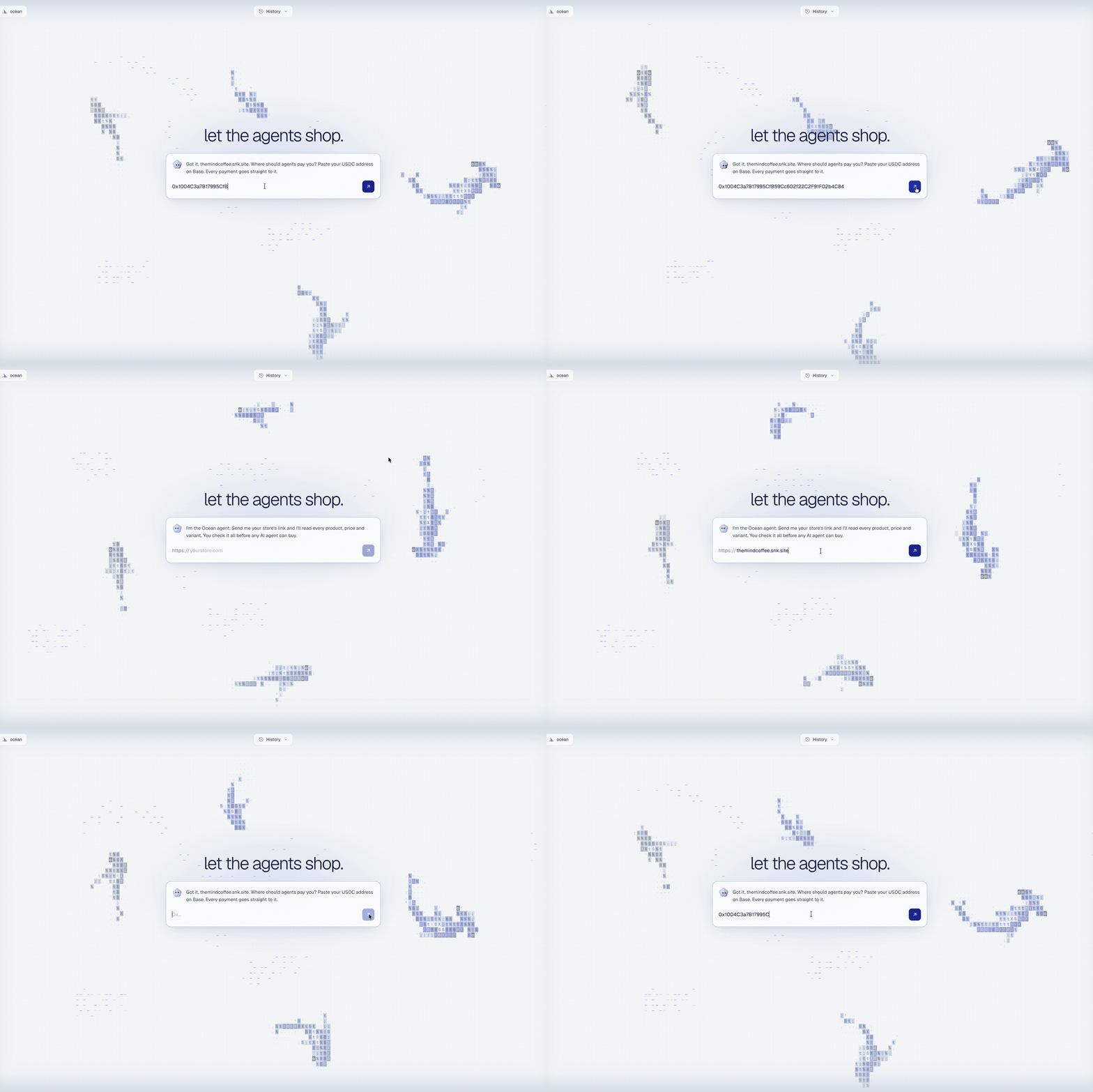
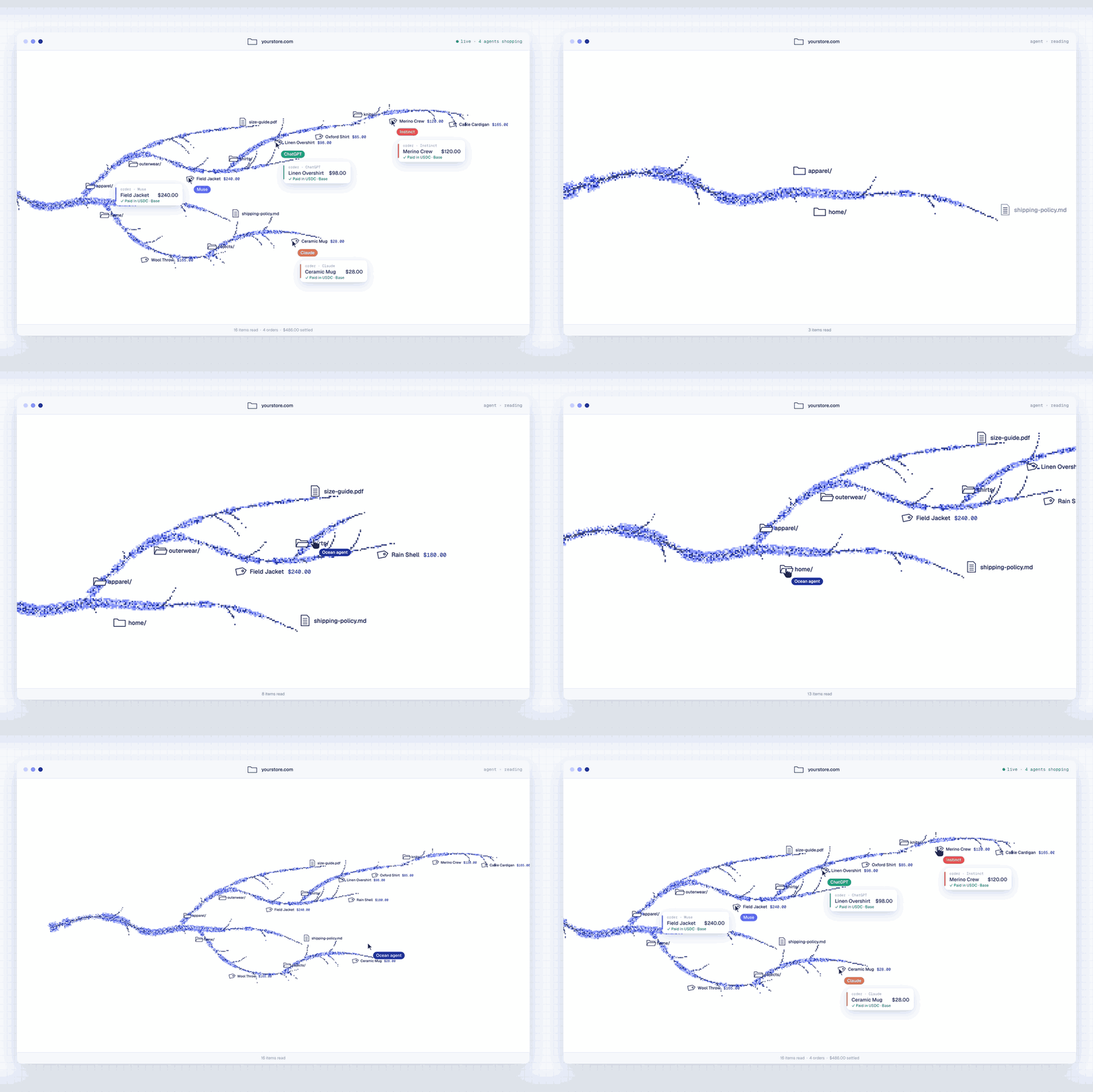
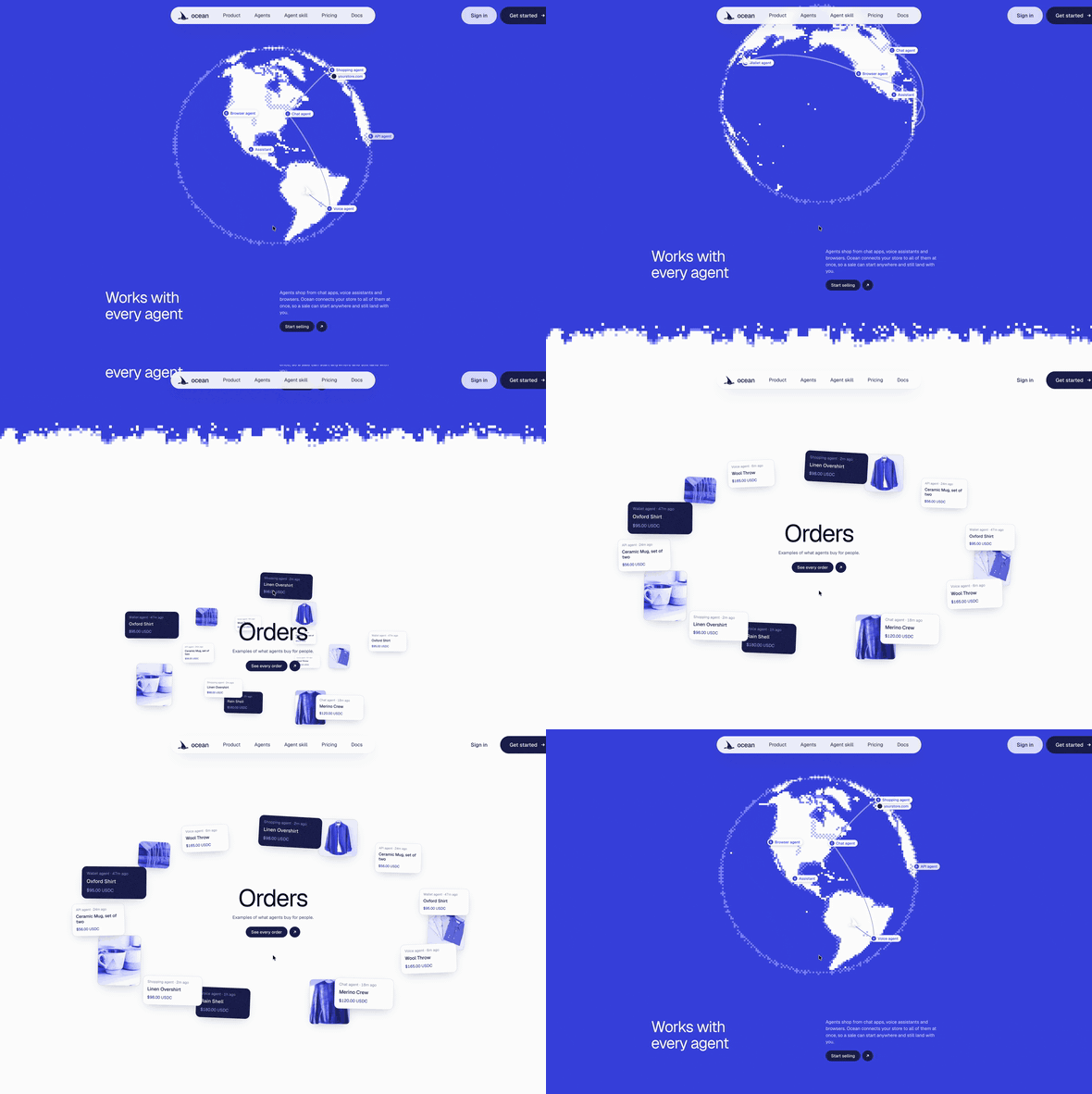
Ocean lets independent businesses turn their existing storefront into an accessible product endpoints, letting AI agents discover products and make purchases directly.
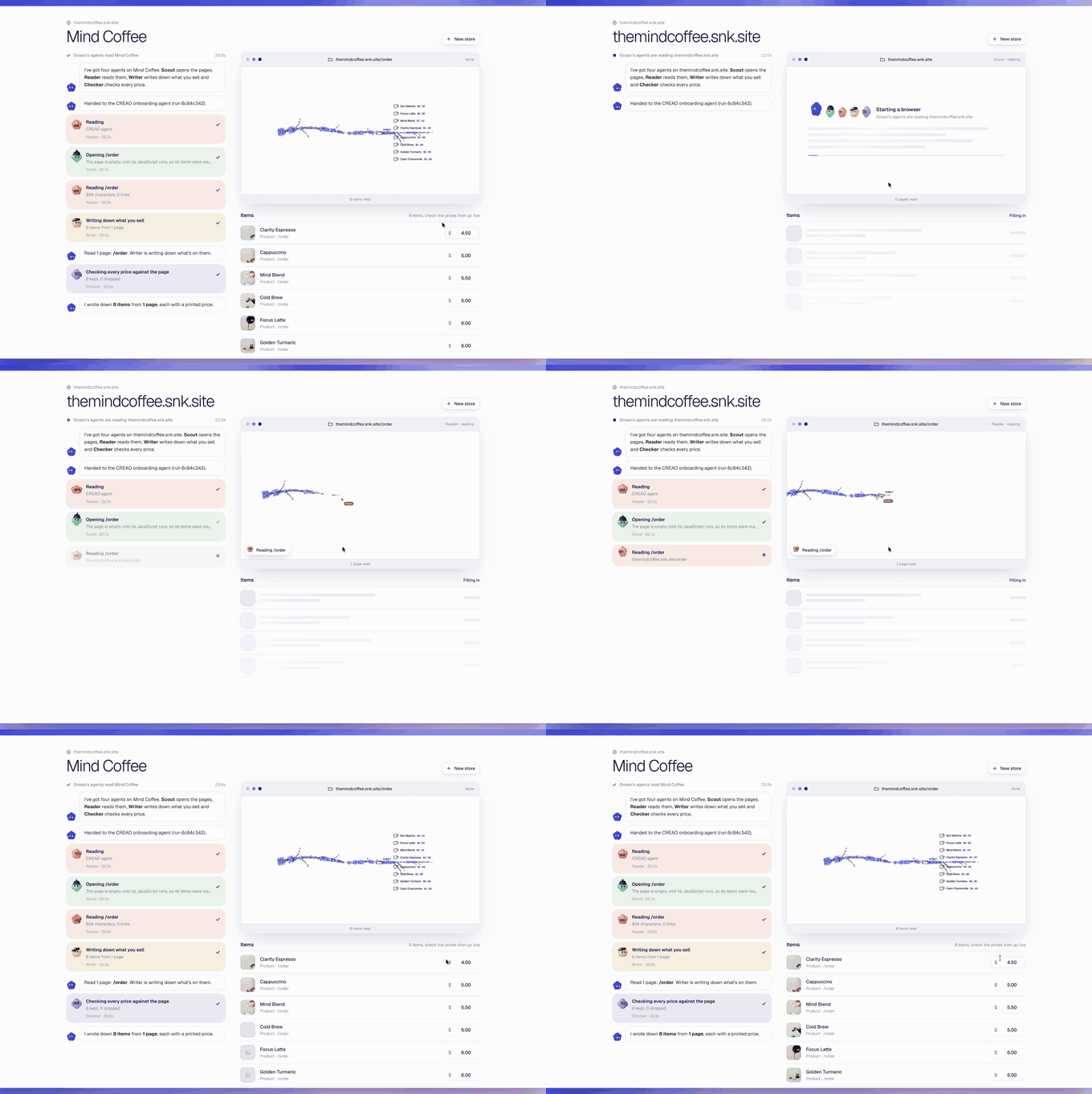
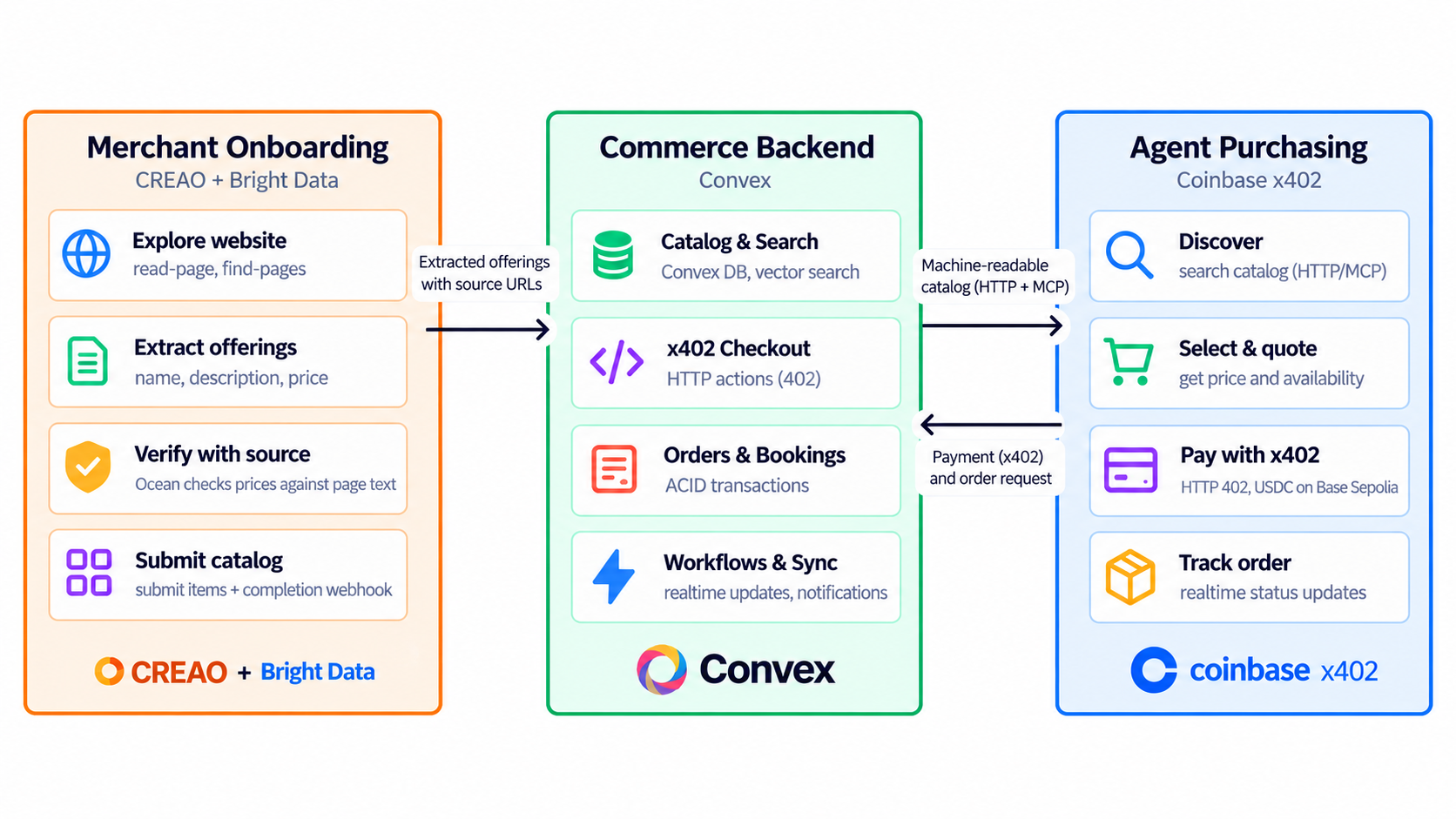
On the merchant side, an AI onboarding agent uses CREAO and Bright Data to explore the business's existing website, understand its offerings, and transform public website information into agent-accessible purchases.
On the buyer side, Ocean is designed to let purchasing agents discover offerings, request prices, and complete transactions using Coinbase's x402 payment protocol.
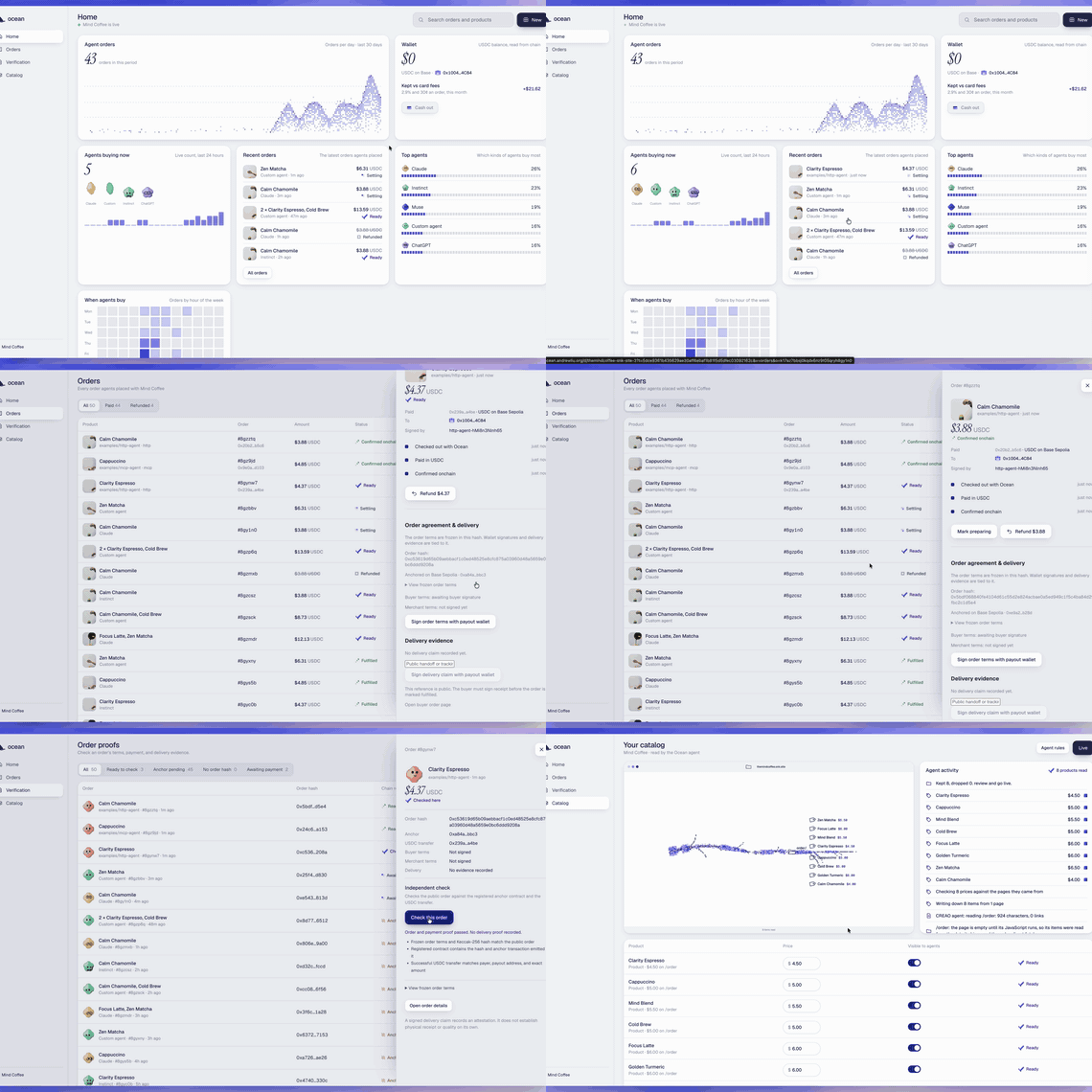
Convex connects both sides, powering the backend catalog, order management, and merchant experience.
The goal is to make agentic commerce accessible to businesses that were never built for it.
Agent Payments with Coinbase x402
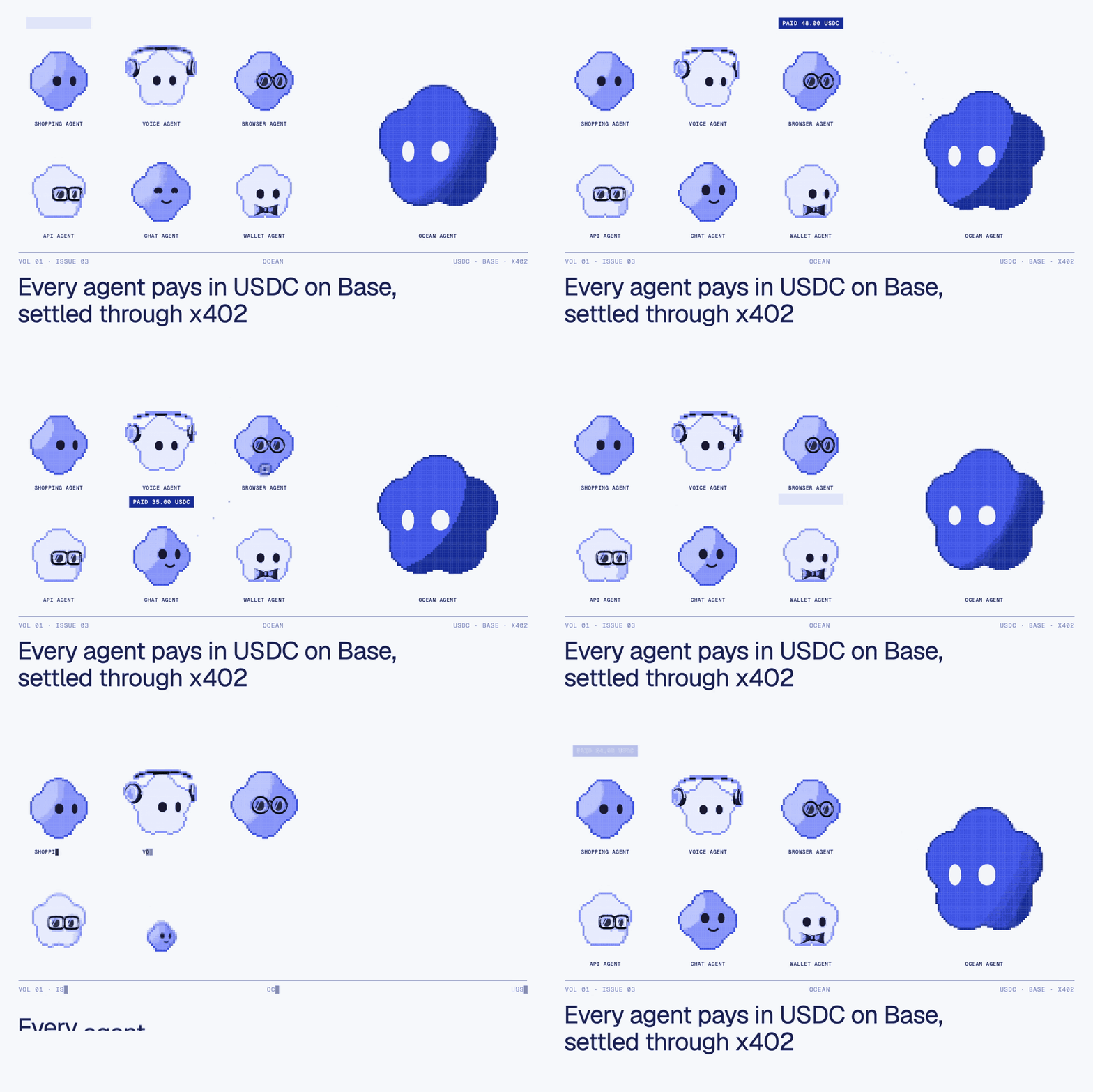
Ocean uses Coinbase's x402 protocol to turn merchant offerings into programmable purchases, allowing personal AI agents to pay businesses directly in USDC over instant, low fee, stablecoin rails.
Here's how the purchase works:
Discover. A personal AI agent starts with a purchase request and finds Ocean's agent readable catalog. Ocean also exposes discovery through MCP and Coinbase x402 Bazaar metadata.
Select and quote. The buyer selects an offering and requests checkout. Ocean calculates the price directly from the merchant's catalog, checks availability, and enforces spending limits rather than trusting a client-supplied amount.
Pay with x402. Ocean responds with HTTP
402 Payment Required, including the USDC payment requirements. The buyer authorizes payment through its connected wallet, and Coinbase's facilitator verifies and settles the transaction directly to the merchant's configured payout wallet.Fulfill. After payment, Ocean records the order in Convex, protects against duplicate settlement, and makes it available in the merchant dashboard. Buyers can follow their order status as the merchant fulfills it.
We've already tested the core payment flow against real website data. Ocean extracted 52 source-price-checked items from a restaurant website and settled a $2.18 USDC testnet payment against our deployed backend on Base Sepolia.
Merchant app · Onchain transaction · Reproduce the demo
Our example HTTP buyer also completed a separate $4.12 USDC purchase on Base Sepolia, discovering the merchant's offerings and completing the x402 payment flow without a traditional checkout page.
To support model-driven integrations (in agents like ChatGPT, Claude, or Muse) we also built an MCP server with an x402-paid buy tool, allowing compatible agents to access the same commerce infrastructure.
HTTP buyer transaction · HTTP buyer source · MCP implementation
We also built payment safeguards around x402, including server-side quotes, merchant and agent spending limits, idempotency keys, payment identifiers, and transactional booking protection. These controls are designed to prevent duplicate charges, incorrect amounts, and overlapping bookings when agents retry or compete for the same availability.
Ocean uses the Coinbase x402 payment protocol to let AI agents shift from product discovery to actually being agentic and making real purchases!
Real-Time Commerce Infrastructure with Convex
Convex powers Ocean's entire transaction lifecycle, from agent checkout to merchant fulfillment.
We chose Convex because agentic commerce needs more than a database. It needs payment endpoints, ACID transactions, durable workflows, and real-time synchronization working together. Convex brings database, functions, workflows, sync, and search into one TypeScript backend, letting us build the entire commerce experience around a single reactive system.
Our implementation uses Convex across the critical parts of the purchasing flow:
- HTTP actions for x402 checkout. Agent requests enter through Convex HTTP endpoints, connecting Coinbase's x402 payment protocol directly to Ocean's commerce backend.
- ACID transactions for safe purchasing. Transactional mutations coordinate orders and bookings, preventing competing appointments from exceeding a merchant's configured capacity. Idempotency controls protect against duplicate purchases when agents or clients retry requests.
- Real-time sync for merchants and buyers. Convex live queries keep both sides synchronized. When an agent places an order, it appears in the merchant dashboard. When the merchant marks it ready, the buyer's agent messages them right away.
- Durable workflows and backend components. Convex Workflows coordinate order processing, Aggregate maintains revenue totals, Rate Limiter protects endpoints, and Twilio supports customer notifications.
- Agent-friendly discovery. Vector embedding-based semantic search helps purchasing agents find relevant merchant offerings from natural-language requests.
The result is a backend where payments, orders, inventory, and fulfillment stay connected rather than being managed by separate services.
Coinbase x402 makes the payment possible and Convex makes that payment a reliable, real-time agentic commerce experience.
Autonomous Merchant Onboarding with CREAO
Most independent businesses don't have product APIs or structured commerce catalogs. Their offerings are scattered across menus, service pages, and booking information designed for humans.
Ocean uses a CREAO agent to autonomously turn existing merchant websites into storefronts that AI agents can buy from.
When an owner enters their website URL, Ocean triggers our CREAO agent through its API. The agent explores the website using custom tools to discover pages, extract products and services, and submit structured offerings with their original prices and source URLs.
We built four tools for the agent:
read-pageretrieves website content through Bright Data when needed.find-pagesdiscovers relevant menus and service pages.progressandsubmitstream agent activity into the merchant dashboard and submit structured offerings for catalog creation.
Ocean independently verifies every submitted price against its source page, rejecting unverifiable offerings. CREAO runs asynchronously and notifies our Convex backend through a webhook when finished.
We've executed 10 production CREAO runs. In one run, the agent extracted 43 of 43 valid restaurant offerings. In our Mind Coffee demo, it submitted 8 items, all 8 accepted, in just 37 seconds, with the completion webhook delivered to Convex.
CREAO Agent: 7fef7a9a-2643-4c7b-b48f-1a84702bc22a (v1.0.1)
View Live CREAO Run — Mind Coffee
Agent implementation · Custom tools
Instead of requiring businesses to build software for AI agents, Ocean uses CREAO agents to do the work for them.
Reliable Web Data with Bright Data
Before an AI agent can purchase something from a business, it needs reliable information about what that business actually sells.
That information already exists across millions of public websites, but it isn't always accessible through ordinary HTTP requests. Modern websites often rely on JavaScript rendering, dynamic content, and protections that make automated retrieval difficult.
Ocean integrates Bright Data into its merchant onboarding backend to retrieve public website content and make it available to our catalog extraction workflow.
Bright Data provides the web data access layer, while our onboarding agent interprets the retrieved information and converts merchant offerings into structured, agent-readable endpoints.
We're using the information businesses have already published to help them participate in agentic commerce.
Bright Data helps Ocean turn the existing public web into a source of merchant offerings that AI agents can discover and purchase.
What's next for Ocean
We envision a web where businesses don't need separate websites, applications, and integrations for every new AI assistant.
A merchant should be able to publish its offerings once and make them accessible to an open ecosystem of purchasing agents.
Ocean is a step toward making commerce native to the agentic internet.
Let your business get discovered by an OCEAN 🌊 of AI agents!!


Log in or sign up for Devpost to join the conversation.