Inspiration
As someone who has struggled with clinical OCD for 5 years, I realized that there are not many resources available for people who cannot pay hundreds of dollars in ERP (Exposure and Response Prevention Therapy). For a mental health condition that knowingly and unknowingly affects millions, it is heart breaking to see the little to no affordable resources available for them. I have tried many apps and softwares available for online treatment but unfortunately, an average subscription costed upwards of $50 a month with therapy charges coming separately. I resorted to forcing myself to watch walk through Youtube videos about ERP and being my own therapist. Eventually, my condition worsened and the subscriptions that I did had were of no help as they did not focus on the main part of ERP: interactivity. Therefore, after meeting with a myriad of people with clinical OCD and little to no resources, I decided that I wanted to make an app that could provide effective interactive treatment to OCD patients that could be useful in preventing and hopefully, curing OCD at a cost that is affordable in today's economy. Hence, OCDot.
What it does
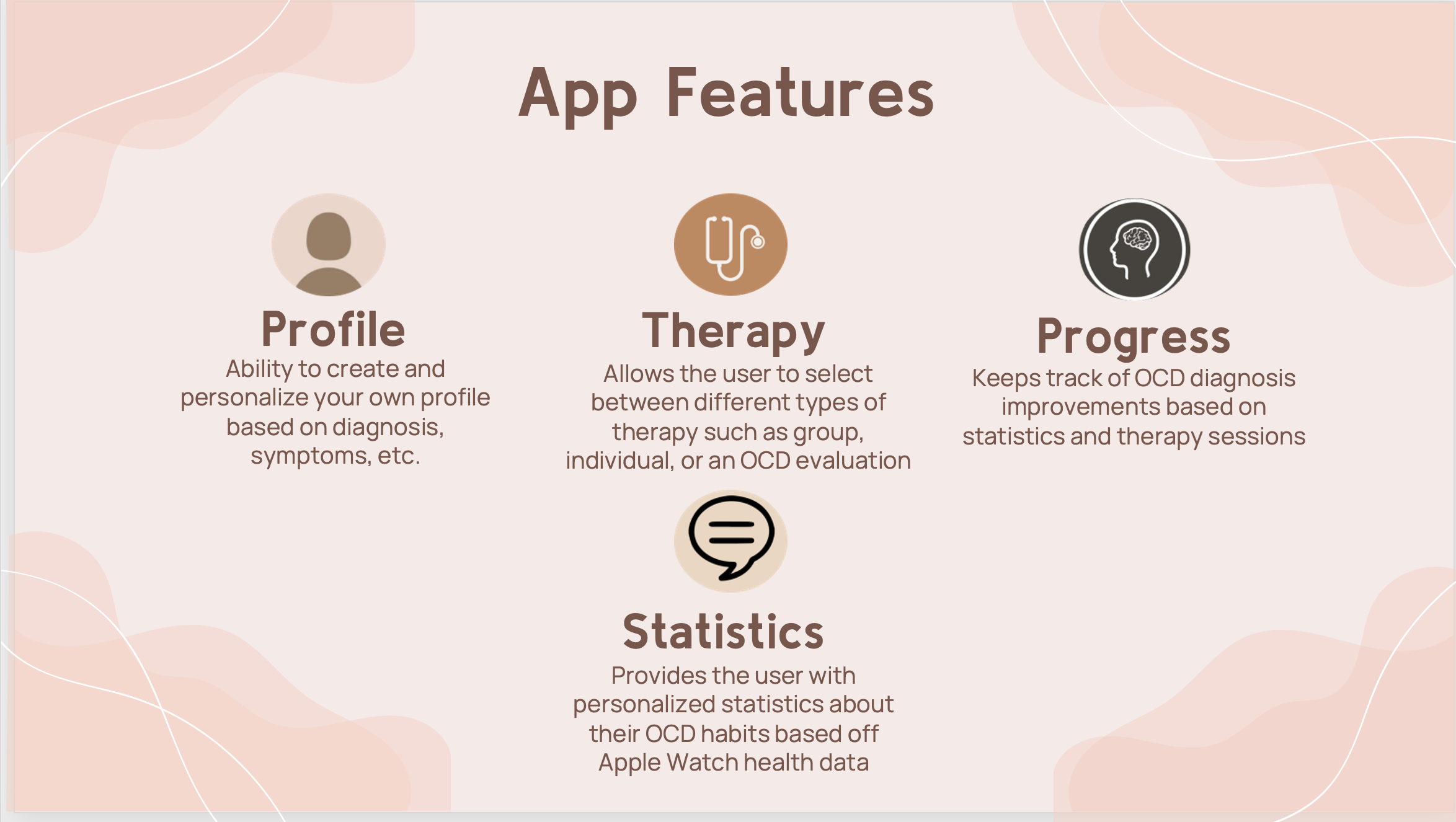
OCDot is an interactive mobile application (with a website to go with it) that has the capability to recognize repetitive movements in a persons daily activity and categorize it as obsessive compulsions. Once these habits are recognized by the AI using the mobile phone's health application data, the app is capable of providing personalized interactive ERP treatment plans that have walk-through videos and explanations of the disorder. Users can take this at their own pace; however, if they ever find themselves in a position where they need in-person help, the app provides resources for 1 free therapy session/consultation a month with other resources outside of OCDot such as emergency services and partnered therapy specialists at an affordable rate.
The app intends to sustain itself as a non-profit with most revenue coming in from advertisements and sponsors. These profits will then be used to pay certified ERP specialists in providing consultations as needed by the users in a timely manner.
OCDot also has interactive ERP modules categorized by the type of obsessive behavior the user is portraying. These modules contain deep breathing techniques in the form of interactive games, walk-through videos that help the user better understand their emotions as well as ways to become better, group therapy sessions with users across the platform in a moderated environment etc. All the resources to overcome OCD in one place. This is OCDot.
How we built it
For the website, we used HTML, CSS, and JavaScript. We first integrated our ideas onto a platform called Figma where we visualized our design. After deciding on the final design of the app, we used VSCode to convert the visual aesthetics into a digital website. We also wrote algorithms to read the hardware from the Apple Watch to recognize repeated movements in the user's daily activity to classify obsessive behavior in their routines. After compiling our code and digital designs, we came up with a successful digital version of the app as well as an online website to correlate the same.
Challenges we ran into
For the website, we ran into a problem collecting the user input and storing the data using JavaScript. For the hardware, we ran into problems integrating the hardware and software through outdated and incompatible versions of operating systems. We also ran into deprecated libraries when we tried to seek alternatives through simulations. In addition, this is our first hackathon.
Accomplishments that we're proud of
We are proud of completing our first ever hackathon as a team who could rely on each other. We learned about product design, development and presentation. However, the biggest accomplishment was learning to code in HTML and CSS overnight to build a functioning website. We also learnt to use the Figma app for digital design and Swift for hardware integration. We accomplished drawing a relation between mental health and technology, used color palettes and aesthetics on the app and website to match those that therapists use to treat their patients. We researched on all the different types of Obsessive Compulsive Disorders and the triggers they are associated with, as well as how effective ERP and interactive module design can be in their journey to recovery. Overall, learning to code as well as understand the human brain overnight were the two accomplishments we are most proud of.
What we learned
We learned app development, website development, time management and the foundations of entrepreneurship. Apart from technical skills, we also understood how the chemistry of the brain works and how technology can be a useful skill in treating mental illnesses. Our most valuable lesson however, was setting manageable goals and achieving them before the deadline, which we believe is an integral part of success.
What's next for OCDOT
I hope to be able to further develop OCDot through sponsors and have a functioning prototype to present at the Randall Family Big Idea Competition in 2024. I believe this app has the capability to change the way we approach mental health in society. Reaching out for help is hard, financial situations should not make it harder. Through OCDot, I wish to be able to change the narrative about mental health and make it more accessible for people to utilize and live a healthier life.

Log in or sign up for Devpost to join the conversation.