-
-
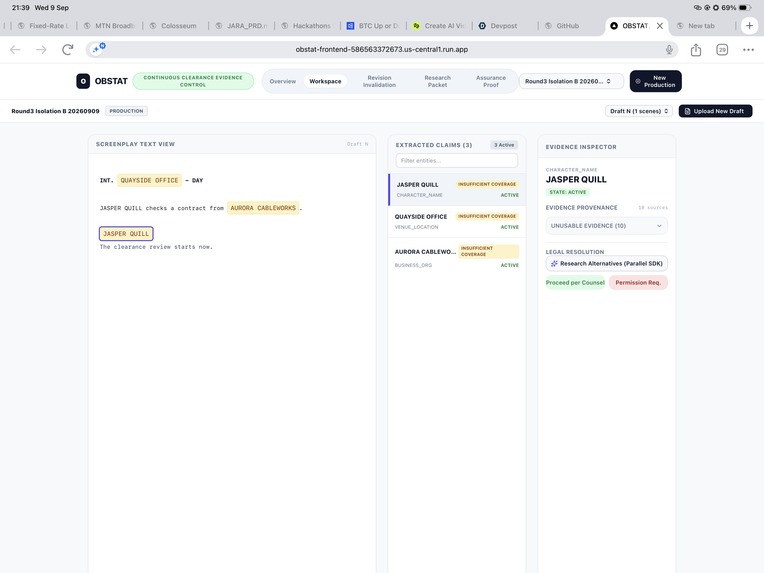
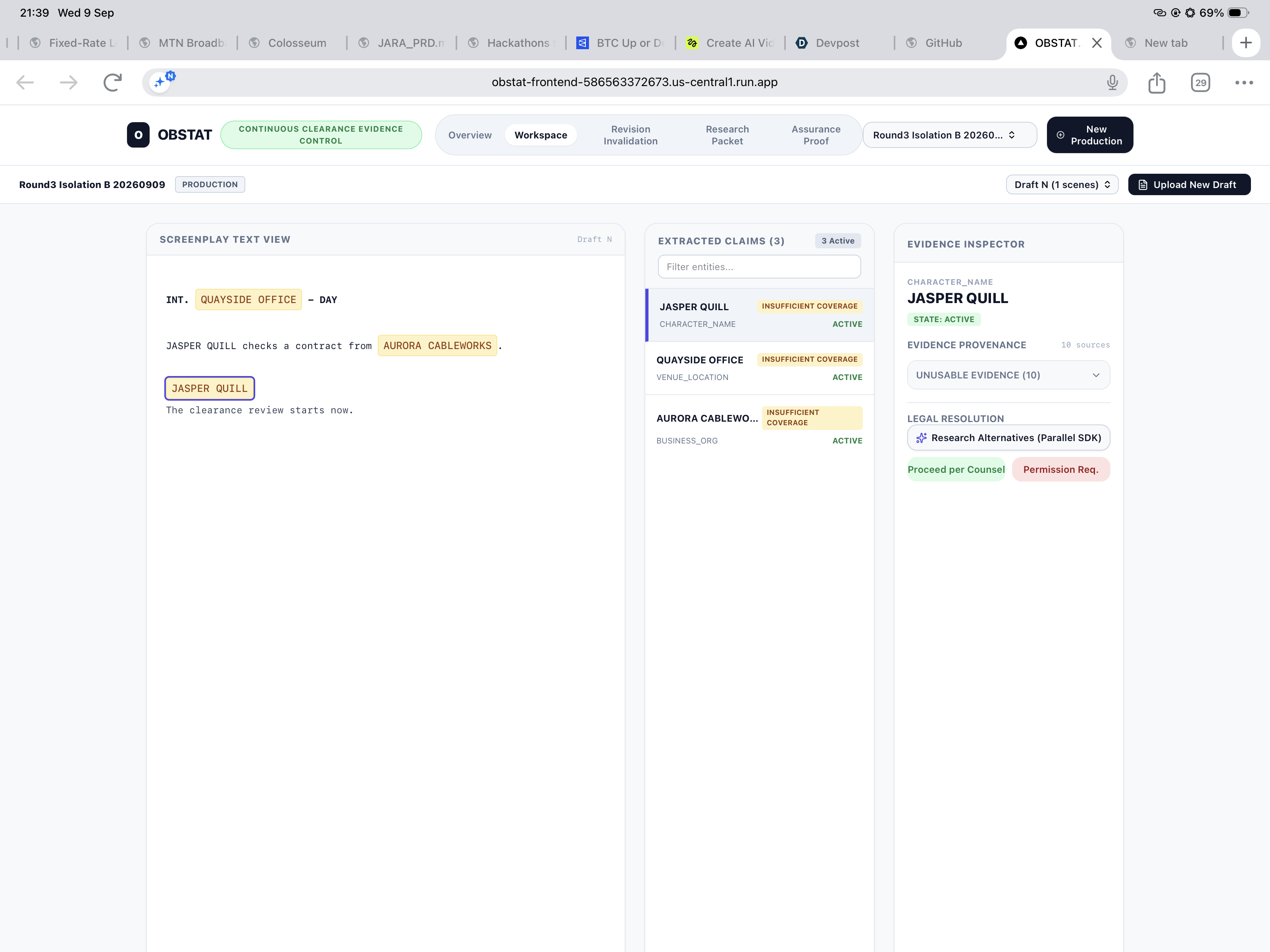
Live screenplay workspace with extracted claims, evidence status, and counsel actions bound to the active production
-
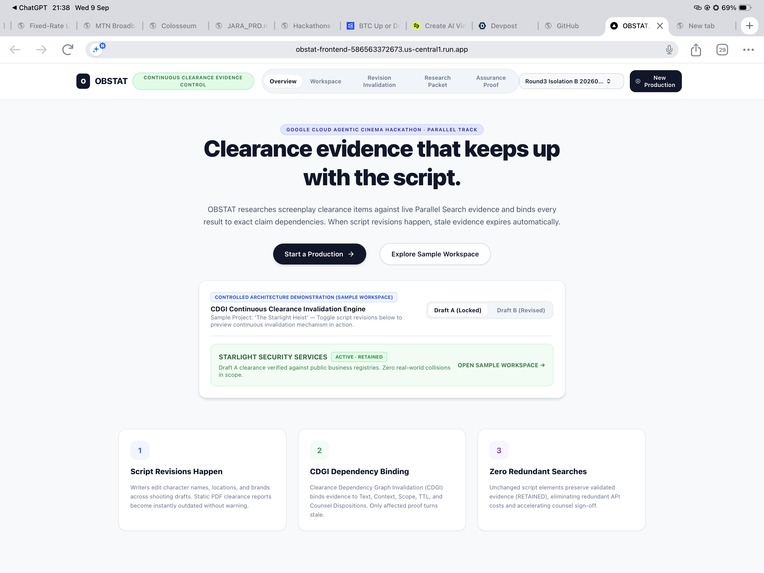
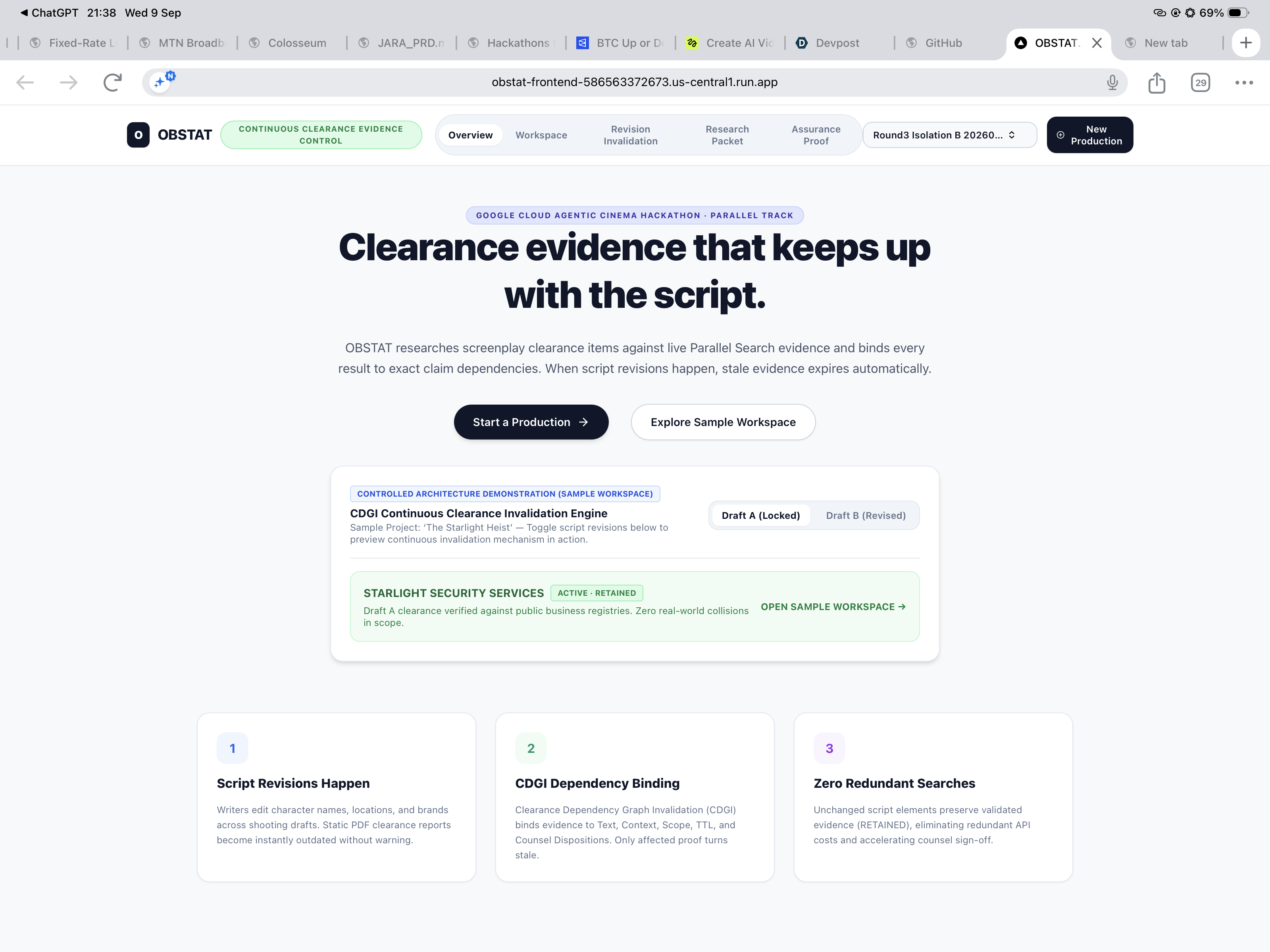
OBSTAT’s dependency-aware clearance model: retain valid proof, invalidate only what a screenplay revision actually changes
-
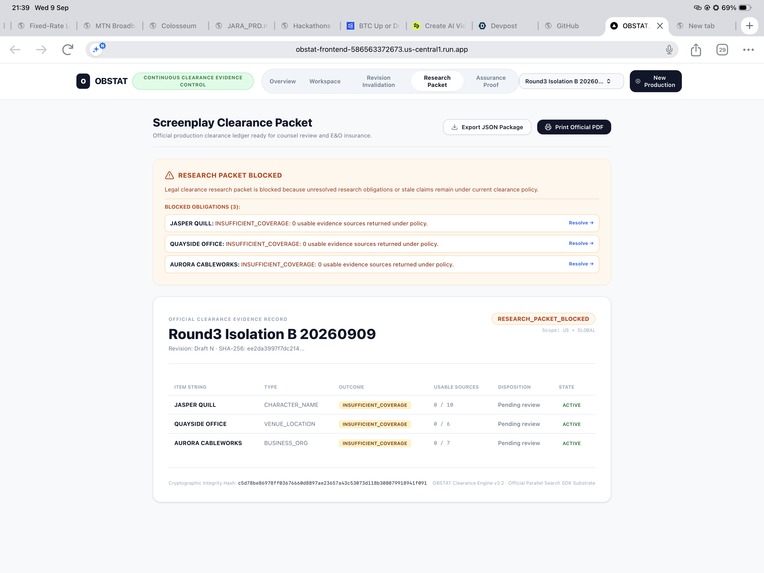
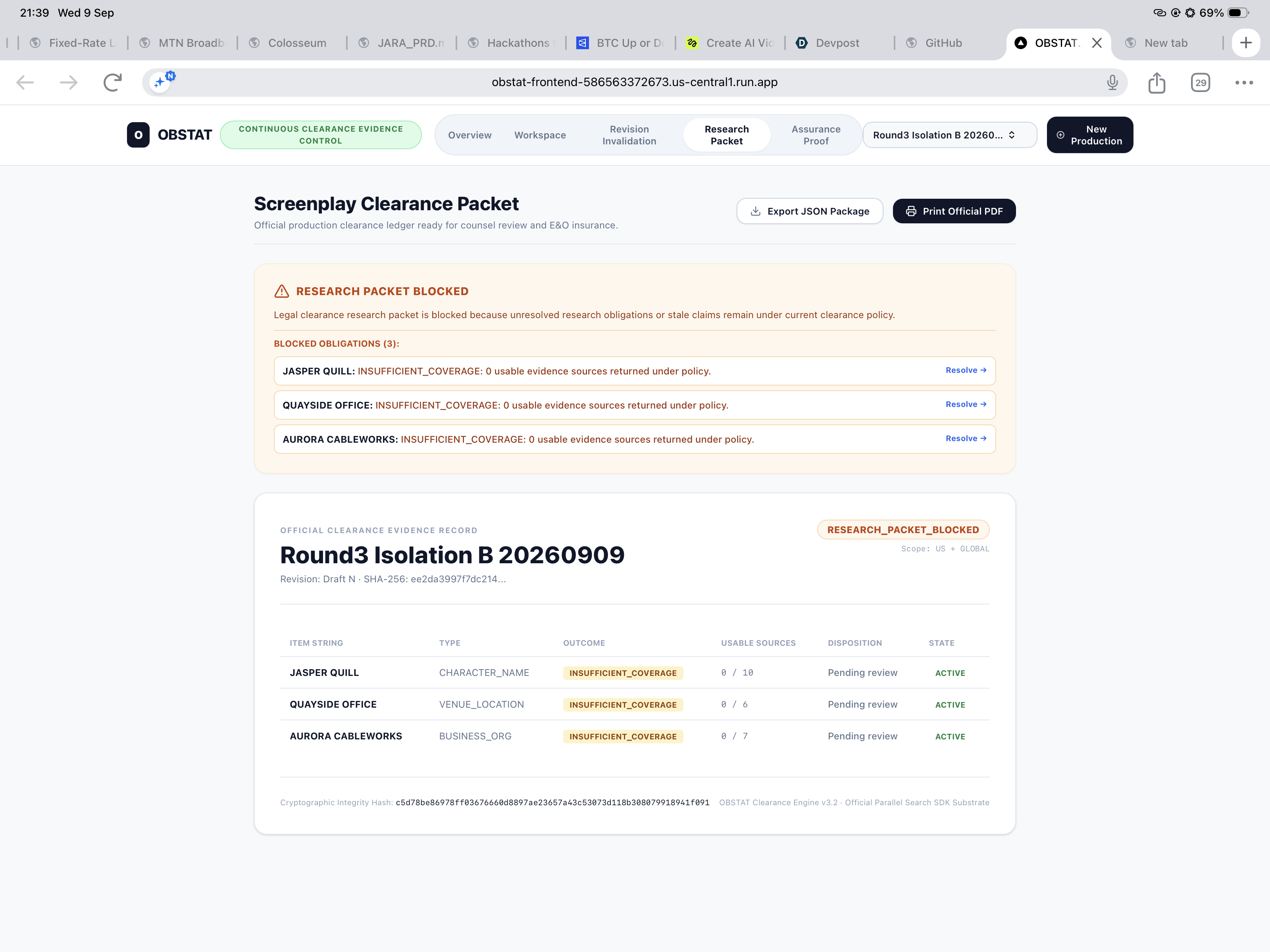
Fail-closed research packet: insufficient coverage blocks completion until every current evidence obligation is resolved
Inspiration
Film and television clearance is not a one-time search. A character, company, brand, lyric, or location may be researched in one screenplay draft and then quietly change in the next. The old report can look complete even when its evidence no longer applies. OBSTAT treats that problem like continuous integration for production legal operations: every conclusion is tied to the exact claim and draft that produced it, and affected evidence expires automatically when the screenplay changes.
What it does
OBSTAT turns screenplay clearance items into versioned evidence claims. It extracts and triages potentially sensitive entities, creates a deterministic research plan, performs live web research through Parallel Search, synthesizes cited evidence with Gemini, and routes each result to human review.
When a new draft arrives, OBSTAT compares claim identity and context—not just page numbers. Unchanged claims retain their evidence. Modified, renamed, added, removed, split, or merged claims are identified, and only affected research is invalidated and rerun. The clearance packet stays blocked while evidence is stale or coverage is insufficient.
OBSTAT never labels a screenplay legally cleared. Its review states are limited to review, likely clear, conflict found, and insufficient evidence. Every conclusion preserves the query, source URL, title, excerpt, retrieval time, tool status, research scope, and human disposition. It is research assistance for clearance coordinators and production counsel, not legal advice.
How we built it
The workflow is a deterministic Google ADK 2.x graph. Gemini 2.5 Flash on Vertex AI performs structured extraction and evidence classification, while Python policy nodes govern what can leave the Google Cloud boundary and whether a result is complete enough to use.
Before any external research call, a provenance egress firewall compiles outbound queries from a strict whitelist of item, template, and scope tokens. Raw screenplay dialogue and plot context are blocked from leaving the protected workflow. Approved queries are sent at runtime to the Parallel Search API. Returned results are normalized into a versioned evidence ledger, and deterministic adjudication rules fail closed when searches error, rate-limit, or return insufficient coverage.
The web interface is built with Next.js and TypeScript. The backend uses FastAPI and Firestore. Exported research packets include provenance and an integrity hash so reviewers can trace each conclusion back to the draft, scope, query, and evidence that produced it.
Challenges we ran into
The hardest challenge was preventing plausible-looking AI output from becoming false confidence. A search with zero useful results must not become a clean bill of health, and a provider failure must never appear as success. We separated model reasoning from deterministic policy enforcement and made missing credentials, unreadable inputs, partial searches, thin coverage, and stale evidence visible states.
A second challenge was revision identity. Page numbers and raw text matching are too brittle for real screenplay changes, so OBSTAT tracks claim identity and context across revisions and distinguishes retained, modified, renamed, added, removed, split, and merged items.
We also had to protect unreleased screenplay IP while still using live web search. The egress firewall limits Parallel requests to the extracted item and policy-approved research terms instead of sending screenplay pages or narrative context.
Accomplishments that we're proud of
- Real runtime integration with Gemini on Vertex AI through Google ADK and with Parallel Search.
- Differential research that retained unaffected claims and reduced repeat searches by 55% in a controlled 100-case revision-policy benchmark.
- A separate 100-case adjudication-policy benchmark with 100% conformance to the reference fail-closed rules. These are deterministic policy tests, not claims of unconstrained live-web accuracy.
- Explicit provenance and human disposition for every result.
- Fail-closed handling for missing credentials, provider errors, partial searches, and insufficient coverage.
- A production-oriented revision workflow that blocks stale evidence instead of hiding it.
What we learned
Agentic research becomes trustworthy when models reason inside a governed system. Gemini is valuable for extracting and interpreting ambiguous screenplay material, and Parallel is essential for fresh, source-linked web evidence. But code must still decide what information may leave the boundary, whether required query classes completed, whether the evidence is current, and whether a human must review it.
We also learned that provenance is not a decorative citation layer. It is product state. Once evidence is bound to a particular claim, context, query policy, and draft, the system can determine exactly what survives a revision and what must be researched again.
What's next for OBSTAT
Next, we would complete a hardened Cloud Run deployment, expand authorized source policies by jurisdiction and clearance category, add collaborative review queues for counsel and production departments, and validate the workflow with professional clearance coordinators on original, license-safe screenplays.
OBSTAT does not provide legal advice, replace professional clearance review, or issue binding legal clearance.
Built With
- fastapi
- firestore
- gemini
- google-adk
- google-cloud
- next.js
- parallel-search
- python
- typescript
- vertex-ai

Log in or sign up for Devpost to join the conversation.