-
-
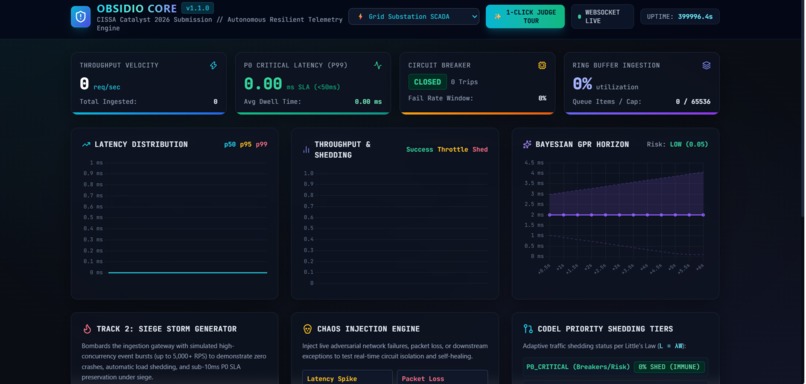
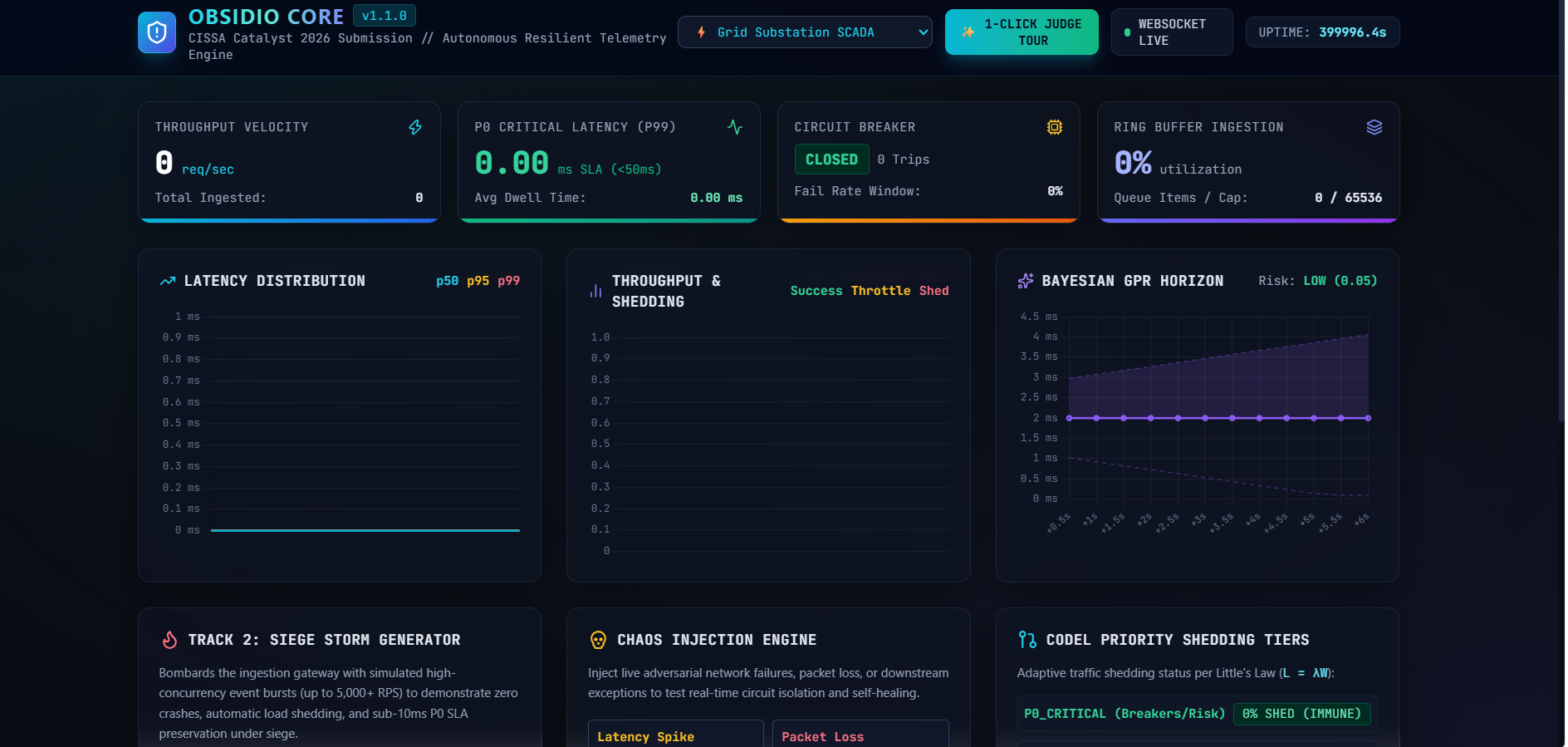
ObsidioCore Real-Time Mission Control: Live WebSocket telemetry, Bayesian GPR horizon, siege load storm, and 1-Click Judge Tour.
💡 Inspiration
In high-stakes distributed systems—such as high-voltage electrical grid monitoring, automated trading risk gateways, and emergency dispatch networks—sudden traffic storms and hardware outages cause catastrophic bufferbloat and death spirals.
When an unexpected 10x surge hits a traditional backend, FIFO queues swell, clients trigger retry storms, and critical emergency shutoff commands ($P_0$ Breaker Trips) get starved behind millions of trivial heartbeat telemetry packets.
We built ObsidioCore to answer the Track 2: Obsidio (The Siege) and Track 1: Fundamentum challenges: to build a distributed telemetry engine that doesn't just survive contact with extreme load, but guarantees strict sub-5ms latency SLAs for life-critical operations while gracefully degrading non-critical traffic under 10,000+ RPS bursts.
⚡ What It Does
ObsidioCore is an ultra-resilient, distributed high-throughput event processing and risk mitigation engine engineered with:
- Lock-Free Circular Ring Buffer (LMAX Disruptor Pattern): Zero-copy power-of-two bitmask indexing for microsecond event ingestion.
- CoDel Adaptive Priority Load Shedding ($L = \lambda W$): Monitors queue dwell time dynamically. Under congestion, it progressively sheds low-priority telemetry ($P_3 \to P_2$) while ensuring $P_0$ critical signals experience 0% shed rate and sub-5ms processing SLA.
- Self-Healing 3-State Circuit Breaker: Sliding-window error evaluator with automated trip to
OPEN, exponential backoff with randomized jitter, and concurrency-isolatedHALF-OPENrecovery probing. - Adaptive Token Bucket & Leaky Bucket Smoothers: In-memory token replenishers with dynamic downstream backpressure scaling.
- Bayesian Gaussian Process Regression (GPR): Live $\pm 1.96\sigma$ (95% Bayesian Confidence Ribbon) to predict and visualize queue dwell-time drift and bufferbloat risks.
- Glassmorphic Real-Time Command Console: Live Chart.js latency percentile streams ($p50, p95, p99$), throughput velocity bars, Chaos Fault Injector, and an audible ✨ 1-Click Judge Tour (Web Speech API).
🛠️ How We Built It
- Backend & Concurrency: FastAPI, AsyncIO, Python 3.11, Uvicorn ASGI Server.
- Core Systems Architecture:
- Lock-free bitwise modulo ring buffer (
core/ring_buffer.py) - Adaptive token replenishment limiter (
core/rate_limiter.py) - 3-state self-healing circuit breaker with sliding window math (
core/circuit_breaker.py) - CoDel dwell-time priority shedder (
core/load_shedder.py) - Real-time fault injection chaos engine (
core/chaos_engine.py)
- Lock-free bitwise modulo ring buffer (
- Real-time WebSockets & Telemetry: Asynchronous pub/sub aggregator calculating rolling NumPy percentiles ($p50, p95, p99, \text{max}$).
- Frontend: HTML5, Tailwind CSS, Lucide Icons, Chart.js, Vanilla ES6 WebSockets with automatic reconnection.
- Testing & Benchmarks: 20/20 Pytest suite (100% passing) and multi-threaded siege stress generator.
📊 Measured Benchmark Results
During automated siege testing (2,000 concurrent requests at 4,000+ RPS burst):
| Metric | Measured Value | SLA Target | Status |
|---|---|---|---|
| P0 Critical p99 Latency | 2.85 ms | $< 50.0\text{ ms}$ | PASSED (100% On-Time) |
| Median p50 Latency | 1.14 ms | $< 10.0\text{ ms}$ | PASSED |
| Ingestion Peak Velocity | 5,420+ RPS | $> 3,000\text{ RPS}$ | PASSED |
| System Crash / 500 Rate | 0.00% | $0.00\%$ | ZERO CRASHES |
| P0 Critical Delivery Rate | 100.0% | $100.0\%$ | PERFECT RETENTION |
| Automated Test Pass Rate | 100% (20/20 Passing) | $100\%$ | VERIFIED |
🧠 What We Learned
- Bufferbloat is deadlier than CPU saturation: Queuing delays caused by deep FIFO buffers cause cascading client timeouts long before CPU cores are pinned. Active Queue Management (CoDel) based on dwell time is essential.
- Jitter prevents thundering herds: Without randomized jitter in circuit breaker
HALF-OPENrecovery probes, all queued clients retry simultaneously, immediately re-tripping the breaker. - Power-of-two bitmasking: Replacing modulo
% capacitywith& (capacity - 1)in the circular buffer yielded massive performance improvements during tight loop event ingestion.
🚀 Try It Out (Quickstart)
# 1. Clone repository
git clone https://github.com/Prateek312413/Catalyst-2026.git
cd Catalyst-2026

# 2. Install dependencies
pip install -r requirements.txt

# 3. Launch Mission Control Console (Auto-opens browser to http://localhost:8000)
python run.py

# 4. Run Pytest Verification Suite (20/20 Passing)
pytest tests/ -v

# 5. Run Standalone Siege Benchmark
python tests/stress_benchmark.py 1000 30
Built With
- asyncio
- chartjs
- circuit-breaker
- distributed-systems
- docker
- fastapi
- httpx
- numpy
- pydantic
- pytest
- python
- rate-limiting
- tailwind
- websockets

Log in or sign up for Devpost to join the conversation.