-
-
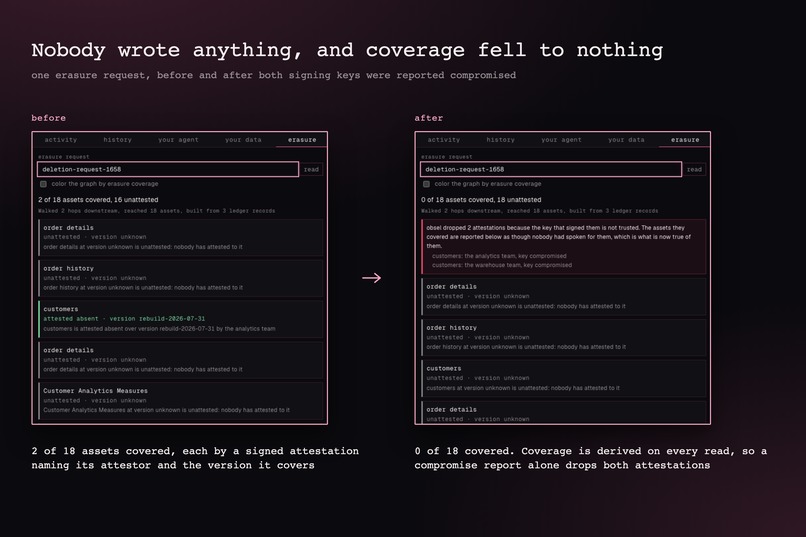
One erasure request, before and after both keys were reported compromised: 2 of 18 covered falls to 0 of 18, each dropped attestation named.
-
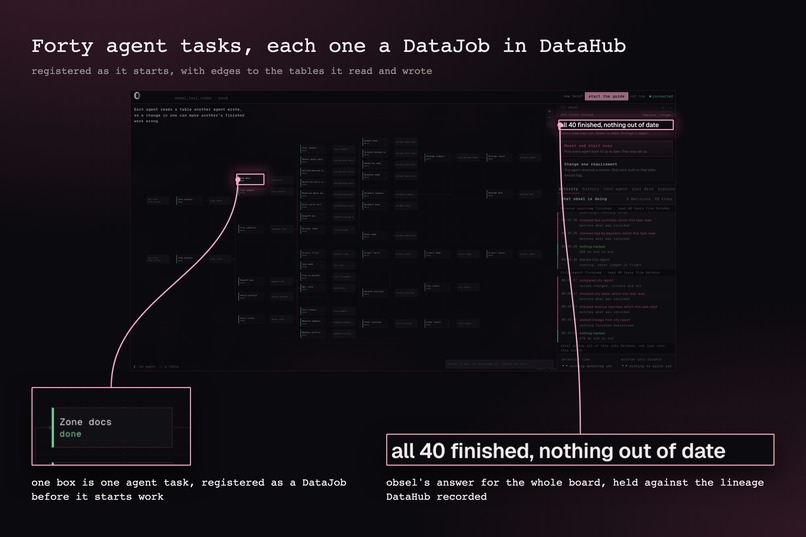
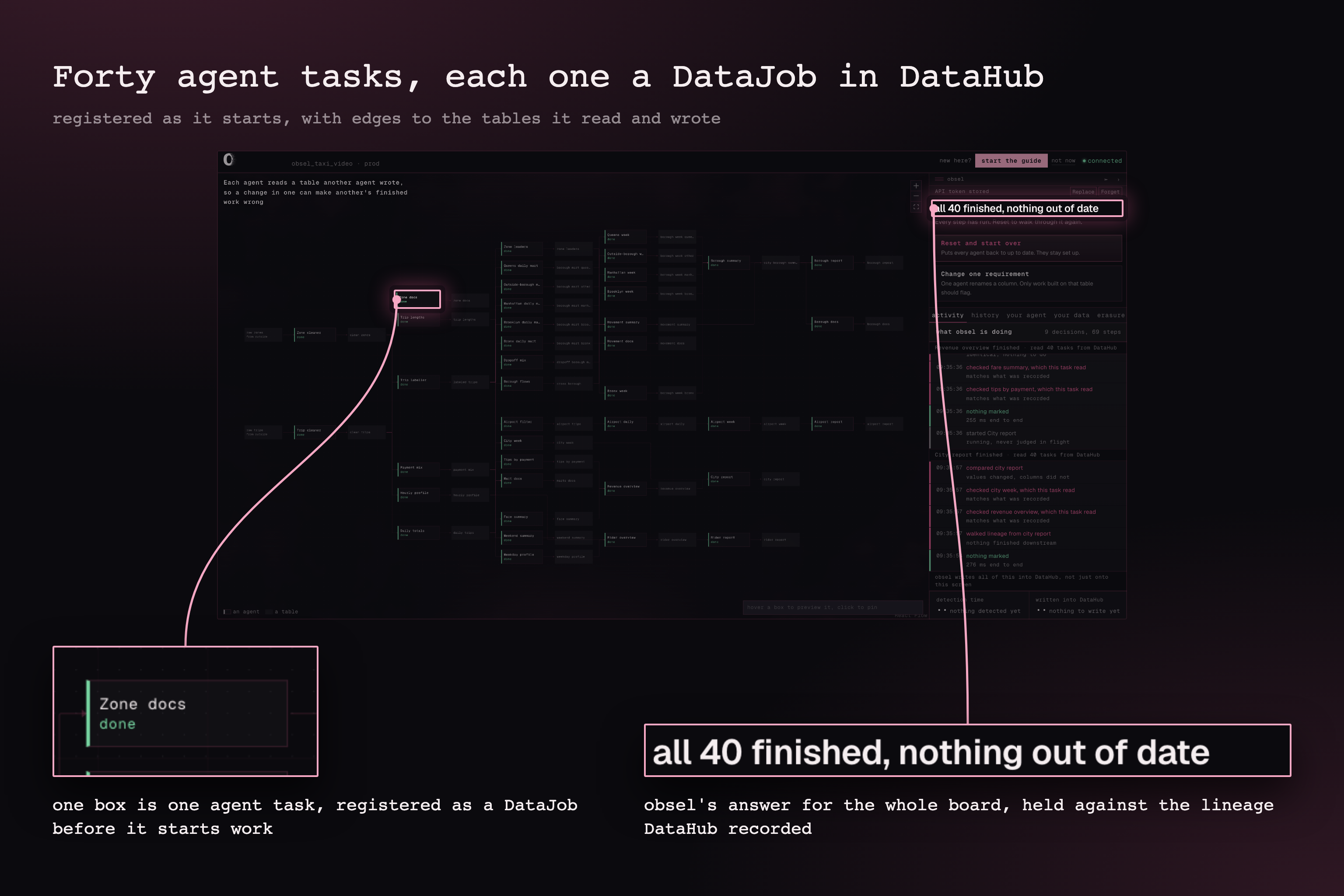
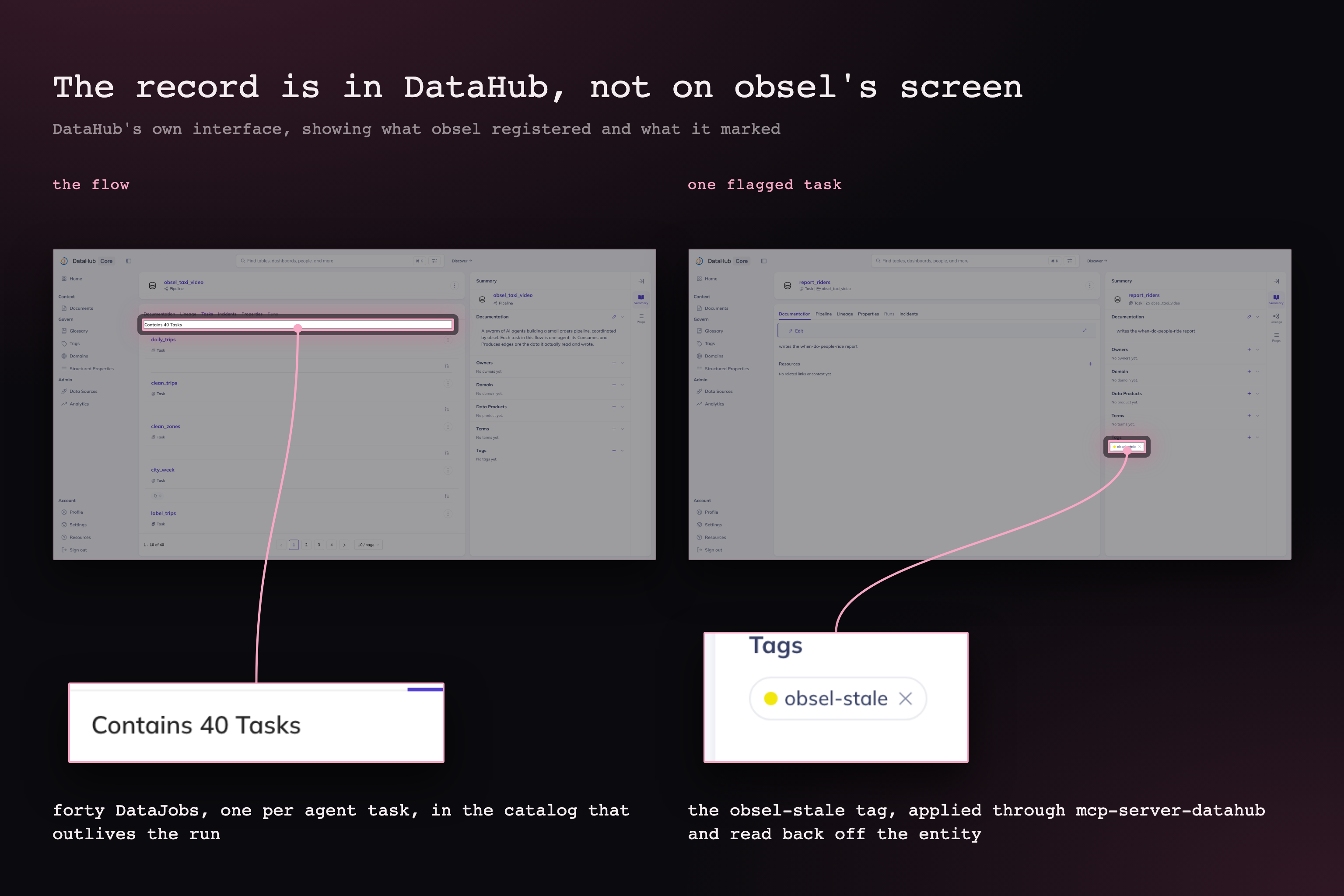
Forty agent tasks, each a real DataJob in DataHub with Consumes and Produces edges. The record belongs to the catalog and outlives the run.
-
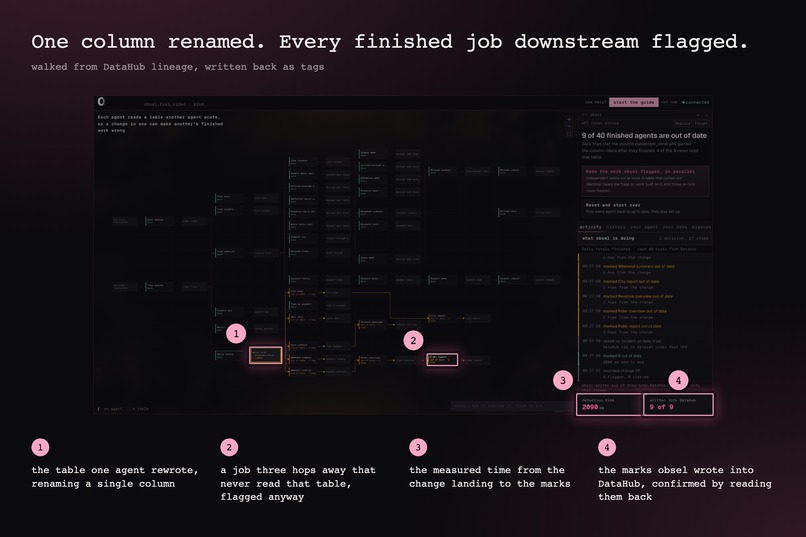
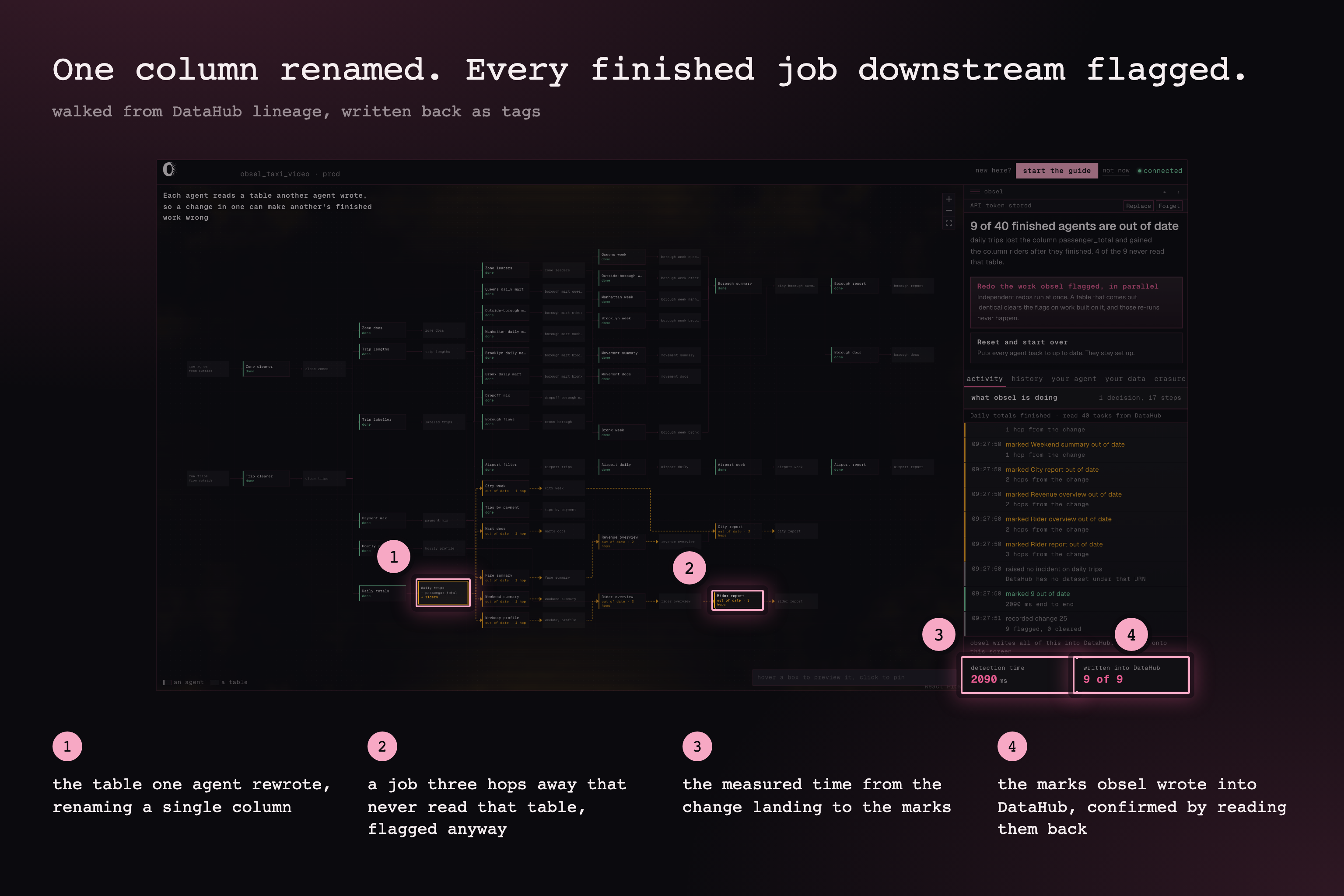
One column renamed on a settled board: 9 of 40 flagged out to three hops, four of them never read that table. Detection measured at 2090 ms.
-
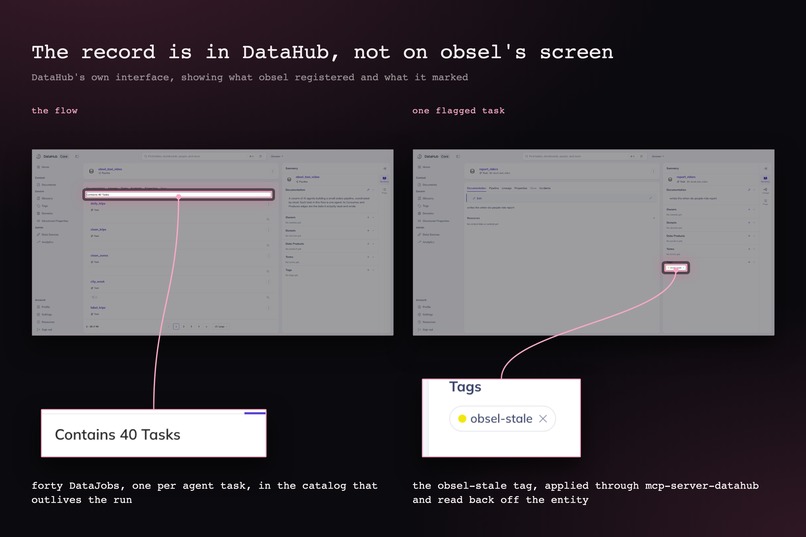
DataHub's own interface: the flow with forty tasks, and the obsel-stale tag on a flagged job, written by mcp-server-datahub and read back.
-
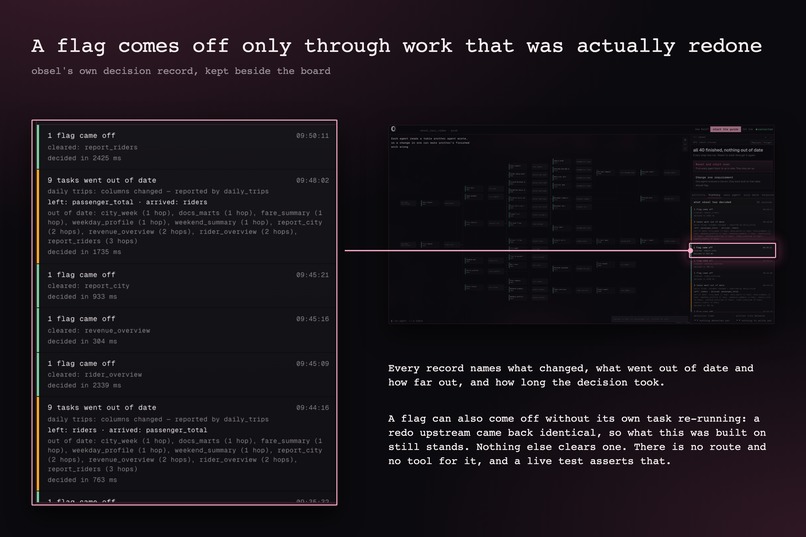
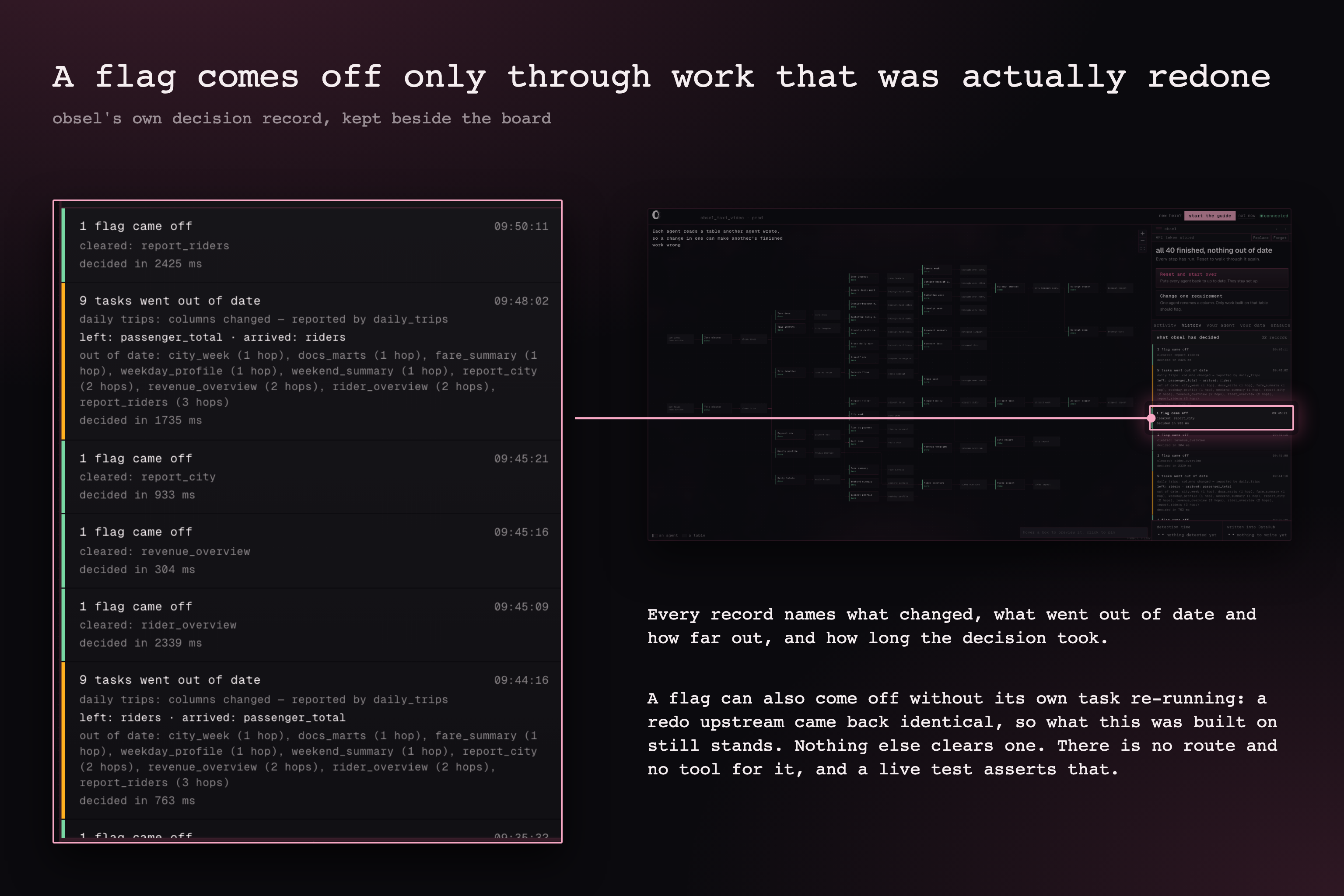
obsel's decision record: what changed, what went out of date and how far, and a flag that came off since an upstream redo landed identical.
-
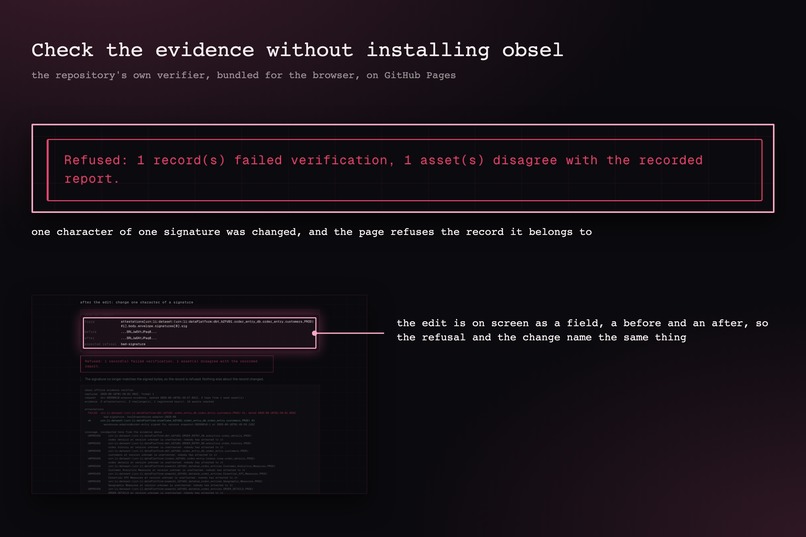
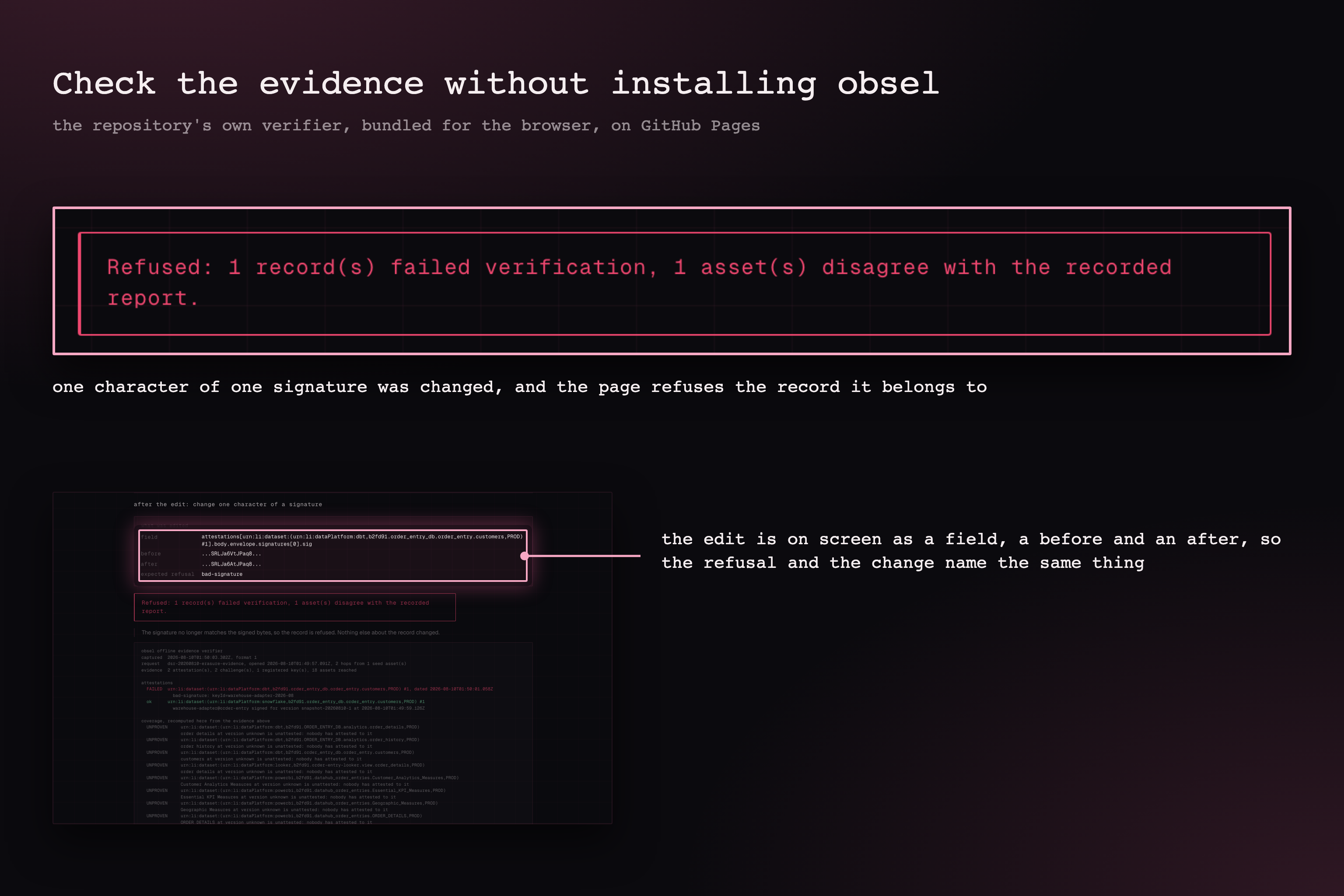
The evidence bundle checked on GitHub Pages by the repository's own verifier: one signature character changed, and the record is refused.
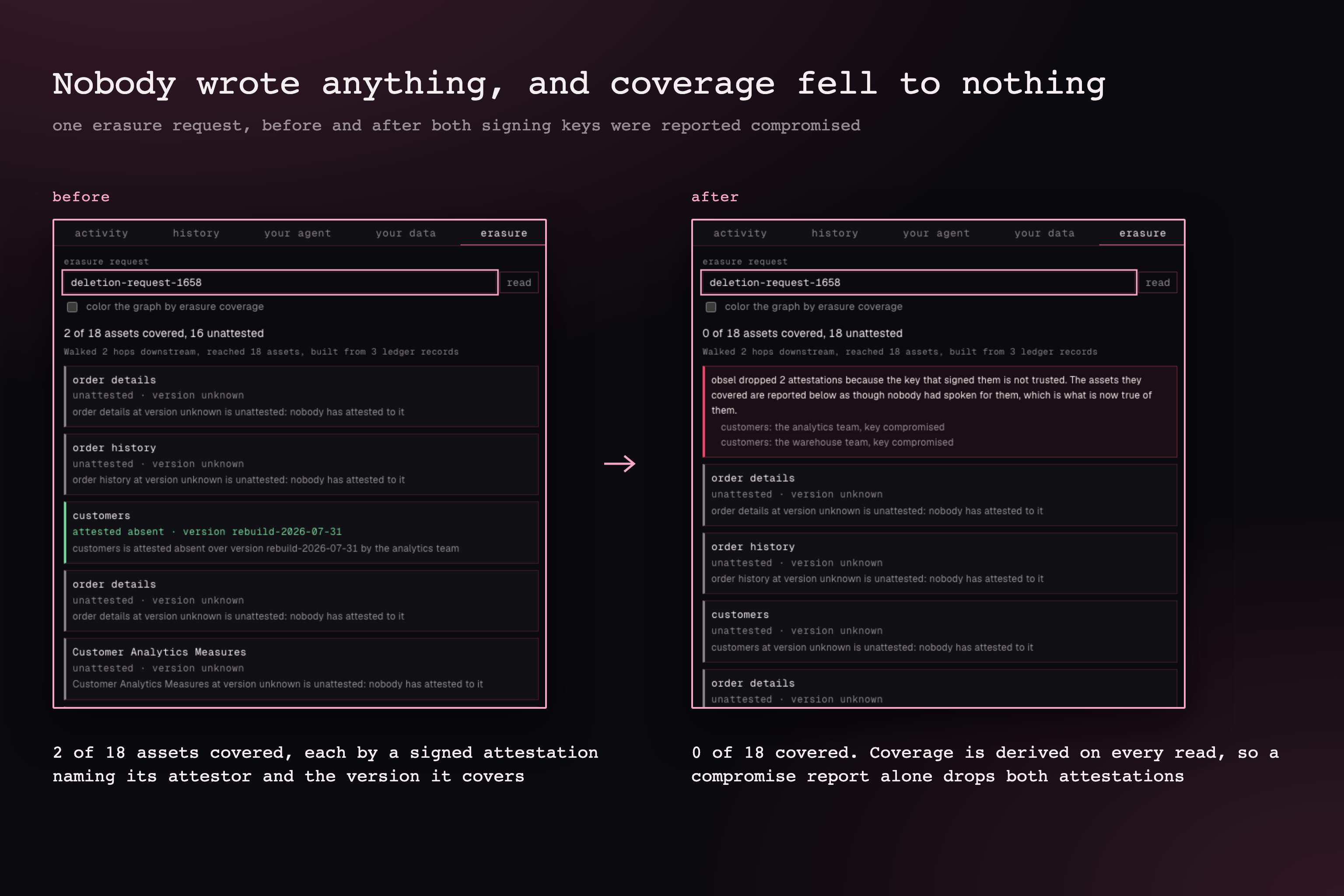
obsel tracks a right-to-erasure request across the systems it cannot see: every asset the request reaches stays unattested until an operator who can look signs for it.
Category: Agents That Do Real Work · Apache-2.0 · built solo · video 2:59 · every number here is traceable to docs/verification.md in the repository.
Erasure coverage
A GDPR Article 17 request arrives, the team holding the system of record deletes the subject's rows, and the ticket closes. Copies of those rows had already flowed into stores other people run, and nothing on file says which of those places anybody has looked at.
obsel starts from the tables known to hold the subject and walks lineage, the Consumes and Produces edges between jobs and tables that DataHub's ingestion already records for the estate. Every asset that walk reaches begins at UNPROVEN, which says nobody has spoken for the asset, not that the subject is still in it.
An asset leaves UNPROVEN when an attestation arrives, a statement signed with a registered Ed25519 key by the operator of the store the asset sits in. The attestation binds the subject's absence to a named version of a named table, the whole version rather than a partition of it. A hash says what the bytes were. A signature says who answers for the claim, and can be revoked. The attestor is whoever holds credentials to that store, and obsel never is, because it holds no warehouse credentials and reads no warehouse data. It cannot establish absence and does not claim to. What it can do is combine those local claims into a per-asset picture no single attestor is positioned to produce, and lead with the assets nobody signed for.
Coverage is that picture totaled, N of M attested and K unattested, recomputed from the append-only ledger on every read and never stored. A stored verdict would still be reporting the old number after a signing key was reported compromised, because a compromise report touches no table and no stored field.
The one-minute version
A day-one report is almost entirely unattested. Seeded from one Snowflake customers table in the showcase-ecommerce catalog, the walk went four hops and reached 23 assets across five platforms, every one UNPROVEN with no-attestation. One Ed25519 keypair, one challenge and one signed attestation moved exactly one of them, to 1 of 23 attested and 22 unattested, driven by hand against a live DataHub on 2026-07-26.
Retiring a key and reporting one compromised are separate code paths. A retired key's past signatures stand. A compromised key's signatures fail whatever their age, so a compromise takes coverage back with nobody touching data. The falsifier is a passing test in tests/attestation.test.ts, "an asset goes back to unattested when the signing key is reported compromised".
No route, tool or argument marks an asset covered. A live test posts to the three paths a later commit would add and asserts there is no mutation behind any of them, and the MCP suite asserts no such tool is offered. With no OBSEL_API_TOKEN set, POST /api/erasure answers 503 and names the reason.
The vocabulary is enforced in code and in every document. Never "proven clean", always "attested absent over version V by attestor A". Never "complete", always "N of M covered, K unattested".
Absence in a table cannot be established from a graph of how tables connect, only carried through one. obsel reports who has accounted for what, and who has not.
The same walk, on finished work
Agents in a swarm read tables other agents wrote. When an upstream table changes, downstream work that already finished is now built on data that has moved, and nothing says so. The work still looks finished, and at forty tasks nobody can eyeball what a change reached.
Every agent task becomes a DataJob in DataHub, wired with Consumes and Produces edges to the tables it reads and writes, so the lineage graph itself does the coordination. obsel runs no message bus and no scheduler. When an agent reports completion, obsel fingerprints what it produced (sha256 over schema and content, separately, so a rename is distinguishable from new rows), compares against the recorded baseline, and walks those edges downstream. Finished work built on the changed table is flagged with the cause, the hop distance, and a plain sentence stored on the flag. The obsel-stale tag lands on the DataJob through DataHub's MCP server, and the cascade raises one native DataHub Incident on the changed table naming every flagged task, so somebody browsing DataHub sees both without knowing obsel exists. The incident comes down when the marks it names are gone, through redone work or a board reset that wipes them, and never on request. Measured live, the raise added 345 ms and the resolve 300 ms, each including its confirming read-back.
Four rules make the flags worth reading.
- A re-run producing the same table flags nothing. Staleness is decided by comparing fingerprints, never by the fact that a write happened. Rows are sorted before hashing and columns the task registered as volatile are left out, so a re-run differing only in row order or only in a load timestamp counts as identical. At forty tasks, an identical re-run flagged zero of 40.
- Work in flight is never judged. A mid-swarm change flagged 8 finished tasks in a measured 13,349 ms while 9 agents were still running, and none of the nine was touched.
- A flag comes off through redone work and nothing else. No route and no tool takes a task to clear, because a tool that declares work fresh would let a caller dismiss the warning obsel exists to raise. When a flagged task re-runs and its table comes back identical, obsel clears the downstream flags that redo restores, and only those.
- Every number on the page was measured, or it is withheld. A failed read blanks every stat.
The demo runs forty Codex agent sessions building a pipeline over one week of NYC yellow-taxi trips (2,100 rows, sha256-pinned, provenance documented), concurrently, peak 8 at once, 252.6 s wall clock. One agent then re-runs with a renamed column. How far that reaches depends on how much has finished, so the runs below differ on purpose.
- On a settled board on 2026-07-24, 9 of 40 flagged out to three hops in 3968 ms. The 30 tasks outside the change stayed unflagged, and all nine tags were confirmed in DataHub.
- The same rename while 9 agents were still in flight, the same day, flagged 8 of 40 finished tasks in 13,349 ms, five direct readers and three transitive, and touched none of the nine running agents.
report_cityfinished after the flags landed, on inputs that had not moved, and was correctly left alone. - On 2026-08-02 the forward and reverse rename alternated on a settled board five times, each a real agent session, and all five flagged 9 of 40 at three hops. Detection ran from 473 ms to 4166 ms with a median of 666 ms, on one machine, so it is a range rather than a benchmark.
- The same pipeline also ran on Claude Code that day. Forty sessions of
claude-sonnet-5at medium effort finished in 129.3 s at peak 8, every output passing its contract and nothing flagged. The settled change then flagged 9 of 40 at 4575 ms, and the repair redid 6 of 9 in 37.8 s, clearing the other three without re-running them.
The repair, run from the 8-flag page, redoes only the flagged work, in parallel, and cancels each downstream redo as soon as an upstream redo lands identical and makes it unnecessary. It redid 5 of 8 in 42.4 s against roughly 188 s to redo all eight, a baseline estimated from each task's own last measured run and labeled an estimate everywhere it appears.
Any MCP-capable agent can join a swarm through obsel's own MCP server: ten tools, seven for the page and three for erasure. Every mutation goes through obsel's HTTP API, the server holds no DataHub credentials, and no tool marks or clears a flag, so an agent can join the swarm but cannot dismiss what obsel decided about its work. The bring-your-own-data walkthrough in docs/setup.md was executed for real, with a five-row expenses CSV and a renamed column. The downstream task was flagged at one hop in 3934 ms and the redo cleared the flag. Declaring your own tasks needs no agent at all. A form on the page posts to the same registration route the MCP tool calls, and that path ran against a live DataHub on 2026-07-26. Reporting the work still comes from whatever runs it, because obsel takes the fingerprint from the rows itself, and a second implementation of that would be a second definition of what counts as a change.
The video (2:59) follows the forty-agent run, the mid-swarm change and the repair end to end, then closes on an erasure request opened against a live catalog, its report on camera reading 2 of 18 assets covered, 16 unattested, each of the two signed by a different team's key. That is a separate run, walked two hops rather than four, and its figures are never combined with the 23-asset walk above.
Check it yourself
pnpm verify runs the typecheck, lint, 792 unit tests and the Python self-checks, no Docker needed. pnpm test:live runs 189 tests against a real DataHub, the real mcp-server-datahub, a real obsel server and real agent CLI sessions. Nothing in the repository is tested against a stand-in. Everything that crosses a process boundary is covered against the real thing, and the one in-memory stand-in that ever existed was deleted for cause, recorded in docs/verification.md. Every screen in the video is a recording of a run that actually happened. One check needs nothing installed but Node:
node scripts/verify-erasure-evidence.mjs examples/erasure-evidence/bundle.json
That re-runs obsel's own signature check and coverage kernel over a committed capture, offline, and exits 0 only if the answer obsel recorded is the one the evidence supports. Change any signature, key status or lineage edge in the file and it exits 1 naming the record and what failed.
With nothing installed at all, bayshores.github.io/obsel runs that same check over that same file, in your browser, and gives you seven buttons that each edit one field of it: flip a character of a signature, report the signing key compromised, replay a record, edit obsel's own recorded answer. The page shows the edit and the refusal side by side. It is attestation.ts, erasure.ts and scripts/verify-bundle.mjs bundled for a browser, not a recording of them, and tests/site-verify.test.ts holds the built page's answers line for line against a spawned node on the CLI.
Built with
DataHub (quickstart; the forty-task numbers were measured on GMS v1.5.0.6 and the 2026-08-09 runs on v1.7.0, each run's stack named in docs/verification.md) for the graph and the record; DataHub's MCP server (mcp-server-datahub, pinned ==0.6.0) for the tag writes; Next.js for the page; Python for the agents and obsel's own MCP server; node:crypto for the Ed25519 signature arithmetic behind the attestations, with no third-party cryptography added; the Codex CLI or Claude Code for the agent sessions, whichever the operator has.
Where the tables an agent reads are already documented in DataHub, an optional step reads that documentation through DataHub's Agent Context Kit (datahub-agent-context 1.7.0), read-only, in its own environment, and folds it into the agent's prompt as a delimited section marked as data rather than instructions. Verified live on 2026-08-09 against a cataloged dbt table, it returned one description and 22 columns each carrying a native type, in three calls at 812, 590 and 626 ms. It plays no part in the forty-task demo. obsel registers its own datasets without a description or a schema, so there is nothing for the kit to return there, and the worker's prompt came back byte-identical with the kit present and with it renamed away.
The traps found on the way, including the endpoint that fabricates entities for invented URNs and the search index that lags freshly registered tasks, are documented with reproductions in docs/environment-findings.md and were submitted through the feedback survey.
What is honestly not proven
Forty-task detection has five observations, all on one machine. The other forty-task figures are still one or two observations each. The Claude Code pass at that scale is a single run, pinned to claude-sonnet-5 at medium effort so it is repeatable rather than dependent on an account's current default.
The erasure half has a page and no workflow behind it. Opening a request is a curl command, no agent drives the tab on its own, and the attestations in those runs were signed by the operator rather than routed to the owner of each asset and waited for. Nothing binds an attestation to a version obsel derived from the warehouse itself, for the reason the erasure section states.
The Agent Context Kit is verified live for the bring-your-own-data case only. No live worker prompt has yet carried a populated catalog section, because no obsel-registered dataset carries a description for the kit to read.
obsel's case is the one where no single orchestrator owns the graph. Agents from different frameworks join at runtime, and each becomes a node in a metadata platform that outlives them. The prior-art survey is in docs/concept.md.
Built With
- datahub
- ed25519
- mcp
- next.js
- python
- typescript


Log in or sign up for Devpost to join the conversation.