Inspiration
Every agentic-memory hackathon project answers "how does an agent remember?" We asked the opposite question: under GDPR/CCPA, agents must also provably forget but production data often has legitimate legal holds (financial records, active disputes) that override a deletion request. We wanted memory deletion that's compliant, auditable, and honest about what it can and can't delete.
What it does
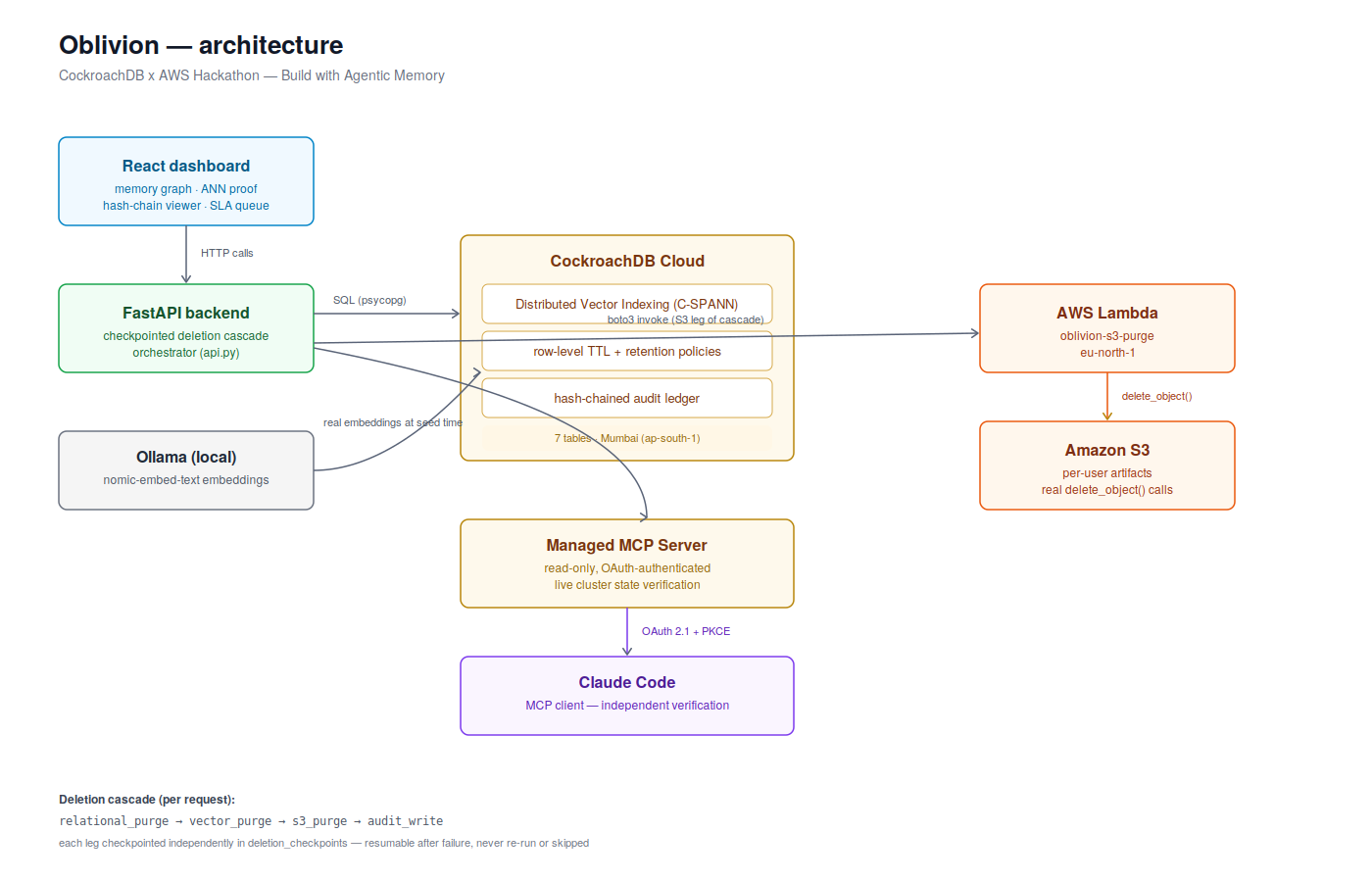
Oblivion is a compliance-driven deletion layer for agent memory. On a "right to be forgotten" request, it executes a checkpointed 4-leg cascade, relational purge, vector embedding purge, S3 artifact purge, hash-chained audit write, across CockroachDB and AWS. If any of the user's data is under statutory retention (e.g. 7-year financial records), it refuses to delete that portion, logs the legal basis, and purges everything else. Deletion is provable, not just claimed: a live nearest-neighbor vector search re-run before and after shows the embedding is genuinely gone.
How we built it
CockroachDB stores relational data plus VECTOR(768) embeddings with a C-SPANN distributed vector index. Row-level TTL auto-expires eligible memory. A FastAPI backend orchestrates the checkpointed cascade, invoking a real AWS Lambda function that deletes objects from S3. Every action purge, refusal, tamper check, writes to a hash-chained audit_ledger table. A React control-tower dashboard visualizes live cluster state: memory graph, before/after ANN proof, hash-chain visualizer, SLA countdown queue. CockroachDB's Managed MCP Server is connected via Claude Code for independent, read-only verification of live cluster state outside the application layer. Local Ollama embeddings (nomic-embed-text) replaced Bedrock per the hackathon's no-free-tier guidance.
Challenges we ran into
Getting genuine end-to-end proof rather than a simulated demo took real infrastructure work: a live CockroachDB cluster, a deployed AWS Lambda with correct IAM permissions, a real S3 bucket, and an authenticated MCP connection via Claude Code, all wired together so the dashboard's purge button triggers a real cascade across all three, not a mocked response.
Accomplishments that we're proud of
Every claim is independently verifiable: re-run the ANN query and the deleted embedding is gone; check the S3 bucket and the object is gone; tamper with a hash-chain block and downstream links visibly break; query the Managed MCP Server from a separate client and get matching live row counts. Retention conflicts are handled correctly, partial deletion with a legally-grounded refusal, not silent failure.
What we learned
Compliance features are usually bolted on as an afterthought. Building deletion-first from the schema up , TTL, retention policies, and checkpointed cascades as first-class citizens made "prove it" a natural design constraint rather than a late addition.
What's next for Oblivion
Multi-region conflict resolution using CockroachDB's distributed consensus (two agents racing to act on the same resource), a "blast radius" reasoning agent for redact-vs-delete decisions on shared/co-signed records, and CDC-based propagation of deletion events to downstream systems via changefeeds.
Built With
- amazon-web-services
- aws-lambda
- claude-code
- cockroachdb
- fastapi
- mcp
- ollama
- python
- react
- tailwindcss
- vite

Log in or sign up for Devpost to join the conversation.