-
-
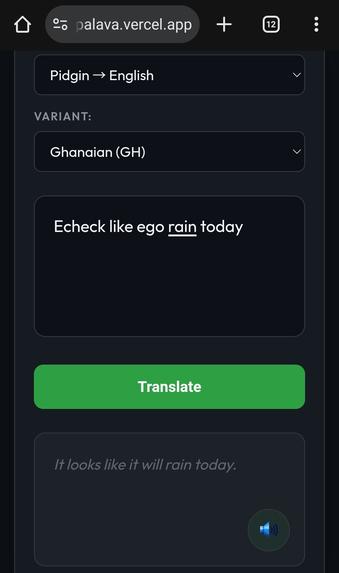
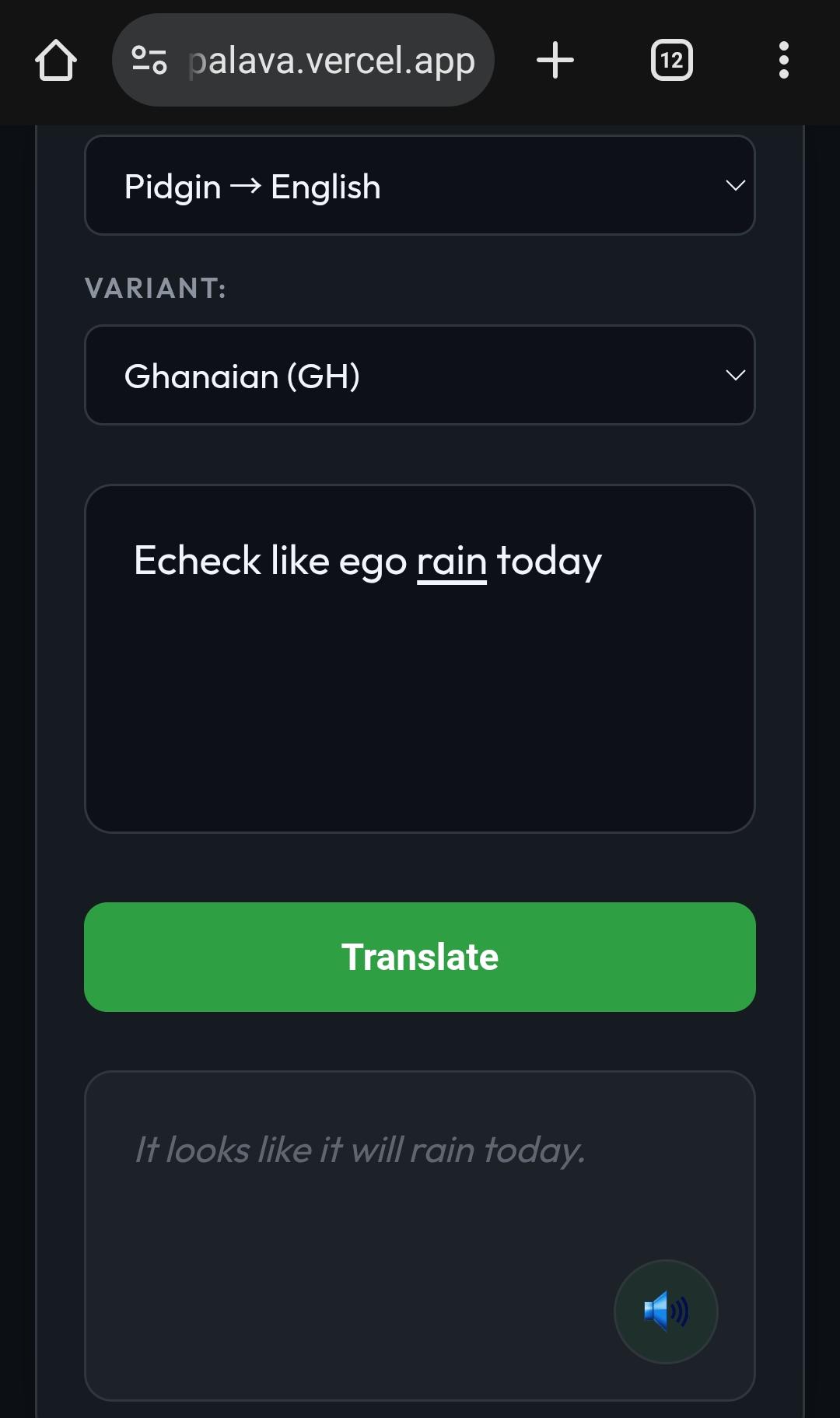
main page
-
logo
Ob-palava: Bridging the Gap with Pidgin AI
🌍 Inspiration
Ob-palava was born out of a desire to make digital communication more inclusive and culturally resonant for West Africans. Language is more than just words—it’s identity, rhythm, and vibes.
While most major AI models handle standard English well, they often struggle with the nuances, humor, and grammatical flow of West African Pidgin (both Ghanaian and Nigerian variants).
The name “Palava” comes from the Pidgin word for discussion or matter, reflecting the project’s core goal:
Seamless, authentic conversations without language barriers.
Ob-palava acts as a bridge, allowing users to express themselves in their most comfortable tongue — Pidgin — while interacting with modern AI systems.
🧠 What I Learned
Building Ob-palava was a deep dive into Computational Linguistics and modern AI engineering. Key lessons include:
1. Prompt Engineering for Dialects
Generic prompts often produce caricatured or broken Pidgin.
Solution learned:
Crafting strict, context-aware system instructions, for example:
- Enforce markers like “Chale”, “No yawa”, “Cedis”
- Explicitly define regional persona (Ghana 🇬🇭 vs Nigeria 🇳🇬)
2. Hybrid AI Architectures
No single model does it all well.
Insight:
Different models excel at different tasks.
- Fine-tuned models → raw translation
- Large reasoning LLMs → refinement & nuance
This led to an orchestrated multi-model pipeline.
3. Latency Really Matters
In conversational systems:
Speed = User Experience
Balancing high-quality output with low response time became a constant optimization challenge.
🛠️ How I Built It
Ob-palava runs on a modular Python (Flask) backend, optimized for serverless deployment.
🔧 Core Stack
Backend
- Flask serving RESTful APIs
Translation Engine (Hybrid System)
Google Gemini
[ H \approx \text{Gemini 3 Flash} ] Used for:- Context interpretation
- English → Pidgin translation
- Refinement of rough Pidgin output
- Context interpretation
Hugging Face Gradio Client
Connects to specialized models such as:Willie999/obalapalava-demo
Used mainly for Pidgin → English translation.
🔊 Audio (Text-to-Speech)
YarnGPT
- Provides authentic African voices (e.g. “Tayo”)
- Optimized for Pidgin speech
Google TTS
- Handles standard English output
🚀 Deployment
- Hosted on Vercel
- Uses serverless functions
🔄 Logic Flow
Before translation, the app performs a Context Interpretation step:
[ C = f_{\text{context}}(T, v) ]
Where:
- ( T ) = input text
- ( v ) = variant (Ghana / Nigeria)
This step determines tone, slang, and cultural nuance before routing the text into the appropriate translation pipeline.
⚠️ Challenges Faced & Solutions
1. Twi Contamination Problem
The AI often mixed Twi, Ga, or Fante into Pidgin.
Solution:
Strict negative constraints in system prompts:
“DO NOT use local languages like Twi, Ga, or Fante. Use English-based Pidgin only.”
2. Serverless Filesystem Limitations
Vercel’s filesystem is read-only, which breaks standard TTS workflows.
Solution:
- Write temporary audio files to
/tmp(the only writable directory) - Serve them through a dedicated route:
3. API Reliability & Quotas
External APIs introduced:
- Rate limits
- Timeouts
- Downtime risk
Solution:
A resilient fallback system:
- Gradio failure → fallback to Gemini
- YarnGPT timeout → graceful degradation with friendly messaging:
“E be like say network dey slow, abeg try again small time.”
4. Regional Nuance Accuracy
Authenticity depends on vibe precision:
- “Chale” ≠ “Tayo”
Solution:
- Separate processing pipelines:
variant = 'ghana'variant = 'nigeria'- Each pipeline injects region-specific cultural markers
✅ Final Takeaway
Ob-palava proves that African languages and street dialects belong in modern AI systems—not as afterthoughts, but as first-class citizens.
Pidgin is not broken English.
Pidgin is culture + context + code-switching intelligence.

Log in or sign up for Devpost to join the conversation.