

Inspiration
It is easy to tap “done.” It is harder to do the work.
Most habit apps reward you for checking a box, even when nothing happened. We wanted to connect progress to evidence and make following through feel like leveling up in a game.
That became OATH: a self-improvement system where you make daily vows, prove your effort, and earn your rank. Alongside you is Iris, a glass-crystal AI companion with a deep voice, a deadpan personality, and very high standards.
Her highest praise? “…Acceptable.”
What it does
OATH turns goals around fitness, learning, focus, and sleep into personalized daily challenges.
A short calibration establishes your starting level. Iris then chooses daily vows based on your baseline, weaker areas, and sleep data. These might include completing push-ups, reading a chapter, finishing a focus session, or turning the lights off on time.
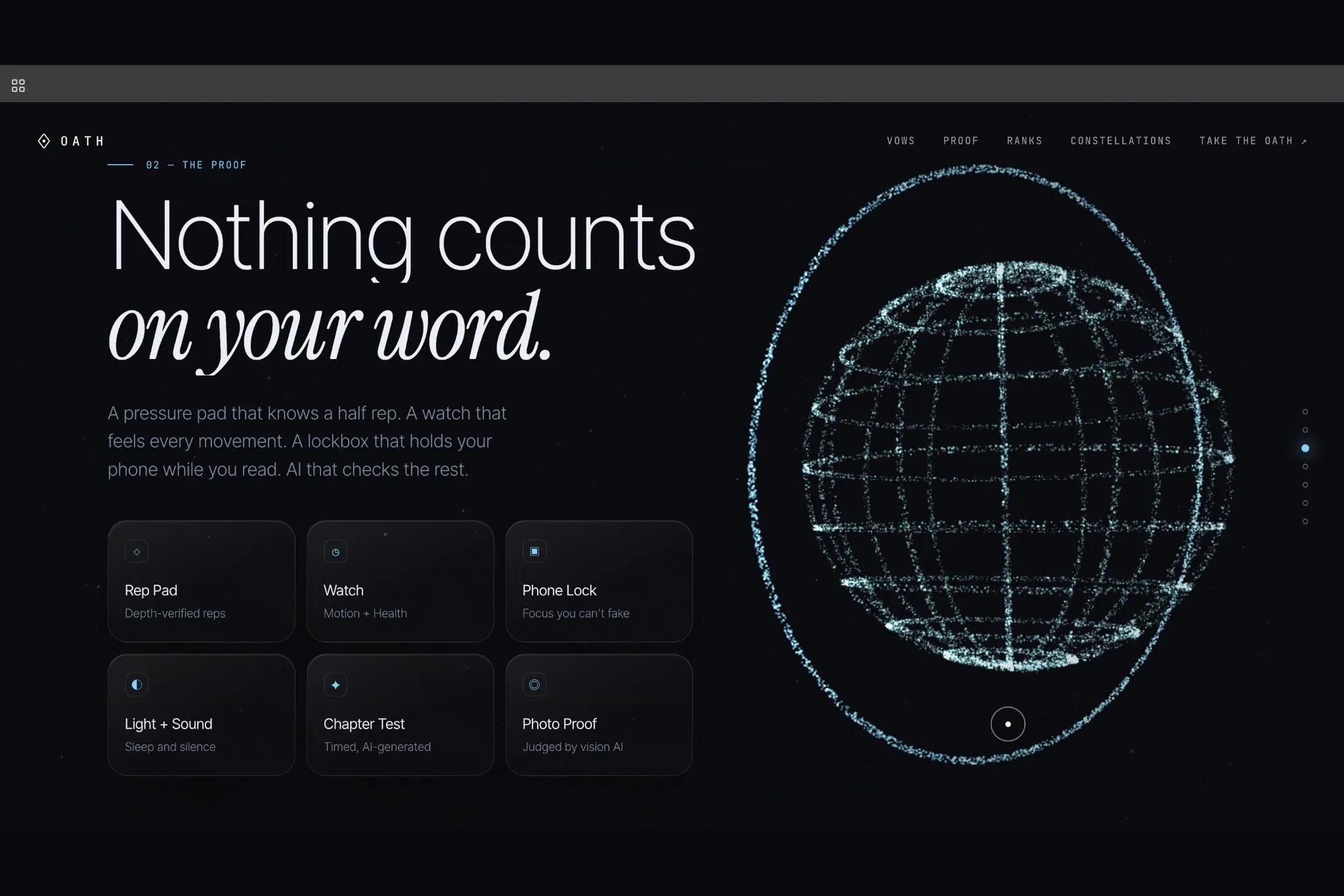
Verification connects the digital experience to the physical world:
- Home Base: An Arduino station uses a push-up pad, sound sensor, light sensor, and a servo-controlled Phone Jail to support physical accountability.
- Phone motion and Apple Health: Motion data supports repetition tracking, while sleep data helps personalize goals.
- AI proof review: Photo evidence and timed reading quizzes give users ways to demonstrate completion.
Verified effort contributes to ranks from E to A and a weekly leaderboard. Challenges scale to your starting ability, making personal improvement central to progression.
Miss a vow, and The Reckoning introduces an alarm and a penalty challenge, giving broken commitments an immediate consequence within the experience.
How we built it
We built the application with Next.js and TypeScript, using Server-Sent Events for live updates and Three.js / React Three Fiber for the 3D interface.
Our physical Home Base uses an Arduino UNO R4 with Grove sensors, connected to the application over serial. Sensor readings become events that the app can use to update challenge progress.
We divided the AI work by purpose:
- Gemini generates daily vows and reviews photo evidence.
- Claude Haiku writes Iris’s short, character-driven responses.
- Claude Opus, accessed through AWS Bedrock with an Anthropic API fallback, generates weekly reports.
- ElevenLabs gives Iris her voice, with Amazon Polly as a backup.
- Supermemory provides continuity around goals and history.
- Amazon S3 stores private proof photos.
- Tiger Data stores verification events in a hypertable, with continuous aggregates supporting leaderboard calculations.
Challenges we faced
The biggest challenge was translating messy real-world behavior into useful evidence. A sensor activation alone does not establish that someone completed a full push-up. We had to think carefully about movement sequences, thresholds, and what each signal could actually demonstrate.
Another challenge was coordinating hardware readings, AI responses, voice playback, and interface updates. Each component operates at a different speed, but the experience needs to feel connected.
We also built fallback paths for model access and speech generation to reduce dependence on a single service during the demo.
What we learned
We learned that verification is a design problem as much as a technical one. Different habits need different evidence, and asking for too much proof can make accountability feel like extra work.
We also learned how much personality matters. Iris gives feedback a recognizable voice and turns routine progress updates into memorable moments.
Most importantly, we learned to distinguish between what a sensor measures and what we can reasonably conclude from it.
What’s next
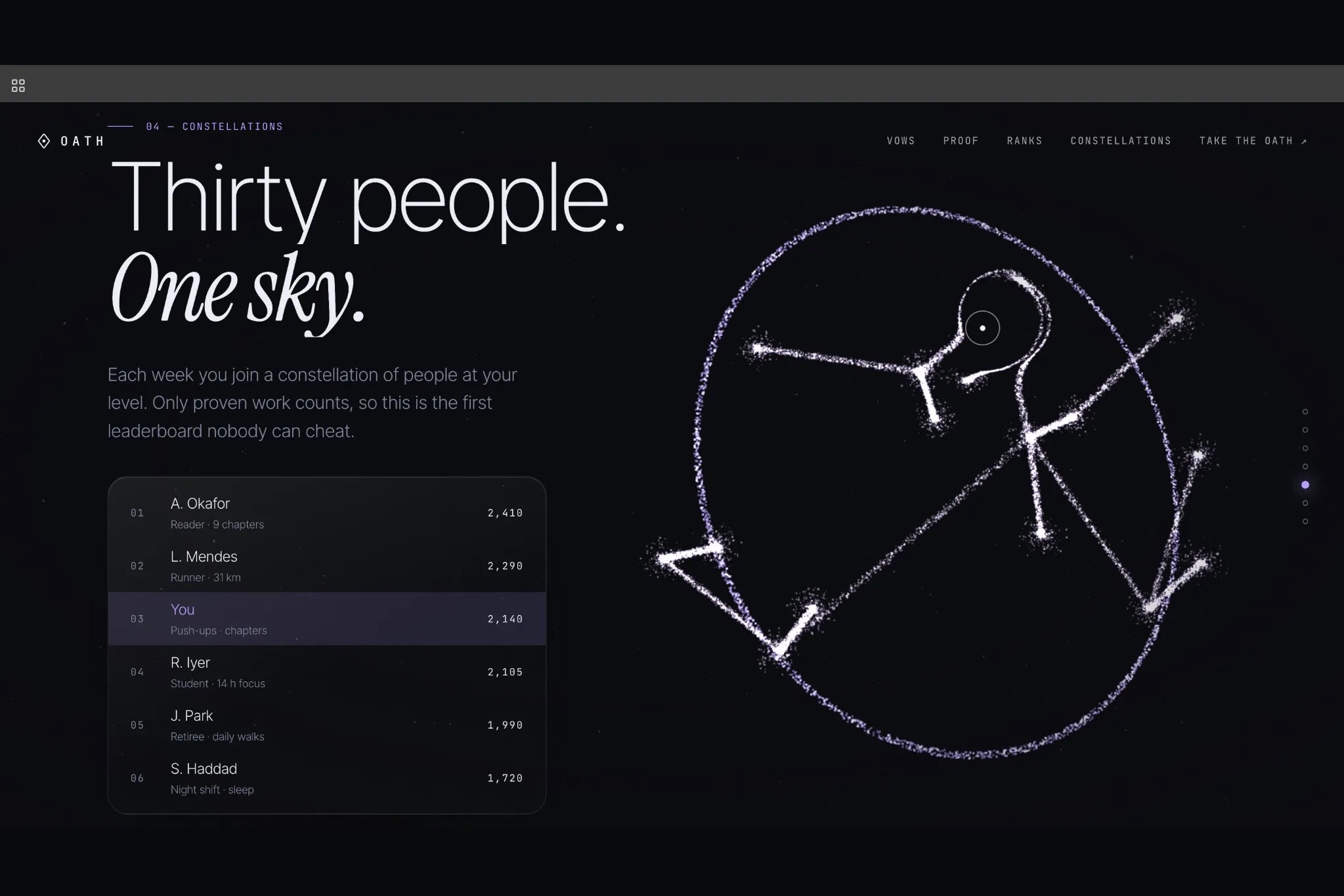
We want to add native iOS Screen Time integration, give Home Base a wireless connection, and introduce Constellations: small weekly groups of people at similar levels.
Our goal is to make consistent effort visible, rewarding, and harder to quietly abandon.
Built With
- amazon-bedrock
- amazon-polly
- amazon-web-services
- apple-health
- arduino
- c++
- claude
- elevenlabs
- google-gemini
- grove-sensors
- next.js
- react
- react-three-fiber
- server-sent
- supermemory
- three.js
- tiger-data
- typescript


