Inspiration
Planning to stay in Ithaca over the summer, we realized that being independent is about resource management, and yet most tools are built for people who do not need to think about it. They assume a full kitchen and a flexible grocery budget; however, for many, including students, low-income households, and SNAP recipients, those assumptions break. Food decisions are shaped by eligibility programs, store access, food pantry availability, and strict budget ceilings.
We built OasisAI to be grounded in that reality, where nutrition is constrained by systems and where a healthy week depends on navigating those systems effectively.
What it does
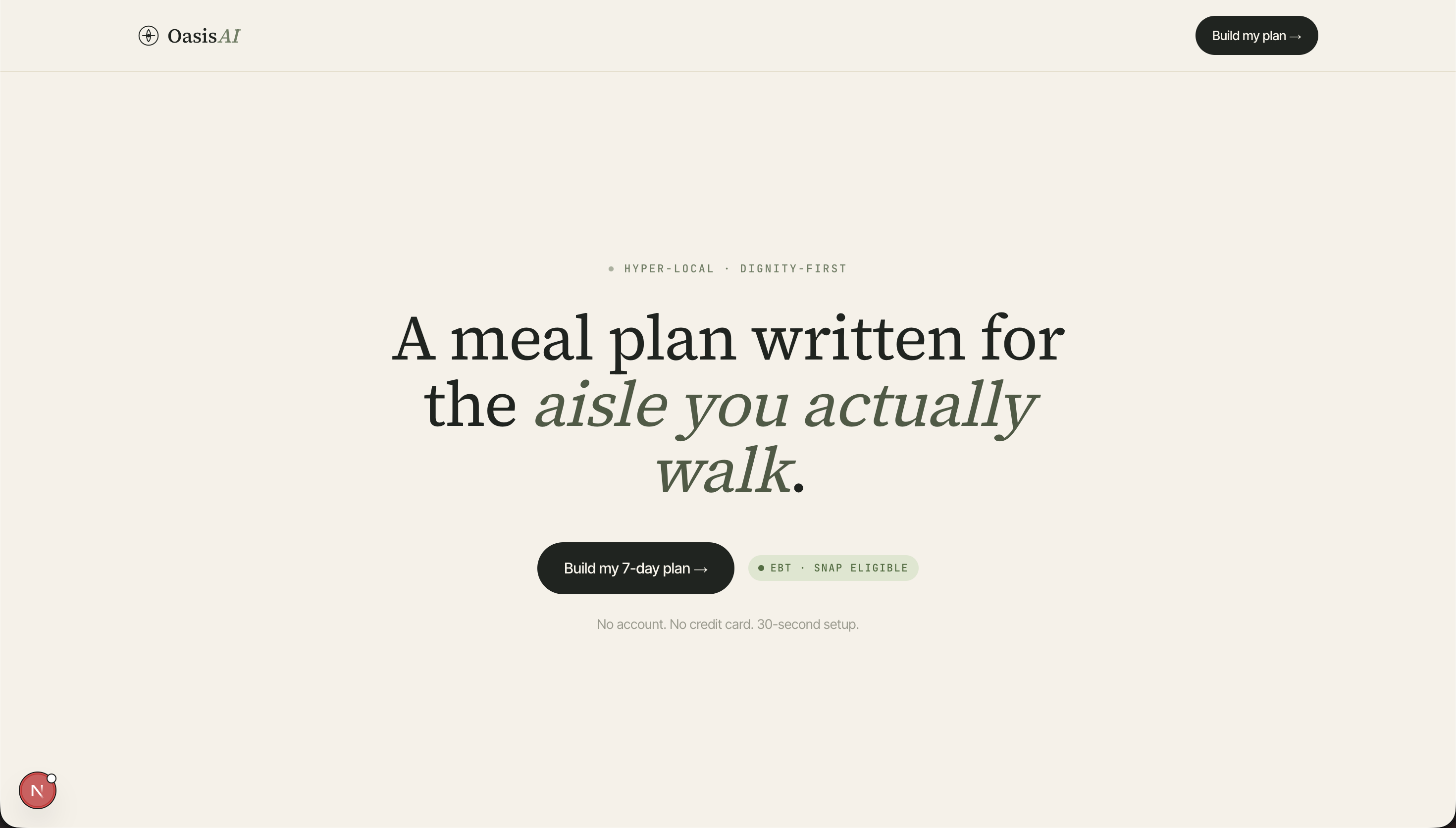
OasisAI generates realistic, week-long meal plans that operate under strict financial and access constraints, focusing on users relying on SNAP benefits, EBT budgets, and local food banks. It enforces non-negotiable spending caps, filters for EBT-eligible items, and incorporates data from organizations like Feeding America to reflect local pantry availability. The system prioritizes low-cost, widely accessible ingredients, optimizes for cost per calorie and protein, and supports limited kitchen setups such as microwave-only environments. Pantry items persist across weeks, allowing users to reduce costs over time. The ultimate goal is to produce plans that are actually achievable within real-world constraints.
How we built it
We built OasisAI around a constraint-based engine that sits between the user and a large language model. The system feeds structured inputs, such as budget, available ingredients, kitchen tools, and local price adjustments derived from a custom mathematical model, into the LLM. We used USDA nutrition data for accuracy, a curated dataset of low-cost ingredients, and a Supabase backend to track pantry persistence. We designed integration pathways for food bank datasets alongside SNAP compliance rules so that outputs align with purchasing realities. The frontend is a simple, mobile-first interface where users can quickly input their situation and receive a plan.
Challenges we ran into
Modeling reality without overgeneralizing was harder than we expected. Prices vary significantly, so estimating an accurate pricing model based on real-time information is complex. So, we had to build a system that treats its own assumptions as defaults but surfaces them to the user for correction.
The other hurdle was constraint calibration: if constraints are too rigid, the engine cannot generate a viable plan; if they are too loose, the output stops being trustworthy. Finding that balance required more iteration on prompt engineering than anticipated, forcing us to think carefully about what "useful" means when the stakes are someone’s food security.
Accomplishments that we're proud of
We are most proud of building a pricing system that reflects where a user actually lives. Food costs are not uniform, yet most nutrition tools ignore this gap. For example, a can of beans in one neighborhood can cost meaningfully more than in another three miles away. We built a layer where users confirm or correct ingredient prices based on local store charges, and those corrections propagate into every subsequent plan. The result is a meal plan that accounts for specific economic geography rather than a national average. Moreover, we are focused on addressing challenges of budgeting and meal planning for lower-income communities by considering local food banks that are close to the individual.
What we learned
Building OasisAI taught us that giving the model strict boundaries actually makes it more useful, not less. Constraints forced better, more practical outputs. We also realized how much user input matters: the more the system assumes, the more it breaks down for people whose lives don't fit the mold.
What's next for OasisAI
Next, we want to improve real-time data integration so pricing and availability are even more precise. We plan to expand pantry tracking into a long-term system that can forecast spending and nutrition over several months. We want to consider using protein macros as one of the inputs for our model. Another priority is refining the resource navigator so users can more easily connect to nearby support services. Long-term, we want to scale OasisAI into a platform that adapts to different regions and continuously learns from user feedback to improve its recommendations.
Built With
- claude
- css
- javascript
- next.js
- postgresql
- python
- supabase
- typescript

Log in or sign up for Devpost to join the conversation.