-
-
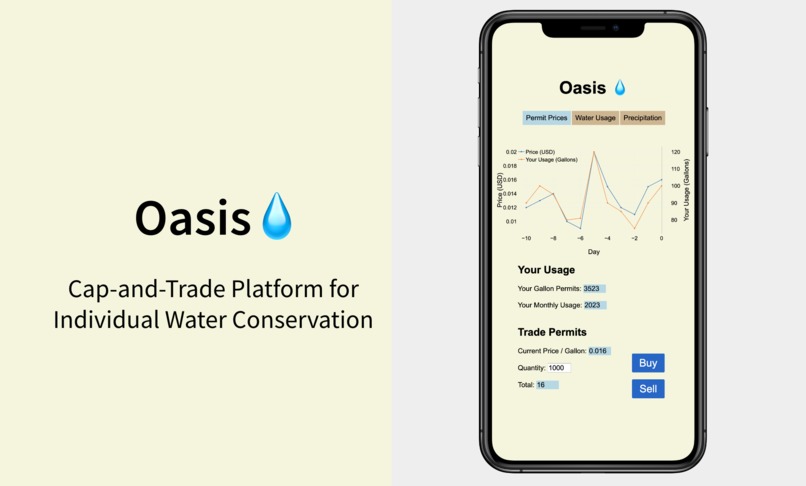
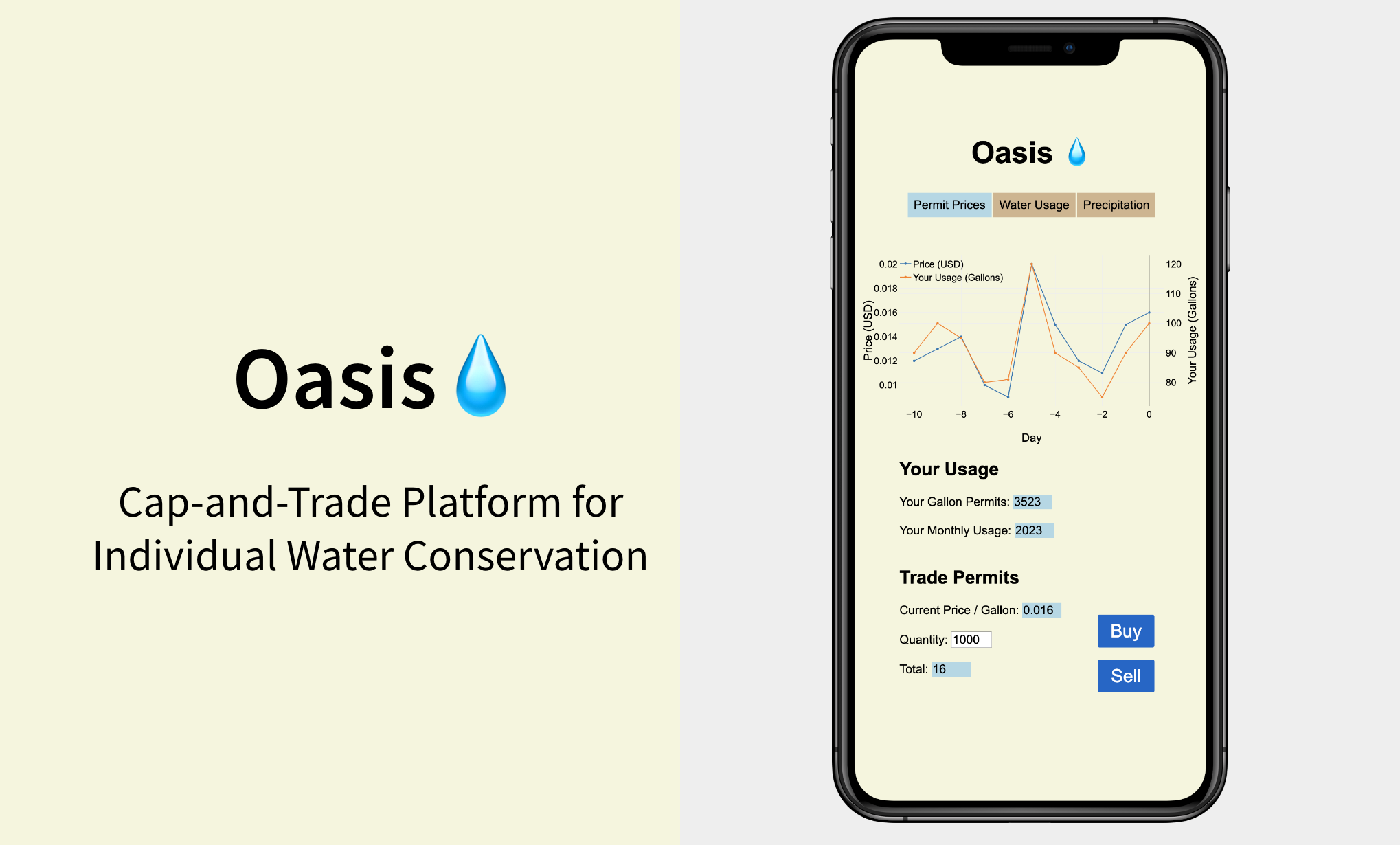
Oasis
-
Inspiration
Water resource management is absolutely critical as climate change exacerbates droughts and water scarcity. Water conservation efforts can help avoid 'dead pool' in reservoirs and reduce carbon emissions due to water consumption. Thus, we turned to one of the most successful policies that have reduced pollutants in the air: Cap and Trade.
What it does
Oasis allows the sustainability benefits a cap and trade system to manage our water resources. It makes it easy for users to participate and work together to help manage and reduce water waste.
Take Caltech as an example, which has a campus sustainability plan. Suppose Caltech decides to cut its water usage for students living on campus. It can sign up for Oasis and set a cap. Then students in Caltech housing would be given per-capita permits. Individuals can then track their monthly water usage in the Oasis platform and trade permits as necessary to cover their usage.
High Impact
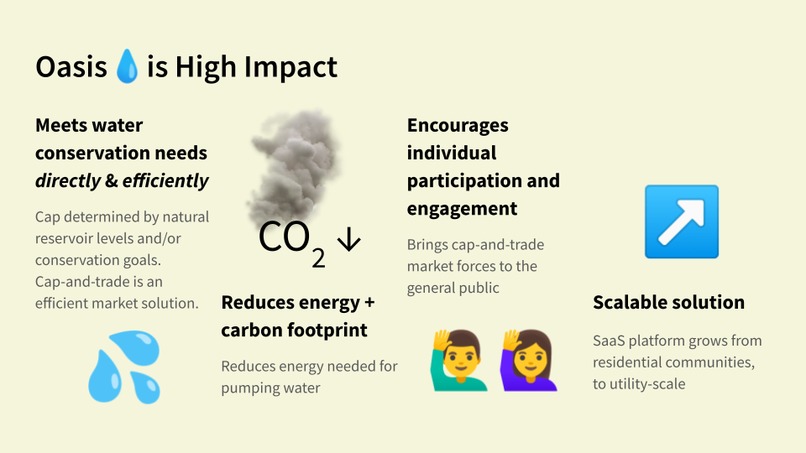
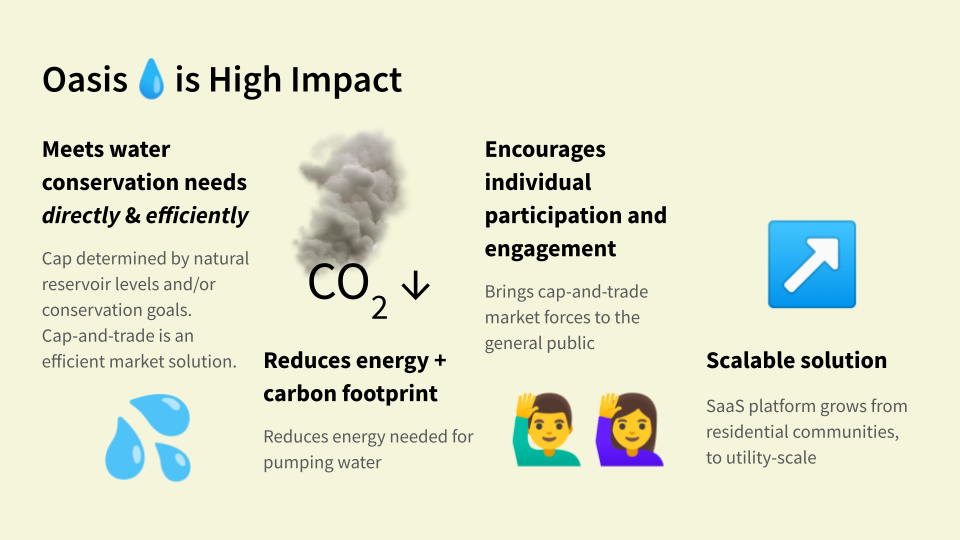
Oasis is designed as high-impact water conservation platform, based on cap-and-trade principles.
Meets water conservation needs directly & efficiently.
By using actual water reservoir levels as the system-wide cap, Oasis will meet water conservation needs both directly and efficiently. This is in contrast to how we currently pay for water via a fixed rate water tax.
Reduces energy + carbon footprint.
Water consumption is also closely tied to our energy and carbon footprint. Conserving water will help keep water levels in hydropower dams high enough. Hydropower is extremely important because it is one of the few dispatchable sources of renewable electricity, meaning that we can control when the hydropower generators run. But as people consume water and water levels in dams fall, hydropower also decreases. For example, the current drought in the Southwest US has caused Hoover Dam’s electricity production to drop by 33%.
Furthermore, the pumping, treating, and heating of water for consumption uses a large amount of electricity. For example, water consumption is responsible for up to 19% of California’s electricity use and therefore also has a large carbon footprint.
Encourages individual participation and engagement.
Oasis brings cap-and-trade market forces to the general public. Unlike other cap-and-trade systems, Oasis directly engages individuals and therefore encourages individual behavioral change.
Designed to be scalable, from residential communities to utility scale
Oasis is designed to be scalable from day 1. As a platform, it will be scalable from residential communities all the way to utility scale.
How we built it
The main idea proposed was built upon many iterations of systemic policy designs. The user interface demo was built with Javascript, HTML, and CSS. As a first sketch of what is necessary this mockup can help us design the interface by which we can encourage individuals to participate in the cap and trade program.
Challenges we ran into
Cap and Trade is fundamentally a challenging concept to grasp and scaling it down to an individual level is not trivial. We were intrigued by the possibility of such a system that could work and brainstormed a path for possible implementation. Javascript is a challenging language to work with after having worked with Python primarily for the last couple years, and there are many hidden bugs (features?) in Plotly that arose as we tried to develop our demo.
Accomplishments that we're proud of
We are proud of proposing a viable solution for incentivizing the lowest hanging sustainability improvements to be made for water resources.
What we learned
In this process, we learned a lot about success of sustainability policies, the impact of our water systems on the environment, and how to build an interactive web app.
What's next for Oasis: Individual Water Cap-and-Trade
Linking the app to home and community water meters and encouraging apartment complex communities to adopt a system like this. After many residential areas are on the system, it will be natural to scale to other users of water to enable a state-wide cap on water usage.

Log in or sign up for Devpost to join the conversation.