-
-
OAKENSHIELD - Cover
-
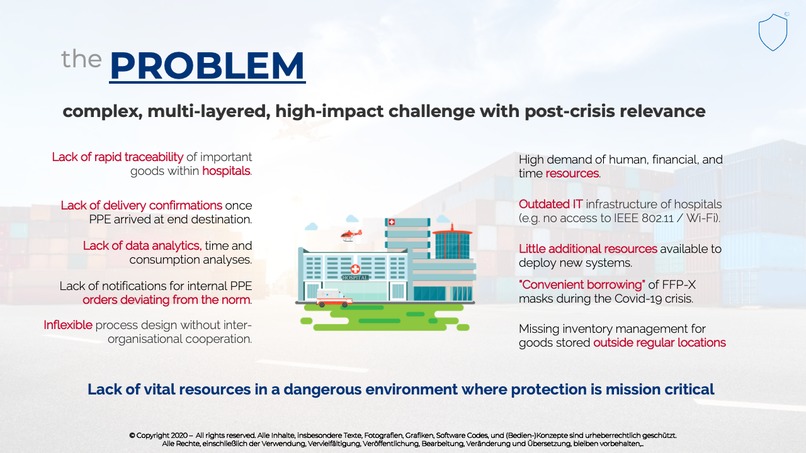
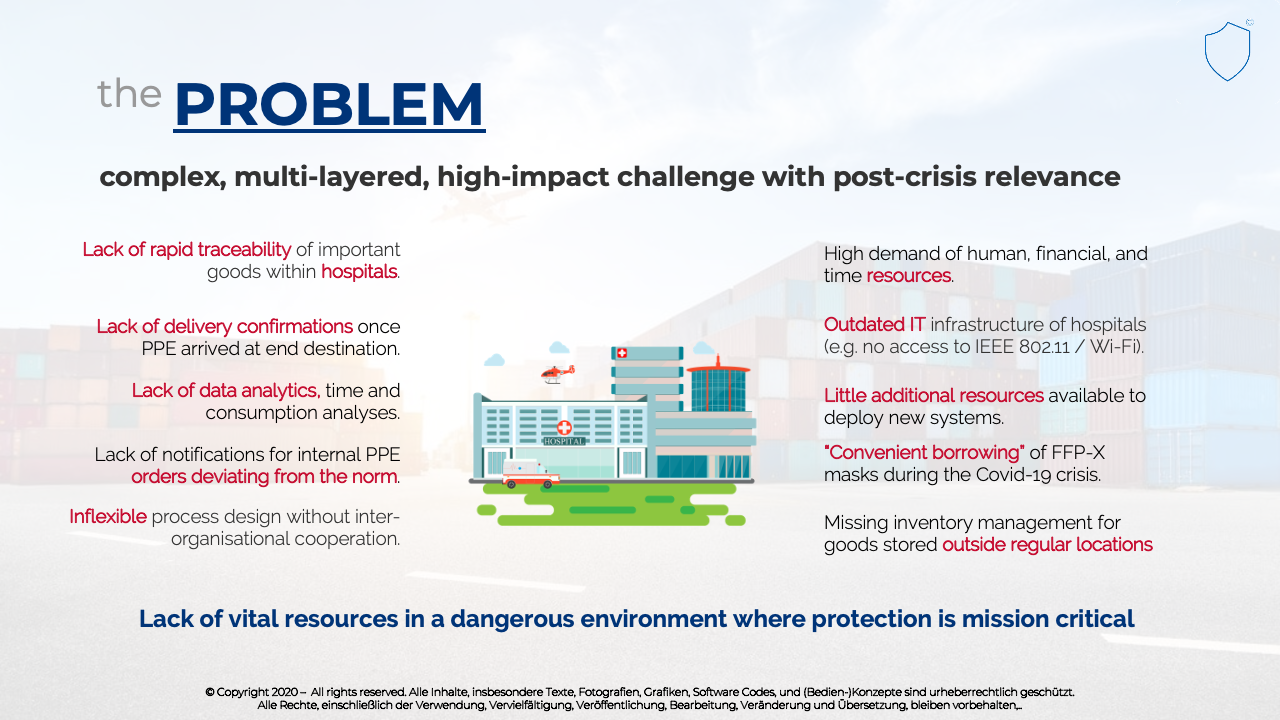
OAKENSHIELD - Problem Statement
-
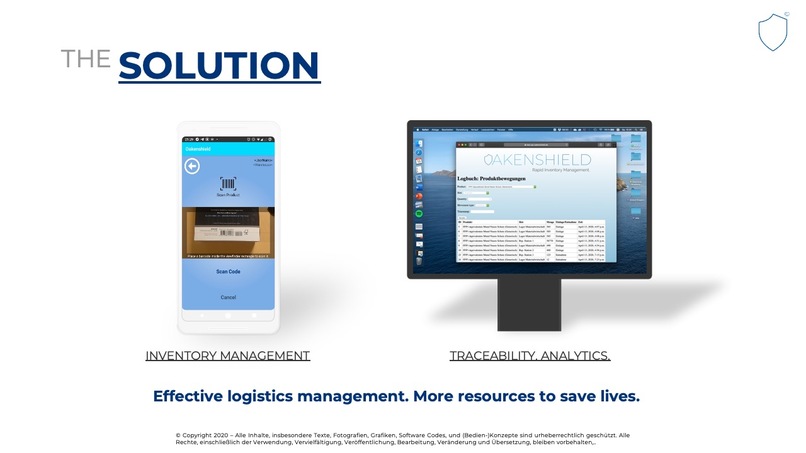
OAKENSHIELD - Fully Functional Prototype

Inspiration
Since the last few weeks, hospitals have experienced a high demand of personal protection equipment (PPE). Across Europe, health care organisations set up temporary warehouses to cope with infrequent delivery of PPE and other vital medical products thus ensuring these reach the right destinations in the right amount.
This results in two challenges. First, hospitals struggle to manage the inventory of their temporary warehouses. Second, for the internal hospital logistics department it is increasingly challenging to keep track of the correct delivery of PPE equipment.
Existing hospital inventory management systems often do not allow for a rapid setup of flexible, temporary warehousing, and flexible tracking. Eventually, this can lead to shortages, bottlenecks, and the interruption of operations directly affecting the most urgent cases in the Covid-19 crisis. OAKENSHIELD is a team of entrepreneurs, industrial engineers and computer scientists at University of Cambridge, Institute for Manufacturing. We have the resources, the ability and the will to address these pressing challenges.
Our mission is to create an infinitely flexible, scalable inventory management system for hospitals and temporary warehouses to enhance the operations excellence of the healthcare organisations across Europe. We are working on a solution to aggregate and assign last mile demand of PPE at hospitals (and for industry at a later stage).
What it does
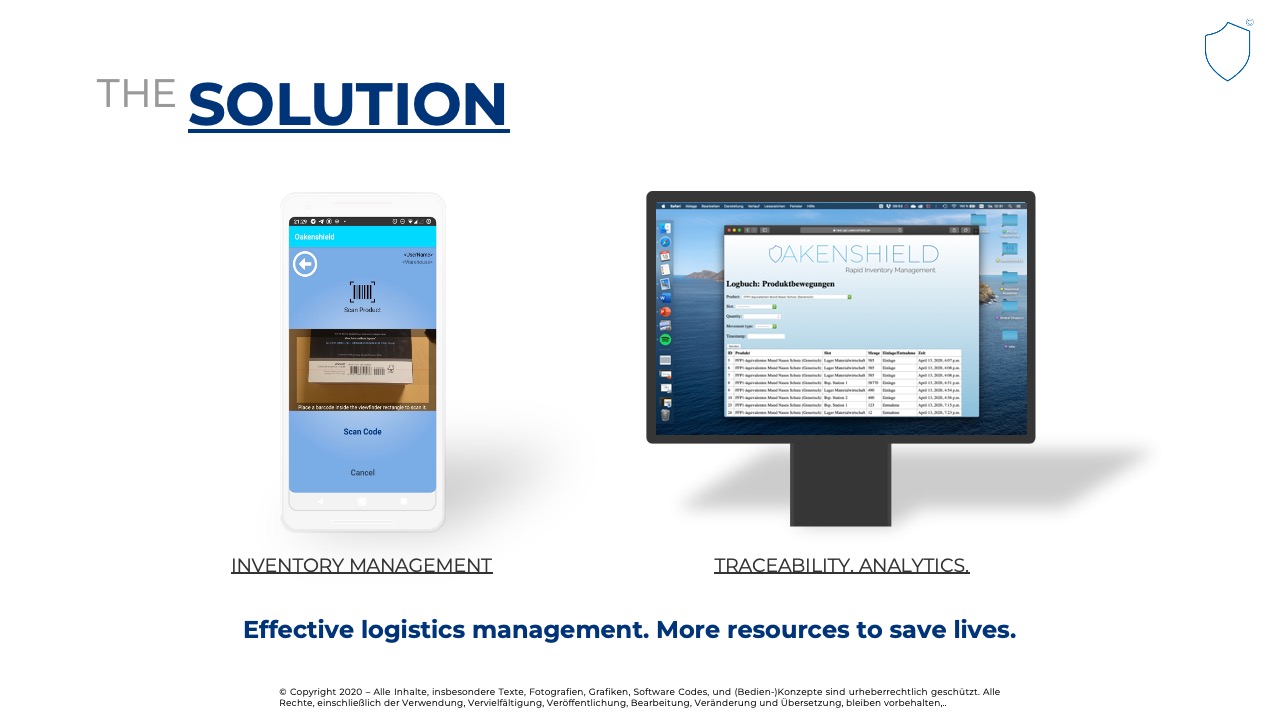
OAKENSHIELD is a rapid inventory management system for hospital and health care organisations. It is designed to rapidly set up and manage temporary warehouses. Further, it allows for simplified item traceability and confirmation of delivery. At its core, OAKENSHIELD is a lightweight, stand-alone scan application. It has minimal requirements for pre-existing infrastructure. OAKENSHIELD only requires a smartphone, connection to the internet and a printer.
OAKENSHIELD supports you with rapid asset class tracking. In doing so OAKENSHIELD incorporates five key functions.
Management (via mobile device; Android 6.0 or higher). Manage your assets and temporary warehouses. Create new products and assign them to specific warehouses and slots.
Tracking (via browser or via mobile device; Android 6.0 or higher). Track the delivery of your items such as highly demanded PPE throughout the internal supply chain to customised destinations (e.g. departments).
Inbound (via mobile device; Android 6.0 or higher). Quickly scan and record arriving items. To keep a transparent overview of the item’s exact location, you can allocate it to a flexible slot.
Order (via browser or mobile device; Android 6.0 or higher). Create internal orders for your temporary warehouses and send picking lists to your distributed teams.
Picking (via mobile device; Android 6.0 or higher). Simplified picking procedure for your operative team within the temporary warehouse.
How we built it
Key programming languages: Python and Java.
Python: Backend programming language.
Django: Used for efficient management of web-requests and database calls.
Java: Frontend of our mobile application.
Javascript for our Web-Frontend.
Other: Android Java API Framework, MySQL, PostgreSQL, Jetpack environment (e.g. Room and Dagger), React and Bootstrap for convenient Web-Development. We do not use any third party API at the moment. Applications run on our own server.
Challenges we ran into
Time Constraints. Producing an fully functional output within the given time of the hackathon.
Rapid Customer Feedback. Getting quick feedback on both our progress and the suitability of our approach.
Lean Startup. Efficiently keeping the focus on the major pain points of our target groups.
Accomplishments that we're proud of
Fully Functional Prototype Within a few days, we have created a) a fully functional hybrid MVP (mobile App, and browser-based dashboard/log for analytics), b) an up and running database on our own server, c) a website.
Business Angel Support. Pitched our idea to an American business angel investor in Cambridge. The business angel is now serving on the advisory board of OAKENSHIELD; supporting in business development.
Major Customer Interests. Spoke to a major hospital in Germany who is interested in applying the solution in order to track their flow of FFP-2 and FFP-3 masks within their organisation. Agreed to schedule a meeting to evaluate the benefits of a collaboration.
Web Services Provider Support. Introduced by our advisor, we pitched our idea to executive managers at a global provider of web services on short notice. The managers are interested in supporting our solution, and scale it to global level.
What we have learned
Customer Centricity. First, as a team of developers you do not fully understand the issue of your target group without talking to them. A customer typically tells you what they need, and what appears to be feasible within their organisation. It is always useful to verify assumptions.
What's next
Development Partner (until May 2020). Within the next two weeks, OAKENSHIELD is striving to sign on a major hospital in Europe as a development partner.
Legal (ASAP). Given a development partner agrees to a collaboration, our team will need to decide how to transform our project into a legal entity.
Global Scalability (from June 2020). Given a robust functionality and a validated proof-of-concept, a major web services provider offered us to support with a server architecture setup which would potentially allow for the global scalability.


Log in or sign up for Devpost to join the conversation.