💡 Inspiration
Digital investigations often involve piecing together information from different sources, such as emails, documents, chat logs, images, and transaction records. Finding connections between these files and figuring out what actually happened can take a lot of time and effort. Important clues may be hidden across multiple records, making it difficult to see the complete picture.
This inspired us to build NyayaTrace AI—a platform that brings scattered digital evidence together and helps investigators make sense of it through a single, connected workflow.
🚀 What It Does
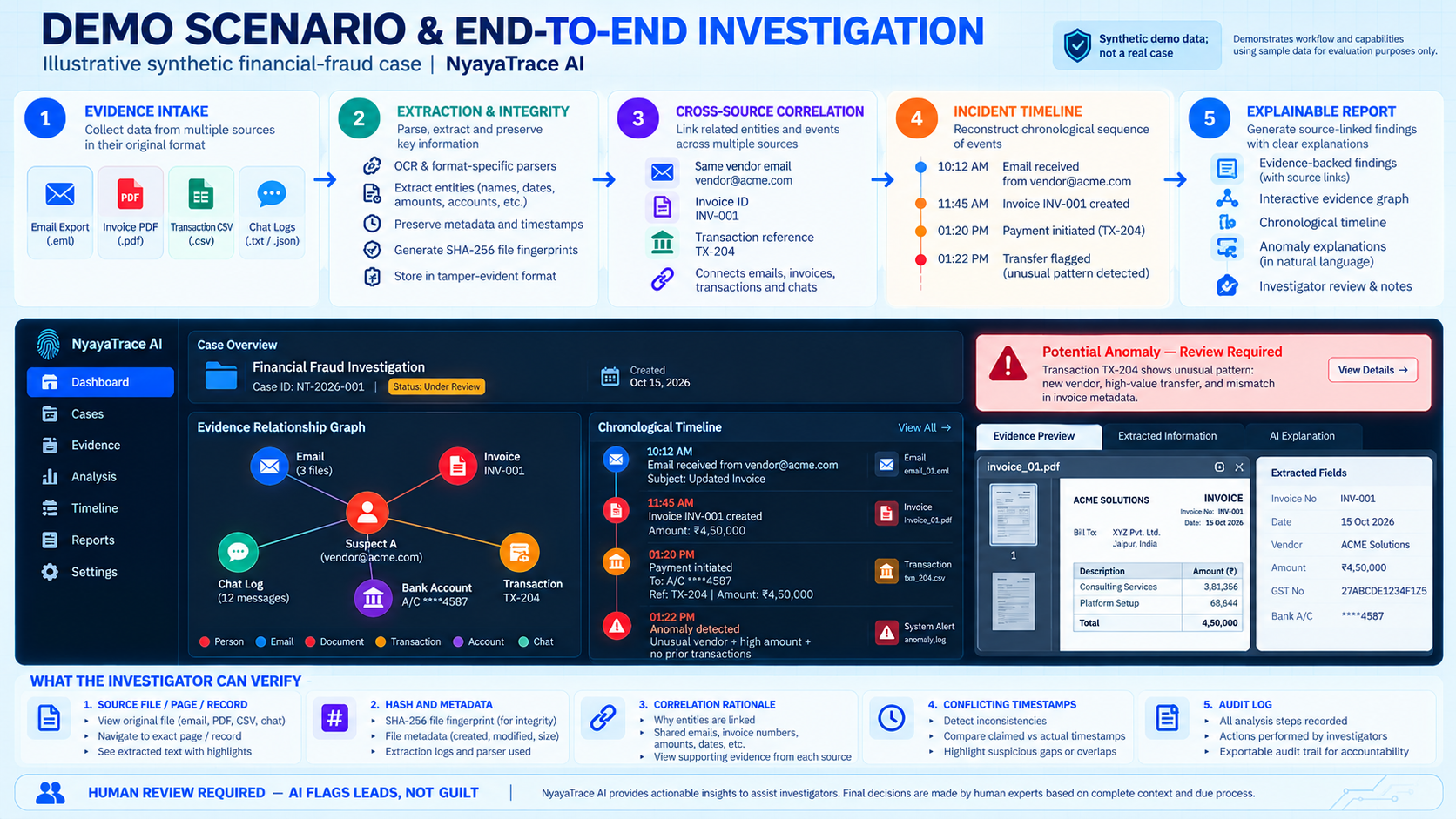
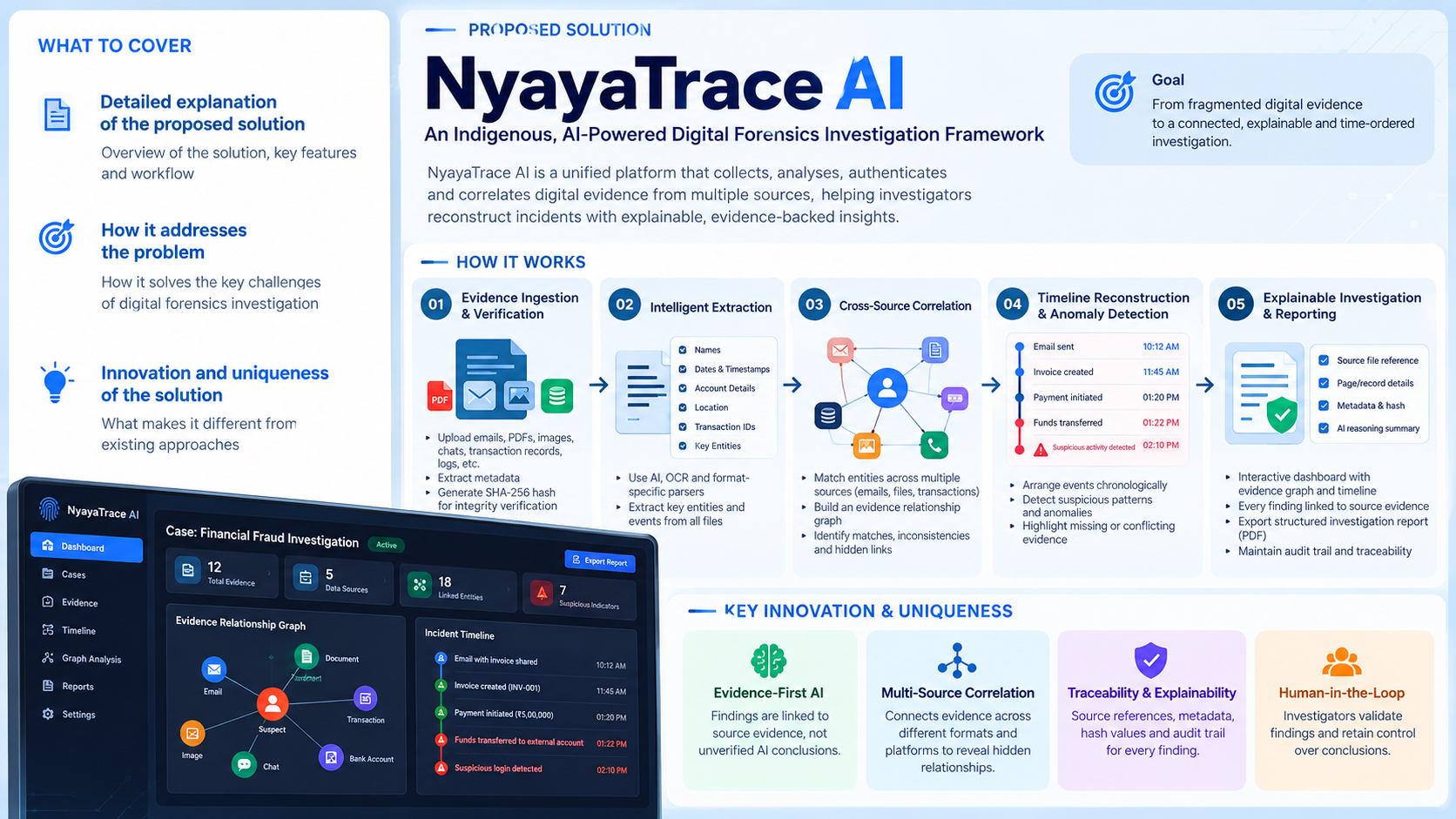
NyayaTrace AI is designed to make digital investigations more organised, efficient, and transparent. It helps investigators extract useful information from different types of digital evidence, connect related records, and reconstruct the sequence of events surrounding an incident.
The platform focuses on five key capabilities:
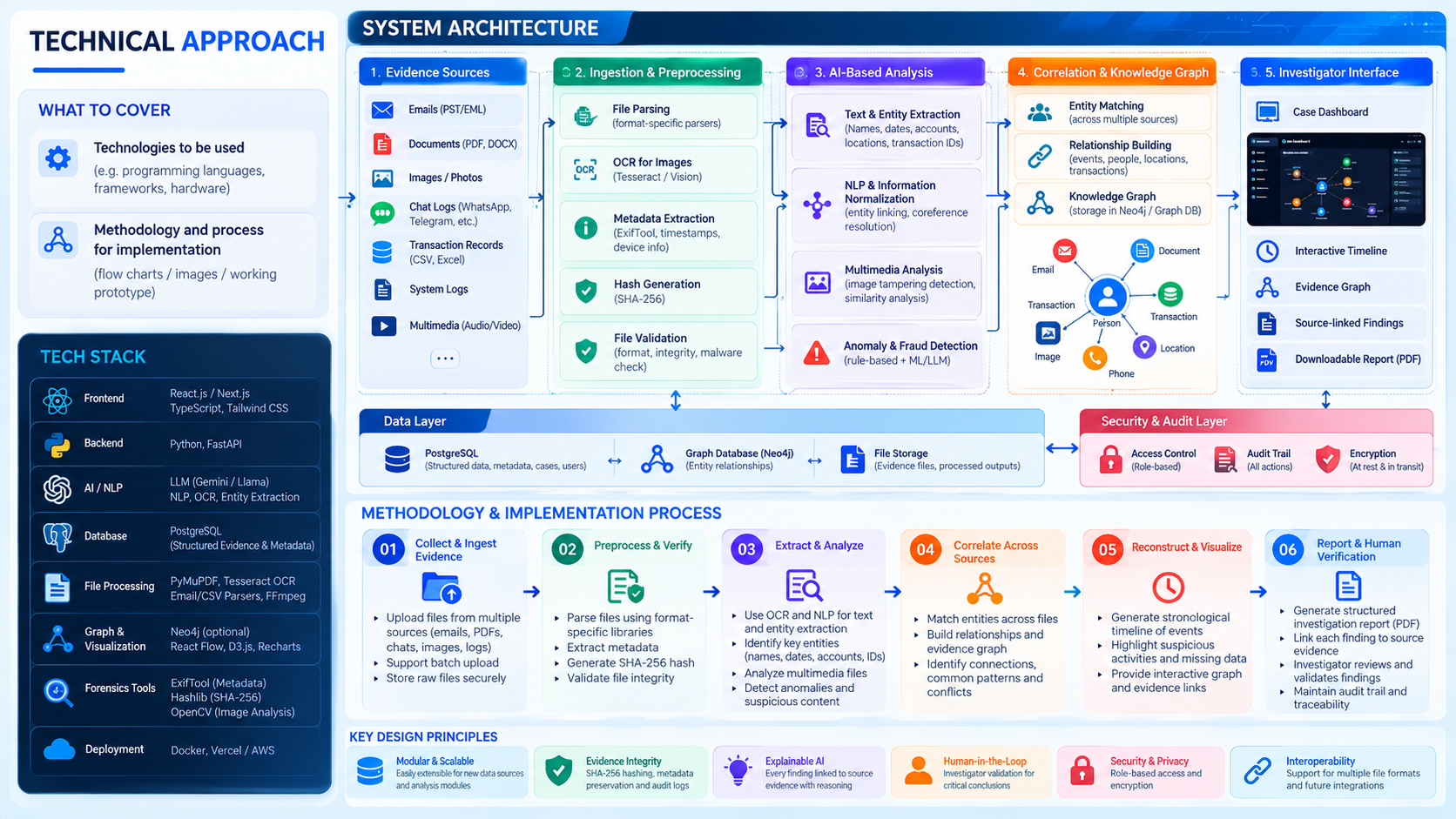
- Evidence Processing: Extract useful information from supported documents, emails, images, chat exports, and transaction records.
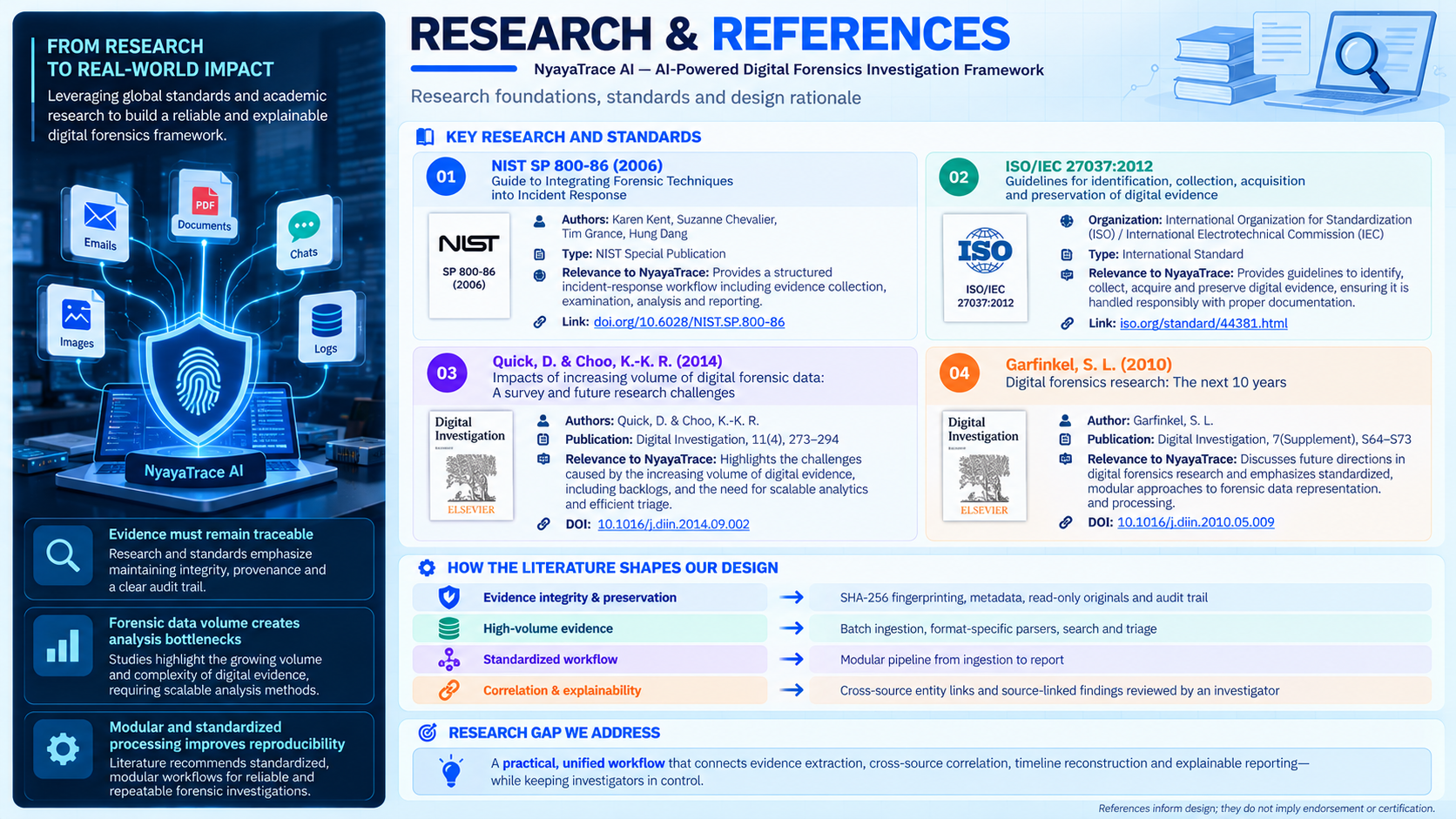
- Evidence Integrity: Generate SHA-256 hashes and record file metadata to help check whether evidence has changed and maintain traceability.
- Cross-Source Correlation: Identify common entities, identifiers, and events across multiple files to uncover potentially meaningful connections.
- Incident Reconstruction: Organise events into a timeline and flag unusual patterns, missing details, or conflicting timestamps that may need further investigation.
- Explainable Reporting: Present findings through an investigation dashboard, evidence relationship graph, timeline, and structured reports, with links back to the supporting records.
🛠️ How We Built the Approach
We approached the problem by breaking the investigation process into smaller, connected stages. First, digital evidence is collected and its metadata and integrity information are recorded. Next, format-specific tools and OCR extract relevant information, while AI-assisted analysis and rule-based checks help identify entities and possible relationships.
The extracted information is then connected across sources to build an evidence relationship graph and reconstruct an incident timeline. Finally, the platform presents the findings with supporting evidence so investigators can examine how each connection was identified.
Our focus is not just on detecting suspicious activity, but also on making the results understandable and verifiable.
🧩 Challenges and What We Learned
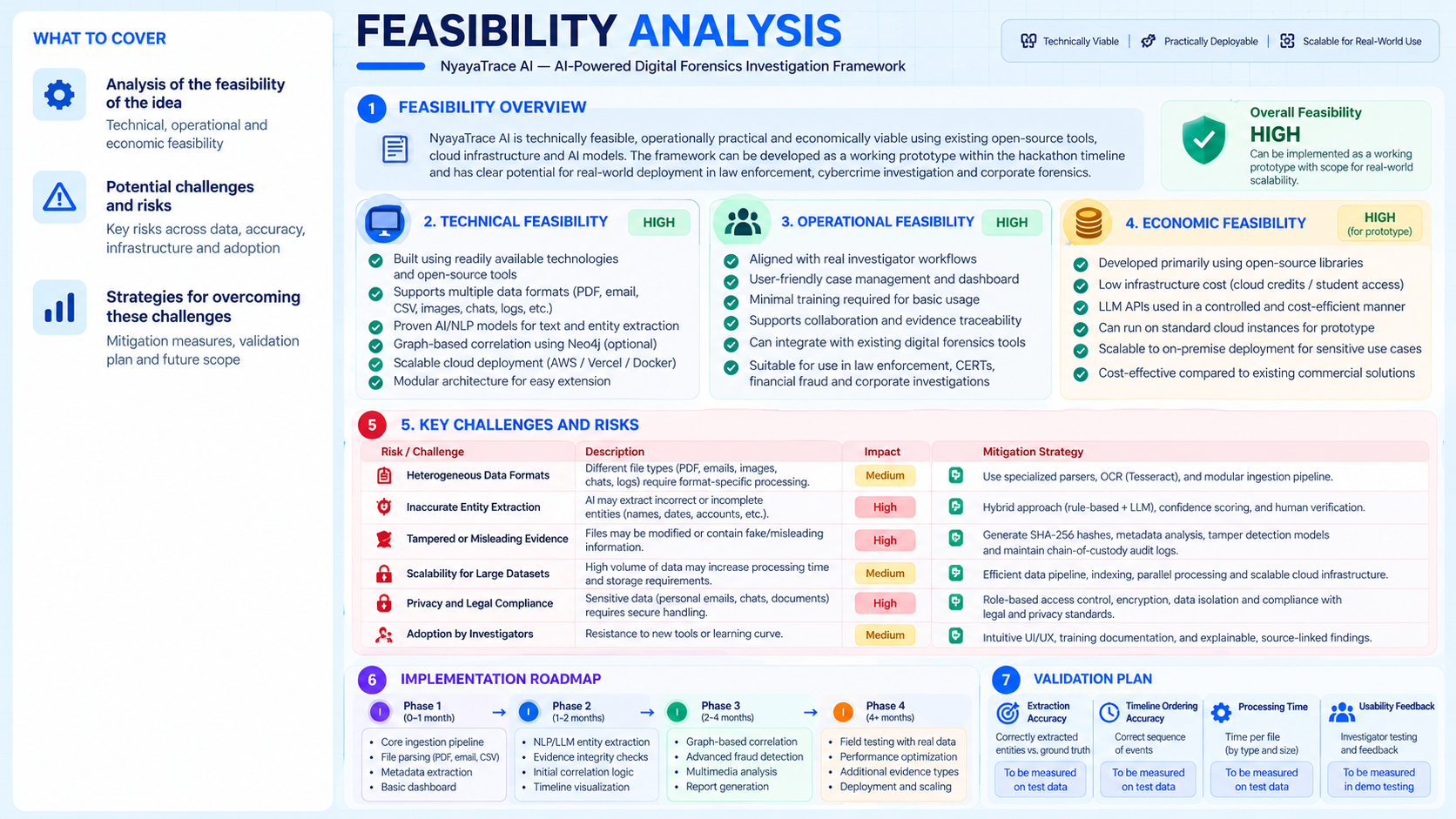
One of the biggest challenges is that digital evidence comes in many formats, and the information extracted from one source may not perfectly match information from another. Missing timestamps, incomplete metadata, similar names, and misleading patterns can also lead to incorrect conclusions.
These challenges helped us recognise why relying on AI alone is not enough. Our approach combines AI-assisted analysis with rule-based validation, source references, integrity checks, and human review. We believe investigators should be able to understand why something was flagged and verify it themselves rather than simply trusting an automated result.
🌍 Impact and Future Scope
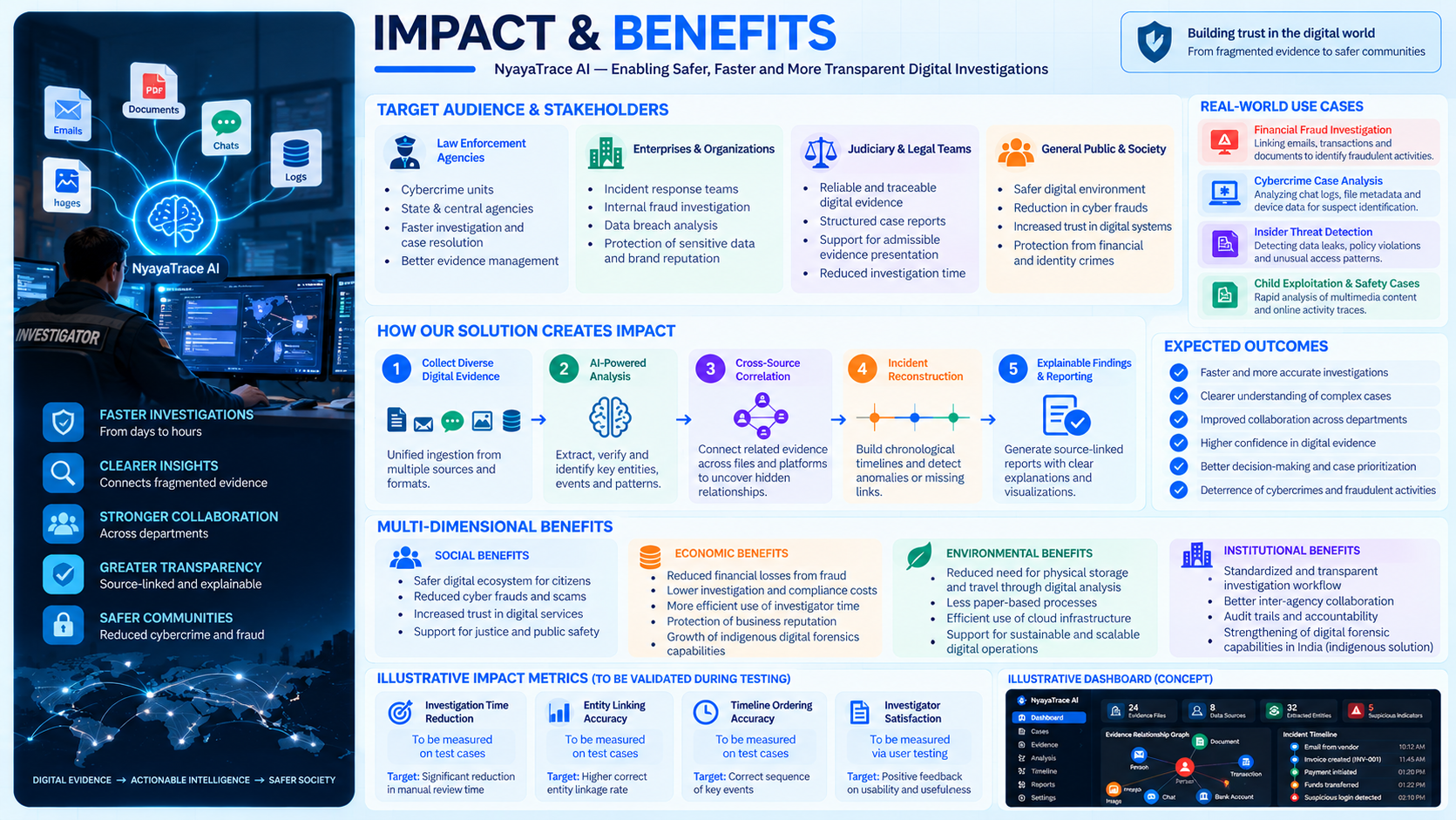
NyayaTrace AI aims to help cybercrime investigators, digital forensic examiners, enterprises, and incident response teams work through complex digital evidence more systematically. By bringing related information into one place, it can make evidence easier to navigate and help investigators focus on the connections that matter.
Looking ahead, we plan to explore support for more file formats, improved entity matching, advanced image and video analysis, larger evidence datasets, and more rigorous testing to measure the system's accuracy and performance.
What matters most to us is that technology should support the investigation, not replace human judgement.
NyayaTrace AI — Evidence-backed insights. Human-reviewed conclusions.
Built With
- artificial-intelligence
- data-visualization
- digital-forensics
- entity-resolution
- evidence-correlation
- fastapi
- incident
- large-language-models-(llms)
- natural-language-processing-(nlp)
- next.js
- ocr
- postgresql
- pymupdf
- python
- react
- react-flow
- recharts
- rest-api
- sha-256
- tailwind-css
- tesseract-ocr
- typescript

Log in or sign up for Devpost to join the conversation.