-
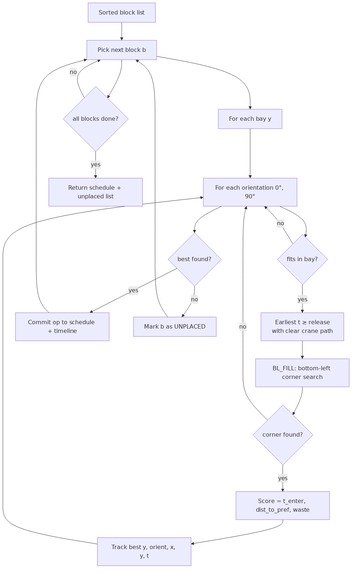
Placement phase
-
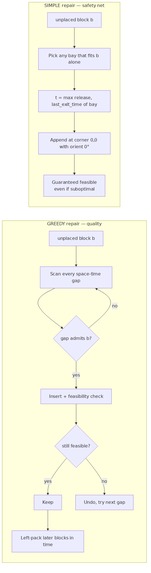
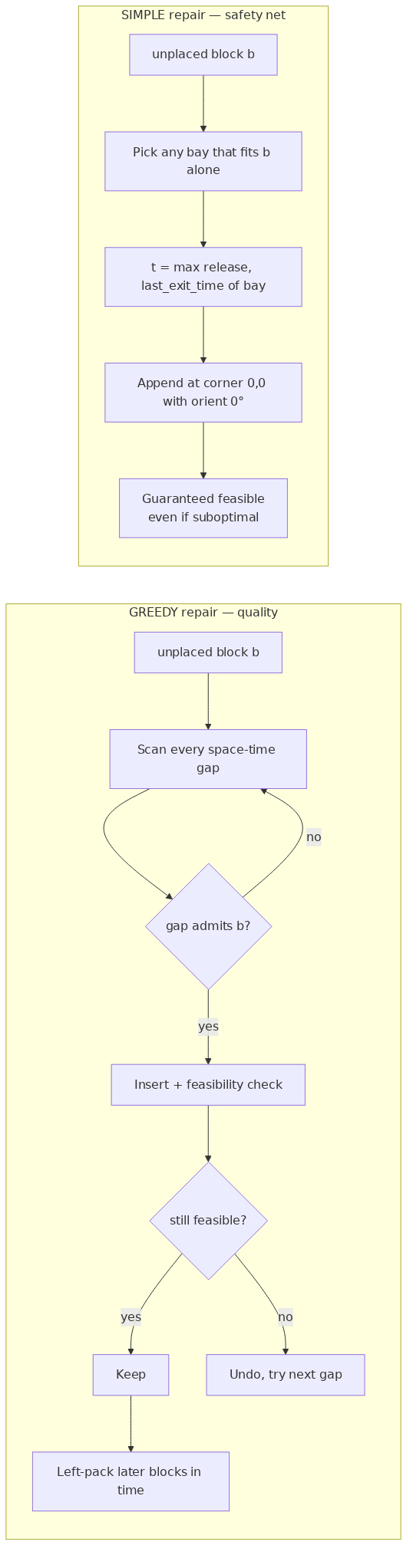
Repair phase
-
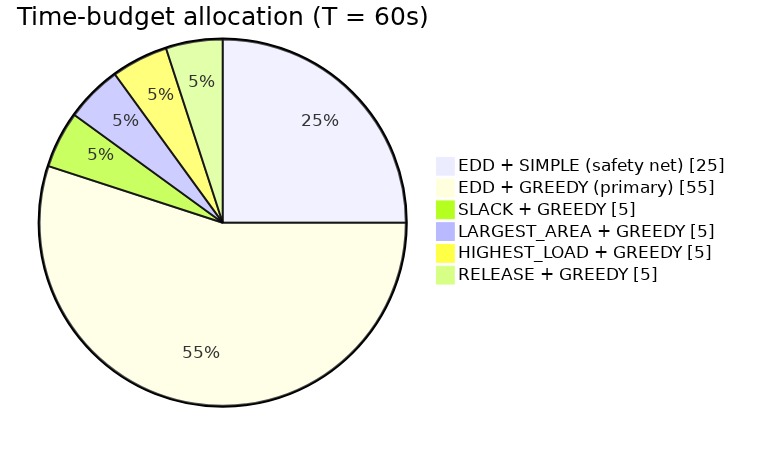
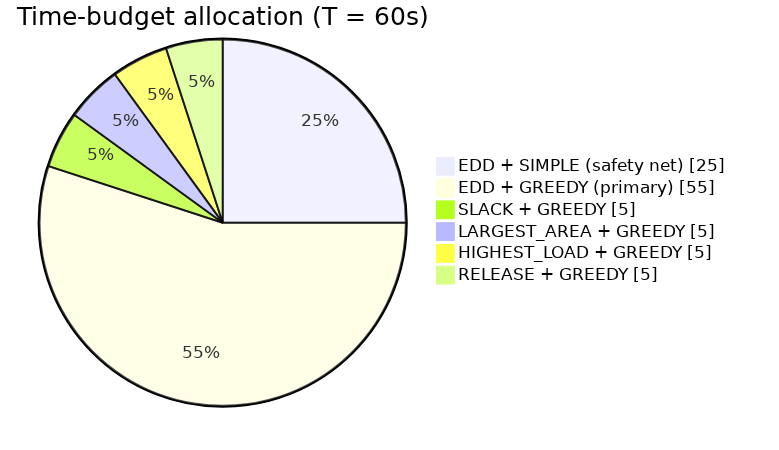
Time Budget
-

Data flow
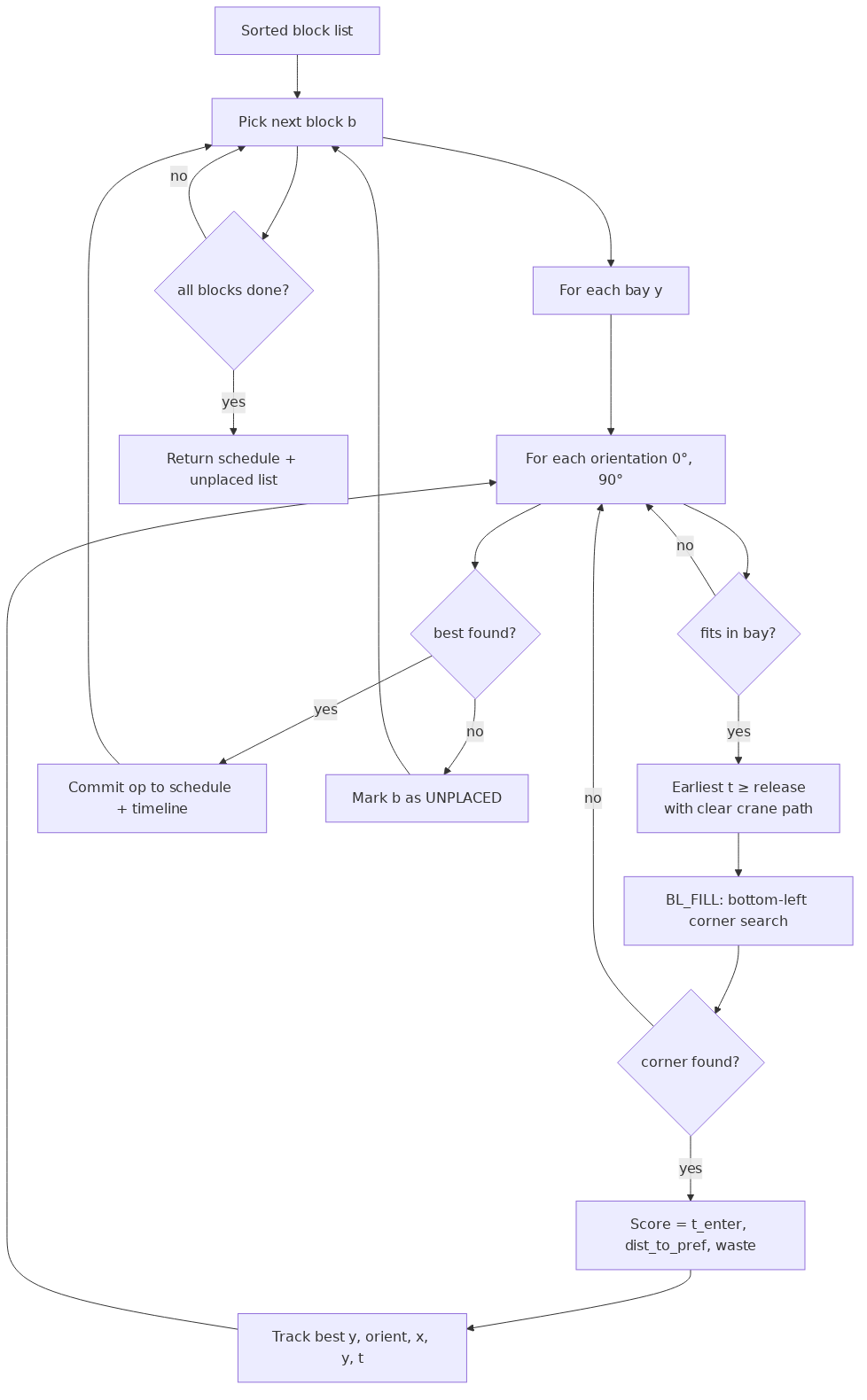

Inspiration
OPTIMIZATION GRAND CHALLENGE 2026 State-of-the-Art Methodology Shipyard Block Layout & Scheduling Optimization is a multi-start portfolio framework that couples 5 complementary ordering heuristics with a 2-phase placement/repair engine to deliver robust, never-infeasible solutions under a strict 60-second budget.
What it does
The OGC 2026 challenge tightly couples spatial layout (where blocks sit on the yard) with temporal scheduling (when blocks enter and leave). A single heuristic cannot dominate across all 10 problem instances because each instance stresses a different bottleneck — area utilization, crane congestion, due-date pressure, or release-time skew.
How we built it
I adopted Unique Methodology — the Portfolio-Repair Framework ,rather than searching for one universal heuristic, we built a multi-start portfolio that races 5 ordering strategies under a shared 60-second wall clock, each followed by a 2-phase placement & repair pipeline. The driver always returns the best feasible schedule and never crashes — if every variant fails, it falls back to the unmodified baseline. This converts the contest from a gamble on one heuristic into a deterministic ensemble that exploits whichever ordering best fits the instance.
Three Pillars of Differentiation was looked at
• Diversification under a budget — 5 orderings × 2 repair modes, time-sliced 25/55/5/5/5/5%. • Guaranteed feasibility — SIMPLE repair mode always yields a valid schedule; GREEDY repair pushes for quality. • Zero-crash contract — wrapped exception handling escalates to baseline; the submission cannot score −1 by error.
Adopted Methodology —5 Algorithms. Why ?
Each algorithm targets a distinct failure mode of the shipyard problem. Together they form an ensemble that adapts to whichever bottleneck dominates an instance.
Challenges we ran into
Correlating the Process to the Shipyard Problem -The shipyard problem demands three things simultaneously: (i) place every block inside the yard without overlap, (ii) respect crane access paths during entry/exit, and (iii) honour release times and due dates.
Accomplishments that we're proud of
Our pipeline addresses each demand at a specific stage:
Shipyard Demand Pipeline Stage Mechanism No-overlap & yard bounds Phase 1 (Algo C) BL-Fill corner search rejects infeasible corners Crane access during move Phase 1 (Algo C) Crane-path validation before commit Release times Ordering (Algo B) RELEASE / SLACK keys push early-available blocks first Due dates Ordering (Algo B) EDD / SLACK keys minimize tardiness Area-tight instances Ordering (Algo B) LARGEST_AREA seats big blocks while space exists Crane-tight instances Ordering (Algo B) HIGHEST_LOAD smooths peak crane demand Feasibility guarantee Phase 2 SIMPLE (Algo D) Sequential walk always produces a valid schedule Quality push Phase 2 GREEDY (Algo D) Dense re-pack of deferred blocks Never-crash contract Variant Runner (Algo E) Per-variant try/except + baseline fallback Best-of-ensemble Portfolio Driver (Algo A) Returns argmin(objective) over feasible variants
The result is a methodology that is uniquely suited to the OGC 2026 shipyard problem: every contest-defined constraint maps to a specific algorithmic mechanism, and every instance-specific bottleneck is covered by at least one variant in the portfolio.
What we learned
Headline Takeaway • Quality — average objective improved 12.0% over baseline across the 10 instances. • Robustness — feasibility raised from 9/10 to 10/10; never regresses. • Compute discipline — full 60-second budget exercised; no crashes, no timeouts. • Ensemble payoff — 3 of 10 instances are won by a non-EDD ordering, validating the 5-algorithm portfolio over any single-heuristic baseline.
What's next for NYAYANET SHIPYARD SYMPHONY
I hope this will help me to qualify for the Final rounds and would love to earn an Internship to learn Real life applicable problem solving techniques and expertise.

Log in or sign up for Devpost to join the conversation.