-
-
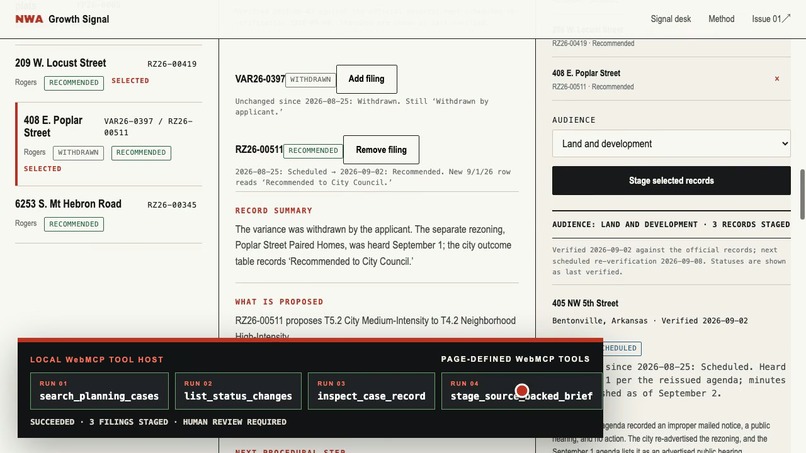
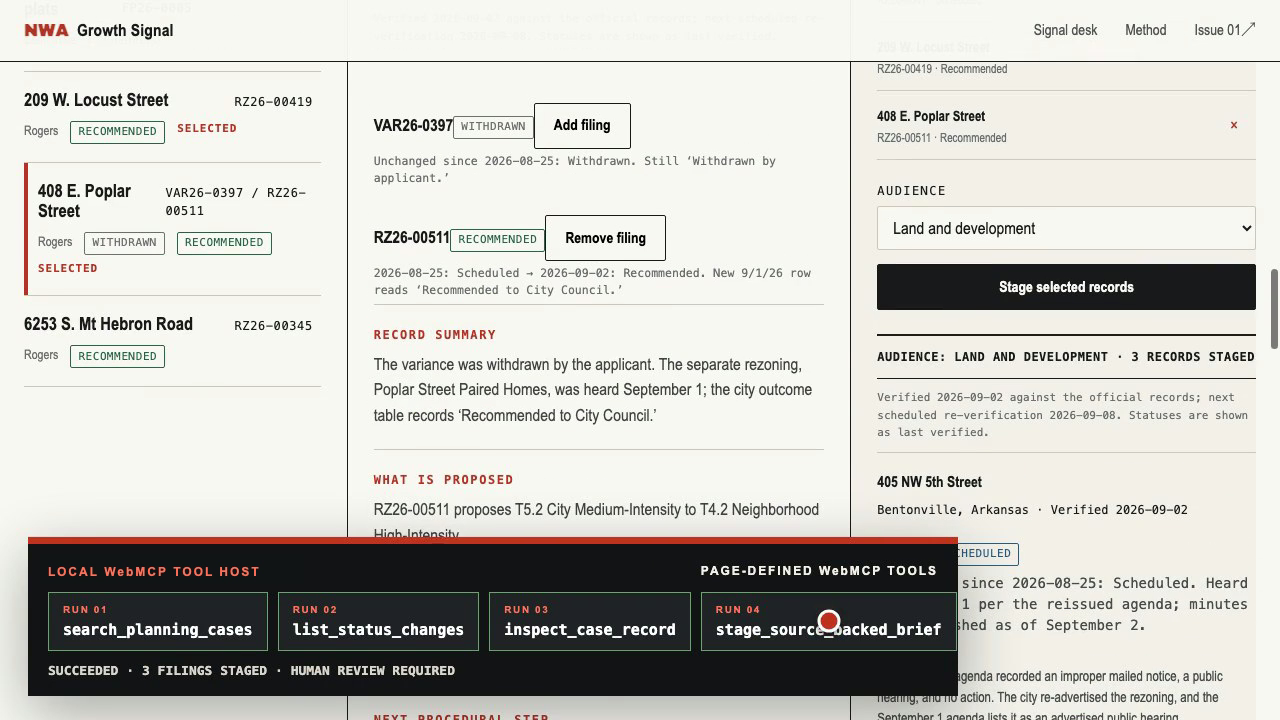
Four real WebMCP calls completed in one visible workflow: search, list changes, inspect, and stage. The brief remains human-review-required.
-
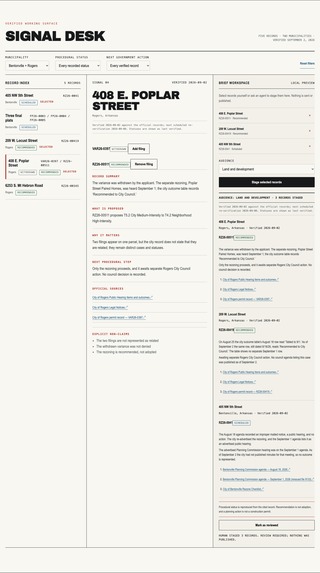
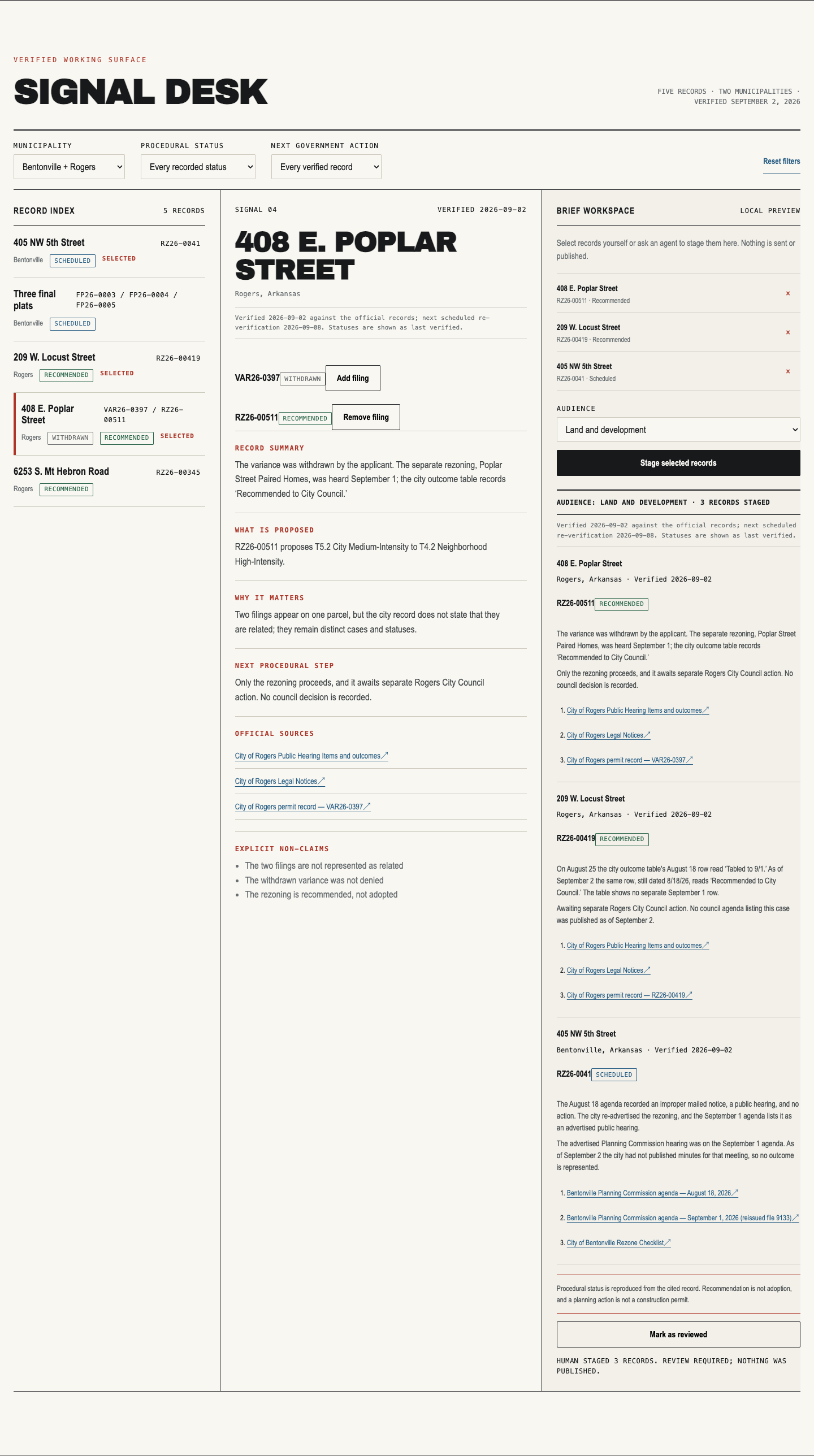
One parcel, two filings: VAR26-0397 Withdrawn and RZ26-00511 Recommended, kept distinct with their official sources.
-
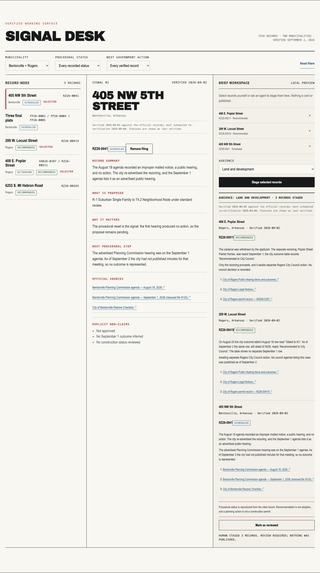
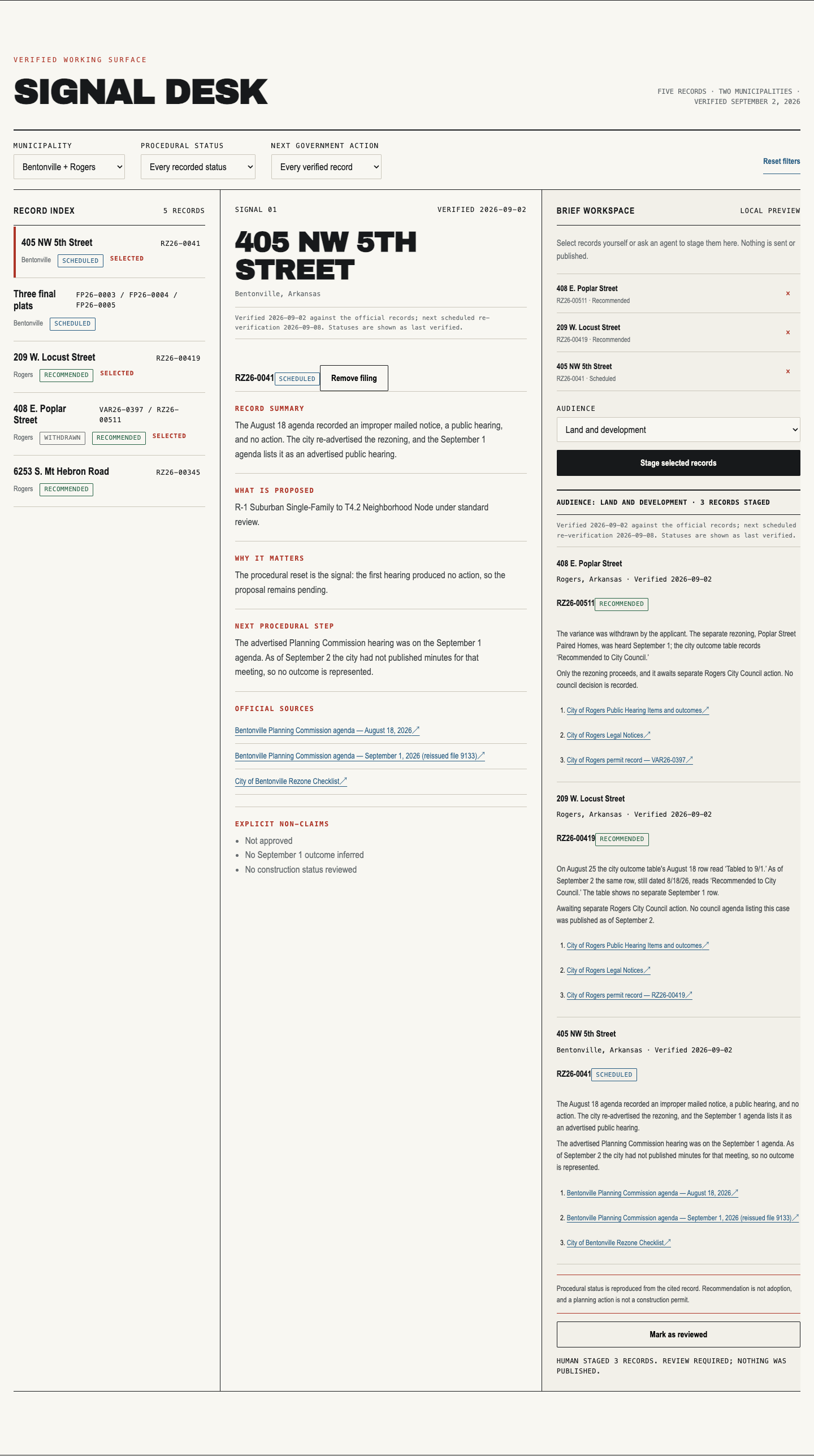
A three-filing brief staged for human review. Nothing is published or sent.
-
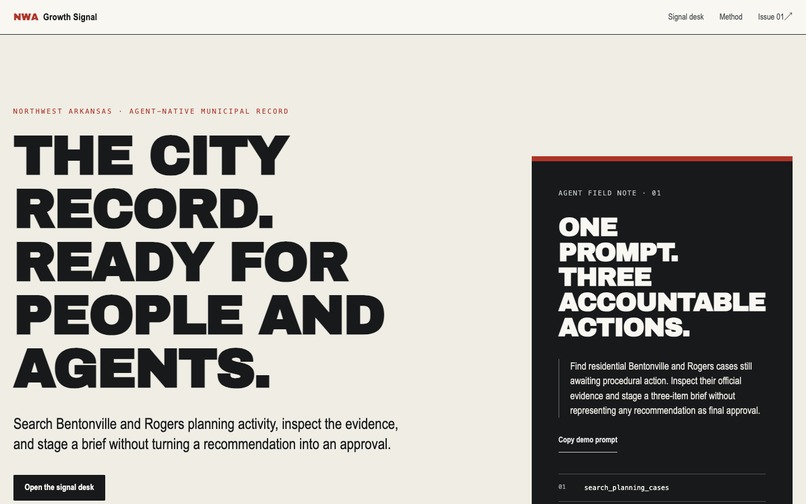
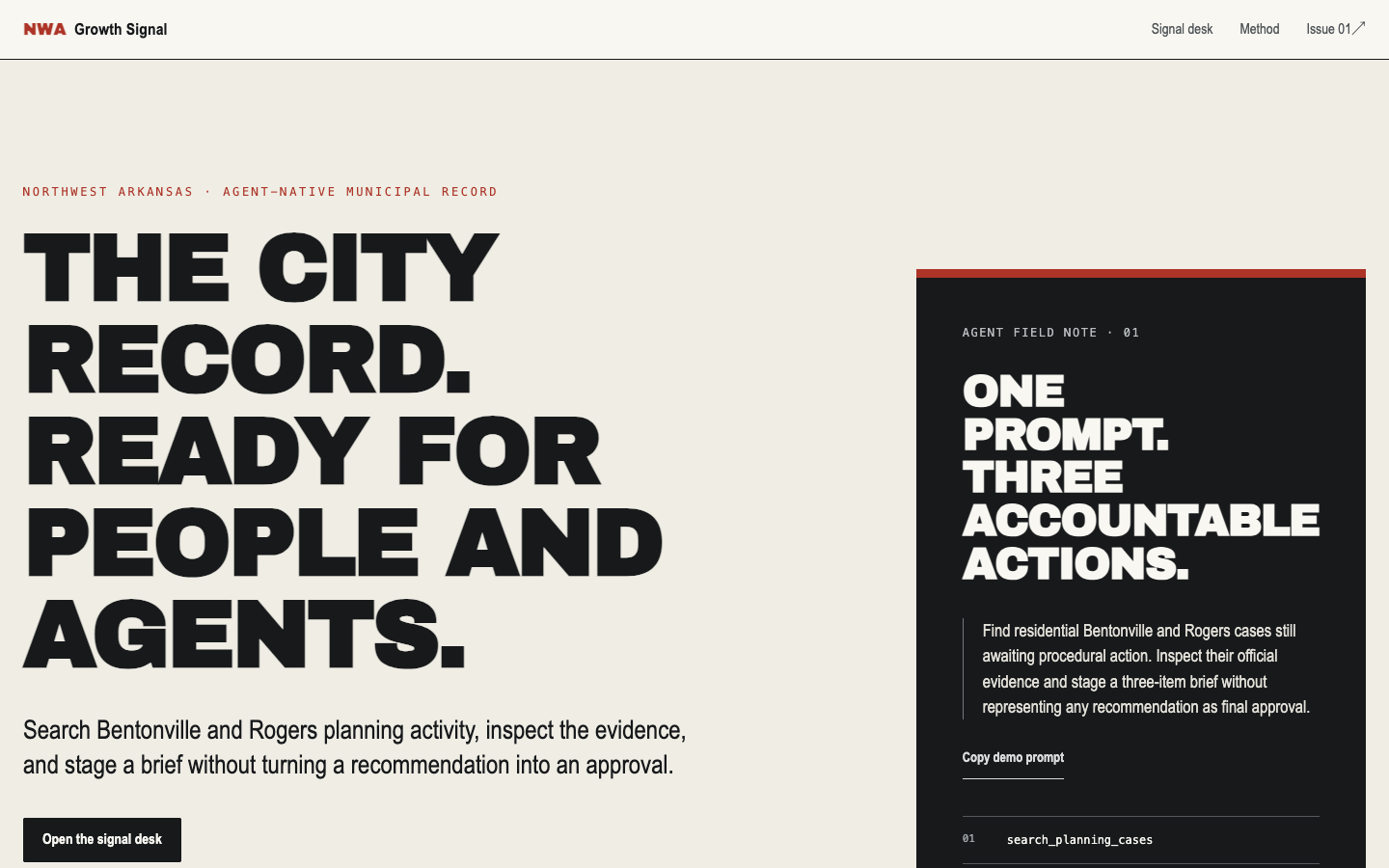
The signal desk: the same dated municipal record for people and browser agents.
Inspiration
An agenda-wording-only heuristic could determine just 3 of 23 real planning outcomes, and 2 of those 3 were wrong: the wording implied approval for requests that were actually tabled. This week, Rogers changed an existing 8/18/26 outcome row in place from Tabled to 9/1 to Recommended to City Council, with no separate September 1 row. That is the kind of quiet procedural change that can burn land and development teams, lenders and title professionals, local journalists, and public-interest planners in Northwest Arkansas.
Municipal records are public, but the procedural truth is scattered across agendas, minutes, outcome tables, hearing pages, and companion filings. One parcel can have several filings with different statuses. NWA Growth Signal gives a person and a browser agent a dated, filing-level planning evidence desk for Bentonville and Rogers, Arkansas.
Adjacent products serve related jobs. CivicPlus provides agenda and meeting management. Regrid provides a parcel and property map. PermitFlow provides permitting workflow. NWA Growth Signal focuses on the evidence handoff between a researcher and an agent as official planning records change.
What it does
Why is this a strong fit for WebMCP?
The research task has four distinct steps, each with a clear contract. search_planning_cases filters 5 verified records by municipality, procedural status, residential relevance, and pending government action. list_status_changes returns the filings whose verified status moved since the previous check, with the official source on both dates. inspect_case_record returns one filing-level record with its context and official sources. stage_source_backed_brief places 1 to 5 selected records into the visible briefing workspace. The agent receives typed results from the same dated data the person sees instead of inferring status from page wording or clicking by coordinates.
How does it create a better experience?
One prompt can drive the whole flow: “Find residential Bentonville and Rogers cases still awaiting procedural action. List which filings changed status since the previous verification, inspect their official evidence, and stage a three-item brief without representing any recommendation as final approval.” The fixed demo script takes 10 direct human control activations or 4 agent tool calls. Each real handler call adds an on-page receipt, so the person can see search, list changes, inspect, and stage start and then succeed or fail in order.
What can people and agents now do together?
The person states the research intent and keeps editorial judgment. The agent searches, inspects the filing-level evidence, and stages the brief. The person can check every selected filing and source before using it. The staging tool cannot publish, send, or persist a brief, and only a human control can record review.
How did we implement WebMCP?
The page registers all 4 tools atomically with document.modelContext.registerTool after the record set loads and supports AbortSignal. Handler inputs are validated. The 3 read tools carry readOnlyHint annotations. Search, inspection, staging, the ordinary browser interface, and the receipt row all use the same deterministic record operations, so the agent and person work from one application state.
Every filing also carries a status_history: its August 25 and September 2 statuses, the official source checked on each date, and a note where the record moved or went silent. The tools return it through their existing outputs, and the page shows the same line beside each filing, so an agent inspecting RZ26-00419 sees Tabled on August 25 and Recommended on September 2 with the same outcome-table URL for both, not a single current label.
A fourth tool, list_status_changes, landed after the first demo video was recorded; the current video shows it in the same run. It reads that same status_history and returns the filings whose verified status moved between the previous check and the current one: RZ26-00419 (Tabled to Recommended) and RZ26-00511 (Scheduled to Recommended), each with the official source checked on both dates. With changed_only set to false it also lists the six unchanged filings and their notes, such as FP26-0005 absent from the reissued agenda. It is read-only, registered atomically with the other three, and writes the same on-page receipt: 2 filings changed since 2026-08-25.
What changed during the challenge
The project was created during the challenge. Its first commit was 85c27f7 on August 26, 2026. In the 8 days since the first snapshot, the official record moved 4 times across just 5 tracked records:
- Rogers
RZ26-00511, Poplar Street Paired Homes at 408 E. Poplar, moved from Scheduled to a9/1/26outcome ofRecommended to City Council. Its companion filing on the same parcel,VAR26-0397, still readsWithdrawn by applicant. The split-filing result is now Withdrawn plus Recommended, and council action is still pending. - Rogers
RZ26-00419, 209 W. Locust, changed inside the same8/18/26row. On August 25 it readTabled to 9/1; on September 2 it readsRecommended to City Council. The table publishes no separate September 1 row. - Bentonville
FP26-0005, Brier Hill Phase II final plat, appeared on the September 1 agenda published August 25 as CivicClerk file9108. The city reissued that agenda as file9133without the filing. The current CivicClerk event record now points to agenda file9143; the tracked filing contents are unchanged, andFP26-0005remains omitted. No reason, outcome, or new date is published, so the product keeps the filing visible with its last published status and states what changed. - Rogers
RZ26-00345, 6253 S. Mt Hebron Rd, disappeared from the outcome table. No City Council action appears in the official sources reviewed, so the product retains the last recorded status, Recommended, and says the row is gone.
Bentonville RZ26-0041, FP26-0003, and FP26-0004 were heard September 1 according to the agenda. Minutes are not yet published, so the product represents no outcome for them.
We also tested the approach on a held-out historical study: 23 real Rogers requests, 26 procedural events, 6 meetings in 2025, and 12 official agenda and minutes documents. NWA Growth Signal preserved 26/26 exact statuses through both inspection and staging. Expected source pairs were present in 26/26 record-wide outputs. All 23/23 same-meeting agenda and minutes pairs were present, and 3 multi-meeting lifecycles stayed intact. The request wording left 20 of 23 outcomes unknowable; as the opening example shows, it also gave the wrong answer for 2 of the 3 outcomes it appeared to reveal.
How we built it
NWA Growth Signal is a dependency-free static HTML, CSS, and JavaScript site deployed on Cloudflare Pages. A dated JSON snapshot holds the editorial sample. Shared JavaScript owns deterministic filtering, record inspection, brief staging, freshness checks, and receipts. The WebMCP adapter and the ordinary browser interface call those same operations.
The release has 99 passing dependency-free tests, a deterministic benchmark, and a fail-closed freshness gate.
The current video and public main both reflect the 99-test release. The team used Codex and Claude Code for implementation, review, testing, and submission work; Hyperagent for municipal research and editorial work; and Google Gemini for the approved demo narration.
Challenges we ran into
The hardest part was preserving truth at the filing level while the official record kept moving. A parcel summary would hide the difference between a withdrawn variance and a rezoning recommended to City Council. We carried each filing, status, source, and date through the data, tools, interface, benchmark, and demo.
The other hard boundary was useful agent action without an unsafe side effect. Staging had to be visible and valuable while leaving review and any later use of the brief with the person.
Accomplishments that we're proud of
- A complete public planning desk with 4 native WebMCP tools over 5 verified records.
- One browser request that searches, inspects, and stages a source-backed brief, with a live receipt for every handler call.
- 99 passing tests, all 4 tools exercised, input validation, atomic registration, cancellation support, and a fail-closed freshness gate.
- Exact preservation of 26/26 historical status events, 26/26 expected source pairs, 23/23 same-meeting source pairs, and 3 multi-meeting lifecycles.
- A visible human-review boundary with no publish, send, or persistence path in the staging tool.
- Loading, empty, error, retry, disabled, focus, copy-recovery, responsive, and keyboard-accessible interface states.
What we learned
Agent-native design starts with trustworthy actions, not a chat box. The model is good at choosing and sequencing tools. Exact municipal status, source boundaries, validation, freshness, and irreversible actions belong in deterministic application code.
We also learned that a source link is not enough. A useful evidence desk must preserve which filing the source supports, when the status was verified, what changed, and where the record is still silent.
What's next for NWA Growth Signal
Next we want repeatable ingestion from official municipal records, status-change diffs across more than two verification dates, and coverage for more Northwest Arkansas cities. We would keep the same filing-level evidence model, freshness gate, visible receipts, and human-review boundary. Any future alerting or publishing action would require explicit user approval.
Known Limitations
- The product contains 5 manually structured and verified records, not a live municipal database or automated ingestion pipeline. Official changes between refreshes require another source review.
Recommended to City Councilmeans council action is pending. The current sources support no claim that these recommendations were approved, adopted, or denied.- Published gaps remain visible: Bentonville minutes are pending,
FP26-0005vanished between agenda versions, and the RogersRZ26-00345outcome row is gone. - The benchmarks measure deterministic handler behavior and status preservation after manual structuring. They do not measure automated extraction accuracy, adoption, revenue, time saved, or changed decisions.
- The downloadable PDF is not tagged for assistive technology, and the YouTube player's public caption control was inconsistent during the latest check even though the timestamped transcript is public.
- Agent-side recovery after an initial record-load failure would require a public tool-contract change and is not included.
Built With
- claude-code
- cloudflare
- codex
- css
- html
- javascript
- webmcp

Log in or sign up for Devpost to join the conversation.