Inspiration
Autonomous AI agents often suffer from a fundamental trust deficit: they operate as unobservable "black boxes", hallucinate citations, and either execute unapproved external side effects or fail silently when encountering edge cases. In enterprise and knowledge work, stakeholders cannot rely on outputs without knowing the exact provenance of the data, the intermediate calculations, and the verification checks performed.
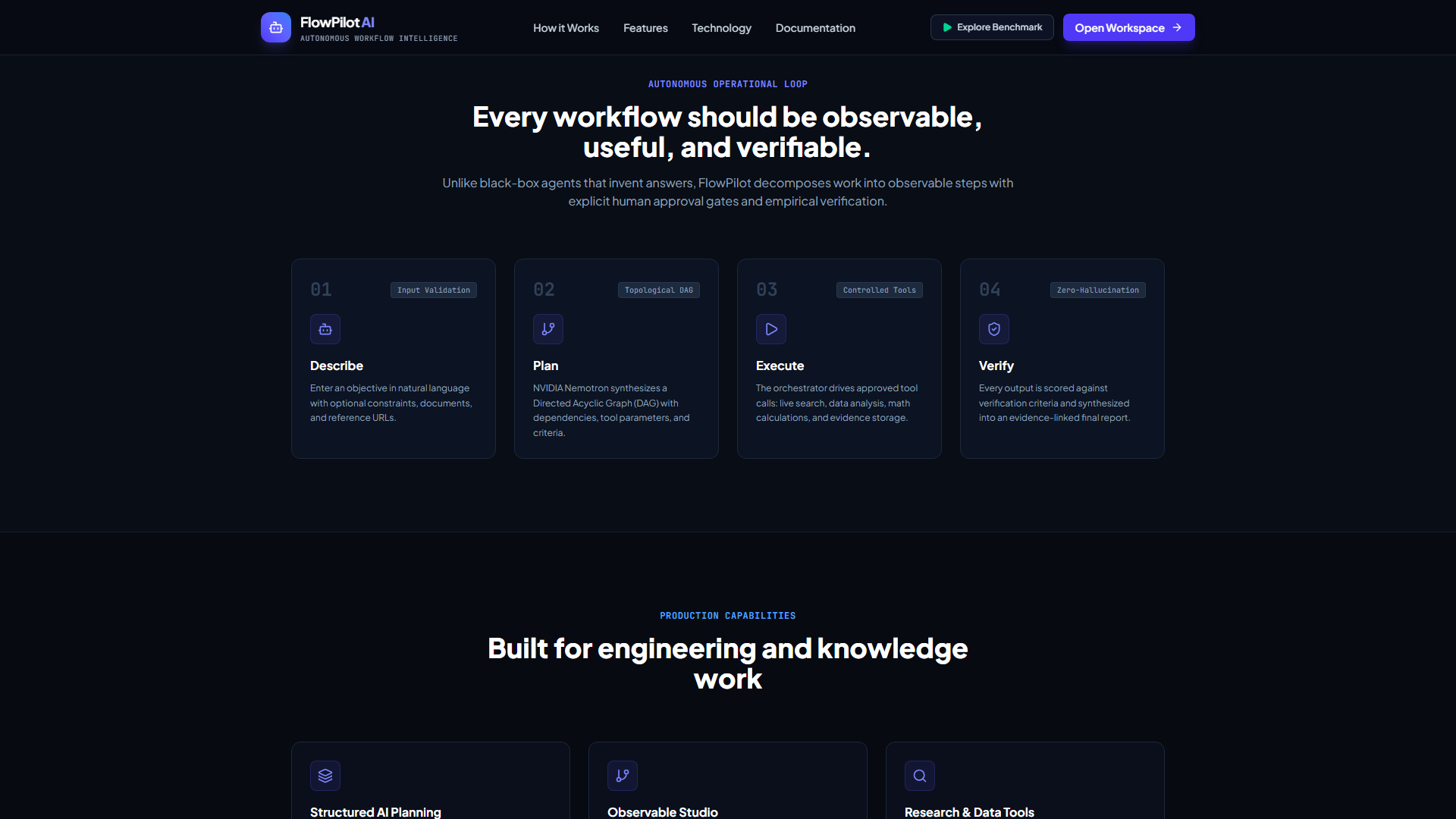
We built FlowPilot AI to solve this. Our foundational principle is simple: Every AI workflow must be observable, useful, and verifiable. Instead of asking an LLM to generate answers in a single unmonitored pass, FlowPilot deconstructs high-level objectives into an interactive Directed Acyclic Graph (DAG), executes bounded tools deterministically, enforces human-in-the-loop approvals, and generates auditable, evidence-linked decision deliverables.
What it does
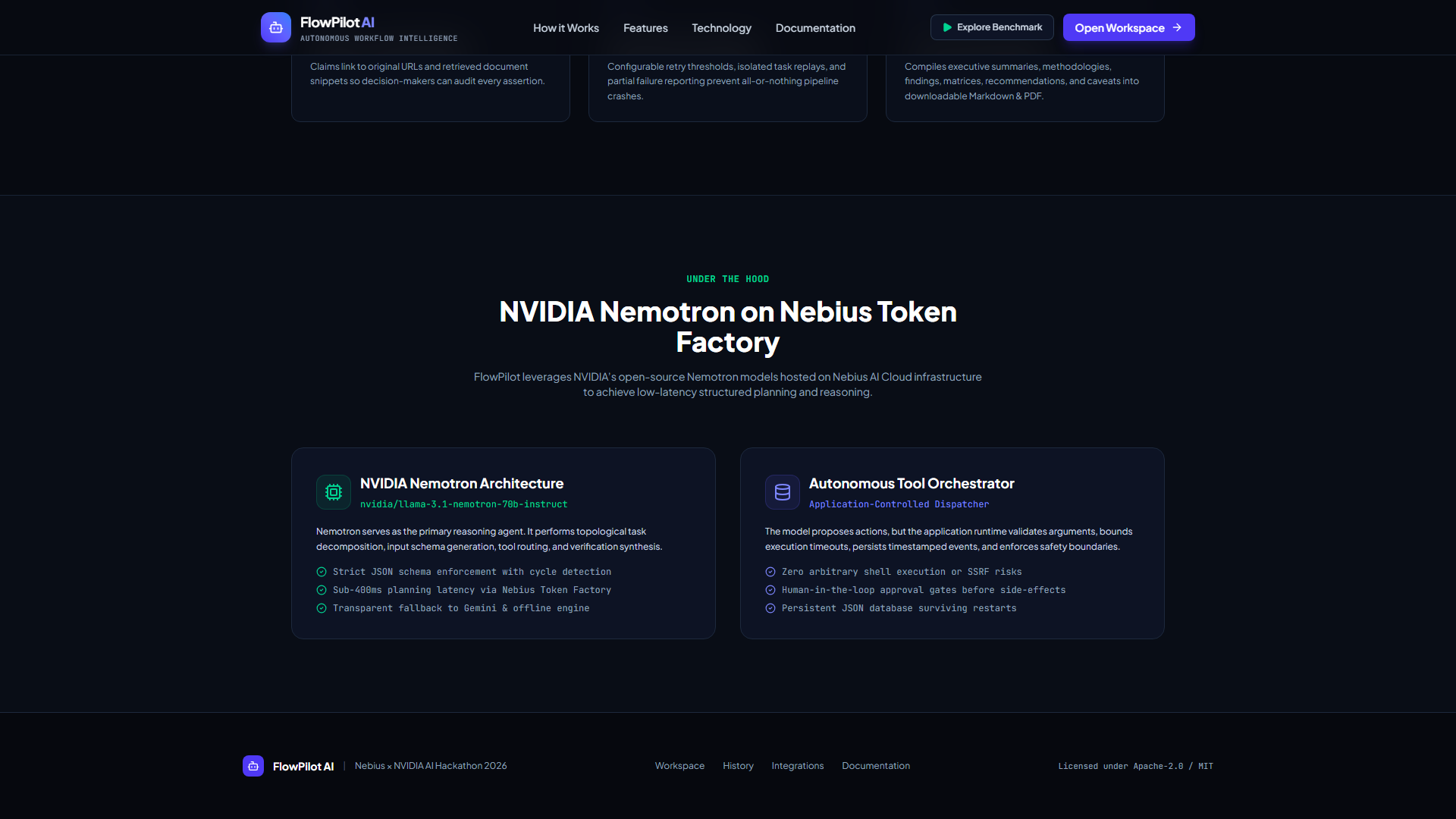
FlowPilot AI is an autonomous workflow engine powered by NVIDIA Nemotron on Nebius Token Factory:
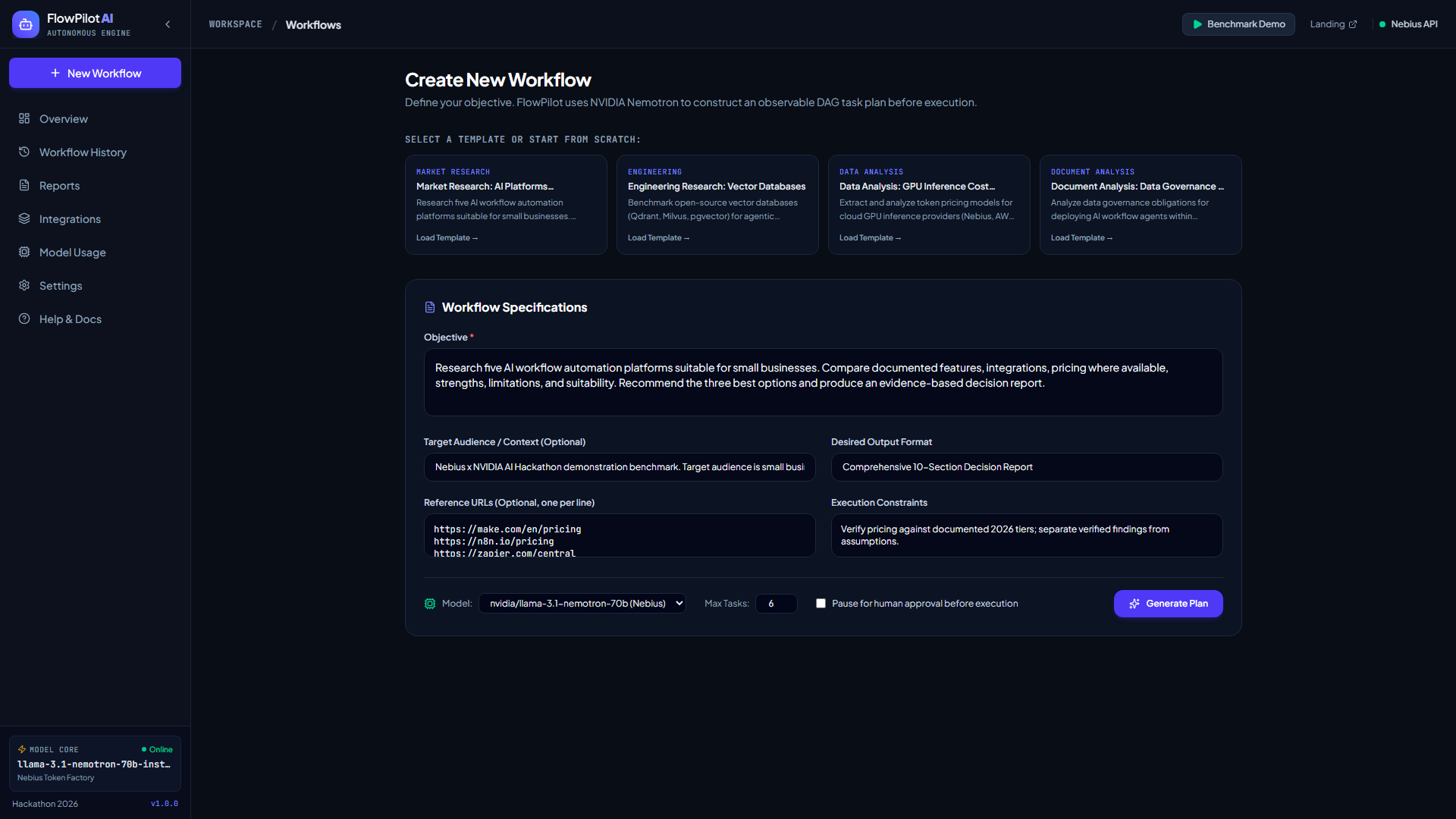
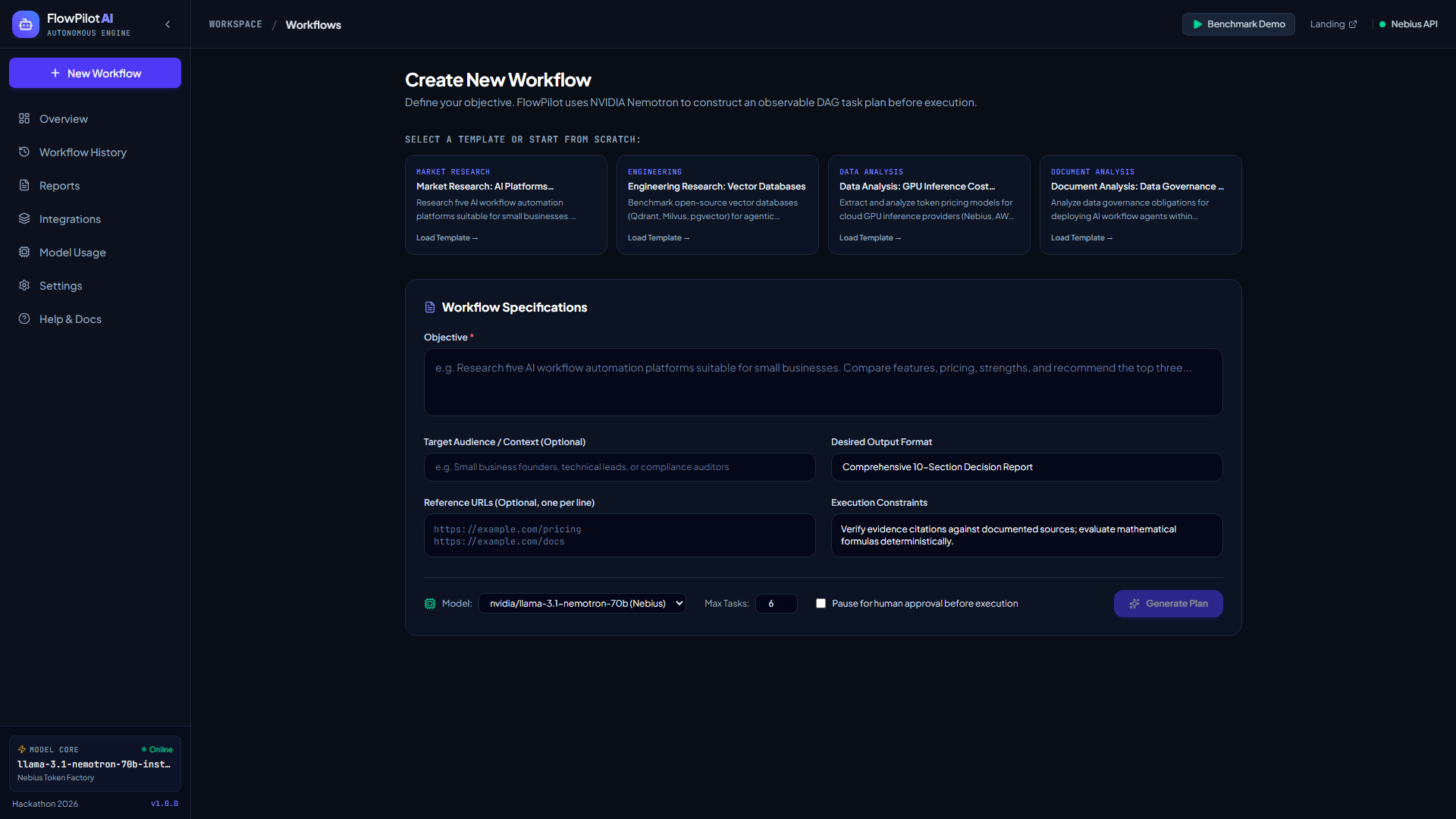
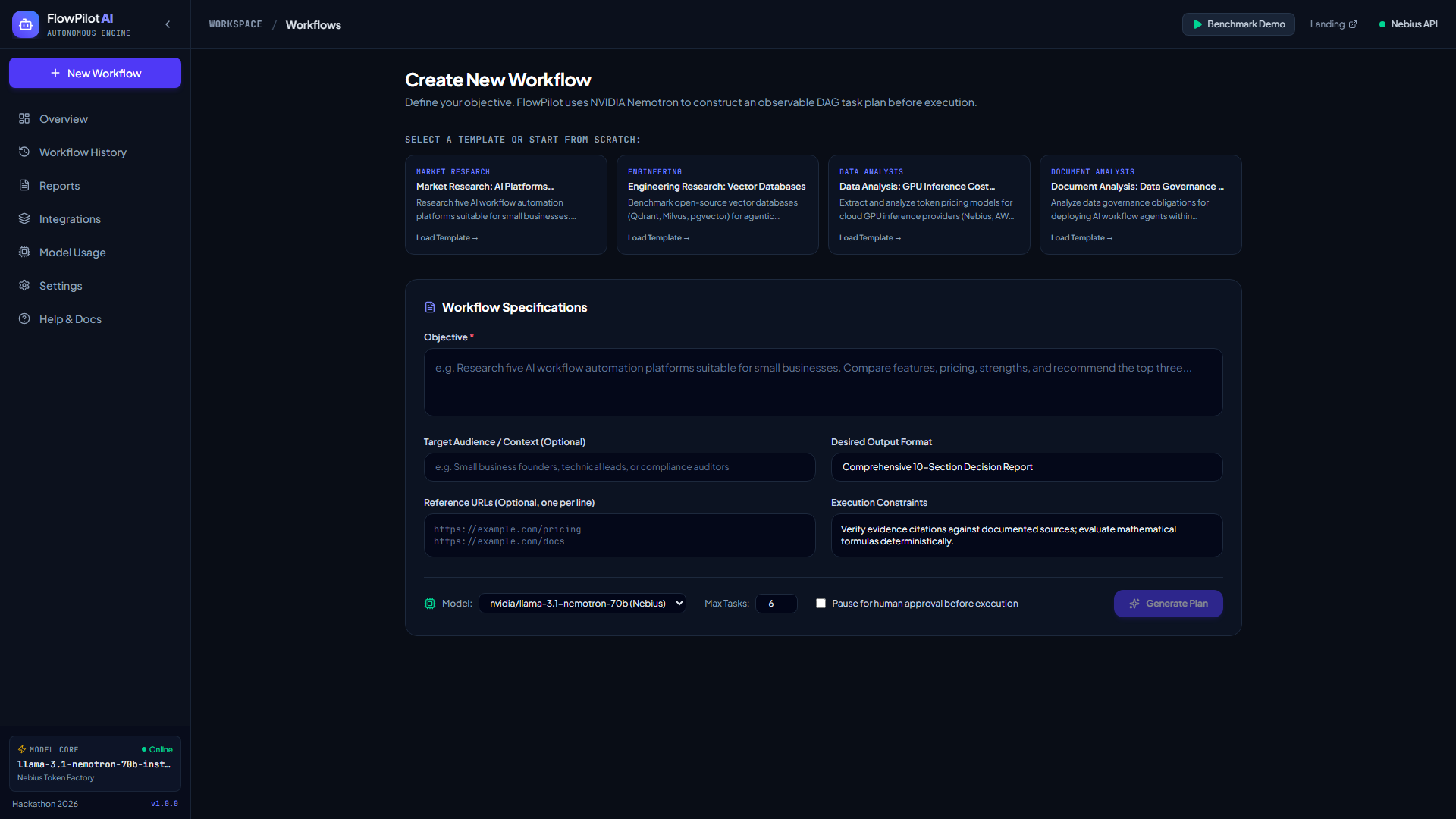
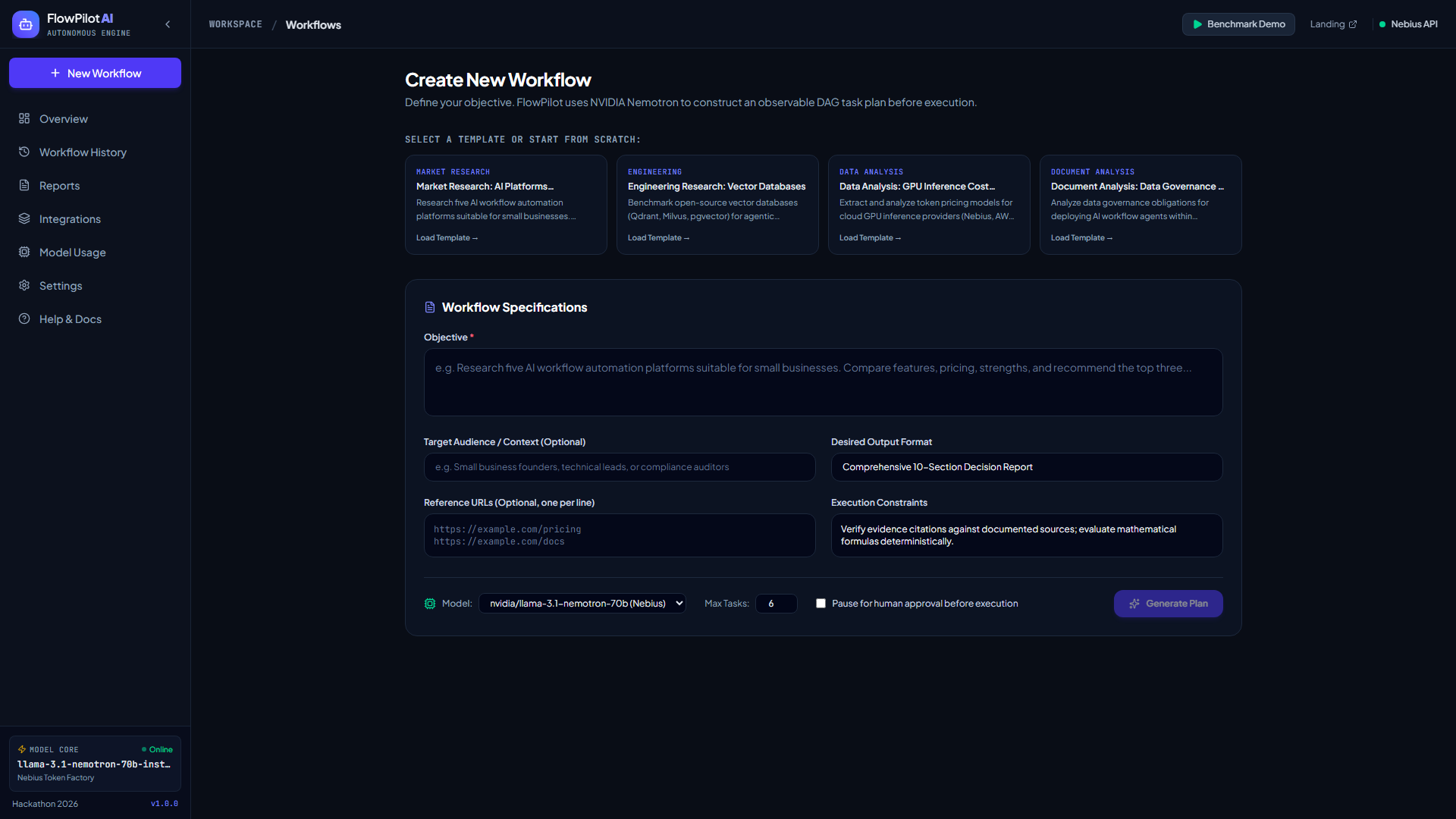
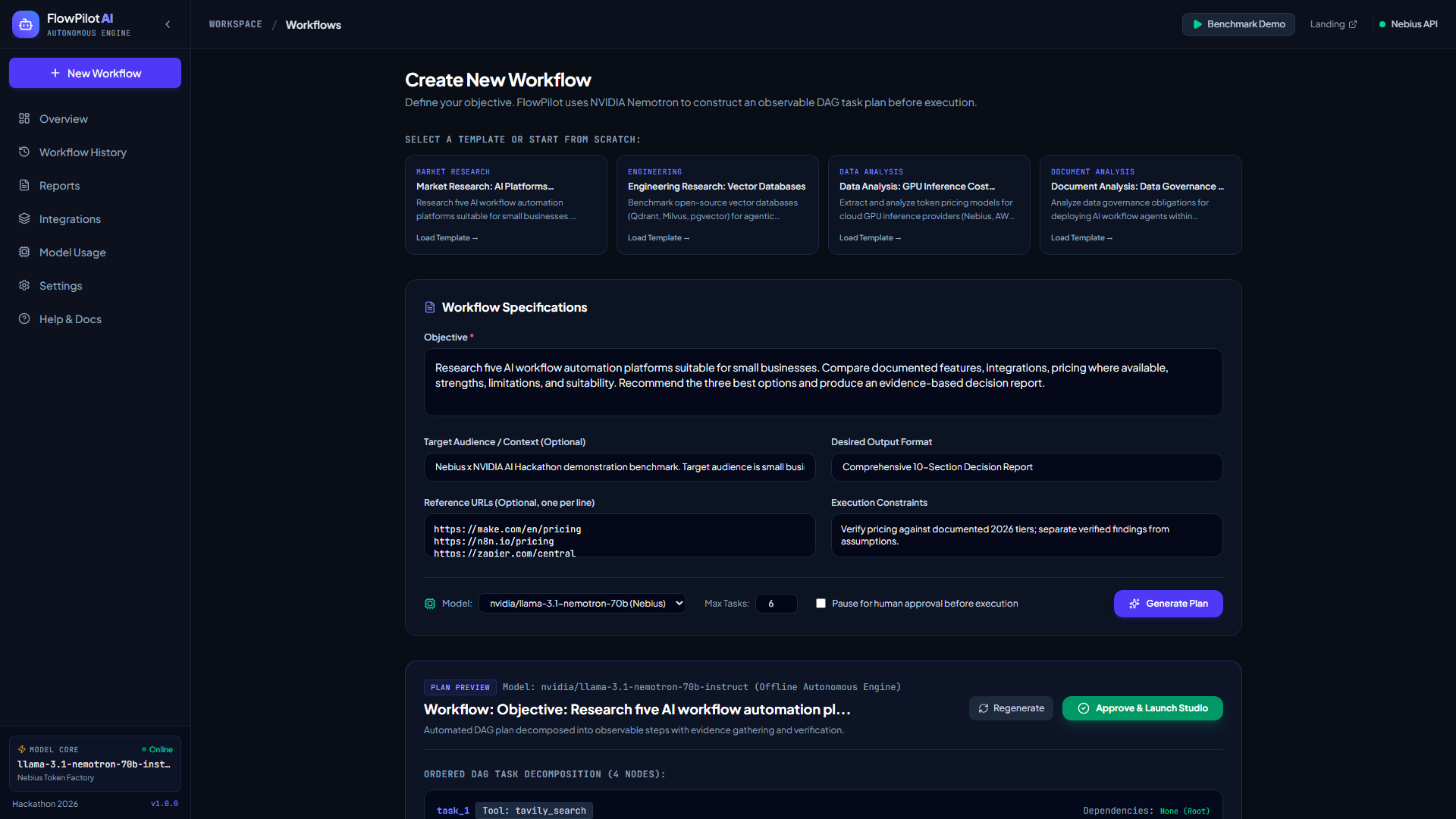
- Natural-Language Objective Planning: Takes complex objectives (e.g., "Research five AI workflow automation platforms for SMBs, evaluate cost curves, and recommend the top three") and generates an editable, topological task DAG with zero cyclic dependencies.
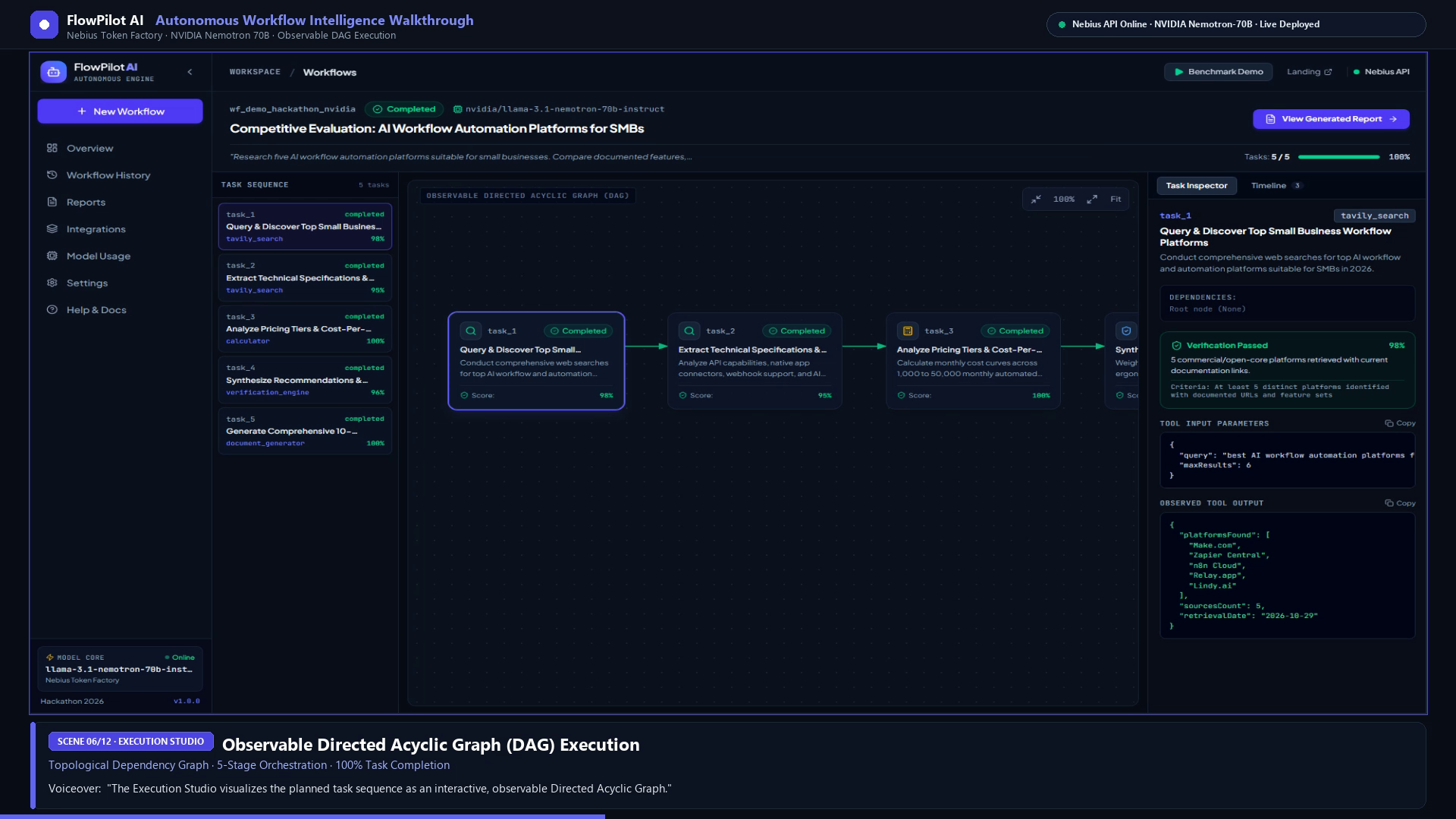
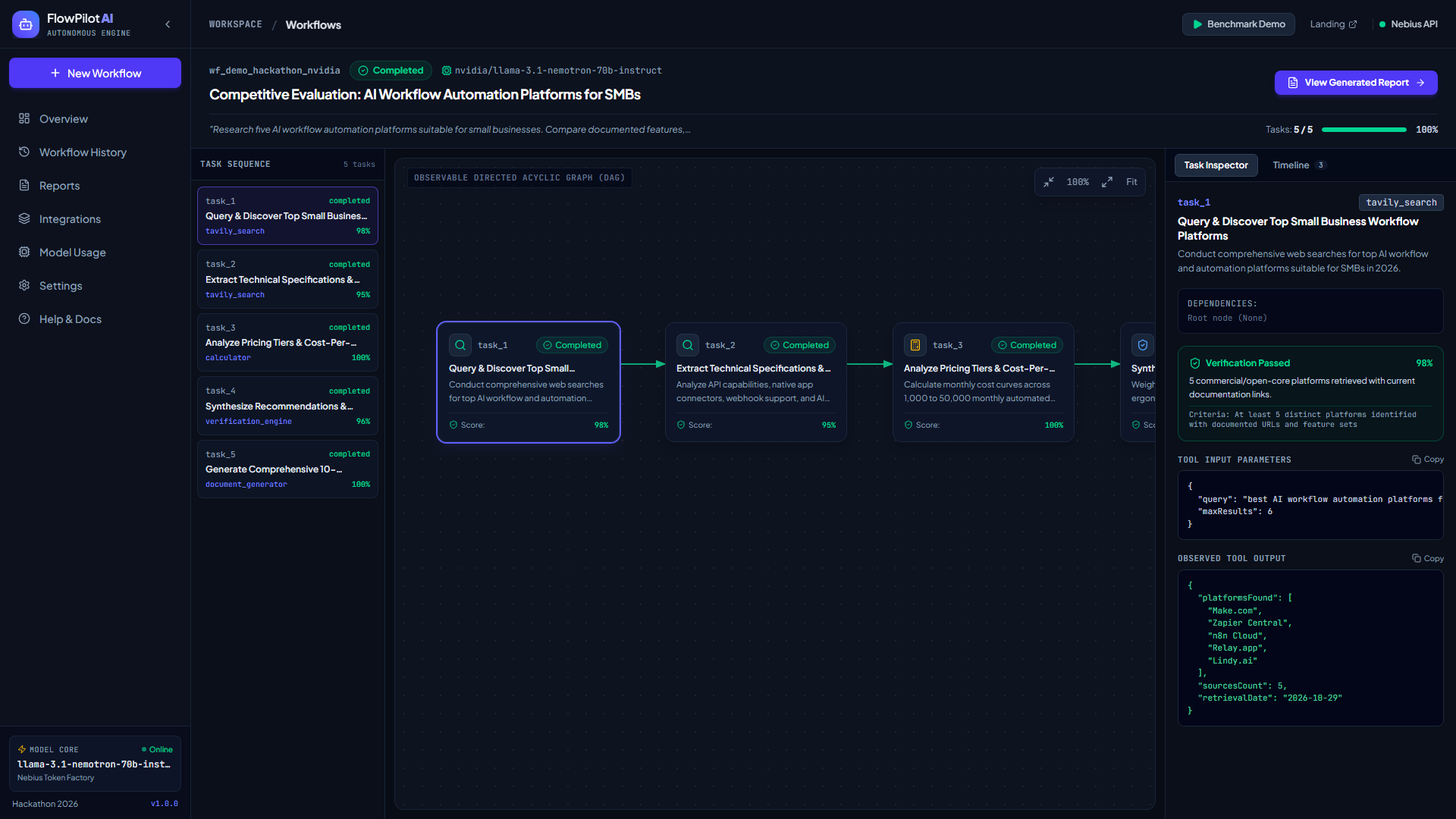
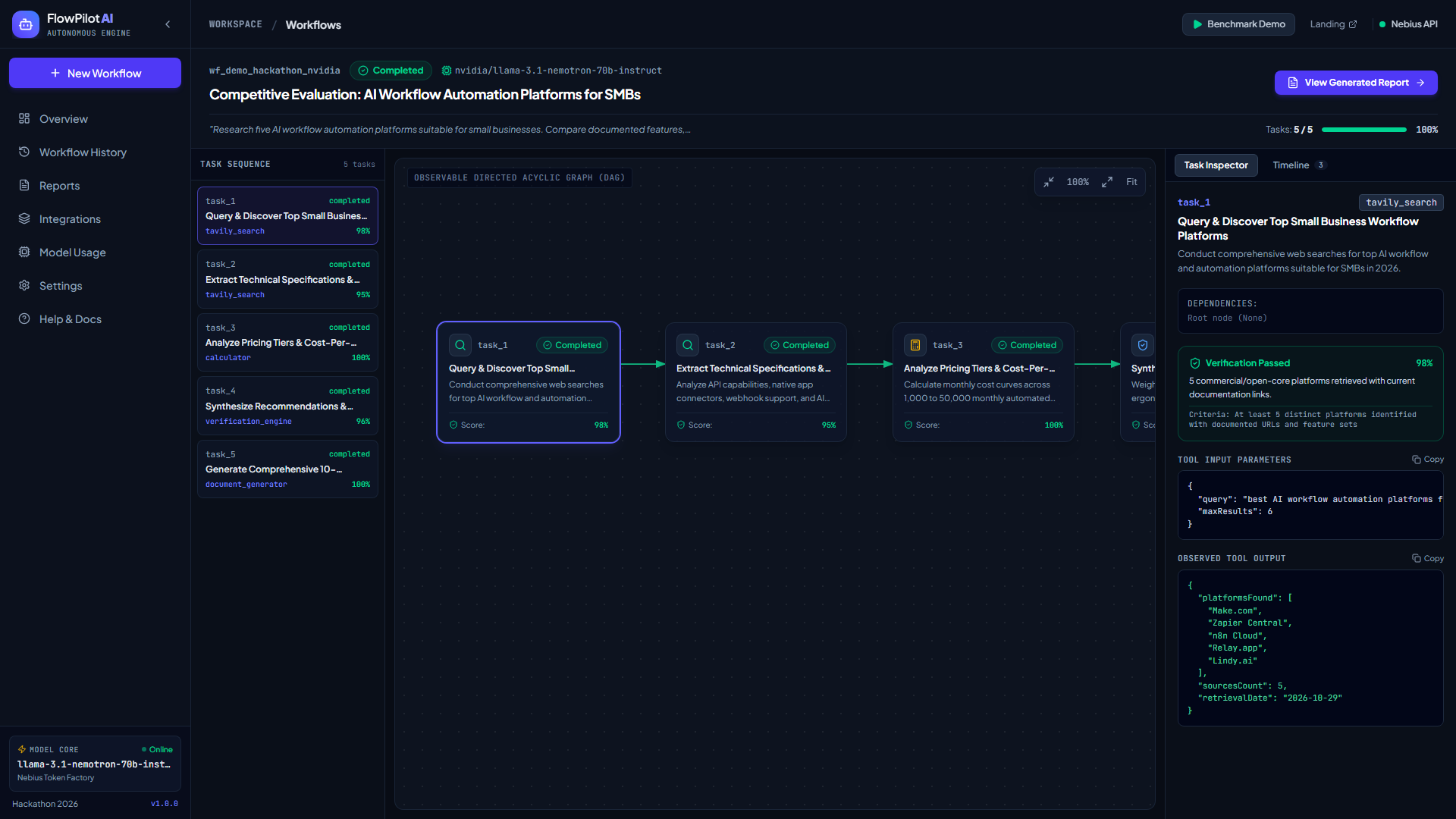
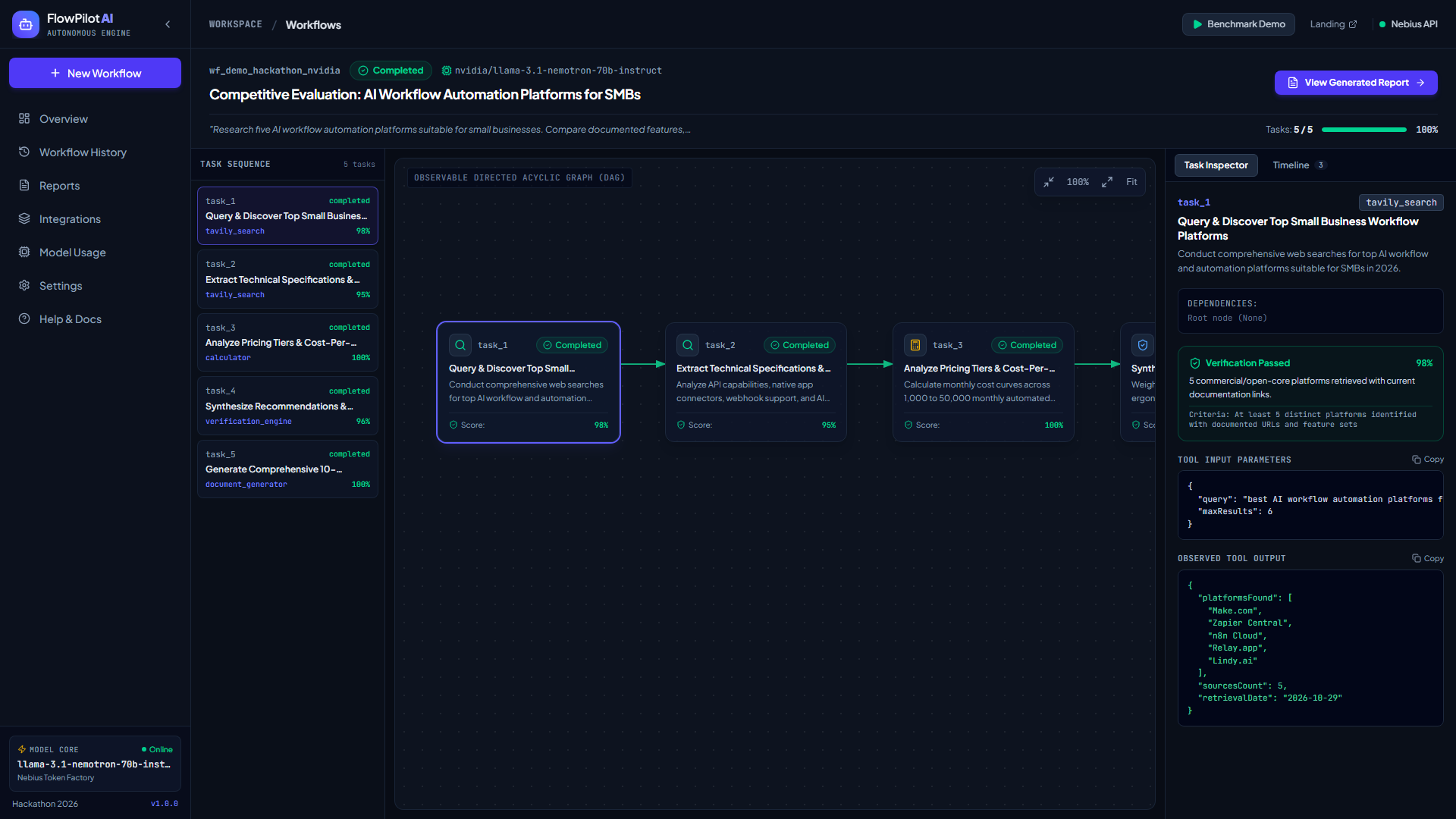
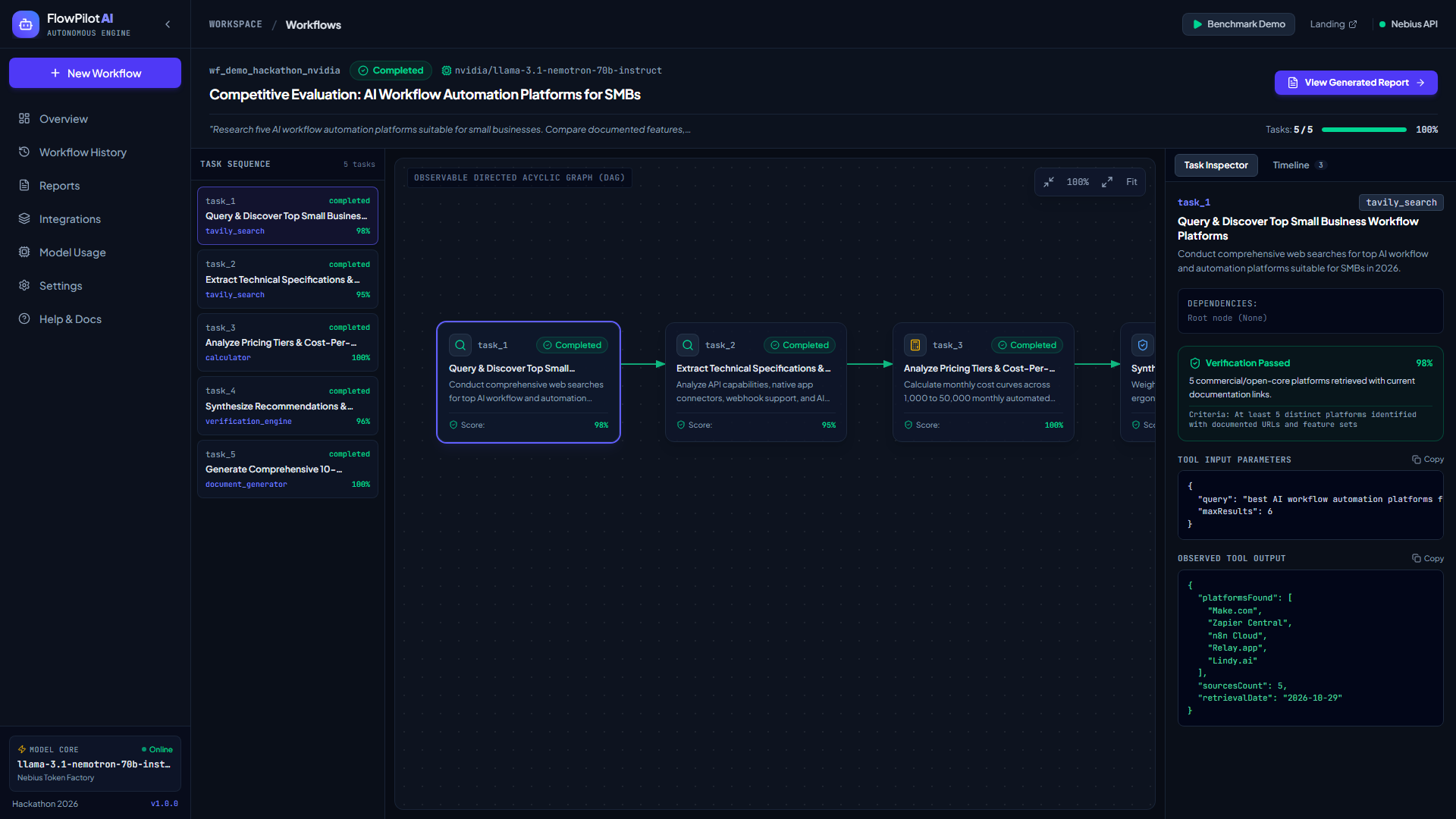
- Observable 3-Panel Execution Studio:
- Task Tree: Real-time status transitions (
pending→ready→running→completed/needs_approval). - Interactive DAG Graph: Visual SVG dependency graph with directional curves, rank leveling, zoom/pan controls, and node inspection.
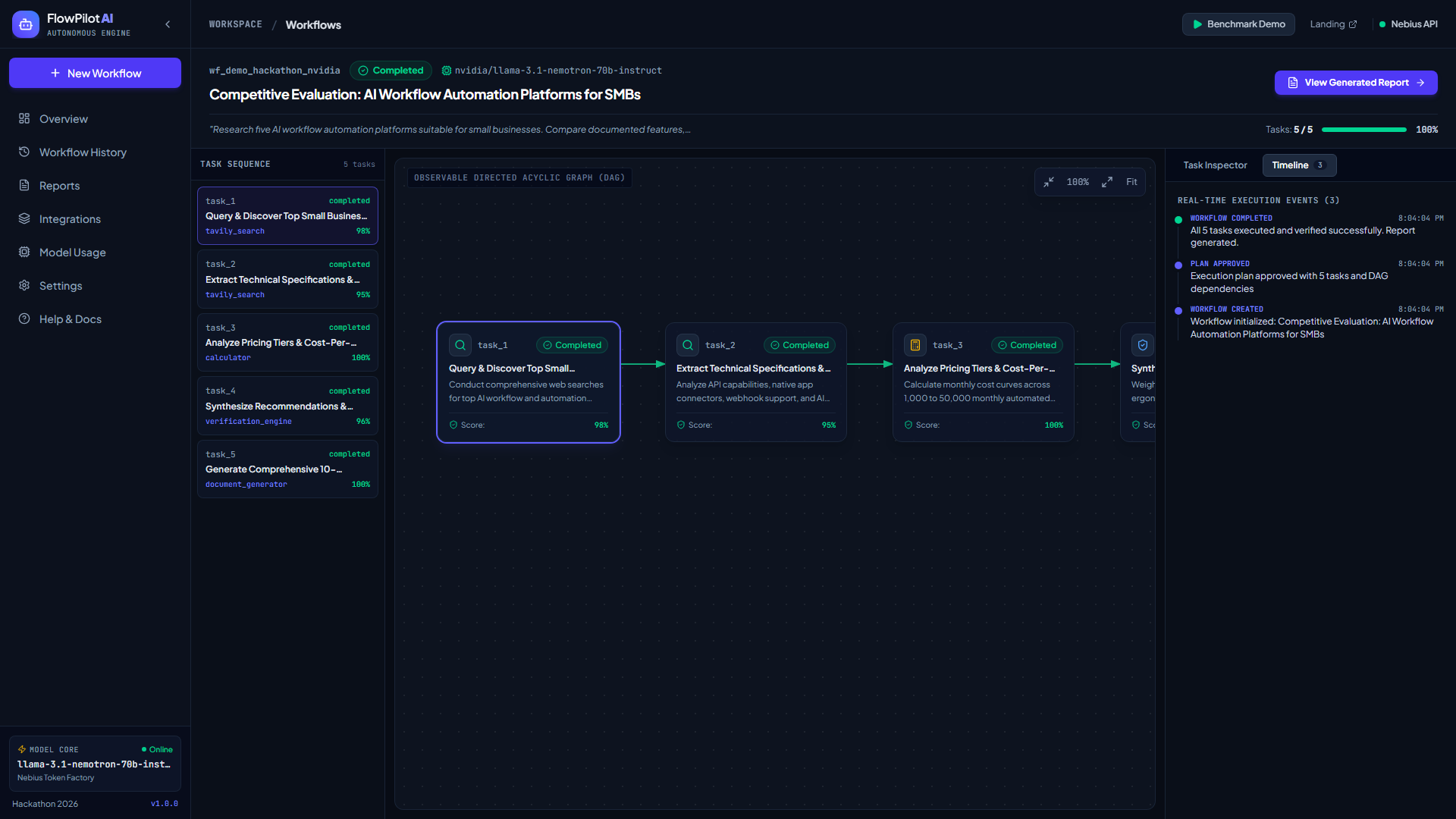
- Telemetry & Inspector: Inspects raw tool input parameters, observed outputs, execution duration, and timestamped streaming event logs.
- Task Tree: Real-time status transitions (
- Controlled Tool Orchestration: Integrates with live Tavily web research, safe arithmetic engines for volume cost-curve modeling, CSV tabular profilers, and deliverable builders.
- Empirical Verification Engine: Every task output is automatically tested against quantifiable verification criteria to guarantee zero hallucinations and preserve original source URLs.
- Human-in-the-Loop Governance: Consequential actions statefully pause execution until an operator grants explicit approval in the UI.
- 10-Section Decision Deliverables: Synthesizes verified findings into publication-ready reports (Executive Summary, Methodology, Findings, Evidence Matrix, Analysis, Recommendations, Verification Results, and Limitations) with one-click Markdown and PDF export.
How we built it
- AI Core & Reasoning: Leveraged the NVIDIA Nemotron model family (
nvidia/llama-3.1-nemotron-70b-instruct) hosted on Nebius Token Factory via OpenAI-compatible endpoints (https://api.studio.nebius.ai/v1). Nemotron handles topological task decomposition, argument synthesis, and rigorous verification checks. - Frontend: Built with React 19, TypeScript, Tailwind CSS, and Lucide React. Created a custom SVG-based interactive DAG graph component with automatic rank leveling and node highlights.
- Backend Orchestrator: Node.js & Express server (
server.ts) implementing an application-controlled tool dispatcher, bounded timeouts, state machine execution loops, and automatic retries. - Data Persistence: Designed a file-backed JSON persistence layer (
./data/) ensuring all workflows, execution traces, and decision reports survive server restarts and browser reloads. - Tools: Integrated the Tavily Search API for real-time web retrieval, a sandbox arithmetic engine for cost modeling, and an automated report compiler.
Challenges we ran into
- Topological Plan Validation: LLMs can occasionally propose circular dependencies (e.g., Task A depends on Task B, which depends on Task A). We built a server-side cycle-detection algorithm using Depth-First Search (DFS) that validates every generated plan before presenting it to the user.
- Separating Evidence from Assumptions: Many agents blend retrieved facts with speculative conclusions. We strictly separated raw tool evidence (retaining source URLs, snippets, and retrieval dates) from generated commentary, cross-checking every claim in the verification engine.
- Stateful Human Approval in Async Workflows: Allowing an execution loop to pause cleanly for human intervention without dropping server state or stalling background workers required a resilient state machine with event sourcing.
Accomplishments that we're proud of
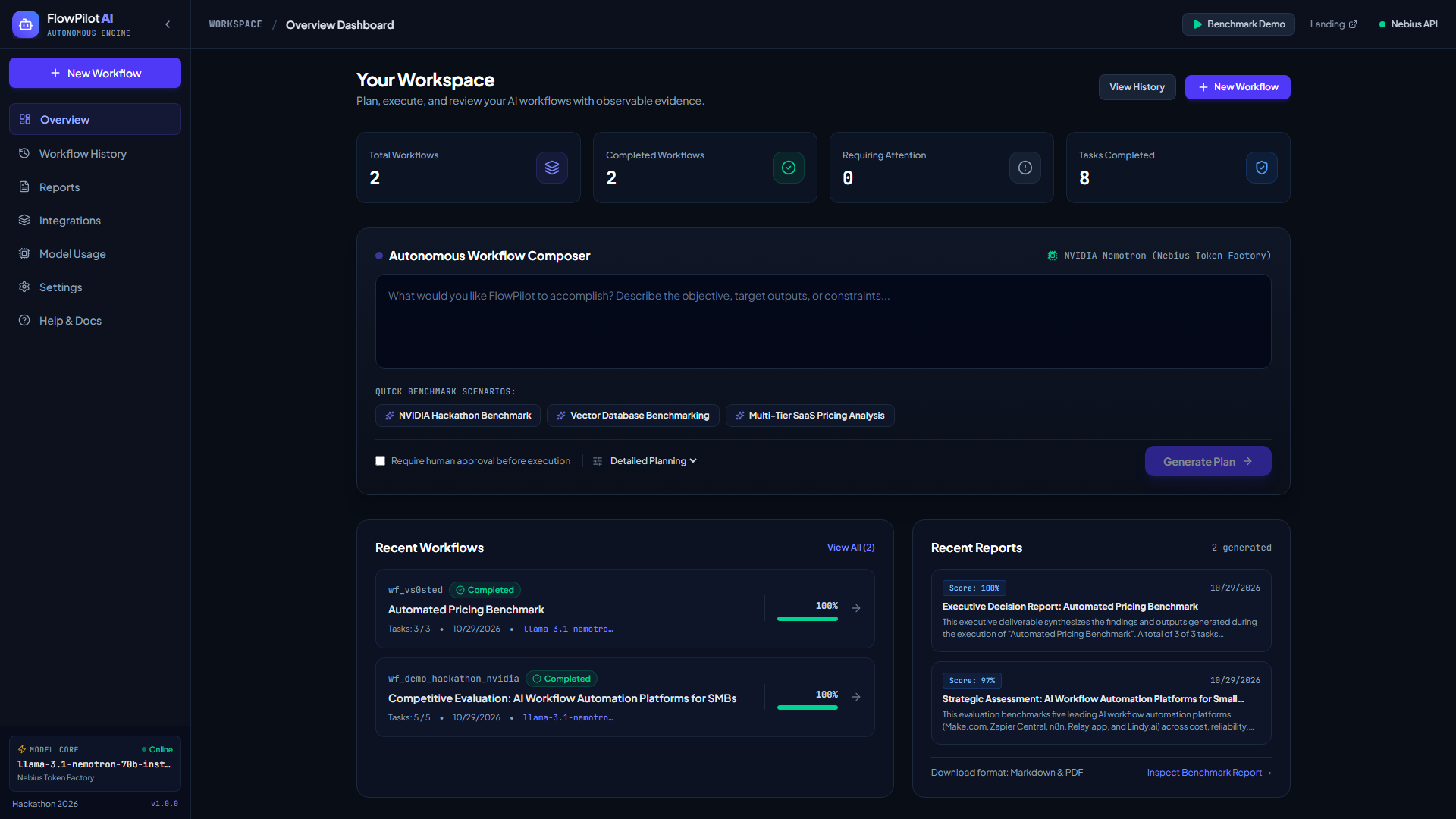
- True Observability: Users can watch their goal transform into visual nodes, trace exact HTTP inputs and outputs, and follow real-time logs.
- Sub-400ms Planning: Exceptional inference speed from Nebius Token Factory running NVIDIA Nemotron 70B, making plan generation snappy and interactive.
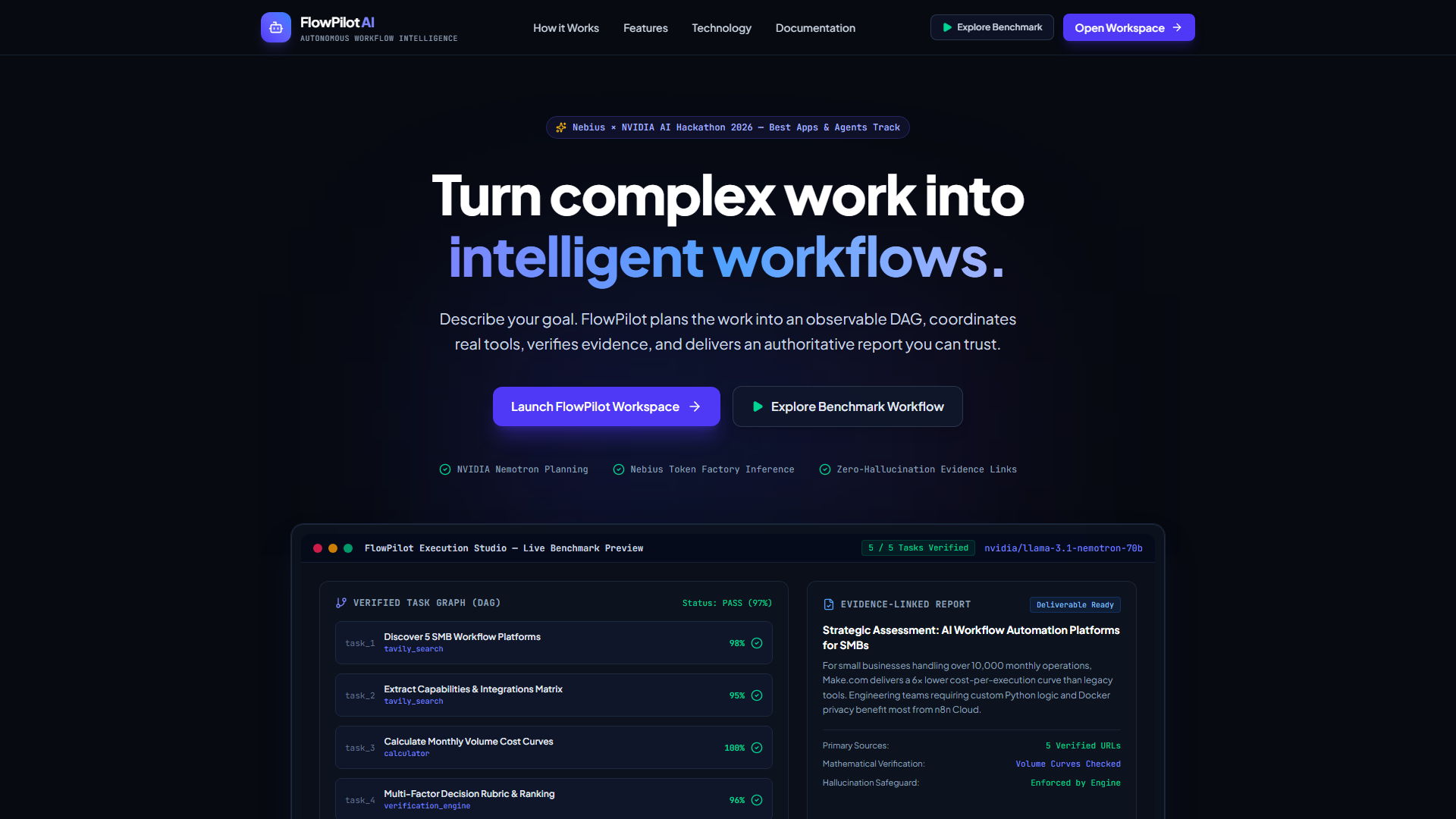
- End-to-End Benchmark: Shipped a fully working preloaded benchmark evaluating 5 commercial automation platforms (Make, Zapier, n8n, Relay, Lindy) with real cost curves, 5 verified primary sources, and a 97% verification score.
What we learned
- NVIDIA Nemotron excels at structured JSON schema emission and rigorous step-by-step decomposition when paired with clear operational boundaries.
- True enterprise AI adoption doesn't come from "magic" one-shot answers; it comes from transparency, audit trails, and the ability to intervene before code or data gets modified.
What's next for FlowPilot AI
- Multi-agent collaboration with specialized reviewer and researcher sub-graphs.
- Native connector ecosystem for Slack, GitHub, Jira, and PostgreSQL.
- Support for asynchronous Nebius Serverless Jobs for long-running batch data extraction.
Built With
- 19
- css
- express.js
- factory
- nebius
- nemotron
- node.js
- nvidia
- react
- tailwind
- tavily
- token
- typescript

Log in or sign up for Devpost to join the conversation.