-
-
-
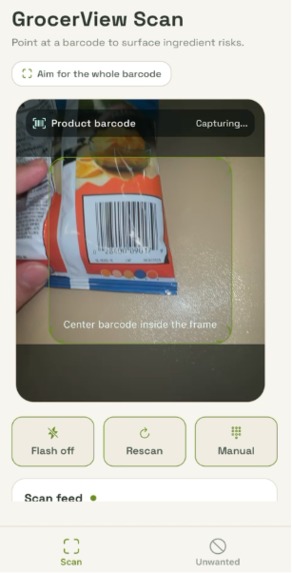
GrocerView scanning
Inspiration
As consumers in a market flooded with competing products and unfamiliar ingredient lists, we often find ourselves staring at labels full of names we've never seen before. Who is this really for? Our inspiration behind GrocerView was to cut through the noise and give people access to real, evidence-based information about what they're putting in their bodies, not influencer opinions, but actual scientific research.
What it does
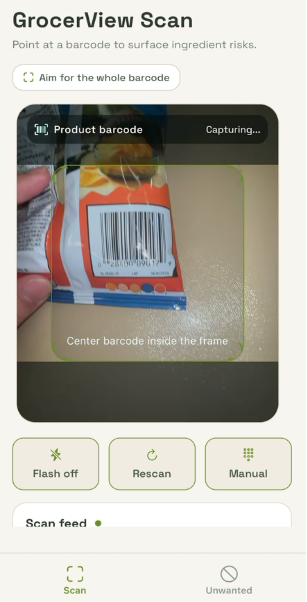
GrocerView is a mobile app that lets users scan the barcode of any grocery item and instantly receive a breakdown of its ingredients backed by scientific literature. The app queries research databases like PubMed and OpenAlex, retrieves relevant papers on each ingredient, and presents AI-generated summaries along with direct quotes from peer-reviewed studies. Users can also flag specific ingredients they want to avoid and see parent company ownership information for products.
How we built it
- Frontend: React Native with Expo for cross-platform iOS and Android support. We used Zustand for state management and MMKV for fast local caching.
- Backend: FastAPI (Python) serving REST endpoints for ingredient resolution and research retrieval.
- RAG Pipeline: We built a Retrieval-Augmented Generation system with multiple stages:
- Paper Discovery: Search PubMed and OpenAlex in parallel using resolved ingredient synonyms
- Full-Text Retrieval: Fetch open-access papers from PubMed Central (with license verification to ensure we can legally quote)
- Chunking & Embedding: Split papers into passages and store vectors in ChromaDB for semantic search
- Regulatory Data: Query authoritative sources (FDA GRAS status, WHO JECFA evaluations, NIH Office of Dietary Supplements) for official safety assessments
- Comprehensive Retrieval: Query three focus areas in parallel (safety, health, general) and deduplicate results
- Quote Verification: Ensure every quote in the LLM output actually exists in the retrieved evidence, ensuring no hallucinated citations
- Summary Generation: Claude (via OpenRouter) generates summaries with inline citations linking back to source papers
- Ingredient Resolution: Multi-source resolver querying PubChem, FoodOn, and Open Food Facts taxonomy in parallel to normalize ingredient names and find synonyms for better paper discovery.
- LLM Integration: OpenRouter API for generating summaries with citations, using Claude as the underlying model.
Challenges we ran into
Our biggest challenge was that the RAG system was technically demanding on its own: fetching full-text papers, parsing them into clean text, chunking appropriately, and ensuring the LLM citations actually matched source material required significant iteration. This complexity made it difficult to test and integrate with the rest of the system. We couldn't easily verify if the frontend was displaying data correctly when the backend pipeline itself was still being debugged. A user scanning a barcode triggers a chain reaction through five different systems, and if any link breaks, the whole experience falls apart. We also had to handle the reality that not every ingredient has extensive research, so we built fallback paths and caching to provide useful information even when papers are sparse.
Accomplishments that we're proud of
We're most proud of building a working RAG system that cites real research papers. In an era where health information on social media often comes from unqualified influencers, GrocerView provides users with information they can actually verify. Every quote links back to its source paper on PubMed. We also built a robust multi-source ingredient resolver that can handle everything from "Red 40" to "E300" to "ascorbic acid" and understand they're related.
What we learned
We learned how to integrate AI as a core part of application functionality rather than just a feature. Building the RAG pipeline taught us about embeddings, vector databases, chunking strategies, and prompt engineering for accurate citations. Beyond the technical skills, we learned to work together under pressure, navigating the stress of a hackathon while keeping momentum going through sleepless nights.
What's next for GrocerView
Planned Features:
- Environmental metrics (plastic pollution, business practices, pesticides)
- Country of origin tracking (e.g., olive oil from multiple countries, products processed/packaged in different locations)
- Nutritional goal tracking (calorie/protein ratios, macro targets)
- Health agency guidance integration (FDA, HHS recommendations)
- Alternative product suggestions (e.g., glass vs plastic packaging)
- Scan history and favorites
- Social sentiment analysis from Reddit discussions about products
Future Possibilities:
- Location-based grocery store finder with sale alerts
- Recipe recommendations based on scanned products
- Crowdsourced product data for items not in existing databases
- Smart grocery lists organized by store

Log in or sign up for Devpost to join the conversation.